Overcapacities Dashboard

Overcapacities Dashboard

China’s ever-increasing production and persistently lagging consumption create spillovers that distort markets globally . The resulting industrial overcapacity issues emanating from China are growing, both to the detriment of China’s own economy and for its many trading partners. On paper, Beijing aims to deal with some of the consequences with its fight against ‘involution’ – the excess competition and race to the bottom on prices happening within China. So far, anti-involution campaigns have not managed to achieve the kind of industrial consolidation needed to resolve overcapacity issues. 

Close monitoring of the indicators of overcapacity is needed to systematically track the success, stagnation, and/or failure of anti-involution efforts. To do so, MERICS has developed and will regularly update this Overcapacity Dashboard, which includes charts covering four main areas: 

  • Evolution of investments
  • Capacity growth and consumption
  • Impact on companies’ profits and losses
  • Export of overcapacities

Regular updates will be accompanied by written analysis to keep readers up to date on developments in this area. To view the charts and their brief explanations, simply scroll down to the chart below and click on it to expand it and bring up the supporting text. 
 

Containers are seen at the Port of Nanjing in Nanjing, Jiangsu province, China, Aug 6, 2024.

Evolution of investments

Investments have remained significantly higher in manufacturing
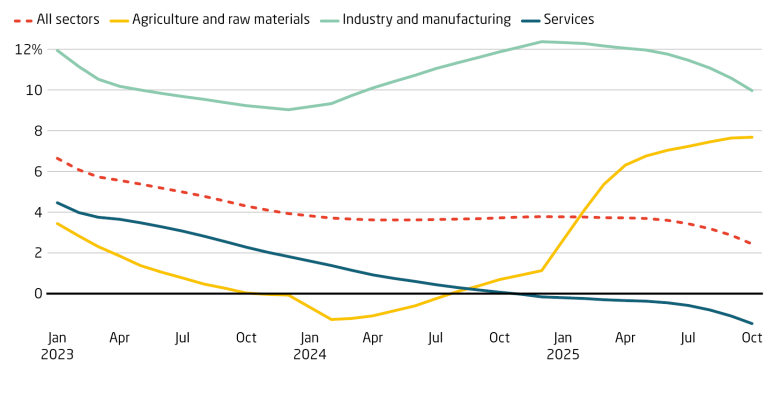
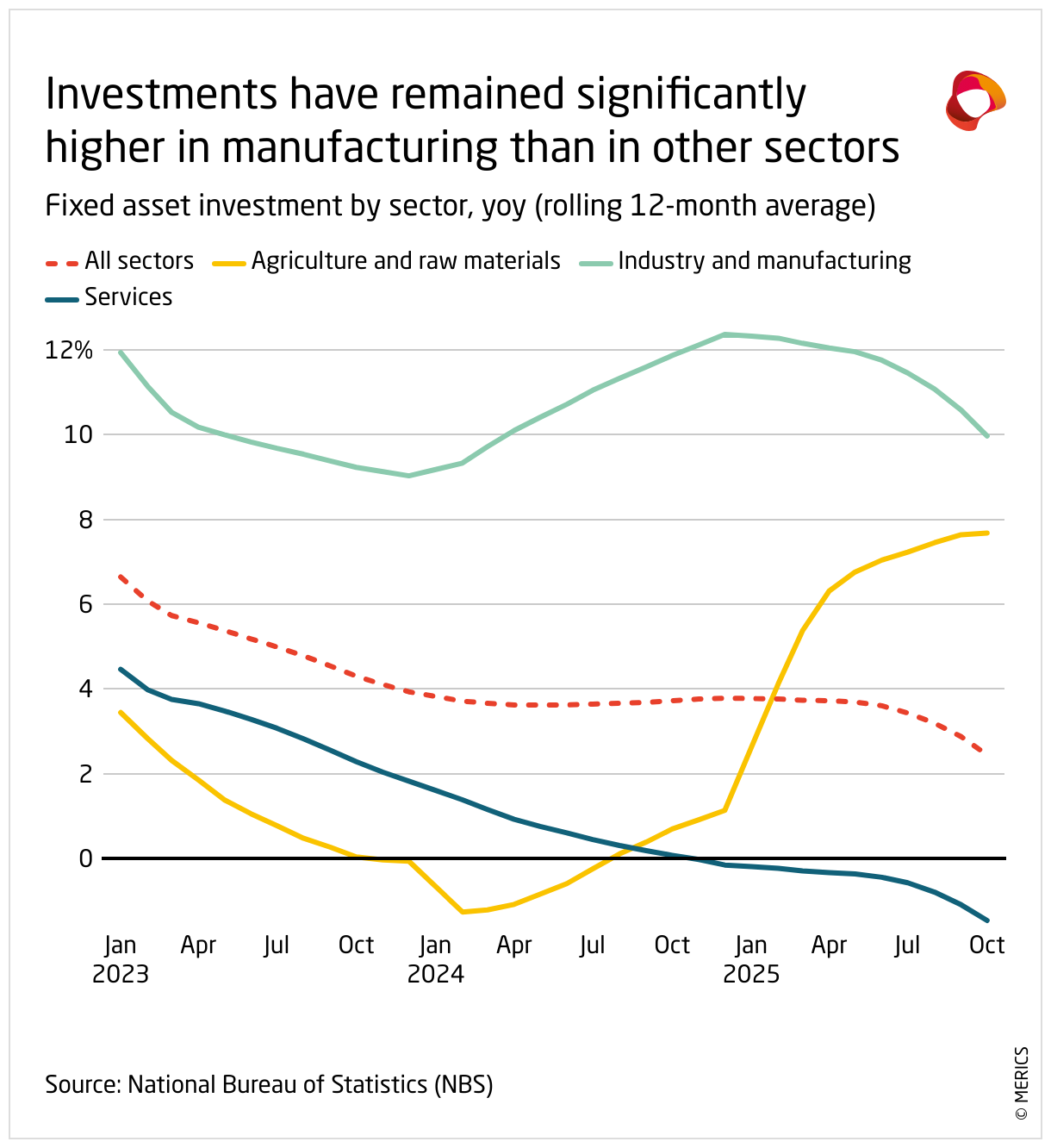
Investments have remained significantly higher in manufacturing than in other sectors. Fixed asset investment by sector, yoy (rolling 12-month average).

Investments remain significantly higher in manufacturing. Despite the recent sharp slowdown, fixed asset investments have remained significantly higher in industry than in other sectors. This illustrates the interests that is put by party-state planners on ‘the real economy’ as they direct all manner of support to manufacturing, even as services see negative investment growth. This contributes to both sides of the ledger, as overinvestment in manufacturing will mean higher supply while underinvestment in services (and the jobs and incomes they generate) will mean lagging demand.  

Investment in High-Priority Manufacturing is increasing
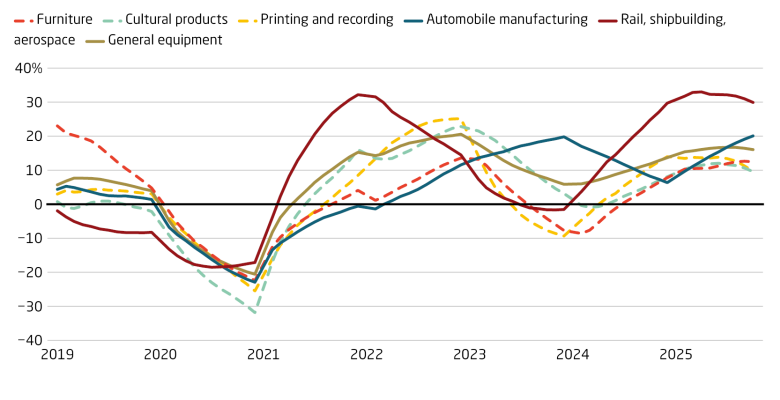
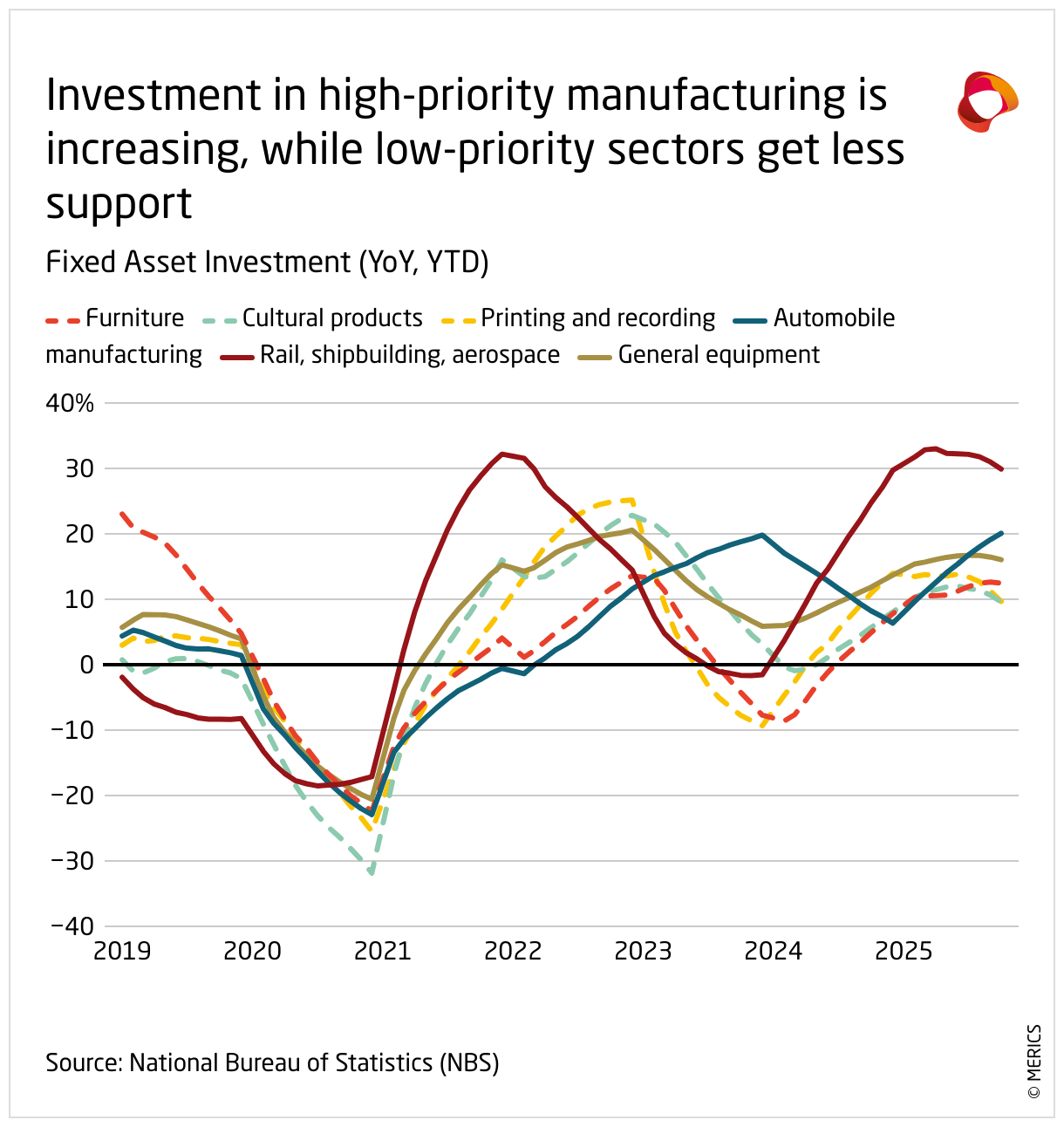
Investment in High-Priority Manufacturing is increasing, while low-priority sectors get less support. Fixed Asset Investment (YoY, YTD).

Increasing investments in prioritized manufacturing - less support for other sectors. Overinvestment in manufacturing has been broad-based, as China’s industrial policy targets not only advancing in higher value-added and higher technology production, but also aims to support more basic industry. Xi Jinping himself has promoted this not only by emphasizing the importance of ‘new productive forces’ – advanced technologies which empower and make more efficient China’s industrial base – but that support for new productive forces does not mean abandoning traditional industries. However, in recent years FAI has clearly favored more strategic industries over those that are more basic or more consumer oriented. 

The State is suppressing investment in “undesirable” services
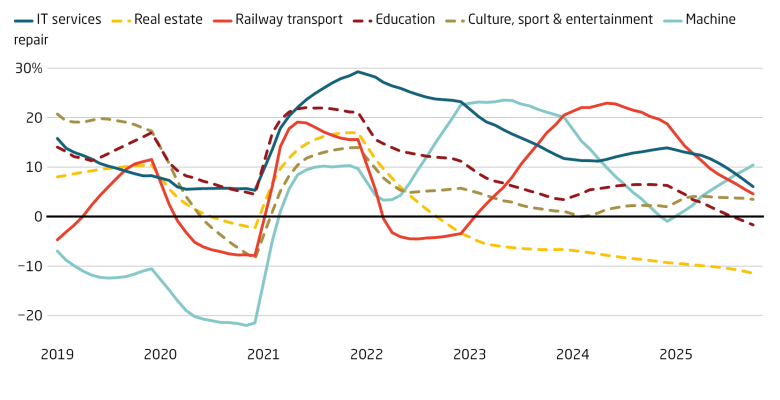
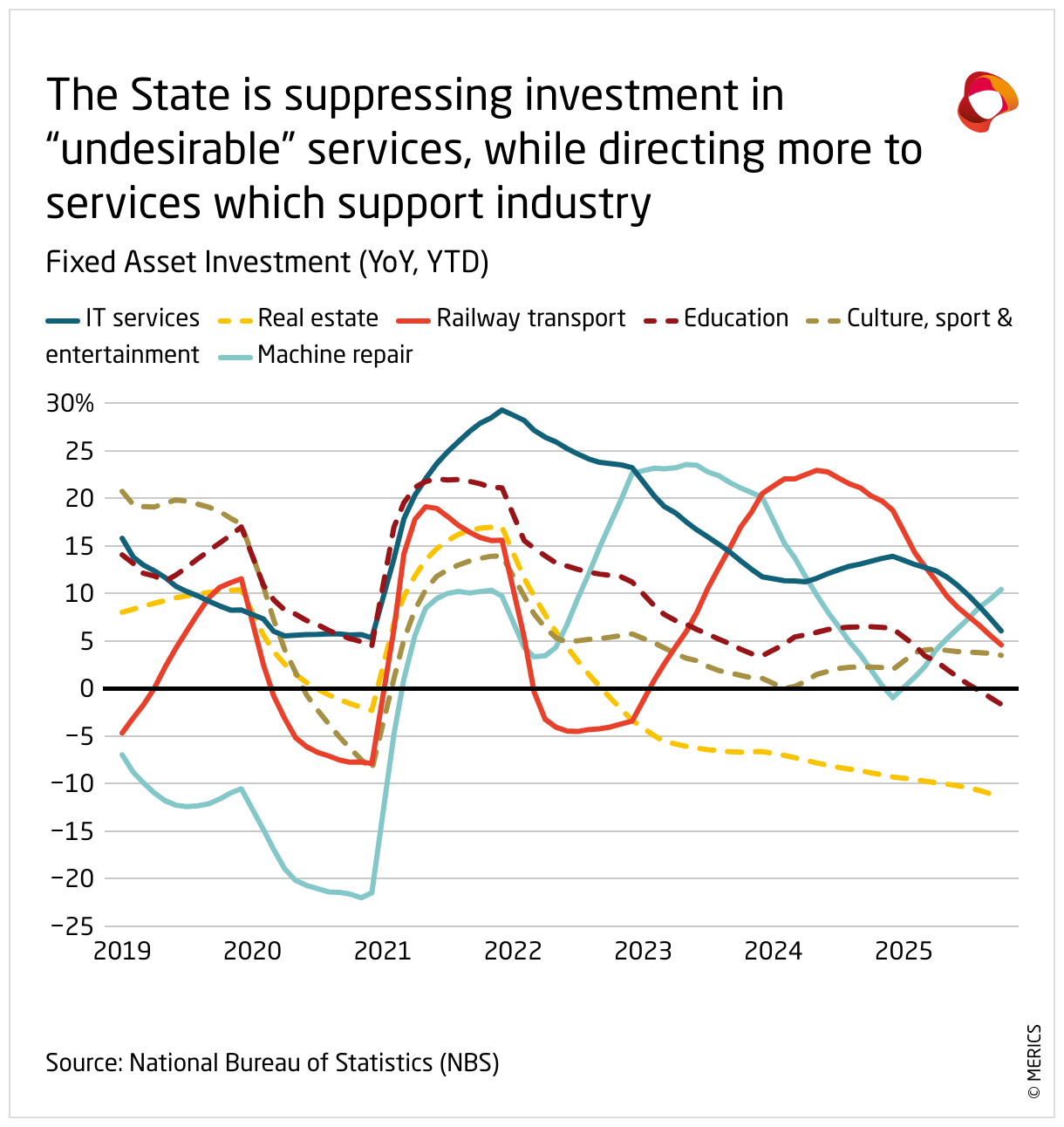
The State is suppressing investment in “undesirable” services, while directing more to services which support industry. Fixed Asset Investment (YoY, YTD).

Beijing directs investments to services which support industry. Investment in services overall has been weak in recent years as manufacturing and the ‘real economy’ have always been top priorities. However, even in services there are clear distinctions where Beijing directs support or neglects based on the strategic relevance of a given sector. Services which support the real economy – like rail services which create demand for train producers, or machinery repair services which are needed to upgrade and maintain new production lines – get notably more investment than other services. In some cases, like in education services and real estate services, growth is actively suppressed by state policy of recent years like the crackdown on private tutoring and the real estate crackdown. 

Capacity growth and consumption
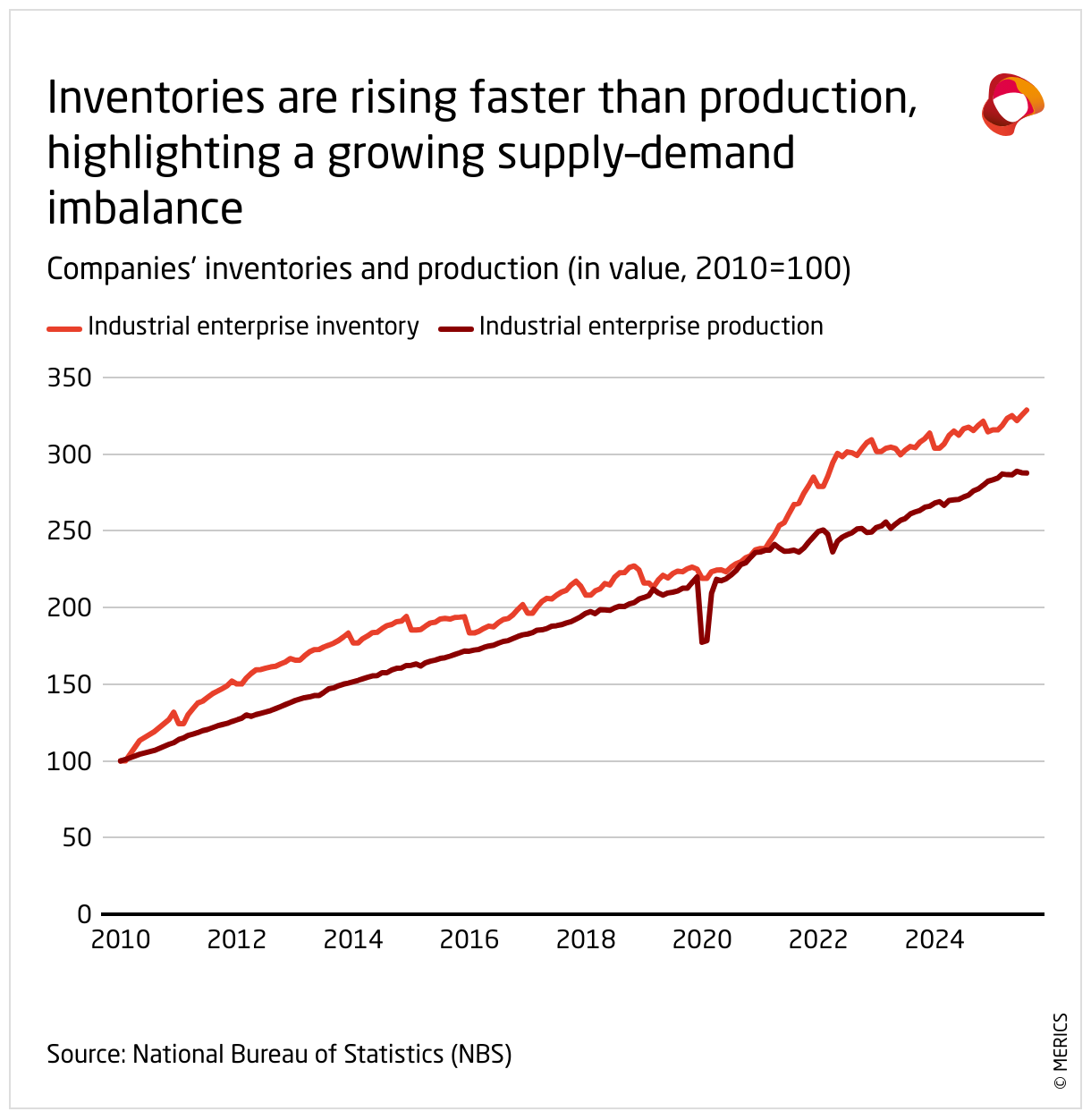
Inventories are rising faster than production
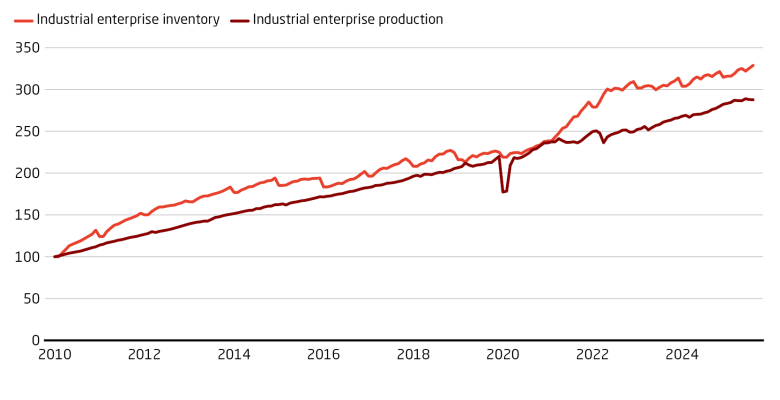
Inventories are rising faster than production, highlighting a growing supply–demand imbalance. Companies’ inventories and production (in value, 2010=100).

The growing gap between production and inventories illustrates the overcapacity issue. The gap between industrial inventories and production expanded significantly during the pandemic as overinvestment in China continued even while consumption growth lagged. Effectively, China’s manufacturers are producing far more than they can sell, and are expanding inventories to hold those goods. In turn, the excess supply suppresses prices to seek any customers possible globally, even in some cases selling at a loss just to recoup what they can. In a normal market economy, that is part of the business cycle, and would lead to market exit by the least efficient players. But in China, such firms are seemingly persisting on cheap financing, subsidies, and other support. 

Capacity utilization has declined in most industries
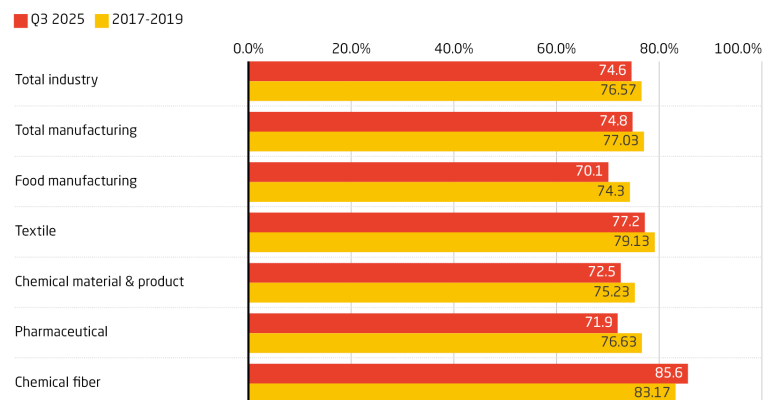
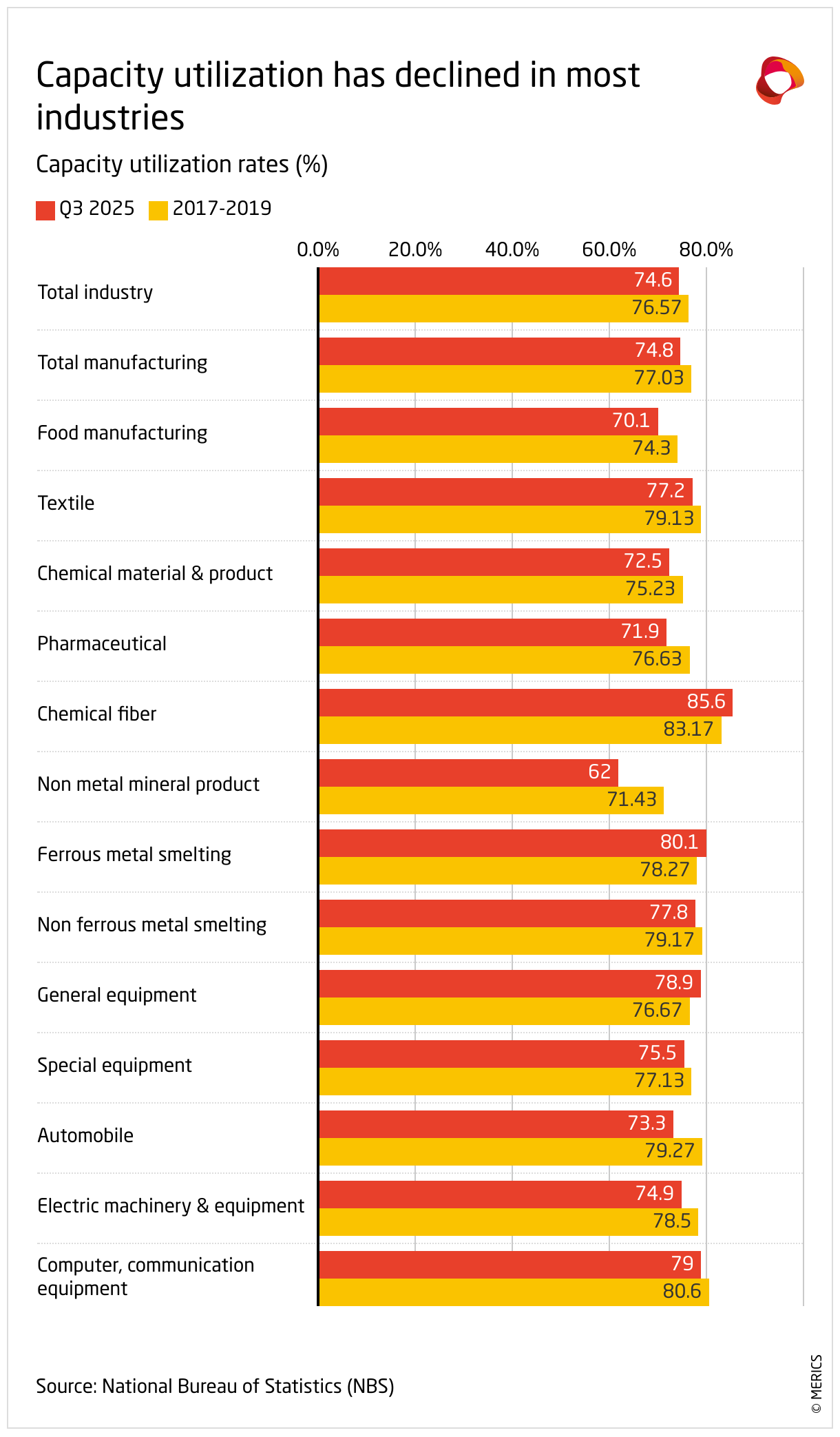
Capacity utilization has declined in most industries. Capacity utilization rates (%).

Capacity utilization has dropped in most sectors since the COVID-crisis. Capacity utilization rates refer to the total amount of production capacity that is actively being used to make goods. It is rare to have anything near 100% utilization rates, as companies will usually start to invest in more production lines as they near full utilization, thus pushing them back down somewhat. However, declining utilization rates that are sustained are indicators of overcapacity problems. In this case, in most sectors, capacity utilization rates are well below where they were prior to the pandemic, implying significant overinvestment in production lines by companies in recent years. 

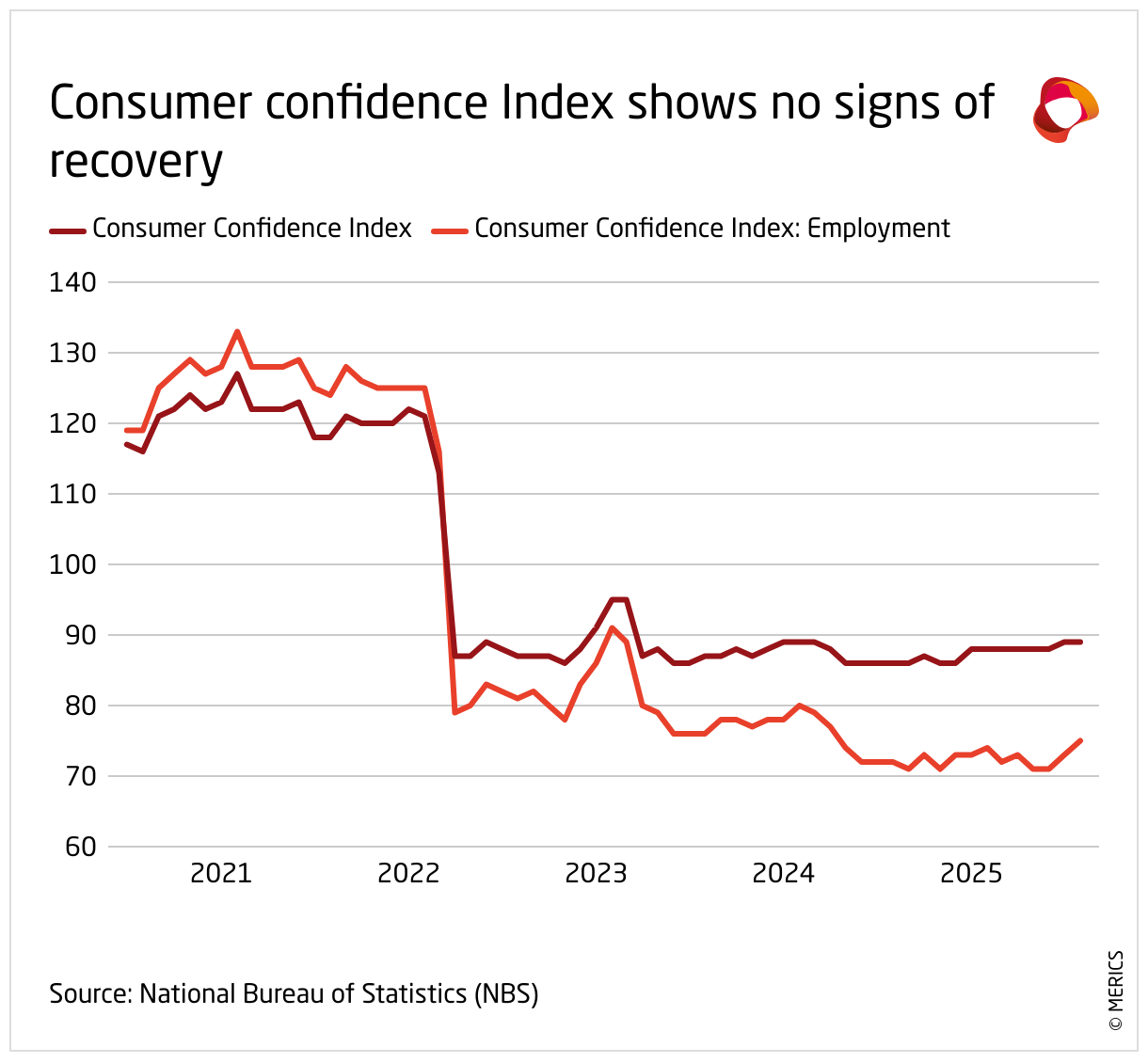
Consumer confidence Index shows no signs of recovery.

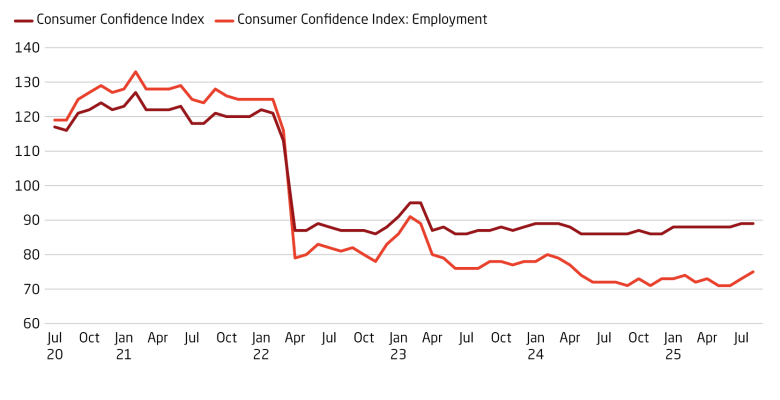
Low consumer confidence is restraining consumption. China’s consumer confidence has collapsed since 2022 and remains persistently weak, reflecting prolonged pessimism about economic prospects. This functions as the ‘demand side’ of the ledger, as low consumer confidence generally means less consumption and more savings as households prepare for tough times. For those worried about employment, setting aside savings is even more important, which suppresses consumption. As China has an extremely weak and underdeveloped unemployment and general social safety net, savings are critical to prepare for difficult periods. 

Impact on companies’ profits and losses
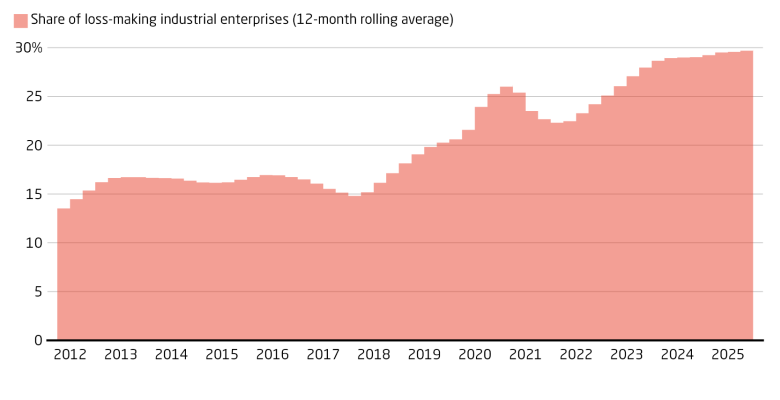
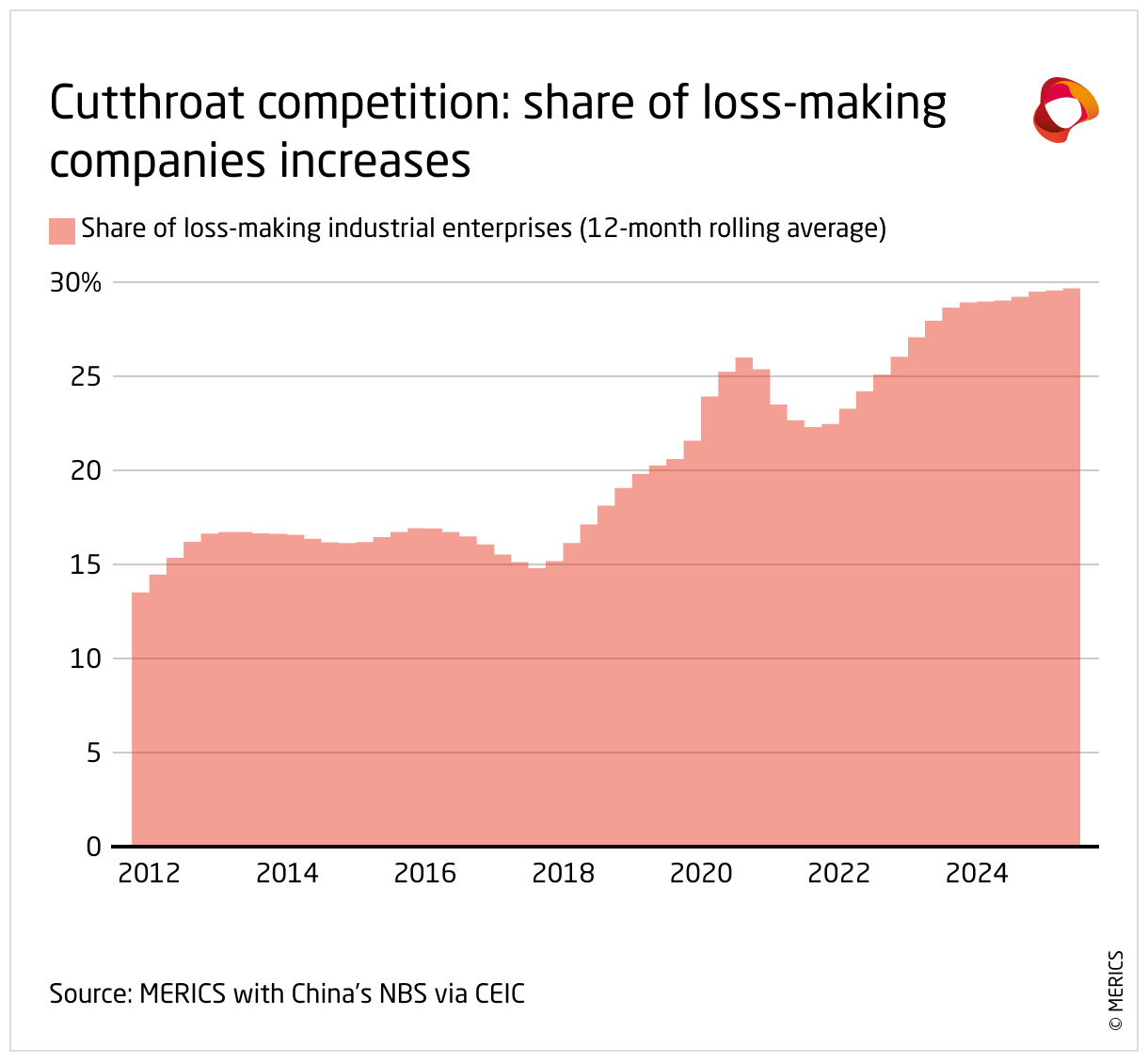
Cutthroat competition: share of loss-making companies increases

Faced with important competition and little demand, the number of loss-making firms increased. With too many producers in overinvested-in sectors often fighting in fierce price wars of attrition, loss-making is increasingly common. The rise of loss-making over the last decade has not been helped by the US-China Trade War and the pandemic, but it has worsened considerably due to the scale of excess competition. Importantly, in a normal market economy, this would lead many bad firms to close shop and consolidation would balance out the supply-demand equilibrium. However, China’s industrial policy toolkit from the Central to local governments are also helping keep zombie firms alive, perpetuating this vicious cycle. 

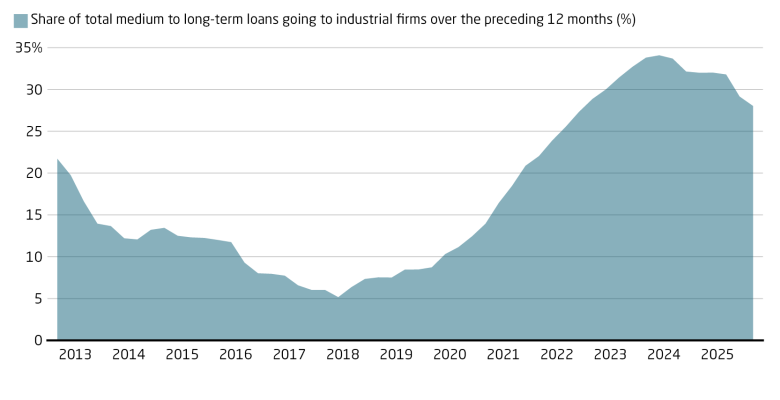
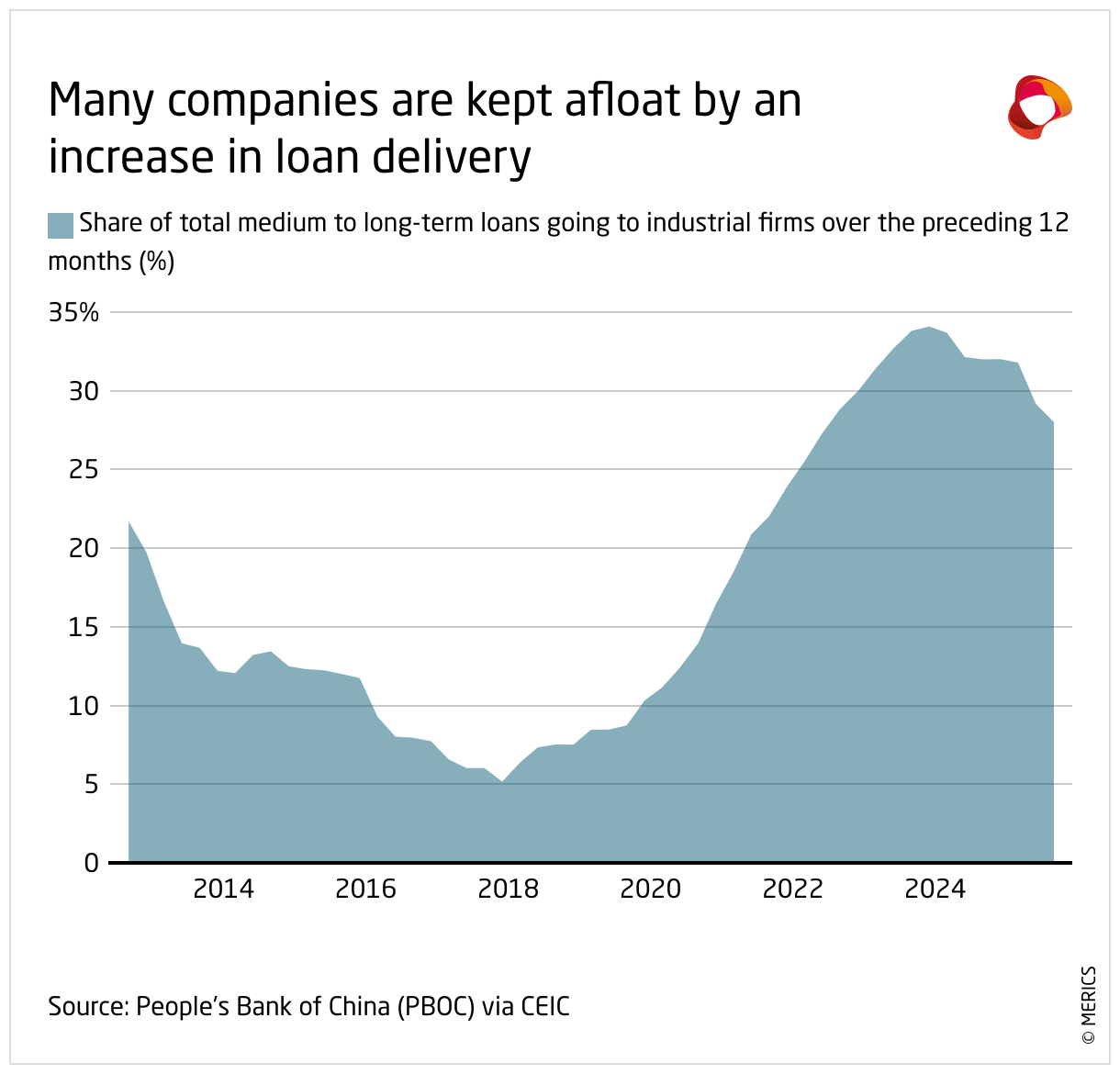
Many companies are kept afloat by an increase in the delivery of loans
Many companies are kept afloat by an increase in the delivery of loans. Share of total medium to long-term loans going to industrial firms over the preceding 12 months (%).

As they struggle to stay profitable, many firms are surviving on loans. Rather than exiting the market, loss-makers are kept afloat by more and more loans even if Beijing is now trying to tackle the issue. Again, the rise in those loans tracks with the pandemic, but it remains far higher than in the pre-pandemic period. 

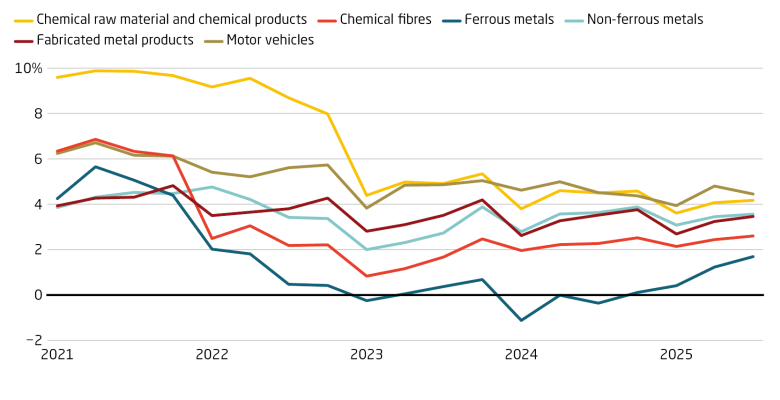
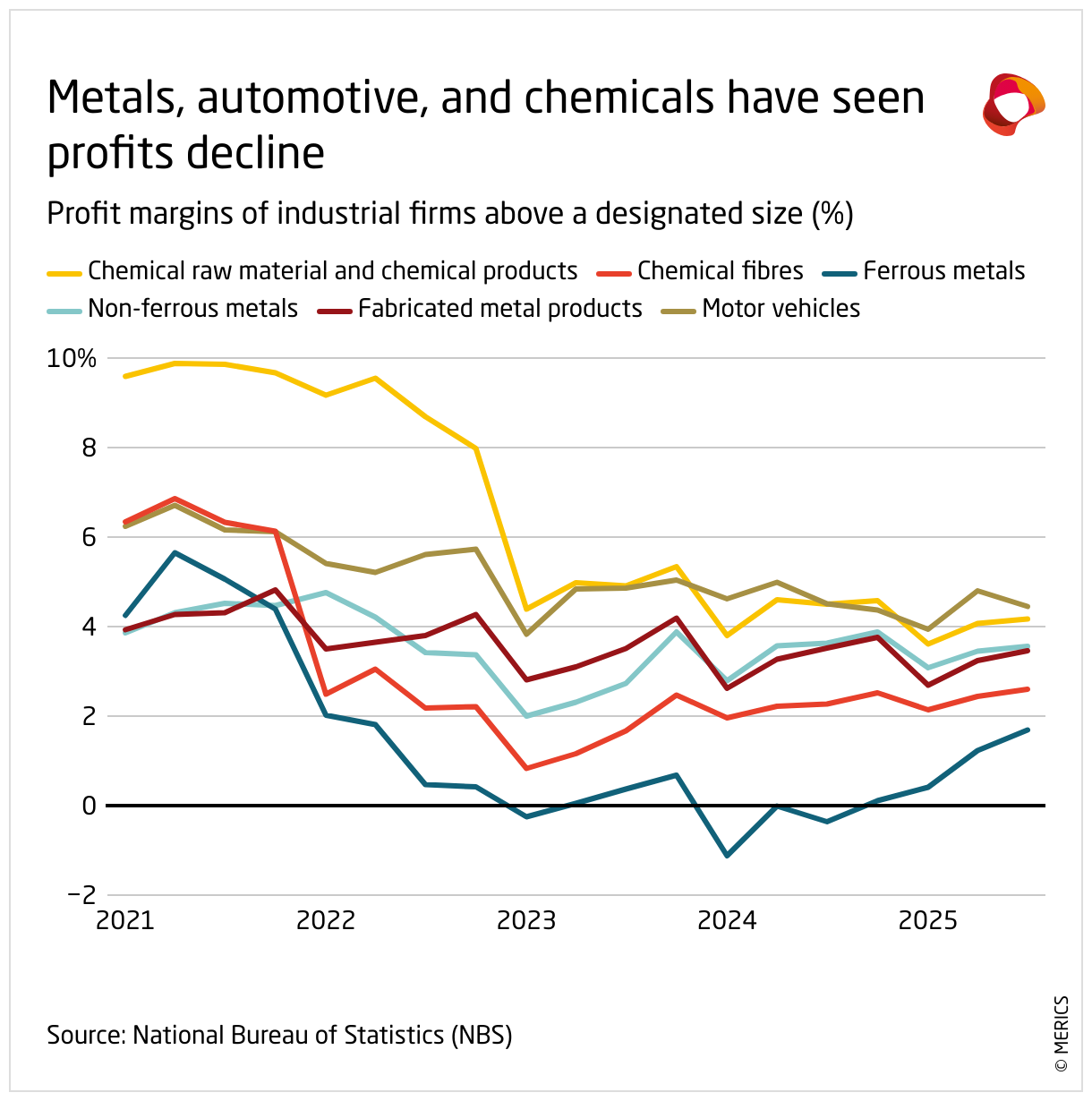
Metals, automotive and chemicals have seen profits decline
Metals, automotive and chemicals have seen profits decline. Profit margins of industrial firms above a designated size (%).

Profit margins remain particularly low in metals, chemicals, and automotive. As price wars of attrition rage on in a variety of sectors, we zoom in on the chemicals, metals, and the automotive industries’ profit margins. In all three of these sectors, the state has pushed for consolidation to deal with overcapacity issues and ‘involution’. For chemicals, efforts have been made to freeze basic capacity and push firms to upgrade to higher end products for future investment. In steel, consolidation decreased the number of producers, but only had a marginal impact on steel output. In the automotive sector, Beijing is pushing for consolidation by dropping some subsidies, but local governments want their local EV champions to outlast the competition and ‘win’ or at least don’t want the job losses that consolidation will bring, so they compensate for losses. In all cases, despite the stated intent of the government to push consolidation and improve profits, profit margins have nonetheless been declining. 

Export of overcapacities

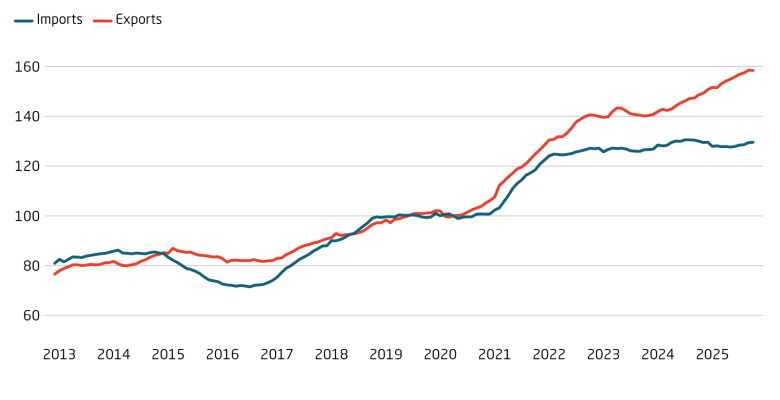
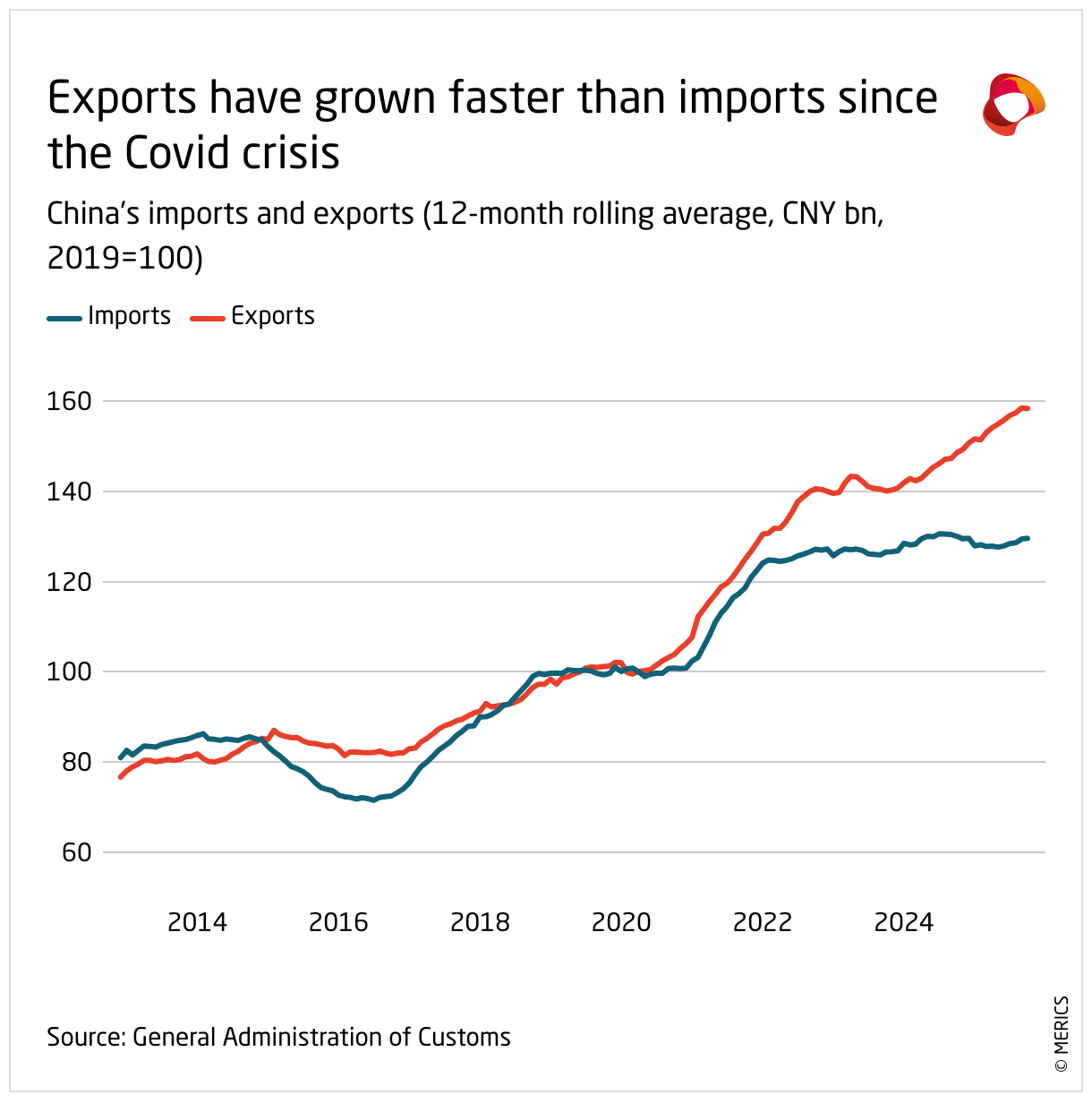
Exports have grown significantly faster than imports since the Covid crisis
Exports have grown significantly faster than imports since the Covid crisis. China’s imports and exports (12-month rolling average, CNY billion, 2019=100).

Exports have grown significantly faster than imports, a sign of a sharply widening trade surplus. China runs a trade deficit with only around 20 countries, and other than Taiwan and Korea, which run surpluses because of semiconductor exports, and Japan, which only recently netted a tiny surplus due to currency issues, all others are commodities exporters. 

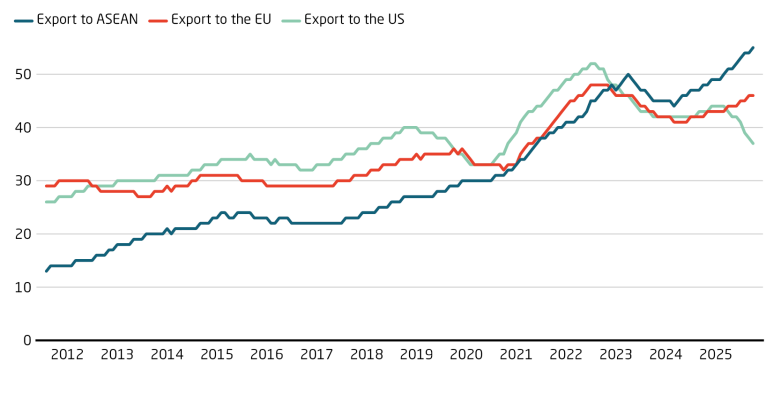
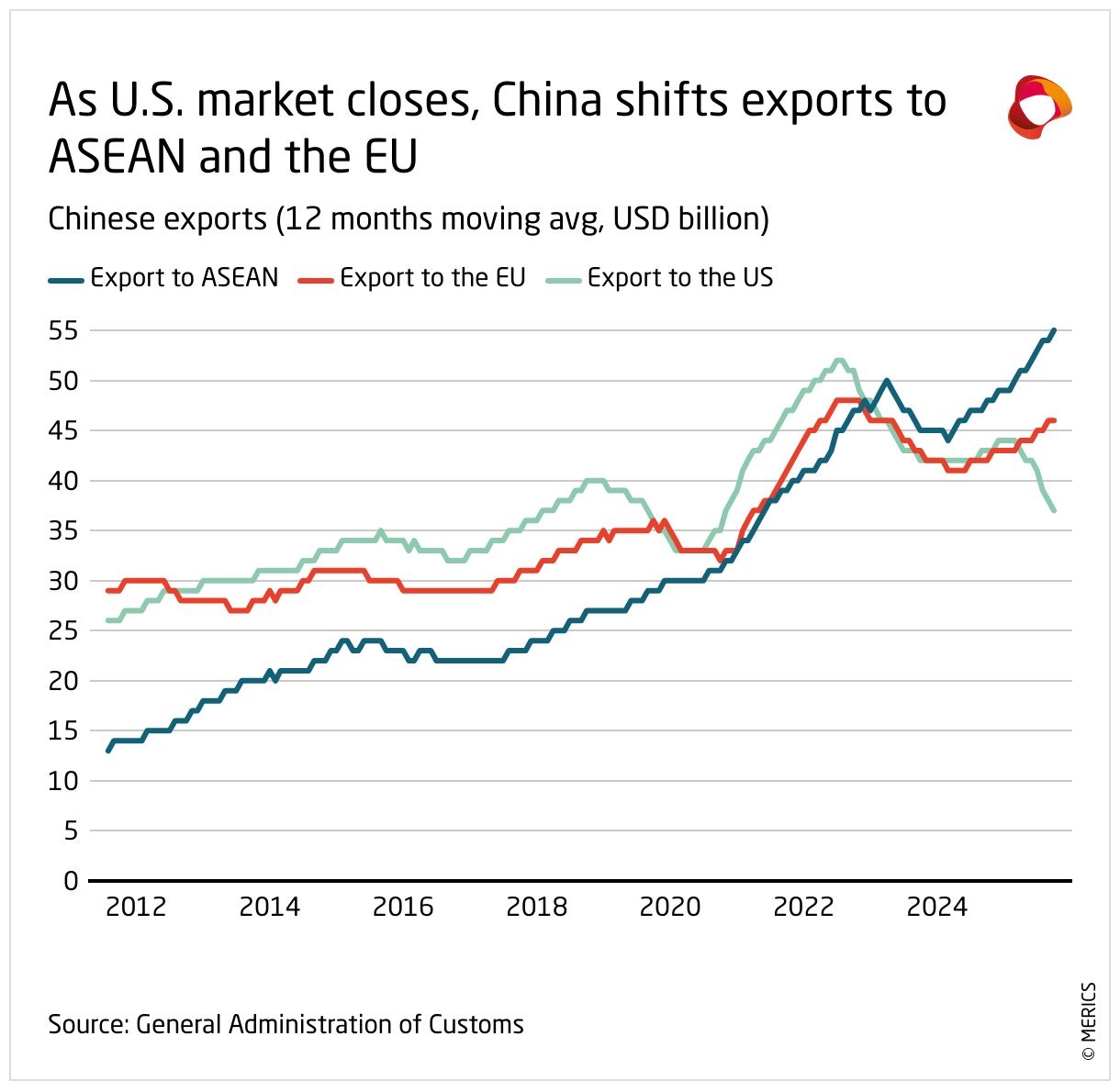
As US market closes, China shifts exports to ASEAN and the EU
As US market closes, China shifts exports to ASEAN and the EU. Chinese exports (12 months moving avg, USD billion).

As the U.S. closes its market, China is shifting exports to ASEAN and, to a lesser extent, the EU. Exports to ASEAN and the EU are now well above their trend over the 2011-2019 period while exports to the US decreased below this pre-covid trend. The US-China trade war and decoupling trends have driven down access to the US market for key areas where China has overcapacity issues, such as in the automotive sector. Meanwhile, open markets like the EU and ASEAN have seen the exports normally bound for the US market but now blocked being diverted to their own. That risks magnifying the problems of China’s overcapacity, as more and more markets raise barriers to Chinese goods, those who remain open will face ever increasing floods of lower and lower priced goods seeking any port in the storm. 

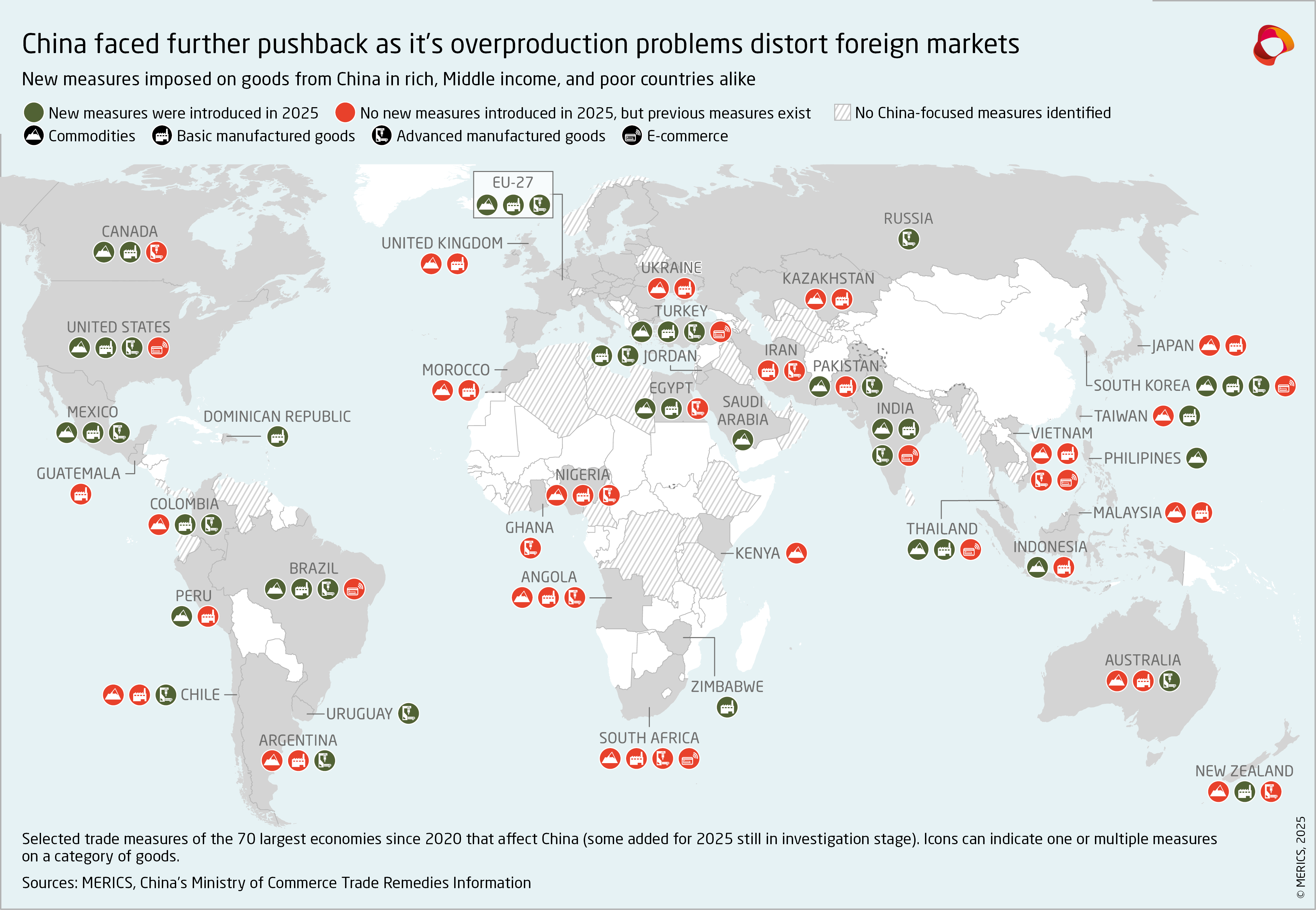
China faces pushback as its overproduction distorts foreign markets
China faces pushback as its overproduction distorts foreign markets. New measures imposed on goods from China in rich, Middle income, and poor countries alike.

As a result, countries around the world are trying to protect their industries by raising trade barriers. China’s overcapacity being exported and distorting markets is a widespread phenomenon. Countries across the globe that are rich, middle income, and poor have all raised barriers to at least some Chinese goods in recent years. 

Authors