
picture alliance / Xinhua News Agency | Hao Yuan
External publication
China as a global development actor: Transforming the international aid landscape
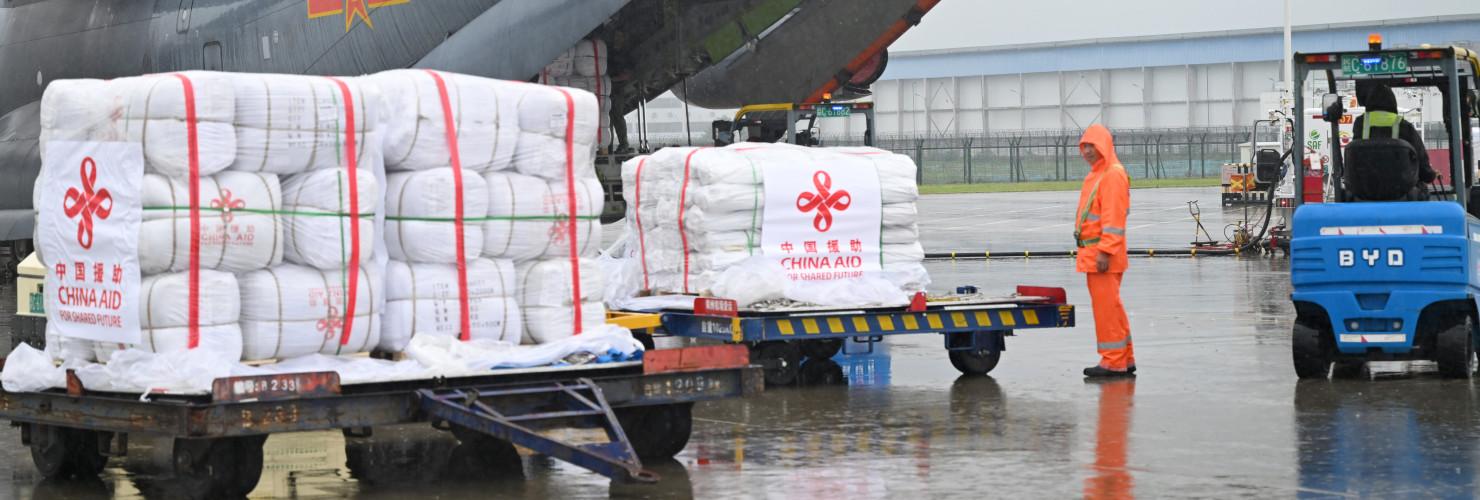
In the last decade, China has emerged as a major development partner for many countries, increasingly visible as traditional Western donors reduce or recalibrate their engagement in various regions and sectors. This shift raises important questions for Swedish and European development policy: How might China fill gaps left by traditional providers? How can development effectiveness be maintained and recipientcountry priorities respected in a multipolar aid environment? Where can Swedish aid have the greatest impact? Understanding China’s global ambitions and its evolving role as a multilateral actor is essential for grasping how it shapes international development.
This anthology situates China within this evolving terrain. It analyzes China’s approaches across health, climate and environmental governance, gender equality, trade, infrastructure, finance, agriculture, and media, with concrete examples and geographical case studies (Africa, Southeast Asia, Ukraine, and Iran). It assesses China’s global development footprint, opportunities, and risks. Key questions include aid modalities (grants vs. loans, tied vs. untied aid), governance and transparency, debt sustainability, local ownership, human rights, governance standards, and the social and environmental impacts of projects. It highlights Sweden’s and the European Union’s comparative advantages and how to leverage them in dialogue with China and partner countries. It also examines how development finance interacts with private investment, public–private partnerships, and domestic policy reforms, core elements of contemporary development cooperation.
Main findings
- China’s rise as an international development actor is tied to its broader strategic, economic, and political objectives, including infrastructureled growth, access to resources, and the diffusion of its standards and governance models.
- China’s development practice encompasses a broad set of sectors, and regional case studies show diverse outcomes. Financing is heavily weighted toward loans tied to Chinese firms and materials, with varying implications for recipient-country debt, local value capture, and procurement practices.
- Western development paradigms have increasingly converged with Chinese models. Major donors, notably the US, have adopted more state-centric and infrastructure oriented strategies, emphasizing transactional engagement with recipient governments.
- Sweden’s new International Trade Strategy, which aims to better integrate trade and investment policies with development objectives, moves Sweden closer to China’s integrated approach.
- Sweden and other traditional donors need clear, evidence based positioning to maintain cohesion and legitimacy in international development governance, leveraging China’s resources for broader development outcomes while protecting recipient-country ownership and adhering to OECD-DAC norms and international human rights standards.
- Multilateral dialogue and collaboration are evolving. There is room for EU–China conversations on development finance, co-financing risks and safeguards, and the exploration of blended finance and guarantees, provided there are strong transparency, governance, and accountability measures.
Helena Legarda, Head of the MERICS Foreign Relations Program, and Abigaël Vasselier, former MERICS Director Policy & European Affairs, contributed to this anthology with the chapter on China's role as a development actor in Ukraine, analyzing Beiing's ambitions to get involved in post-conflict reconstruction work, as well as the likely shape that its involvement might take.
They conclude that China is likely to play some role in Ukraine’s reconstruction, if only because the costs will be so high that contributions will have to come from as many countries as possible. A strong Chinese involvement can have positive implications for Ukraine and for Europe. But risks will also emerge. For the EU, the priority will be to support Kyiv in monitoring and regulating China’s investments and activities in ways that help mitigate some of these risks.
You can read a full text version of this chapter as well as the full report here.
This anthology was published by the Expert Group for Aid Studies (EBA), a Swedish government committee mandated to evaluate and analyse the direction, governance and implementation of Sweden’s official development assistance. EBA’s aim is to contribute to the efficient implementation of well-designed aid.
Author(s)

Head of Program

Former Director Policy & European Affairs/Former Head of Program Foreign Relations
Author(s)
Head of Program
Former Director Policy & European Affairs/Former Head of Program Foreign Relations