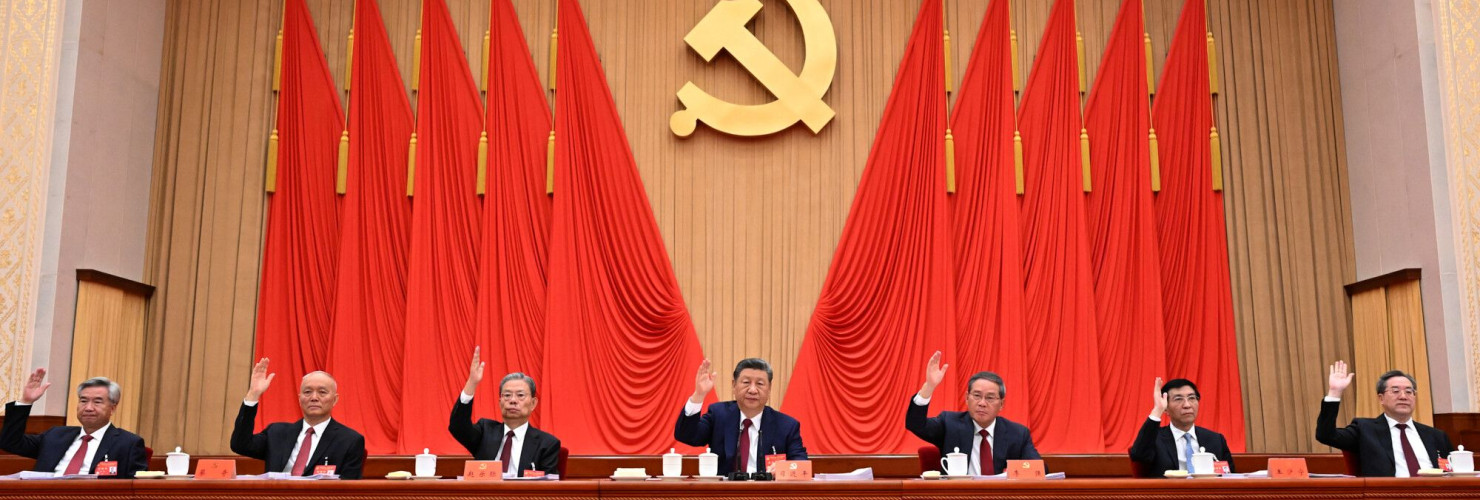
picture alliance / Li Xiang/Xinhua via AP
Content
MERICS Briefs
MERICS China Essentials
Fifth Plenum + Electronics testing ban + Falling share prices
Top story
Central Committee raises bar for loyalty and performance among CCP officials
One year before the 21st Congress of the Chinese Communist Party (CCP), Xi Jinping is demanding greater loyalty and stronger performance from CCP officials, yet tensions in the party leader’s governance system may hamper his effort. The CCP gathered 279 members of the Central Committee for its fifth plenary session on October 26-29, down from the 376 officials selected in 2022, highlighting personnel gaps left by recent anti-corruption campaigns. The meeting offered key insights into political, ideological, and personnel priorities as China faces mounting economic and geopolitical pressures.
A lengthy resolution on “full and rigorous party self-governance” adopted at the end of the plenum makes clear that the campaign to strengthen discipline is far from complete. Front and center are concerns that cadres are unwilling or unable to deliver on policy tasks, the need to keep in check those in high-powered, central positions, and the perceived lack of “party spirit,” especially among younger CCP officials. The document formally elevates the growing body of Xi’s “thought on party building” and portrays him as having rescued the party from internal corrosion and a fading grasp on power.
To address disciplinary and performance failures and ensure that cadres do not engage in corruption, the resolution lays out expanded party rules, stricter performance and promotion standards, and stronger supervisory mechanisms. It also prescribes extensive political education to strengthen loyalty and identification with the CCP. Together, these measures are meant to cultivate a cohort of high-caliber officials capable, in the words of the Central Committee, of “shouldering the mission of national rejuvenation.”
At the same time, the document reveals persistent tensions within Xi’s governance model. Efforts to reduce formalism rely on additional layers of oversight and bureaucracy. Cadres are encouraged to be innovative and proactive, but only within approved boundaries and after securing authorization. They are expected to voice concerns, yet not challenge decisions handed down from the party center. Navigating these at times contradictory demands requires skill, loyalty and political savvy.
“Xi’s purges and disciplinary measures are not just tools for maintaining personal power but a matter of ideological conviction. They serve to keep the party focused on the higher goal of ensuring China’s continued rise. While Europe may hope that Beijing will be more willing to compromise as it focuses on internal party issues in the coming year, it should expect China to continue to assert itself resolutely as cadres rush to demonstrate their dedication to national interests.”
Katja Drinhausen, Head of Program Politics and Society, MERICS
Media coverage and sources:
- Xinhua (CN): 中共中央关于持之以恒推进全面从严治党若干重大问题的决定
- Xinhua (CN): 习近平:关于《中共中央关于持之以恒推进全面从严治党若干重大问题的决定》的说明
- Xinhua: Resolution of the Central Committee of the Communist Party of China on Certain Major Issues concerning Persevering with Full and Rigorous Party Self-Governance
- Xinhua: Explanation of the Resolution of the Central Committee of the Communist Party of China on Certain Major Issues concerning Persevering with Full and Rigorous Party Self-Governance
METRIX
10
This is the number of officials who were promoted from alternate to full members of the CCP’s Central Committee at last week’s fifth plenary session of its 2022-2027 term. When full members retire or get expelled, vacancies are traditionally filled by elevating alternate members in the order of the number of votes they received at the last Party Congress, in this case in 2022. But this time, some contenders – including officials from the People’s Liberation Army and the People’s Armed Police – were passed over, signaling either unusual political maneuvering or possible further purges in China’s security apparatus. Those who did get promoted included some provincial deputy party secretaries in their early 50s, a sign that Beijing is trying to cultivate a younger cohort of officials for senior positions in the coming years. (Source: Xinhua)
Topics
Wider US ban on Chinese electronics testing could raise costs for manufacturers
An expanded US ban on electronics testing labs in China – which 82% of devices entering the US market pass through – could reshape the global testing landscape, creating both risks and opportunities for European firms. Citing national security concerns that testing could expose sensitive information about electronic devices, the ban expands the US Federal Communications Commission’s (FCC) 2025 “Bad Labs” rules. Previously, these rules applied only to government-controlled laboratories. They will now cover all testing facilities in countries that lack a Mutual Recognition Agreement (MRA) with the US, which allows the reciprocal recognition of testing results. China’s Ministry of Commerce (MOFCOM) criticized the move and warned Beijing could take countermeasures.
Under the new restrictions, electronic devices exported to the US must be tested by laboratories outside China. Despite the two-year transition period, manufacturers are expected to face supply chain delays and higher compliance costs as they diversify their testing suppliers, with alternatives to Chinese providers likely to be more expensive. The ban will affect not only domestic Chinese laboratories but also the Chinese subsidiaries of European testing companies, such as TÜV Rheinland and Eurofins. While this could disrupt their operations in China, it may also create opportunities for European laboratories as demand for testing and certification services shifts to other markets.
”The FCC’s new restrictions are set to reshape the global electronic device testing landscape, creating supply-chain challenges for manufacturers, while offering European testing laboratories new opportunities to expand."
Elizabeth Ru-Tung Sun, Analyst, MERICS
Media coverage and sources:
- Reuters: FCC votes to ban all Chinese labs from testing US electronics
- FCC: Announcement of new restrictions
- State Council Information Office: China urges US to revoke FCC restrictions on China-based testing, certification bodies
More on the topic: China’s economy steadies as surging exports lift Q3 growth above forecasts, MERICS Economic Indicators for Q3 2026
Media coverage and sources:
- People’s Bank of China (CN): 中国人民银行 金融监管总局 中国证监会召开支持资本市场两项工具座谈会
- Xinhua: China steps up monetary policy support to bolster stock market
- Bloomberg: China boosts use of stock support tools to stabilize market
- State Council: China to strengthen capital market regulation, risk prevention
Vis-à-vis
“The lowest turnout of the post-Mao era – an indication of the scale of recent purges”
After the Fifth Plenum of the CCP’s Central Committee, China Essentials spoke with MERICS Senior Analyst Daria Impiombato about who was pushed out and who was allowed to move up.

Senior Analyst
The Plenum promoted General Zhang Shengmin to the Politburo, China’s second-most powerful body. What does this rare move outside of a Party Congress signal?
The timing of Zhang’s appointment was unusual, as well as the fact that Zhang, at 68, is already past the customary age limit of 67 for new Politburo members. His current position of Central Military Commission (CMC) Vice-Chairman is, however, typically aligned with a spot in the Politburo. Pulling the appointment forward from next year’s Party Congress could be related to plans for a potential restructuring or restocking of the CMC, where Zhang’s experience would be highly useful. As CMC Vice-Chairman and the general in charge of Xi’s recent military purges, he is a veteran of the PLA’s discipline system – the internal oversight structure for rooting out corruption and ensuring party loyalty among the armed forces. Next year’s Party Congress could be an opportunity for his retirement. Yet the fact that no other PLA officer was promoted to full membership in the Central Committee also signals that Xi Jinping is in no rush to fill vacant positions, and that the anticipated generational and post-purge transition may still take time.
There were also more purges than usual at the Plenum. Who was ousted and why?
This Plenum saw the lowest turnout of the post-Mao era – around a quarter of all Central Committee members did not attend – an indication of the scale of the recent CCP purges. The Plenum formally ratified the expulsion of several high-level officials such as Ma Xingrui, the former Party Secretary of Xinjiang – the so-called autonomous region where Uyghurs and other ethnic groups have lived under decades of repressive policies, as well as the two top PLA Generals Zhang Youxia and Liu Zhenli. The additional expulsion of Liu Jianchao, former Head of the CCP’s International Department, an important instrument of China’s global influence, confirms the growing impact of the purges on China’s foreign relations apparatus. While these purges may be an attempt to reinforce Xi’s control over the party, they also risk creating a climate of fear and uncertainty inside and raise questions about the institutional capacity of the state.
But as officials were pushed out, some younger figures managed to move up. Why?
While many more positions were left empty in the Central Committee, ten of its alternate members were promoted to full membership. They are all civilians, and some of these officials have profiles that set them up for a potentially bright future in central leadership and decision-making organs, especially those who are currently in their early to mid-fifties. One of them is Liu Jie, the Deputy Party Secretary and Governor of Zhejiang province, Xi Jinping’s former power base. The Plenum’s resolution hints at the leadership’s anxieties around the character and core beliefs of younger leaders, especially those born after 1978 – the beginning of China’s reform and opening. Many of the efforts laid out in the resolution – intensified education on Communist ideals or training in conduct and discipline – will be directed toward these future leaders. This not only aims to secure excellent performance, but also to “forge” their political conviction, love for the party, and loyalty to Xi Jinping, so that his legacy can continue long after he is gone. Whether that will work once the new generation rises to power will be another question.
MERICS China Digest
In his speech at Peking University, President Frank-Walter Steinmeier said Germany does not want to decouple from China but does want fairer economic relations and a reduction in trade imbalances. He also said Germany is open to dialogue and that it acts in accord with the EU. (10/29/26)
China's Xi hails new chapter with Germany, urges friendly policy towards Beijing (Reuters)
During his meeting with Steinmeier last Friday, Xi Jinping urged Germany to adopt a “rational, pragmatic and friendly” stance towards China. He expressed support for closer ties between the two countries and a relationship based on strategic stability, mutual benefit and equality. (10/30/26)
This is Wong’s second conviction under the National Security Law seen by critics as a means to silence political opposition in the city. The 30-year-old was a key figure in the city’s 2014 protests and has been in prison since 2020. (11/05/26)
China’s factory activity slips as new export orders weaken (Associated Press)
China’s official manufacturing purchasing manager’s index fell to 48.7 in October from 50.0 in September, driven by a drop in new export orders. Export orders weakened as trading partners raised concerns about a widening trade deficit with China. China’s prolonged property sector downturn continues to be a drag on internal consumption, pushing firms to rely more heavily on exports. (10/31/26)
China’s population falls by 3.39 million, largest drop since 2022 (Caixin)
China’s population fell for a fourth consecutive year in 2025, with recent data indicating a new record decline of 3.39 million. This trend underscores the long-term demographic pressures that Beijing faces. (10/27/26)
China’s fiscal revenue slips (Caixin)
China’s general public budget revenue dropped for the first time in September 2026, intensifying financial challenges for local governments amid a prolonged property market slump and recent policy adjustments. (10/24/26)
Beijing queer film festival cancelled after harassment from authorities (The Guardian)
One of China’s oldest independent film festivals, the annual Beijing Queer Film Festival, planned for October 30, was cancelled amid reported pressure from authorities. According to reports, the police had put considerable pressure on the festival organizers, making repeated phone calls to them in the preceding weeks, putting considerable pressure on the festival. (10/30/26)
Content