
picture alliance / CFOTO
Inhalt
Studie
Domestic obstacles, global opportunities: The road to implementing China’s 15th Five-Year Plan
Key findings
- Economic security and the establishment of autonomous supply chains, innovation-driven growth, scientific and technological breakthroughs, industrial modernization, and the strengthening of China’s domestic market are key priorities in China’s 15th Five-Year Plan, covering the period from 2026 to 2030. Since the plan was adopted in March, various sectoral plans have been published, for example on agricultural and rural modernization, urban renewal, education, the environment and consumption.
- However, the party state faces several obstacles to achieving its goals. Budgetary constraints may prevent the government from fully implementing its industrial modernization goals or driving scientific breakthroughs. Macroeconomic factors could also have a negative impact: fixed asset investment (FAI) fell in 2025 for the first time in decades, and consumer sentiment is weak. Long-term structural trends will also constrain the government’s ambitions, given an aging population and weak productivity growth.
- Other factors seem to favor China’s leadership. The international situation, characterized by uncertainty and discord, gives China room to maneuver. The country has been able to rely on exports to deliver the baseline economic growth vital to social stability and enjoys continued access to many foreign technologies. However, these factors may lead Beijing to carry on delaying structural reforms necessary for a shift to consumption-driven growth, which it officially strives for
Introduction: Domestic and geopolitical tensions have shaped China’s new Five-Year Plan
In the few months since the adoption of the 15th Five-Year Plan (FYP)1 in spring 2026, a host of details has already emerged in China regarding how its ambitious goals are to be implemented. The State Council and several ministries have published more detailed sectoral plans, for instance on agricultural and rural modernization, urban renewal, education, the environment and consumption.2 Some provinces have issued their own provincial FYPs, such as Shandong, Fujian, Hunan, Heilongjiang, Liaoning, and Hainan. Even further down the administrative hierarchy, a slew of municipalities has released local plans, including Nanjing, Xi’an, or Guangzhou.
This diligence in execution takes place against the backdrop of a volatile international environment. The May summit between Presidents Donald Trump and Xi Jinping extended the China-US truce on trade matters. However, EU-China relations are entering increasingly rocky territory. According to reports,3 the EU is developing new economic security rules that would force European companies to source critical components, such as chemicals and machinery, from at least three different suppliers. These cannot all be from the same country.
France’s president Macron has suggested the EU adopt anti-dumping and anti-monopoly measures similar to the United States’ Section 301 mechanism, which enables tariffs on countries that engage in unfair trade practices. Even Germany, which traditionally opposes tougher EU-level trade action, has signaled willingness to back stricter measures. The EU leaders’ summit in June instructed the Commission to develop new instruments for the EU’s trade toolkit. However, since then the EU and China have also reengaged in trade talks, in hopes of finding a negotiated solution and preventing an all-out showdown.
China’s domestic problems include the ongoing real estate downturn and high youth unemployment (16.9 percent in March 2026). Poor consumer sentiment combined with price wars (“involution” / 内卷) had driven producer price deflation. In March, producer prices entered positive growth territory for the first time in more than three years, lifted by rising prices for oil and raw materials. In June, producer price growth increased to 4.1 percent, but still signaled rising input prices rather than stronger demand. Implementation of the 15th FYP is likely to be held back by fiscal pressures, short-term obstacles to growth, and various long-term challenges (chapter 3).
The 15th Five-Year Plan remains focused on technology and self-reliance
Setting priorities and ranking objectives
Several criteria have proven useful for assessing priorities in Chinese policy documents. For example, the content’s importance can be determined by its placement in the chapter sequence. Each section’s length also indicates how much importance China’s leadership attaches to the topic. Furthermore, phrasing and changes in terminology suggest whether a topic, measure, or goal is gaining or losing importance. Additionally, the number of times certain keywords are mentioned signals the topic’s importance.
Based on the criteria used for this analysis, the following priorities emerge in the 15th FYP:
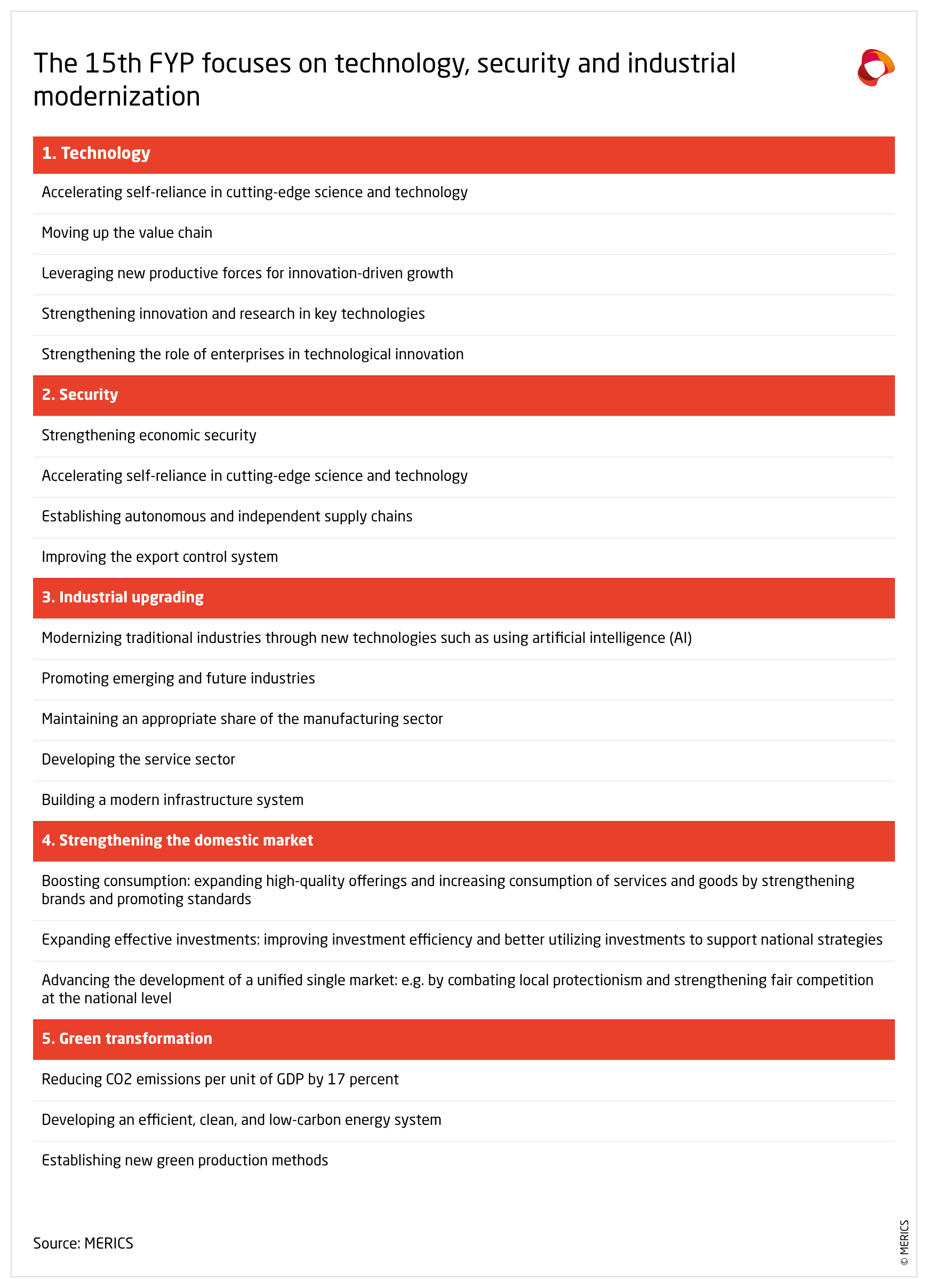
Boosting industry, innovation and science and technology
Promoting the “new productive forces” (新质生产力) has become the leadership’s central response to slowing growth and rising debt. These technologies are expected to bring about technological breakthroughs, utilize factors of production to foster innovation and drive industrial upgrading processes. The new productive forces are to act as a kind of multiplier that lifts efficiency across the entire manufacturing sector. The intention is to accelerate China’s economic and technological development to strengthen industrial resilience, move up the value chain and reduce dependencies on foreign technologies.
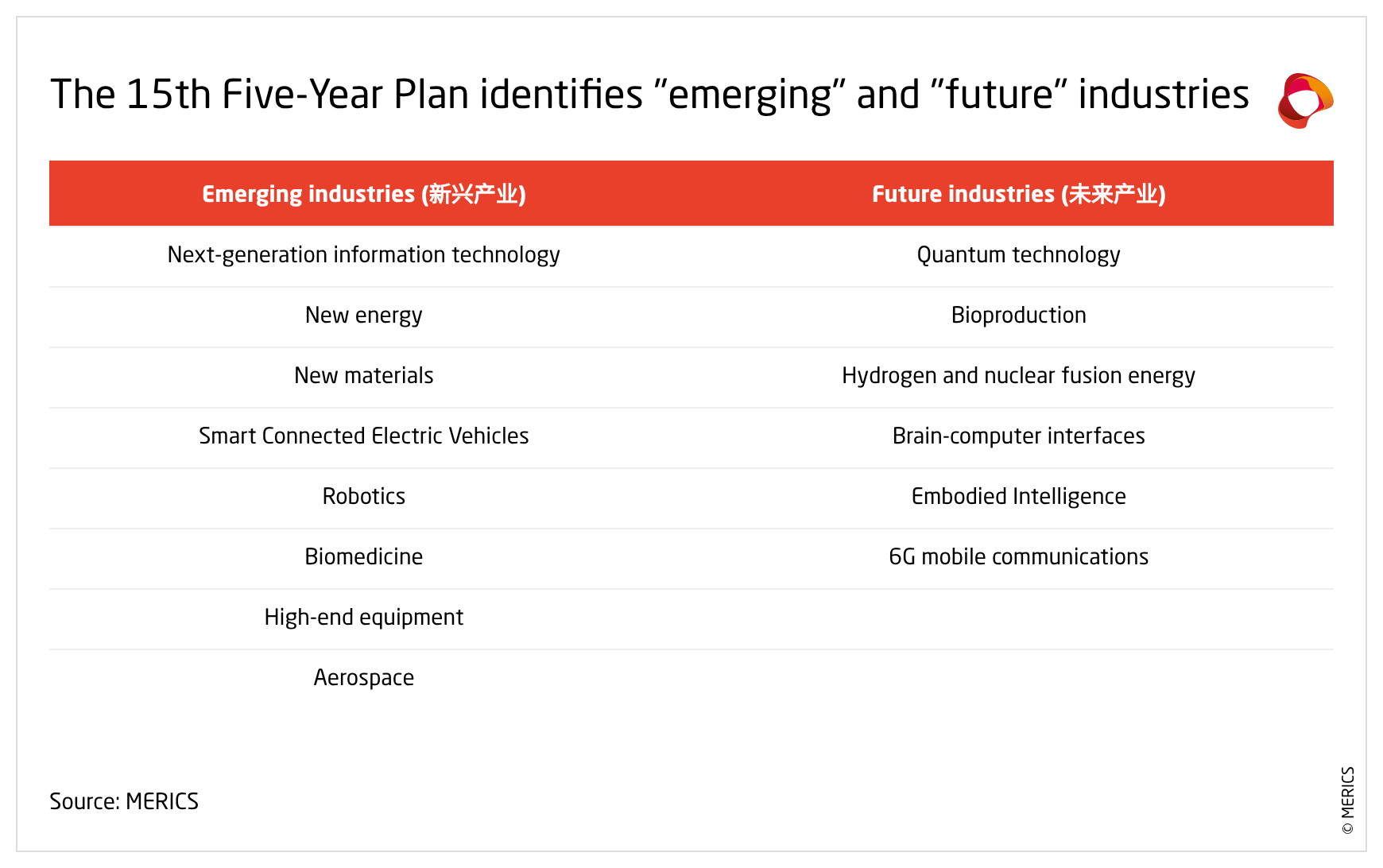
Xi Jinping has emphasized that promoting new productive forces does not mean abandoning traditional industries.4 Rather, traditional sectors such as steel and textiles should integrate smart solutions to boost their productivity. “Digital and smart development” is given greater priority than in the 14th FYP, underscoring how the integration of AI solutions, algorithms and computational models should transform traditional industries.
A central component of this strategy is the deepening of supply-side structural reforms. This includes reducing overcapacity in certain industrial sectors, avoiding investments in so-called ghost projects and making more efficient use of existing capacities to create an appropriate and modernized industrial base.
Strengthening the domestic market
The fifth overarching chapter, “Building a Strong Domestic Market and Accelerating the Formation of a New Development Pattern” (建设强大国内市场加快构建新发展格局), is dedicated to the topic of boosting domestic demand.5 When speaking of demand, China’s leadership is not thinking solely of household consumption, but of strengthening aggregate demand across the value chain. Consequently, demand is to be stimulated at every link in the chain, covering final and intermediate products.
This focus on the domestic market flows from the concept of the “dual circulation” (国内国际双循环), which emerged at a May 2020 meeting of the Standing Committee of the CCP Politburo. The concept distinguishes between the domestic cycle, which is based on production and domestic demand, and the international cycle, which includes international trade and foreign investment. It emphasizes the domestic cycle, or domestic market, as the central driver of growth.
China also pursues a strongly supply-oriented approach to increasing demand in final consumption. Although the plan occasionally calls for improving the population’s standard of living, new offerings are also to be developed to create new demand. This approach rests on the assumption that new, better products will unleash latent demand. This supply-induced consumption logic presupposes that households have the purchasing power to respond to new products. Provisions on income growth and the expansion of social benefits are included but take a back seat to supply-side instruments. Whether latent demand can be activated without significantly boosting underlying household incomes remains to be seen.
To support households, the plan provides for an expansion of elder care and childcare. In addition, income growth is to be more closely linked to economic growth in order to strengthen consumption. Nevertheless, these measures are likely to remain secondary to stimulating demand via the supply side, such as trade-in subsidies for household appliances.
Energy policy, green transition, and decarbonization
The plan aims to increase non-fossil fuels’ share of total energy consumption from 21.7 percent in 2025 to 25 percent by 2030. To replace fossil fuels with clean energy, the plan proposes building large-scale projects across all renewable energy sectors, including nuclear power. At the same time, the green transition is to be more closely integrated into economic structures, for example by developing zero-emission industrial parks and factories. For the same reason, energy-intensive industries will be relocated to regions with high availability of renewable energy.
However, the target for reducing CO₂ emissions per unit of gross domestic product over the five-year period was lowered to 17 percent, down from 18 percent in the 14th FYP. This may be because the previous target of 17.7 percent was narrowly missed. While the government continues to reaffirm its commitment to achieving decarbonization targets, concerns about energy security mean that China is also relying on fossil fuels as a backup.
Budgetary, economic and structural issues complicate implementation of the 15th Five-Year Plan
Three barriers that could prevent China reaching the 15th FYP’s goals as fully as intended are fiscal constraints, slowing economic momentum and long-term structural challenges.
Budgetary constraints and fiscal pressures
China’s strained public finances make it tougher to keep increasing spending on technology and industrial policy goals. The government has already set a record projected national general public budget (which combines central government and local finances and is China’s primary budget) deficit of CNY 5.89 trillion for 2026.6 This is a six percent increase over the actual deficit in 2025. Still, China’s 2026 headline deficit target of four percent of GDP leaves out additional debt from the announced issuance of CNY 4.4 trillion-worth of special purpose bonds or CNY 1.3 trillion ultra-long special treasury bonds for 2026. These bonds fall under a separate budget, the government funds budget. China’s budget deficit is significantly higher than the deadline deficit target of 4 percent if they are included. For comparison, France’s 2025 budget deficit to GDP ratio was one of the highest in Europe at 5.1 percent.
Rising budget deficits bring rising national debt interest payments, up by more than half since 2019. While 5 percent of national general public spending went on debt interest payments in 2025, the burden was more onerous for the central government, at almost one fifth of spending. Moving forward, things could worsen for the national general public budget as well, as its spending on debt interest payments rose by over 6 percent year-on-year in the January to April 2026 period, faster than overall expenditures.7
Local governments make up the bulk of China’s total spending. In the national general public budget, expenditures are projected to surpass CNY 30 trillion, with more than 85 percent of this spent by local governments, according to the 2026 budget draft. In the government funds budget, local governments’ projected share of expenditures is even higher, at 91 percent.
These large shares of national spending explain why local government debt, in particular, can pose a serious, structural fiscal problem for China. The debt problem is largely attributable to an imbalance between the revenue and expenditure responsibilities of central and local governments.
While local governments’ share of total revenue has declined over the years, they have been assigned an increasing number of tasks. Industrial policy measures, such as the development of industrial parks, were often financed locally. For instance, in the national public budget, the central government’s share of spending on industry is below 10 percent. The rest comes from local governments. Those have also relied on so-called “Local Government Financing Vehicles (LGFVs),” off-budget entities that make it difficult to track actual debt levels.
Local governments tend to duplicate spending efforts and have a high tolerance for loss-making projects, leading to an inefficient use of resources. The share of loss-making companies, for example, stood at 23.8 percent in 2025.8 Elements of the new FYP, such as combating “involution” and creating a unified national market, aim to reduce these inefficiencies, but their effectiveness is far from certain.
In recent years, the central government has tried to phase out the model of generating extra-budgetary revenue. It has urged local governments to convert off-budget debt into official bonds and has attempted to reduce the interest burden through the use of special government bonds, with limited success so far. Although the extent of the debt remains opaque, local government debt could exceed China’s GDP. Officially, local debt stood at CNY 48 trillion in 2024. Added to this are estimates of LGFV debt ranging from CNY 90 trillion to CNY 110 trillion, compared to China’s GDP of CNY 135 trillion in 2024. Furthermore, as early as 2022, monthly interest costs exceeded monthly revenues in 12 of China’s 31 provinces and regions.9
Many local governments continue to suffer from acute budget constraints, even though wealthier regions such as Shanghai are comparatively better positioned (see exhibit 3). Reports of delayed or missed salary payments in the public sector illustrate the tense situation. To bolster the public purse, local governments have turned to unusual revenue sources such as “deep-sea fishing” (远洋捕捞). The phrase describes the tactic of imposing arbitrary fines on companies to generate additional funds. Central government has repeatedly issued regulations to rein in deep-sea fishing, but unless the underlying cause (a mismatch of fiscal revenue and spending responsibilities between central and local governments) is solved, it will be hard to achieve.
As a high-level document, the 15th FYP does not provide specific amounts for the available funds. Rather, it implies various channels to finance its measures and objectives: a mixed financing model that is partly state-directed and partly market-based; significant capital allocation to strategic sectors; increased use of green financing; a selective role for foreign capital; and stronger regulation of local governments’ investments and debt issuance. With fiscal pressure growing, mobilizing and balancing these financing channels well may become harder to pull off.
 Hover over/tap the charts to see more details.
Exhibit 3
Economic momentum is slowing
In the short term, weak investment and consumption are holding back economic growth. Fixed investment has been declining across the board since 2025, affecting China’s real estate sector as well as public and private investors, though a recovery began to emerge in early 2026.10 Consequently, stronger gross capital formation, the investment component of GDP, lifted economic growth from 4.5 percent in the final quarter of 2025 to 5 percent in Q1 this year. Yet, most of this uptick appears to be policy-induced, as state-owned enterprises (SOEs) ramped up investment by 7.1 percent year-on-year.
Infrastructure, a sector traditionally dominated by SOEs, saw even stronger year-on-year investment growth, at 8.9 percent. Yet, local governments’ financial problems and declining firm profits make that recovery unsustainable. Overall FAI entered negative territory again in April and decreased even faster by 4.1 percent in May 2026 (see exhibit 4).
Hover over/tap the charts to see more details.
Exhibit 4
At the same time, private business and household confidence remain low. Private-enterprise investment declined by 8.5 percent in June, while retail sales of consumer goods in May fell for the first time in several years before returning to meagre one percent growth in June. Regulatory interventions, for example in the consumer-oriented technology sector, are also weighing on business activity. Local protectionism within China hinders economic integration, so growth potential is lost as efficiency gains from a unified domestic market cannot be realized.
Crucially, fiscal strain coupled with declining company profits makes it harder to achieve the technological breakthroughs China’s leadership wants. Persisting overcapacity has caused industrial enterprises’ aggregate operating profits to decline steadily, from a peak of CNY 9.2 trillion in 2021 to CNY 7.2 trillion in 2025, according to National Bureau of Statistics data.
Meanwhile, the share of loss-making industrial enterprises reached 23.8 percent in 2025, almost double their share a decade earlier. Diminishing profits may restrict the funds companies have available to put towards research and development (R&D) going forward, hampering new product development and innovation. Growing fiscal pressures also curb the government’s ability to subsidize companies’ R&D efforts directly. All this may make it harder to achieve 15th FYP priorities, like technological self-reliance or strengthening innovation and research in key technologies.
Long-term structural challenges
Even more serious are the long-term structural challenges, especially demographic change. China’s population is aging rapidly. A 2019 study by the Chinese Academy of Social Sciences (CAS)11 and more recent research12 warned that financial pressure on the pension system continues to rise, even though China still falls short of comprehensive social security. Expanding social benefits would demand significant fiscal resources due to the aging population, which is why the government is likely to proceed cautiously in this area.
There is also growing social discontent, driven partly by high youth unemployment, which reached 16.9 percent in March 2026, higher than year-earlier. Movements such as “lying flat” (躺平) reflect a shift away from the traditional meritocracy; many young people see little incentive to improve their performance in an environment marked by uncertainty and long working hours. This societal shift has also dampened startup activity, with the number of new startups falling from 51,302 in 2018 to 1,202 in 2023 and as low as 260 in the eight-month period from January to August 2024.13 Regulatory interventions and potential political campaigns add to the risks of entrepreneurial activities.
Weak productivity growth is another structural problem (see exhibit 5). Earlier productivity gains were largely driven by urbanization. From 2000-2009, China’s total factor productivity (TFP) grew by an average of more than four percent per year, but this rate fell to 2.3 percent per year in the decade from 2010 to 2019, despite efforts to promote innovation-driven development.14 From 2020 to 2023, it dropped again, averaging 1.7 percent.
Hover over/tap the charts to see more details.
Exhibit 5
At the same time, China remains committed to modernizing traditional industries, such as steel or textiles. Planners want these industries to remain in the country to secure supply chains, among other things. However, from a macroeconomic perspective spending on upgrading traditional industries inevitably ties up resources that could otherwise flow into more lucrative areas, such as “emerging sectors” and “future industries”, to boost returns on capital and total factor productivity.
Outlook: Despite obstacles, the geopolitical environment plays into China’s hands
As detailed above, Chinese government officials will face formidable obstacles in reaching the goals set by the 15th FYP. Other factors appear more favorable for China’s leadership:
- The international situation is characterized by uncertainty and discord, which gives China room to maneuver. Inconsistent US policy under Donald Trump, as well as ongoing hesitation of EU member states to develop a stronger toolkit to protect economic security, make it easier for Beijing to stick to its own course.
- China has been able to rely on exports to deliver the baseline economic growth needed for social stability. In 2025, exports accounted for around 30 percent of overall economic growth, pushing China’s trade surplus to a record USD 1.2 trillion.
- China can still depend on continued access to many foreign technologies it needs for its own progress and technological goals, such as high-purity silicon and electronic design automation software in the semiconductor supply chain.
- Added to this is the political system, which allows for centralized control of the economy and can limit political resistance.
However, these favorable factors could be a double-edged sword in the long run. Despite providing short-term breathing space to focus on technology and industrial policy goals, they could lead to further delays in structural reforms. This is particularly the case for any notable income expansion or redistribution or boosts to household consumption. Such reforms would be needed for a real shift from export-led growth toward consumption-driven growth. Although China has long been able to rely on exports as a pillar of economic growth, this might change, if recent trade talks between the EU and China fail to bear fruit and the EU finds the stomach for tougher measures on China.
- Endnotes
1 | http://www.npc.gov.cn/npc/c2/c30834/202603/t20260316_453274.html
4 | https://english.www.gov.cn/news/202403/05/content_WS65e722bdc6d0868f4e8e4b87.html
5 | “Adhering to the strategic focus of expanding domestic demand, …,” Chapter 5.
6 | https://www.mof.gov.cn/zhengwuxinxi/caizhengxinwen/202603/t20260316_3985331.htm
7 | http://gks.mof.gov.cn/tongjishuju/202605/t20260515_3989956.htm
8 | https://merics.org/en/china-overcapacities-monitor
10 | https://merics.org/en/merics-economic-indicators-0
11 | http://cisscass.com/yanjiucginfo.aspx?ids=26&fl=3
12 | https://www.researchgate.net/publication/388829217_Evaluation_on_the_Pension_System_Reforms_in_China
13 | https://www.ft.com/content/1e9e7544-974c-4662-a901-d30c4ab56eb7?syn-25a6b1a6=1
Autor(en)

Analyst

Senior Analyst
Autor(en)
Analyst
Senior Analyst
Inhalt