
MERICS Economic Indicators

MERICS Economic Indicators

MERICS Economic Indicators is our quarterly analysis of China’s economic data. The MERICS Economy and Industry team provides updates on the latest macroeconomic trends and their impact on Europe. The findings are presented on a dashboard in interactive charts and explained in concise texts. In-depth analyses put a spotlight on the most important developments. 

MERICS Members have privileged access to this publication. Learn more about the Membership program here.

merics-economic-indicators-visual

Graphs

Stock market keeps lifting the MCCI


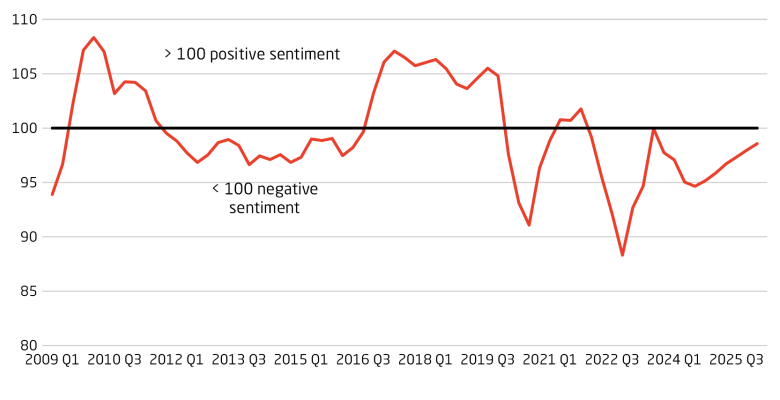
  • The MERICS China Confidence Index (MCCI) continued its gradual ascent in the final months of 2025, rising to 98.5 in Q4 2025 from 97.4 in Q3 2025. The MCCI has been steadily recovering from a two-year low in Q3 2024, indicating that sentiment has been gradually improving since then.
  • Persistently strong turnover value at the Shanghai Exchange Stock underpinned its rise, as the value of shares traded reached an all-time high of CNY 85.33 trillion in December 2025.
  • Despite its steady rise, the MCCI remains significantly below earlier levels; it touched 104.7 in Q4 2019, shortly before collapsing at the onset of the Covid pandemic.

The MERICS China Confidence Index (MCCI): The MCCI – first developed in 2017 – includes the following indicators: stock market turnover, future income confidence, international air travel, new manufacturing orders, new business in the service sector, urban households’ house purchase plans, venture capital investments, private fixed asset investments and disposable income as a share of household consumption. All components have been tested for trends and seasonality. The index is weighted between household and business indicators.

Exports retained their strength as a major contributor to GDP growth in 2025
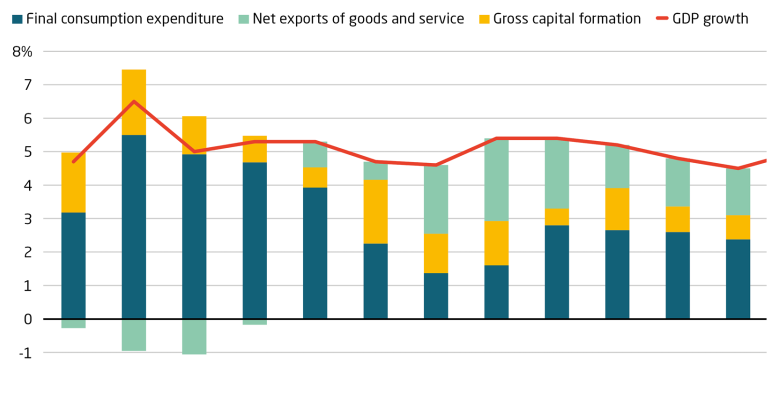
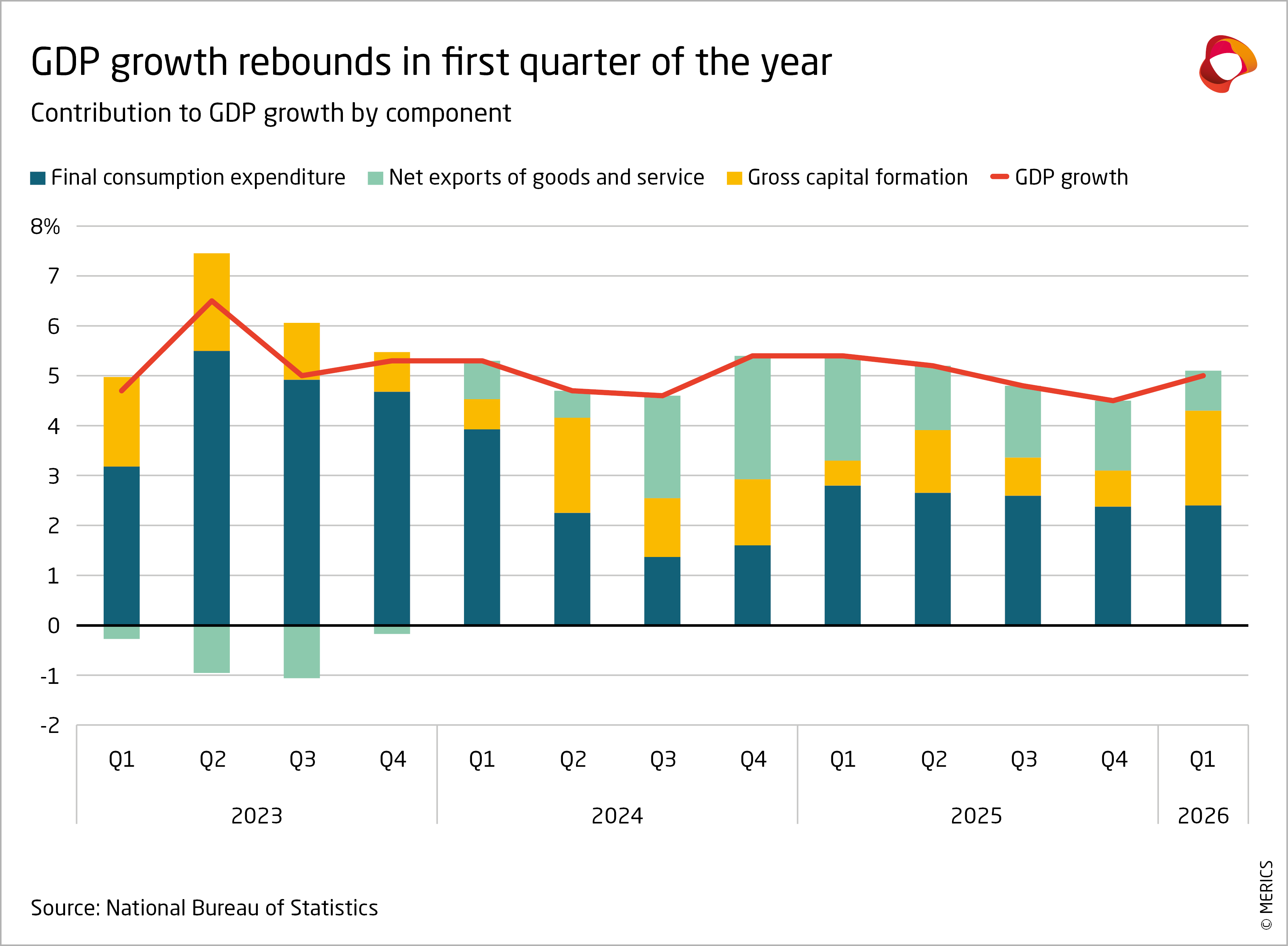
  • Quarterly GDP growth has been declining gradually since Q1 2025, to a 3-year low of 4.5 percent in Q4 2025. The government will likely want to introduce moderate stimulus in the coming months to reverse this downward trend and safeguard current levels of GDP growth. 
  • China’s GDP growth has received a significant boost from exports since Q3 2024. Exports accounted for 32.7 percent of GDP growth in 2025, underlining their crucial role in compensating for weak consumption. The threat of tariffs from the Trump administration encouraged the frontloading of orders in early 2025. Even after the US raised tariffs on Chinese goods, exports continued their strong growth and gained momentum throughout 2025.
  • Beijing will be eager to see exports generate further growth momentum in 2026. Whether this is possible will depend on the extent that other markets, particularly European ones, are willing or able to absorb additional imports.
     
Industrial output growth stayed broadly steady in Q4


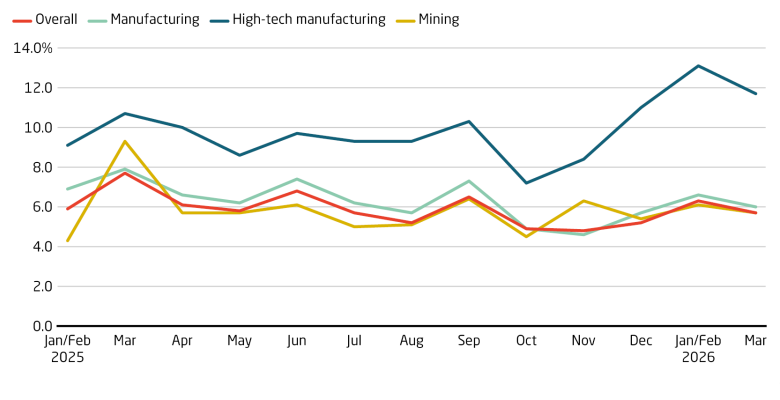
  • Value-added industrial output growth made a mild recovery from its gradual downward trend, to finish at 5.2 percent in December, a notch below 5.9 percent growth in 2025 as a whole. 
  • Growth in high-tech manufacturing jumped to 11.0 percent in December, its highest level since April 2024, driven by demand for industrial robots (up 14.7 percent), semiconductors (up 12.9 percent) and new energy vehicles (NEVs) and power generation equipment (both up 8.7 percent).
  • Official concerns about “involution” (i.e., overcapacity issues) have not led to any overall slow-down in industrial output. The broad policy agenda remains supportive of continued growth. In addition to expanding new industries, such as NEVs, policies supporting the upgrade of all domestic sectors with advanced equipment and production processes have helped to boost demand for inputs like chips and industrial robots.
     
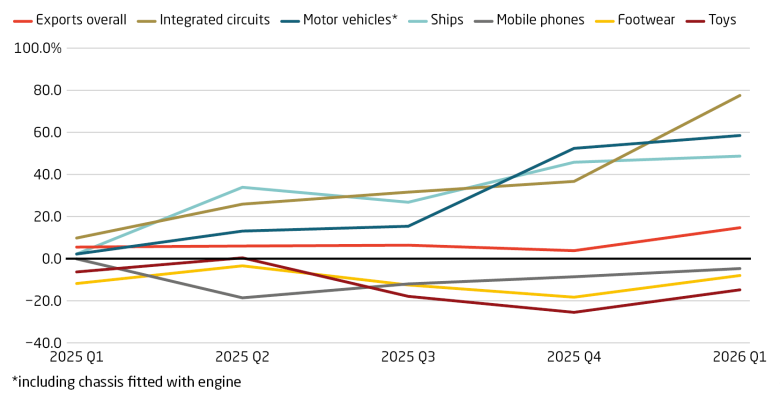
Chinese exports are growing everywhere except North America


  • China’s trade surplus hit a new record in 2025, reaching USD 1.2 trillion, on a rise of 5.5 percent. The latest record may trigger stronger policy pushback from third countries and increase pressure on Beijing to address industrial overcapacity—often discussed domestically as “involution”—to reduce Chinese manufacturers’ reliance on external demand.
  • Exports have been redirected away from the US since the renewed trade war in Donald Trump’s second presidency: an 11 percent year-on-year increase in Q4 2024 turned into a 28 percent decrease by Q4 2025 . 
  • Third markets have absorbed China’s reallocated surplus goods, led by ASEAN, Europe and Africa. The share of China’s total exports going to the three regions rose to 38.4 percent in 2025, up from 35.8 percent in 2024. Meanwhile, those sent to US ports shrank to 11.1 percent in 2025, down from 14.6 percent in 2024.
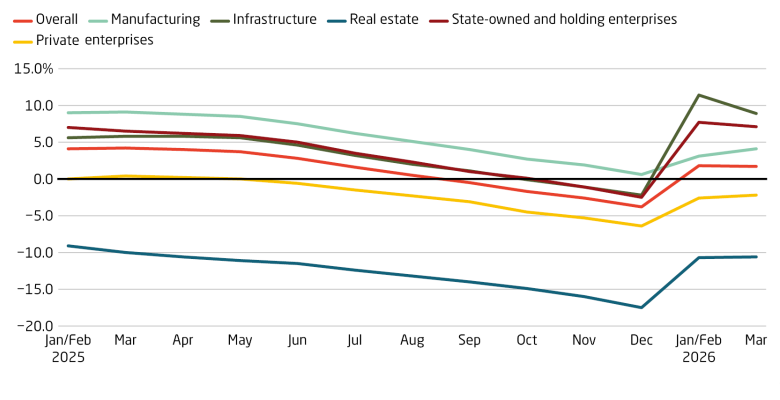
For the first time in decades, fixed asset investment turns negative


  • Overall fixed asset investment (FAI) declined 3.8 per cent for the January-December period on a year earlier, showing the first contraction in reported FAI in recent decades (with the exception of the Covid-19 pandemic in 2020).
  • Growth in manufacturing investment eased down to remain slightly positive at 0.6 percent year-on-year (ytd) in December. This slowdown shows that the unusually high growth rates for manufacturing investment in previous quarters proved unsustainable at last. On a sectoral basis, investment growth in the automotive industry remained strong 11.7 percent year-on-year in December. Yet, it did not defy the trend, decelerating from 19.2 percent year-on-year growth in September.
  • The slowdown in manufacturing growth is further undercut by a sharp fall in investment in services (7.4 percent yoy ytd decline in December). The main driver for this was the still tumbling real estate sector, in which investment fell by a whopping 17.5 percent yoy ytd in December, the sharpest decline in five years.
China’s stock market rally continues for a second year


  • China’s stock market rally continues, with indices at exchanges in Shanghai, Shenzhen, Beijing and Hong Kong up between 42 percent and 71 percent since January 2024. In December 2025, the Shanghai Composite Index and Shenzhen’s Composite Index reached their highest levels since China’s stock market boom in 2015, at 3954.8 and 2509.3 respectively. Beijing’s BSE 50 has almost doubled within two years, touching a record 1582.7 in October 2025.
  • China’s “slow bull market” has been aided by recent developments, such as the injection of ample liquidity into the economy and steady investments by institutional investors. The central government will be mindful to avoid any re-run of 2015 when stock markets underwent a drastic spike, then crashed.
  • Stock markets were a favored investment option for Chinese households in 2025, as the housing market has failed to bottom out, heightening the government’s need to avoid volatility.
Household borrowing plunged in 2025 as the real estate slump continued to bite


  • Total new increased loans fell by 28 percent between 2023 and 2025 (from CNY 22.744 billion to CNY 16.270 billion), indicating that sentiment in the Chinese economy is still low.
  • Household borrowing has been particularly weak: it accounted for only 3 percent of total new loans in 2025, whereas it accounted for 19 percent of new loans in 2023. Households have not been persuaded to take on more new loans, despite Beijing’s stimulus measures in 2025, such as cuts to the reserve requirement ratio or interest rate cuts. 
  • With housing prices still falling, many households are repaying mortgages on property that is losing value – a fact that is likely to make others wary of taking on property loans while there is no end in sight to the real estate crisis. 
China’s job creation lingers below pre-Covid levels


  • New job creation seems to have been stronger in 2025 than in the previous year. While December data has not yet been released, 12.1 million new urban jobs were added in the year to end-November 2025, compared with 11.98 million urban jobs in the same period of 2024.
  • However, job creation still lags far behind the more dynamic pre-Covid labor market. In both 2018 and 2019, more than 13.5 million new urban jobs were added.
  • Although overall urban unemployment is fairly low, at around 5 percent, finding work remains a painful problem for young people. Among 16 to 24 year-olds, unemployment stood at 16.9 percent in November 2025, higher than the 16.1 percent a year earlier. Labor market pressures and imbalances continue, in the form of weak demand, skills gaps, and automation.
Consumer spending growth slowed significantly in Q4


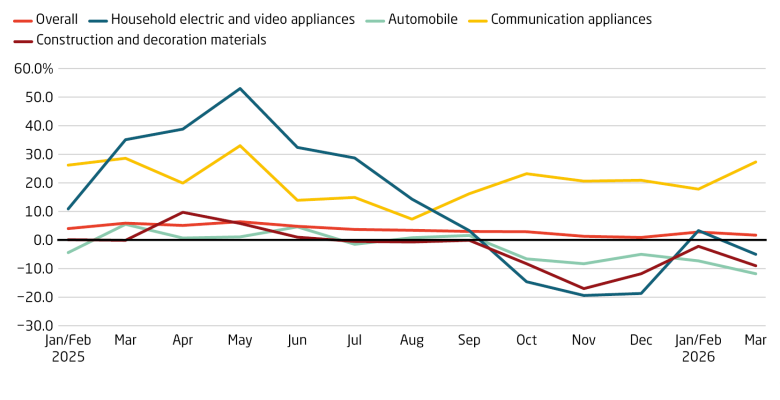
  • Consumer spending remained weak as growth in consumer goods sales continued declining in the final months of 2025, slipping from a peak of 6.4 percent in May to a mere 0.9 percent in December. For the year as a whole, retail sales grew by 3.7 percent, slightly more than the 3.5 percent growth recorded in 2024.
  • The government’s consumer goods trade-in program, which subsidized purchases of home appliances, cars and digital products, succeeded in bringing purchases forward at the start of 2025. However, it also resulted in growth contracting in Q4 for some of these products, in particular household appliances.
  • The continued weakness of the real estate and construction sector is hitting consumption. Sales growth for furniture, and in construction and decoration materials, finished the year in negative territory. 

Analyses

Authors