picture alliance / CFOTO
Content
MERICS Briefs
MERICS China Essentials
MERICS China Essentials Special Issue: EU-China economic relations enter a critical phase
Top story
Europe risks non-essential, high-volume exports as its China trade stance hardens
Europe’s decisionmakers are weighing the ways in which Beijing could use trade restrictions to retaliate against the region’s efforts to “derisk” its economy from China. This follows the mid-October decision by EU leaders to strengthen trade defenses against China and boost efforts to reduce supply-chain dependencies. Signs that the bloc had edged closer to a confrontation emerged even before the European Council meeting had concluded, with China’s Ministry of Commerce warning that the EU “should not underestimate China's determination and ability to safeguard its own interests."
European measures could trigger retaliation, starting with major European exports for which China has little strategic need (see exhibit 1). Beijing has a history of targeting high-quality agri-food and beverage products (AFB) from French cognac to Swedish salmon, and could also readily target fashion, cosmetics and luxury cars. It could encourage its companies to avoid foreign financial services providers – although this would deprive them of international finance – and restrict imports of critical goods like advanced European machinery and components, although likely only as a last resort.
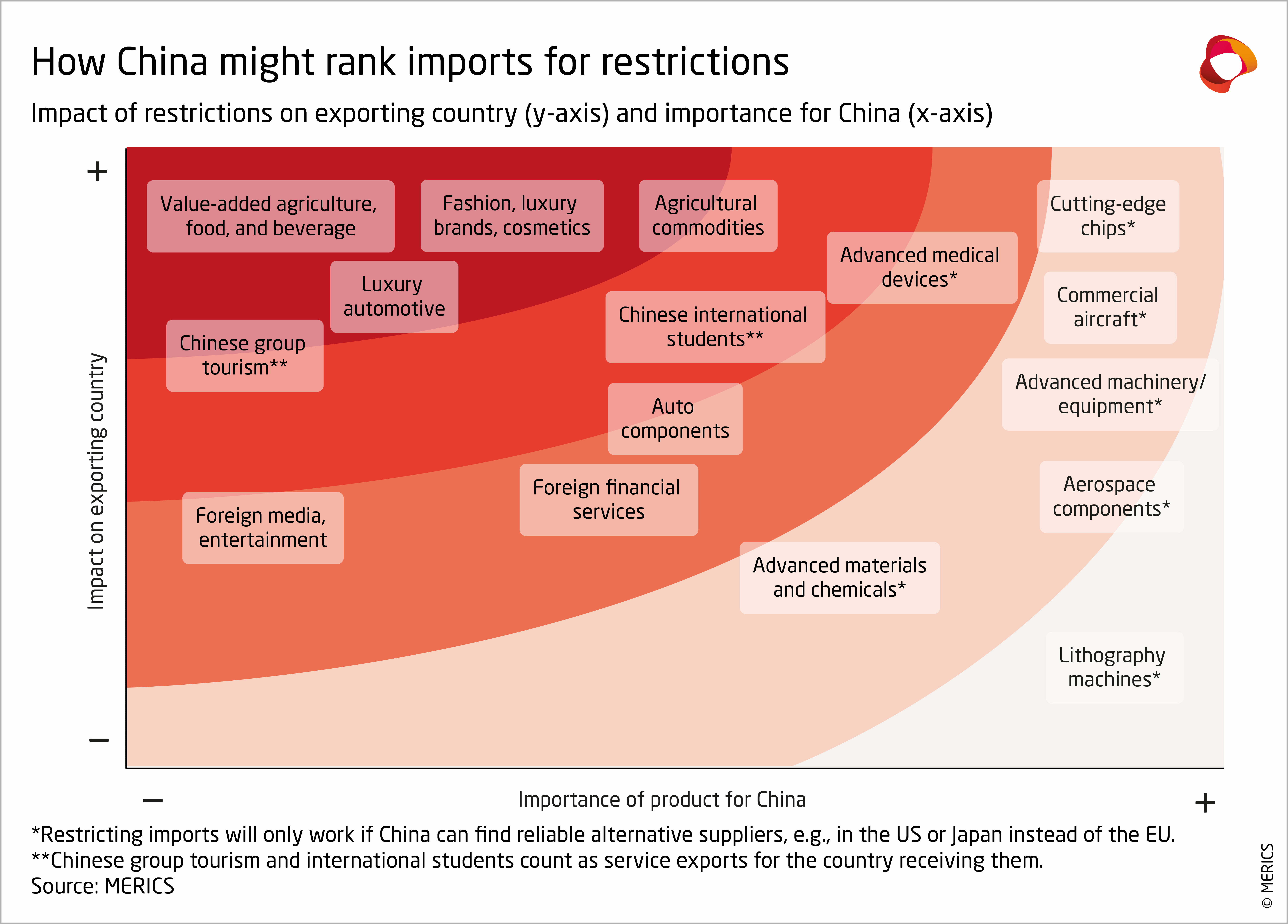
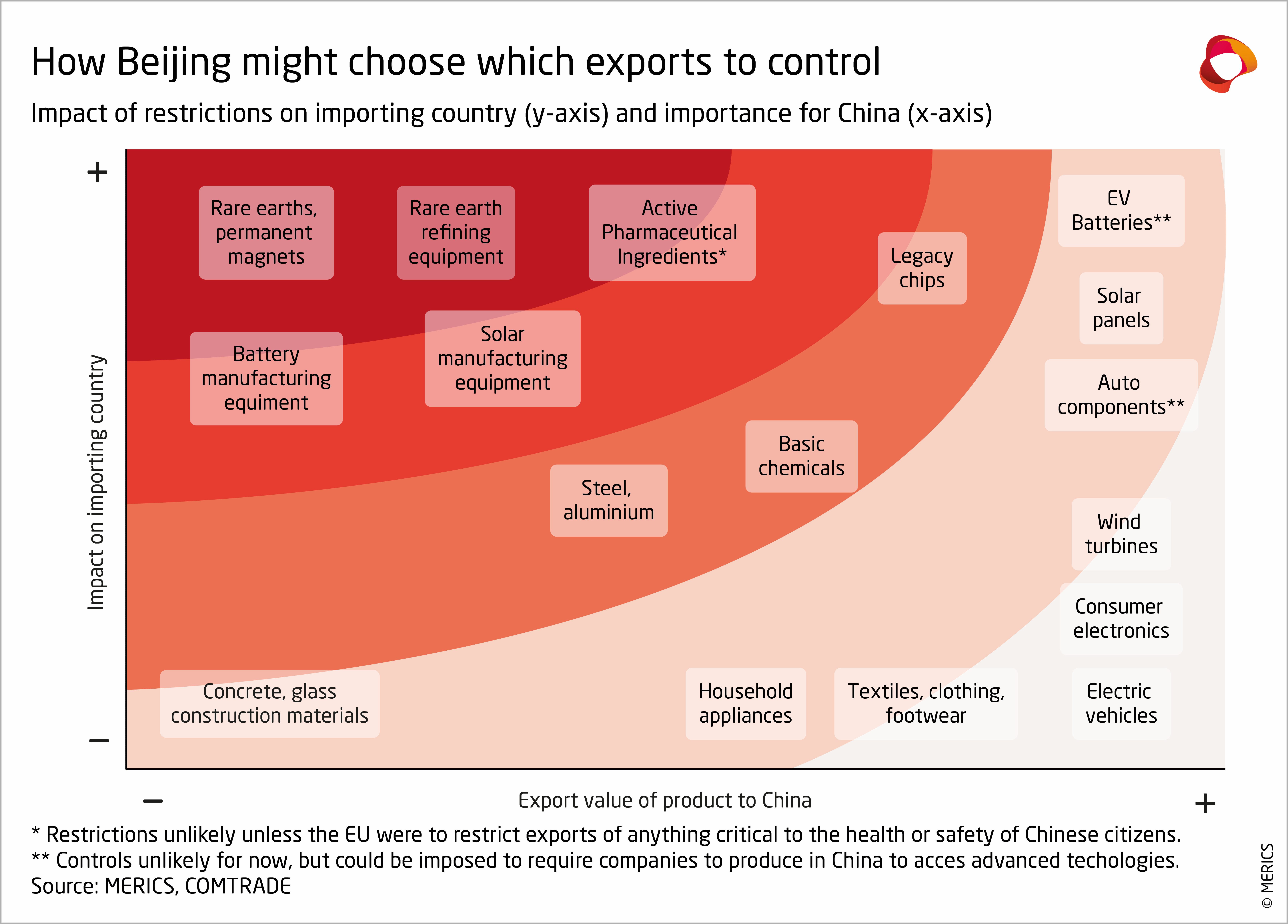
Beijing could also tighten export restrictions to deny Europe access to critical products. Rare earths promise maximum impact on Europe and a negligible effect on Chinese exports, with rare-earth refining equipment and battery-manufacturing equipment also being useful to derail European derisking. But the danger is that restrictions could threaten European goods China still depends on – German machine tools, French metrology instruments, Dutch lithography machines. This means Beijing will take care to maintain the flow of some critical Chinese inputs to Europe and of critical imports from the region, even if it has to exempt them from restrictions, as with key US goods during the 2025 US-China trade war. For now, Beijing is unlikely to block high-value exports like EV batteries or car parts, as it is counting on exports for growth (see exhibit 2).
“Europe needs to be aware that new restrictions on Chinese goods will encourage Beijing to tighten its own inbound and outbound restrictions to hit European companies hard. Europe needs time to reduce its dependencies, so it must now demonstrate that it, too, has the stomach for an economic conflict. It must prepare to restrict China’s access to European technologies and markets at short notice – thereby creating a credible deterrent against Chinese pressure.”
Jacob Gunter, Head of Program Economy and Industry, MERICS
Media coverage and sources:
- MOFCOM (CN): 商务部新闻发言人就欧盟峰会提出对华“双轨”思路答记者问 (MOFCOM Spokesperson Answers Reporters’ Questions on the EU Summit’s “Two-Track” Approach Toward China)
- EU Council: Conclusions adopted by the European Council at the European Council meeting on 15 and 16 October 2026
- European Commission: Joint press statement by Commissioner Šefčovič and Minister Wang
- CNBC: China indicates rare earths will keep flowing to EU, regardless of U.S. trade deal expiration
METRIX
2.06%
This is the share of all Chinese exports to the EU accounted for by hybrid vehicles between January and August 2026. That is more than double the rate of 0.95% recorded for 2025, but the figure still points to the limited economic impact that Beijing’s agreement to moderate hybrid-car exports to the EU is likely to have. By acknowledging that “progress in one sector […] cannot fix” China’s huge trade surplus with the EU, European Commission President Ursula von der Leyen signaled that the deal – which included Chinese pledges of better market access for some EU products and a reliable supply of rare earths – was more symbolic than practical: It showed that diplomacy can help bridge the differences between Brussels and Beijing and keep both sides talking – without taking the EU’s threat of further measures off the table. (Source: Eurostat)
Topics
Europe warns hybrid vehicles deal with Beijing is no trade breakthrough
Berlin, Paris, and Brussels have signaled that the trade conflict between China and the EU remains unresolved despite the October 9 “shared understanding” on Chinese hybrid vehicle exports. Instead, EU and member state leaders are framing tensions as structural and emphasizing that Europe’s reliance on China still needs to be addressed. Without mentioning China, Chancellor Friedrich Merz told the Bundestag that Germany and Europe “will no longer stand idly by while other countries harm our economy through high subsidies, artificially devalued currencies, overcapacity, and aggressive pricing.” He stressed the importance of his upcoming visits to Singapore, South Korea, and Japan – countries he described as “crucial […] in reducing critical, one-sided dependencies.”
Following the 15–16 October European Council, Commission President Ursula von der Leyen and French President Emmanuel Macron characterized the hybrid vehicle deal as a mere pit stop on the road to a potential trade conflict.
Von der Leyen described the trade deficit with China as “structural, and … unsustainable.” New tools were already available or on the drawing board, she noted: The DiversifyEU initiative to accelerate de-risking, the Solidarity Mechanism to counter coercion or retaliation, and a new instrument to limit access to the single market. Macron called on the EU to consider new measures targeting chemicals, plastics and ferro-alloys, indicating potential new trade flashpoints.
“European leaders are taking a combative stance despite the hybrid vehicle deal with China. The agreement may offer Europe’s car makers temporary relief from pressure from Chinese exports, but it is likely to only postpone a confrontation that Beijing feels confident of winning. A full-blown escalation still cannot be ruled out.”
Aurelio Insisa, Senior Analyst, MERICS
Media coverage and sources:
- Financial Times: EU “safeguards” hybrid car sector from Chinese imports under new deal
- German Government: Regierungserklärung von Bundeskanzler Friedrich Merz
- European Commission: Statement by the President: EUCO of 16 October 2026
- Reuters: EU to propose import curbs on other Chinese sectors, says EU chief
China casts EU trade barriers as a symptom of the region’s economic failings
It’s Europe, not China – that was the gist of Chinese state media coverage of EU Trade Commissioner Maroš Šefčovič’s visit to Beijing for talks with Chinese Vice Premier He Lifeng and Minister of Commerce Wang Wentao in early October. State media commentaries praised the in-person visit and the opportunity for dialogue as an important step towards a healthier trade relationship.
While highlighting China’s goodwill in seeking to ease tensions, media coverage largely portrayed EU trade barriers as a protectionist fix for Europe’s home-grown problems. By stressing that supply chains in sectors ranging from cars to new energy and biomedicine were deeply intertwined, commentators suggested that any trade conflict would hurt both sides.
While noting Beijing’s pledges to promote more balanced trade, media were adamant that China was not the cause of Europe’s woes. As a piece in China Daily put it, trade barriers will not help cure the EU's “systemic economic problems”. An editorial in the People’s Daily even said China could help address Europe’s “development challenges”. Irritation with recent European moves was palpable. France and Germany’s push to reduce supply dependencies was lambasted as a turn toward protectionism. A comment on the website China Finance Net praised China for being sincere and patient in talks – but warned that “sincerity is not one-sided, and patience is not without limits.”
“Chinese state media tend to place the blame for trade tensions on Brussels and select European member states, France and Germany in particular. The rhetoric also reflects a growing confidence in China’s development model and economic strength, even if new EU trade instruments could still bring Beijing to the negotiating table.”
Katja Drinhausen, Head of Program, Politics and Society, MERICS
Media coverage and sources:
- People’s Daily (CN): 中欧要做彼此稳定、平衡的关键贸易伙伴(钟声)
- People’s Daily: France and Germany are lowering the banner of free trade themselves
- China Daily: Dialogue and cooperation represent rational path to healthy China-EU trade relationship
- China Finance (CN): 玉渊谭天:中欧谈判,所谓混动汽车出口砍半是怎么回事
Europe retains fast track for rare-earth licenses, but China keeps hand on the switch
The EU-China trade deal reached in early October may ease Europe’s immediate rare-earth supply problems – but also strengthens Beijing’s ability to use them as a political weapon. The EU committed to resolving priority licensing cases for dual-use exports to China in return for Beijing agreeing to continue expediting decisions on critical-mineral exports to Europe.
In doing so, Brussels in practice treated two very different systems as equivalent bargaining instruments – an EU control regime designed to prevent sensitive technology being used for military purposes and a Chinese one that exploits the country’s dominance in rare earths for geopolitical leverage. This highlights Europe’s limited ability to do anything against Beijing using export controls as a bargaining chip.
Although China began licensing critical minerals as far back as 2023, Europe has yet to cut its dependence on Chinese supplies. Over the last 18 months, the EU has announced various mining, processing and recycling projects, but these have yet to deliver any alternative supplies.
The latest deal with Beijing does not guarantee rare-earth shipments to European companies. The Chinese government promised to speed up licensing approvals last year, but progress has been slow and uneven. At the same time, it has shown its willingness to use export controls for political retaliation: It in July banned shipments of dual-use goods to 14 European companies a day after the EU sanctioned 14 Chinese companies over their alleged support for Russia’s war against Ukraine.
“This is another signal that Europe must move faster to secure alternative sources of critical minerals or risk losing its supply-chain security. Beijing stands to benefit from keeping the licensing rules introduced in 2025 in place, using them as a bargaining chip and keeping a hand on the switch while Europe struggles to derisk.”
Altynay Junusova, Analyst, MERICS
Media coverage and sources:
MERICS China Digest
China’s economy accelerated in the July-September quarter on robust exports (AP)
China has reached 4.5% growth rate in its 3rd quarter, in line with Beijing’s target of 4.5%-5% growth for the whole year. This expansion is largely powered by an export-oriented economy, triggering trade partners’ complaints about excessive trade imbalances and unfair domestic competition. (2026/10/21)
Visa gets approval for China card business ahead of Trump-Xi summit (Financial Times)
China’s Central Bank has granted approval to payments giant Visa to operate in the country, following years of Beijing’s ban on foreign payment providers. However, the company now faces a transformed market, since QR code payments monopolize everyday transactions. Despite the approval delay, the move displays a “positive signal of China’s willingness to expand opportunities for foreign companies”. (2026/10/13)
Beijing's population expected to become super-aged by 2035 (Reuters)
One-third of Beijing’s residents will be aged 60 or above by 2035. Policymakers are discussing the introduction of possible measures to tackle potential economic repercussions, including raising pensions for elderly residents to stimulate domestic consumption. (2026/10/19)
According to the Central Commission for Discipline Inspection and the National Supervisory Commission, Huang Qifan, former mayor of Chongqing, is currently under investigation for suspected corruption. Huang Qifan previously worked under Bo Xilai, the former purged Chongqing party chief. (2026/10/13)
The New Yalu River Bridge, built in 2014, officially opened on 15 October. The bridge is expected to become a major economic link between China and North Korea. The opening was delayed by inadequate North Korean Road, customs, logistics infrastructure, strained bilateral relations and Covid-related border closures. (2026/10/14)
China announced revised export controls on drones and related components and technologies, updating technical criteria and introducing simplified registration procedures for certain exports. The measures aim to facilitate legitimate civilian trade while maintaining controls on dual-use technologies and will take effect on 18 November. (2026/10/19)
US formally publishes order to remove DeepSeek from federal civilian IT systems (US DHS)
The US Department of Homeland Security ordered federal civilian agencies to remove DeepSeek products and services from their IT systems and restrict future procurement. The measure also covers certain third-party products incorporating DeepSeek technology, extending security restrictions on Chinese AI to downstream applications. (2026/10/19)
Beijing seeks tighter grip on AI exports amid US rivalry (Reuters)
China proposed adding 40 technologies to its prohibited and restricted technology export catalogue, covering 23 AI technologies. Public consultation on the proposal will close on November 15. (2026/10/16)
Content