picture alliance / abaca | Pool/ABACA
Content
MERICS Briefs
MERICS China Essentials
AI at the Trump-Xi summit + Taiwan + EV overcapacities
Top story
Trump and Xi will talk AI, but don’t expect a major breakthrough
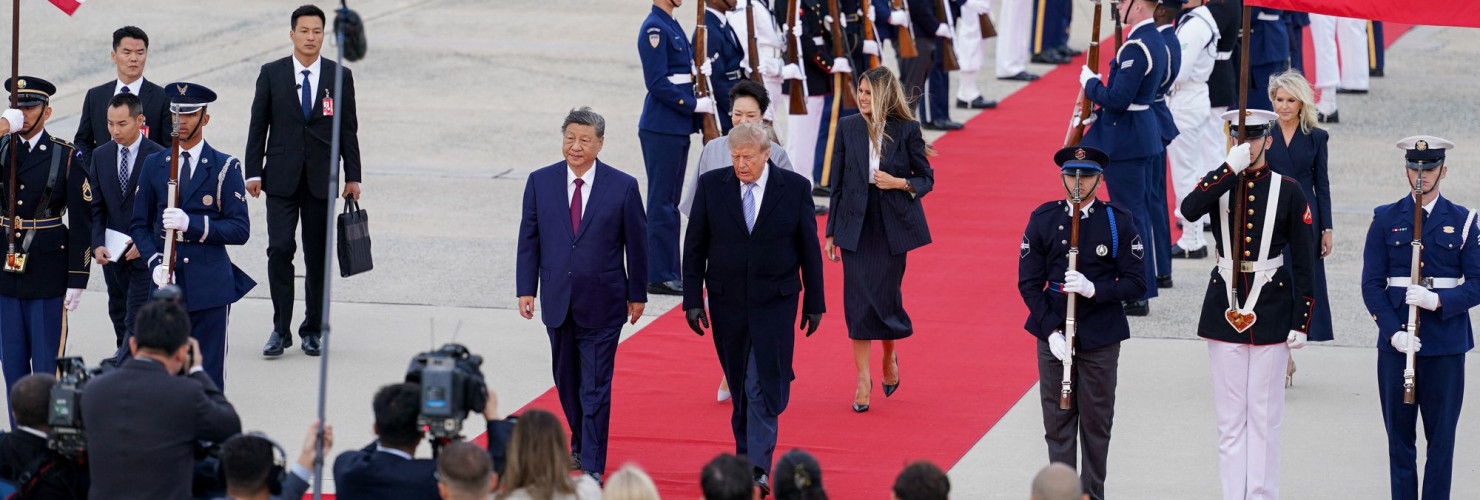
Amid a wave of AI mishaps and calls for regulation, hopes are running high that Chinese President Xi Jinping and US President Donald Trump may find some consensus on AI regulation in their meeting this week. On key trade issues, top officials from both sides had already reached agreements before Trump personally welcomed Xi at the airport on Wednesday: The US extended the suspension of additional tariffs negotiated in the 2025 Busan Agreement until January 10; China will not further tighten export controls on rare earths for the time being.
Meanwhile, in the race for advanced AI applications, mistrust between the two countries remains high, making significant agreements or accords on AI seem unlikely. Both governments are likely to focus on small but achievable results. One door-opener that may at least have a chance is the US pitch for a crisis hotline specifically focused on AI.
With the two countries locked in a competitive spiral of distrust reminiscent of the Cold War, neither has sufficient incentive to put the brakes on its own AI development. Earlier attempts by the Biden administration to find a common approach were thwarted by Beijing’s demands for Washington to relax trade restrictions on technologies it lacks.
From Beijing’s perspective, US government and corporate calls for a slowdown – which until now have remained mere rhetoric – are simply an excuse to “blunt China’s AI advance.” China, already number two in what both sides view as an arms race, faces US export controls on AI chips. It is of course concerned about the lack of controls over rogue AI tech in the US, while Washington worries that an increasingly assertive Beijing would not comply with a negotiated slowdown.
China may, however, be more open to bilateral talks now than when Joe Biden was in office. In July, Xi publicly warned for the first time about the risk of “technological loss of control” in AI, and in September, the head of China’s intelligence enumerated concerns about increasingly sophisticated and autonomous AI systems. Last week, China’s most influential standard-setting body for AI released the third version of a framework for developing safety standards. Still, safety guardrails for China’s own AI industry are still lacking.
A grand bargain between the US and China on AI safety is highly unlikely. Still, the fact that the world’s two major AI powers may be resuming some form of bilateral dialogue is encouraging. Even a seemingly small win like a crisis-communication channel could go a long way in averting or managing AI incidents before it is too late.
Rebecca Arcesati, Head of Science, Technology and Innovation Program (Co-lead) MERICS
Media coverage and sources:
- POLITICO: ‘The scientific, technical term is BS’: Inside the new Bessent-China AI hotline
- China Daily: 'Dr Frankenstein' alarm cries of US' AI elites a self-serving bid for profit: China Daily editorial
- Lianhe Zaobao (CN): 中国国安部长陈一新提AI六大风险:系统影响政治安全环境 (China’s Minister of National Security Chen Yixin mentions six major AI risks: AI systems affects the political security environment)
- Cyberspace Administration of China (CN): 《人工智能安全治理框架3.0》发布 (‘AI Safety Governance Framework 3.0’ published)
- DigiChina: Forum: Xi Jinping Headlines World AI Conference
METRIX
110%
This is the percentage by which the number of PhD graduates in China grew in the last decade, rising from around 54,000 in 2015 to almost 113,000 in 2025. Despite this jump, China still counts only 62 doctoral graduates per million people, one quarter of the rate of the US and Europe, where there are 240 and 230 PhDs per million, respectively. But, as PhD admissions jumped from around 74,000 in 2015 to more than 201,000 in 2025, China is likely to continue closing this gap. The question is, to what end? Academic and professional opportunities for PhDs are already failing to keep pace with the number of graduates. Anecdotal evidence suggests that elite secondary schools, for one, are becoming attractive alternatives. Shenzhen Middle School, for example, employs more than 100 teachers with doctoral degrees at its central campus, about one quarter of teaching staff there. (Source: Caixin /Ministry of Education Statistics)
Topics
Washington and Beijing needle each other over Taiwan, despite May summit pledges
Despite pledging to pursue “strategic stability” after Xi Jinping and Donald Trump’s last meeting in May, both the Chinese and US governments have continued to test each other over Taiwan – albeit in more low-key ways. In the spirit of what it has called “a constructive relationship of strategic stability”, the Trump administration has only twice ordered US warships to cross the Taiwan Strait since May 2025 and effectively halted foreign military sales to the self-ruled island since Trump’s visit to China. And Beijing, in its quest for what it calls “constructive strategic stability”, has refrained from major military exercises in the Strait since its 29-31 December 2025 drills, which were a reaction to Washington’s last weapons sale to Taiwan.
But the security situation in the Asia-Pacific remains tense beneath the surface. China’s People’s Liberation Army (PLA) has continued to patrol the waters and skies near Taiwan in recent months. Meanwhile, US allies and other regional partners have remained engaged in sustaining the island and the fragile security order across the Strait. The Philippines reportedly will allow Taiwan to open a second representative office, as tensions with China over the South China Sea remain high; two Royal New Zealand Navy warships transited the Taiwan Strait on 18 September to demonstrate what Wellington called “continued interest and commitment to the region”; and Japan in March 2026 started deploying new cruise and hypersonic missiles, weapon systems capable of striking Chinese cities such as Shanghai and Nanjing.
Developments in the Asia-Pacific suggest a novel dynamic in which other regional actors have partly compensated for growing uncertainty over US security engagement with Taiwan – a good, but also potentially fraught shift for the island, given the immense strain Trump has placed on US alliances and partnerships.”
Aurelio Insisa, Senior Analyst, MERICS
More on the topic: MERICS China Security and Risk Tracker 01/2026
Media coverage and sources:
- State Council of the People’s Republic of China: Xi steers China-U.S. relations towards stability
- Reuters: China's Xi expected to press Trump to halt Taiwan arms sales under 1982 agreement, sources say
- Nikkei Asia: Taiwan to open new Philippines mission in diplomatic push, sources say
- Reuters: New Zealand naval ships transit contested Taiwan Strait
China says it wants to curb EV overcapacity – but other priorities point the other way
China’s latest five-year plan for the car industry calls for better control of production capacity – but the conflicting goals of maintaining global competitiveness, domestic employment and economic stability are likely to limit any positive effects for foreign car companies suffering under China’s electric vehicle (EV) export glut.
The government’s 15th Five-Year Plan for the Development of the Intelligent Connected New Energy Vehicle Industry, released early September, seeks to entrench China’s global leadership in EV sales, supply chain integration and technological innovation for autonomous driving – and officials have explicitly invited more foreign firms to produce vehicles in China for the global market. Despite Beijing’s worries about overcapacity, European companies and policymakers should expect even more competition from Chinese manufacturers.
The plan for the first time calls for better management of the car industry’s production capacity through investment supervision for new projects, market consolidation, and enhanced tech and safety standards, which could drive out underperforming players. This comes after repeated calls from regulators to address overcapacity, and particularly the destructive competition that results from it – aggressive price-cutting to gain market share that squeezes profits.
But efforts to curb overcapacity are likely to encounter broader social and economic priorities. Local governments are, in particular, likely to resist shuttering factories to avoid increasing unemployment, taking responsibility for stranded assets and sunk costs – and conceding defeat in the race between regions to produce the nation’s next EV or autonomous-driving champion.
The Chinese government has been calling for an end to cutthroat competition driven by overcapacity in the auto sector. But conflicting political goals and techno-industrial ambitions are likely to keep officials from disrupting the status quo, leaving Chinese companies with little choice but to seek further expansion abroad.”
Sophia Pradels, Analyst, MERICS
Media coverage and sources
- Ministry of Industry and Information Technology (CN): 工业和信息化部等九部门关于印发《智能网联新能源汽车产业发展“十五五”规划》的通知 (MIIT and Eight Other Departments Release the “15th Five-Year Plan for the Development of the Intelligent Connected New Energy Vehicle Industry”)
- Ministry of Industry and Information Technology (CN): 工业和信息化部举行新闻发布会 介绍智能网联新能源汽车产业高质量发展情况 (MIIT Holds Press Briefing on the High-Quality Development of the Intelligent Connected New Energy Vehicle Industry)
- State Council (EN): Intelligent connected NEVs set to boost China's auto industry upgrade
- Automotive World: China targets 70% NEV sales and mass self-driving by 2030
New immigration rules help Beijing enforce supply chain and tech security
New cross-border travel rules in effect since September 15 are now helping Beijing restrict entry and exit if travelers fail to comply with China’s expanding economic and technological security regime. This raises new risks for both Chinese and foreign nationals. Exit bans in the case of criminal investigations and debt disputes have long been possible, but the new rules significantly expand the possible grounds for restrictions on visitors and citizens alike.
The new conditions now tie travel into or out of the country closely to China’s growing supply chain security, countersanctions and export controls. This allows Chinese authorities to block Chinese citizens from exiting if they have special expertise in strategic fields such as AI, engineering, advanced manufacturing or rare-earth processing or have worked in a sensitive industry such as defense.
China may also prevent foreigners from entering or leaving the country if they or their employer are under investigation or have been placed on a countermeasures, unreliable entry or sanctions list or if they are deemed a threat to China’s supply chain security and broader national security interests. This means substantial new risks for international residents or visitors if they or their companies engage in supply chain diversification, due diligence, or anything that can lead to penalties or placement on one of these lists.
Recent years have seen a significant easing of travel regulations to draw international visitors, with offers of visa-free entry and streamlined access to services on the ground. But political and business representatives visiting China should not be blinded by the open-door policies and keep this new addition to the laundry list of geopolitical risks in mind.
Katja Drinhausen, Head of Program, Politics and Society, MERICS
More on the topic: China's economic security offensive: How the PRC pursues dominance in industry, trade and technology – MERICS Report by Katja Drinhausen, Rebecca Arcesati and Jacob Gunter
Media coverage and sources:
- BBC: China tightens travel restrictions for citizens
- Chinese State Council (CN): 国务院关于出境入境管理的规定 (Regulations of the State Council on Exit and Entry Administration)
MERICS China News Digest
Woman reunited with family after 26 years (South China Morning Post)
A woman from northern China has been reunited with her biological family after 26 years. While it remains unclear whether the case of Sun Meihua involved human trafficking or whether anyone will face accountability, Sun’s story has ignited broader debate online. (16/09/26)
Draft rules for protection of minors online (China Law Translate)
China’s State Council has released a new set of rules in the country’s ongoing efforts to make the internet safer and healthier for children. Among other things, they cover new and existing methods for identifying young users and restricting functions they can use. (21/09/26)
Supreme People’s Court sets rules for AI-related disputes (China Law Translate)
China’s highest court released a set of rules related to AI, covering liability for civil violations, IP and contract violations, as well as courtroom and trial procedures. (17/09/26)
China convicts former IPO review committee members for bribery (Caixin Global)
Two former members of China’s IPO review committee have been convicted for bribery. Yang Xiong was sentenced to 9 years in prison for using a “shadow shareholder” arrangement to invest in a listed company through a private fund, while Guo Xudong was given 10 ½ years for accepting shares as bribes and using her regulatory position to help companies advance their IPO and refinancing plans. (21/09/26)
Former Shenzhen mayor probed for corruption (South China Morning Post)
Qin Weizhong, former mayor of the southern technology hub of Shenzhen and local deputy party secretary, is under investigation for corruption. During his career, Qin had worked with Ma Xingrui, a Politburo member and former Xinjiang party chief, who was stripped of party membership and dismissed from public office in July. (21/09/26)
China’s share of global container exports soars (Financial Times)
China’s 40% share of global container exports over the past three months highlights its heavy reliance on trade to power economic growth. With a 2.5 percentage-point jump in just nine months, global trade imbalances are growing faster than expected. As the EU weighs additional tariffs against cheap Chinese goods, Washington and Beijing are expected to discuss extending their trade truce at their summit this week. (22/09/26)
China strengthens rules to curb price dumping (Caixin Global)
China has boosted its regulatory framework for determining when manufacturers are selling goods below cost, giving regulators a concrete basis for intervening in price wars. While Chinese law already prohibits dumping, authorities previously lacked detailed rules for calculating production costs, a gap this updated process aims to close. (11/09/26)
China pauses new battery projects as it reviews capacity (Caixin Global)
China has suspended construction of new power and energy-storage battery projects pending a year-end review. As part of intensifying efforts to curb overcapacity, the freeze may help phase out lower-end capacity and boost competitiveness. But it could also constrain companies planning additional capacity to accommodate new products. (10/09/26)
Content