
picture alliance / CFOTO
Content
Report
Germany and China in the cleantech sector: Between opportunities, competition and location policy
Executive Summary
- German positions on China are diverse: German stakeholders in the cleantech sector find themselves caught in a strategic trilemma regarding China, where security, economic and decarbonization interests come into conflict. Stakeholders often are aligned with one or two of these three areas of interest, with positions that contradict each other.
- Areas of consensus present opportunities: There are, however, areas of overlapping consensus. These provide chances to resolve conflicts of interest in a politically and socio-economically acceptable manner, so that economic viability, decarbonization and European security can be integrated in a more sustainable manner.
- A coherent cleantech strategy is needed: These areas of consensus require political ownership. Germany should use policy tools that bind existing climate, energy and CO₂ targets to a long-term industrial and technology policy in order to guarantee their effective implementation. This will create planning certainty for investments, stimulate innovation in the cleantech sector, and enable more efficient advance planning for cooperation with China.
- Create lead markets for German cleantech production: Binding public and private procurement rules and “Made in Europe” criteria should boost demand for European technologies of the future. This enables economies of scale, reduces costs, safeguards jobs and supports innovative small and medium-sized enterprises.
- Differentiate trade policy by industry: Where cooperation and constructive political collaboration on decarbonization are mutually beneficial, Germany should continue to promote trade and investment cooperation with China. Chinese cleantech products are also essential for European decarbonization. However, stricter regulation is necessary for critical technologies and their key components. Support for joint ventures and direct investment should provide clear added value for Europe as a business location.
- Establish a common European cleantech policy that incorporates clear shared objectives for engagement with China: Germany and its EU partners should develop and strengthen binding common targets for investment conditions and rules for cleantech. European countries should coordinate closely to bolster supply chain resilience and trade policy bargaining power vis-à-vis China.
Introduction: China’s dominance in green technologies poses a challenge to Germany and the EU
The so-called China Shock 2.0 – a wave of high-tech exports – has put traditional German industrial sectors like automotive and mechanical engineering under pressure. In addition, innovation, cost advantages and supply chain dominance are giving Chinese industry inroads into core areas of the German economy. The consequences are far-reaching: Germany’s industrial base and technological independence are at risk. Even the ”clean technology” sector – known as cleantech – is increasingly shifting into crisis mode. Chinese dominance in this area is affecting German and European efforts to secure energy supplies and transition to a decarbonized, climate-friendly economy.
European companies find themselves in a double bind of cut-throat competition. While they are losing market share in China, they are also facing massive competitive pressure from Chinese players in their home markets. This is particularly true for cleantech, where China is catching up in electric mobility, wind power, batteries, hydrogen and other segments. The business-driven priority for German firms to maintain a presence in the Chinese market is increasingly coming into conflict with macroeconomic risks in EU markets, like industrial decline and job losses.1
This report concludes a pilot study that surveyed German perspectives on China’s role in decarbonization – the reduction CO2 emissions – and cleantech.2 It analyzes public statements, press releases and background discussions with representatives from industry, politics, research and interest groups with the aim of mapping the various interests and positions and contrasting them with Chinese ambitions. Positions on China vary depending on the interests of the stakeholders and are in some cases even at odds with one another.
By presenting the various positions in a structured manner, this report aims to help identify common interests and put forward proposals for a policy based on a broader consensus. In light of Beijing’s growing dominance in the cleantech sector, the options outlined in the report emphasize the urgency of Germany taking swift and coordinated action.
This requires a more resolute policy that unites as many stakeholders as possible. Economic interdependence between the EU and China is becoming unsustainably tilted in Beijing’s favor: China’s trade surplus with the EU stood at EUR 360 billion in 2025.3 The political will of European member states to reduce strategic dependencies as part of a de-risking strategy – for example, in critical infrastructure and energy security – is currently at odds with geo-economic realities. The lack of (affordable) European alternatives, as well as high and complex supply chain dependencies, make diversification difficult in the short and medium term, particularly due to the significant costs involved.
In this time of geopolitical change, Beijing also faces the challenge of maintaining economic sovereignty and independence. It has clearly stated its intention to achieve global technological leadership and to promote its own industries. Through far-sighted policies and the deployment of substantial resources, China has succeeded in establishing dominant positions in technologies and global markets that, just a few years ago, were firmly in European hands.
Beijing is taking a systematic approach to implementing its innovation goals and has also strategically addressed its own dependencies. Europe, and Germany in particular, are now feeling the consequences. China has adopted the German, export-oriented economic model and combined it with centralized control. Germany and the EU must act immediately to safeguard industry, jobs, technology and energy security.
In addition, advocates of a greater focus on European security, particularly in the energy and technology sectors, warn that the shift away from fossil fuels – accelerated by the wars in Ukraine and Iran – may lead to a growing dependence on China’s technology without the development of locally sourced alternatives. Risks are also rising in the areas of cyber security, the protection of critical infrastructure, and the control and security of energy networks.
Yet, the conditions for decarbonization in Europe have never been more favorable than they are today, given the availability of cheap and innovative technology from China. Beijing recognized cleantech and the global energy transition as an economic opportunity at an early stage. Through consistent technological support and industrial policy, China has overtaken Germany as a pioneer in green technologies. It now dominates global value chains for photovoltaics, batteries, and electric mobility, among others, and supplies high-quality, innovative cleantech at the most competitive prices.
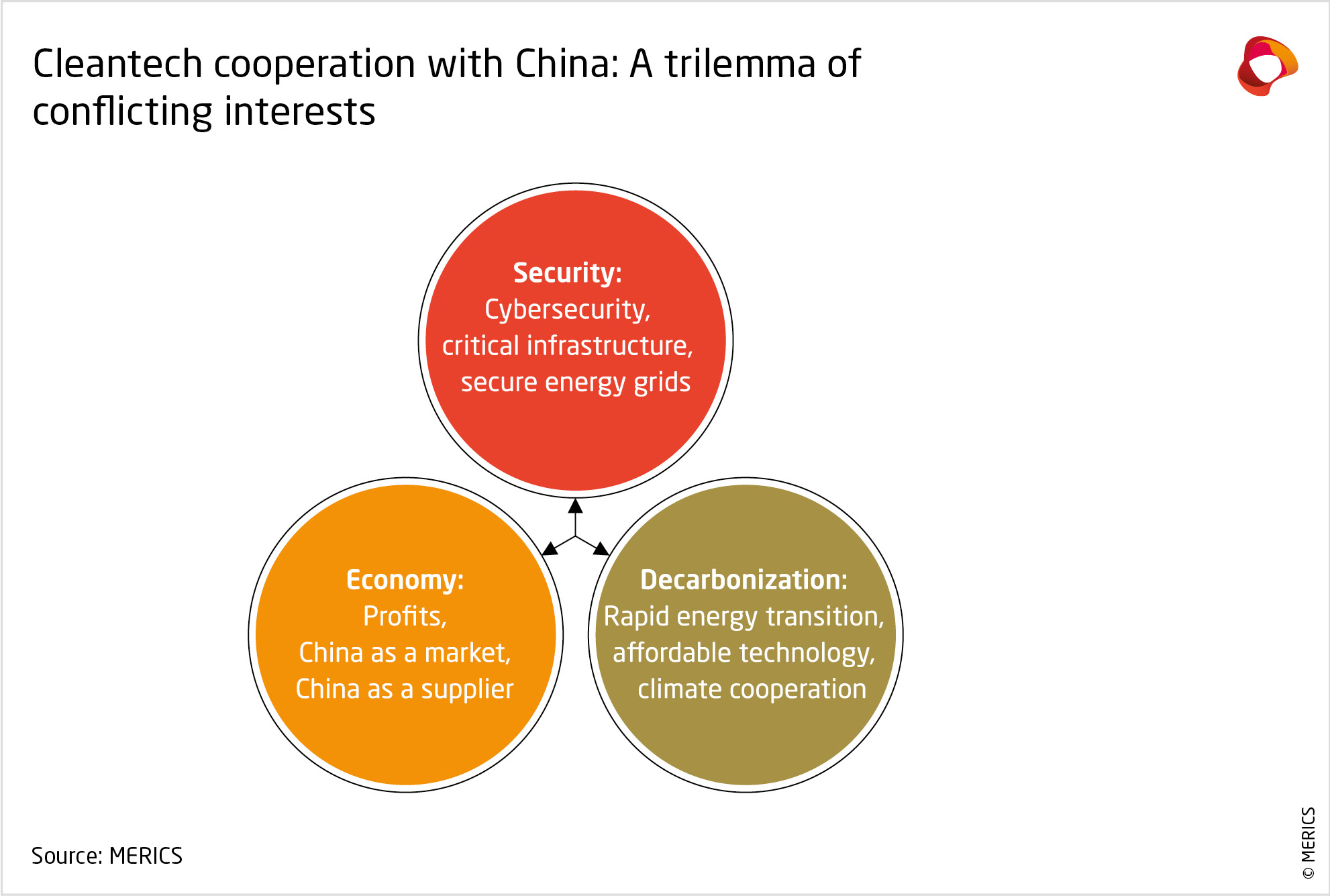
For Germany and the EU, this results in a complex strategic trilemma in which security, economic and climate interests come into conflict. The aim of protecting critical infrastructure and domestic industry conflicts with the need to implement the planned expansion of renewable energies swiftly and affordably through the import of low-cost technology.
To date, there is no agreement on a good balance for the use of domestic and Chinese products and technologies to achieve CO2 reduction targets. Without these Chinese goods, Germany’s national targets will be virtually unattainable in the short and medium term. They are therefore linked to Beijing’s geo-economic interests.
Conflicting interests: German stakeholders view China’s role in clean technologies differently
German stakeholder positions on China’s role in the cleantech sector are situated among three opposing poles that form a triangle of economic interests, security requirements and climate targets. These interests and objectives are not necessarily mutually exclusive and may overlap, but they may just as easily conflict.
Economic interests: China is particularly significant for major players as a market and technology partner
For decades, the Chinese market was a major sales market for German companies. German technology was developed at home, produced cheaply in China, and then sold worldwide. This division of labor was a recipe for economic success. With manufacturing facilities in China since the 1980s, German firms played a key role in making Germany one of the world’s largest exporting nations.
Today, trade relations between Germany and China have changed fundamentally. Germany’s decades-long trade surplus with China shifted to a deficit of EUR 89 billion in 2025, and China is now competing with German firms in the very same market segments that Germany previously dominated.4 Many of the driving forces behind the German economy remain firmly rooted in China. This also applies to companies in the cleantech sector. Today, however, German firms are represented in China not only by production facilities but also by research and development centers, and they maintain essential technology partnerships with Chinese companies.
Although the economic future of these firms in China now appears more tenuous, and even the view of large corporations regarding China is shifting, many continue to invest in the People’s Republic to maintain their position within the Chinese network of suppliers, and to benefit from the local innovation ecosystem. German firms also consider it important to maintain a presence in the Chinese market in the future, particularly in view of competition in third markets.
Industry representatives do not necessarily interpret the term de-risking as diversification of suppliers, but primarily as a strategic shift of production to alternative locations to mitigate the negative effects of trade barriers and boost their own competitiveness. A few selected quotes from the interviews conducted for this report illustrate this:
For automotive companies, de-risking means being less dependent on geopolitical measures. — Paraphrased from a confidential expert discussion5
“In China for China. That’s the only way to make headway in the current pricing landscape.” — Ola Källenius, CEO, Mercedes-Benz6
“We are deeply rooted in China and understand customer needs and market dynamics. The combination of German engineering, China’s extensive supplier network and local innovation creates a unique global advantage.” — Oliver Zipse, CEO, BMW7
“China is no longer just a manufacturing hub, but a global powerhouse for innovation. […] We are investing heavily and will continue to do so, […] and Bosch will optimize its presence to maintain its competitive edge.” — Stefan Hartung, CEO, Bosch8
However, even among companies that have been active in China for a long time, the mood is shifting in the face of shrinking market shares, particularly in the cleantech sector. German car manufacturers are being squeezed out of the electric vehicle sector by domestic manufacturers, and in the green energy sector, Chinese manufacturers generally have the upper hand for reasons of cost and procurement. This cut-throat competition is reflected equally in quarterly results in both China and Germany. While, for example, Mercedes’ latest electric vehicle sold only a few hundred units in China in the first half of 2026, Xiaomi – a company that only entered the market two years ago – delivered tens of thousands of models per month.9
German SMEs in particular feel under threat, as they are often unable to manufacture in China and benefit from low production costs. This is where the most critical voices on China are found.
Due to the comprehensive subsidy regime, we cannot compete with Chinese rivals. Even if we were to manufacture in China, we would not be able to benefit from the same level of capital subsidies and export support. So, does EU industry need protection from Chinese competition? Yes, because we are not competing with a single company, but with an entire economy. — Paraphrased from a confidential expert discussion
Security concerns: China’s investment and export strategy poses risks to Europe’s sustainable energy supply
Since at least the start of Russia’s full-scale war on Ukraine in 2022, many stakeholders in Germany have also become acutely aware of the risks of one-sided supply chain dependencies, particularly in the energy sector. The disruption to global oil supply chains due to the Iran war have once again highlighted this risk.
Reducing the share of fossil fuel sources in Germany’s energy mix – as the acting Federal Minister for the Environment, Carsten Schneider (SPD), has also stated10 – would make Germany less dependent on foreign energy suppliers. At the same time, however, there are complex security concerns regarding Chinese involvement in the European economy in general, and in Germany’s energy supply in particular. These include, for example, cyber-security risks arising from the use of Chinese technology for critical infrastructure, like wind farms.11
Competition from heavily subsidized Chinese companies is another cause for concern among German suppliers, as domestic firms are unable to match low Chinese prices. They fear being squeezed out of their home market. Furthermore, Germany and the EU face the threat of a gradual loss of manufacturing expertise and technological sovereignty in certain sectors – and thus of industrial independence from China.
There is also a dependence within cleantech supply chains, particularly when it comes to rare earths. The consequences of this became very apparent when China imposed export controls on rare earths in April and September 2024.12 Germany imports 47 percent of its rare earths needs from China, and this figure is rising.13 Further job losses are to be expected in industry. German industry is estimated to be losing 15,000 jobs per month – a trend that could continue if cut-throat competition persists.14
Various organizations and companies take a security-critical approach to China. These have often never had a presence in China or they have been squeezed out of the Chinese market due to Beijing’s support for domestic firms. Critical voices are also coming from trade associations and trade unions, whose members are already feeling the full force of competitive pressure from China.
In politics and policy-related research, security aspects of doing business with China have been the subject of more intensive debate for several years – yet there is still a lack of uniform and binding approaches to this challenge. A general strategy of de-risking – selectively reducing dependencies on China without fully decoupling – has been advocated, for example, by German Chancellor Friedrich Merz (CDU).15 In most cases, this approach is not clearly defined, although there have been some specific decisions to reject Chinese technology in favor of German suppliers. Following sharp criticism from political and security circles, for example, the offshore wind farm operator Luxcara awarded a contract to Siemens Gamesa instead of the preferred Chinese supplier Ming Yang.16
The line between acceptable risk and strategic vulnerability in the energy sector has not yet been definitively established and remains a matter of debate. It is becoming apparent that even a partial exclusion of Chinese components and products is likely to significantly increase the costs of Germany’s energy transition to renewables. Industry representatives are calling for systematic political support so they can compete with Chinese rivals:
“Following the solar sector, we are now exposing another future-oriented technology [wind energy] to the risk of falling victim to unfair competition. That cannot happen. If Germany aspires to be a frontrunner in green technologies, then we must back this up with clear political will.” — Jürgen Kramer, Deputy Chairman, IG Metall17
“Any project that receives even a single euro from European funding schemes should be obliged to purchase the technology in Europe as well. [...] As European companies, we cannot participate in China. We are denied this. On the other hand, we are still too naïve in Europe.” — Nils Aldag, CEO, Sunfire18
“Europe is the only continent that invites manufacturers from all over the world to offload their excess capacity here – and even subsidizes them to do so. […] Support should explicitly be given to companies that generate the bulk of their value added in Europe. France and Poland have already clearly aligned their funding regulations accordingly.” — Thomas Heim, Manager – Climate Solutions, Carrier (manufacturer of heat pumps, among other things)19
Climate targets: Decarbonization will be more expensive without affordable Chinese technologies
As part of its climate protection program adopted in the spring, Germany’s center-right and center-left government coalition (CDU/SPD) set itself the target of reducing CO2 emissions by 25 million tonnes by 2030. In order to achieve this and its other climate targets, Germany will need to make considerable societal and economic efforts. This is because simply reducing fossil fuel usage in the power supply is not enough – passenger and freight transport, as well as industry, must also decarbonize.
In this context, China’s range of renewables, batteries and electric vehicles (EVs) is unbeatable on price. Technologically, depending on the sector, the quality is comparable to Germany and therefore very attractive. It is thus crucial that policymakers also provide regulatory support and create effective incentives for the domestic economy. Among other things, the framework conditions for expanding renewable energy must be optimized. Take, for example, Germany’s current auction design for wind farms. In this process, sites are allocated through competitive bidding. This means that the developer who offers the highest sum may develop the site. The developer will therefore seek to reduce construction costs and tend to purchase cheaper Chinese turbines.
“Governments wish to maximize revenue through auctions. This auction design exerts price pressure on wind farm developers, who consequently switch to Chinese suppliers or pass the pressure on to European manufacturers, who in turn offset the higher prices by importing Chinese components. — Paraphrased from a confidential expert discussion
Partly because development cycles are often shorter, innovative solutions reach the commercial market more quickly in China than in Germany. Representatives at one research institute consider cooperation with China to be essential given the rapid pace of innovation in cleantech:
It is no longer possible to work without Chinese institutes. Innovation and research have reached a pace that is hard to imagine outside China. The scale achieved in China can be seen as an opportunity: technologies and production techniques can reach Germany more quickly and cheaply, thereby driving forward the energy transition. — Paraphrase from a confidential expert discussion
Climate research organizations and companies in the renewable energy sector also regard failing to decarbonize as a significantly greater risk than collaborating with Chinese suppliers. These stakeholders often view security risks a manageable – such as grid outages caused by Chinese components that have been tampered with. The following quotes illustrate the tension between risk awareness and competitiveness:
“By opting for the world’s most powerful offshore wind turbine [MingYang], we will be able to accelerate Germany’s energy transition while fostering much-needed competition in the industry. In any case, the management, operation and control of the Waterkant wind farm will remain entirely in the hands of an independent German company.” — Holger Matthiesen, Project Manager at Luxcara July 2, 202420
“The target of 15 million electric vehicles by 2030 can only be achieved with the involvement of Chinese manufacturers. An increase in import duties on Chinese vehicles would lead to significantly higher financing requirements for the roll-out of electric mobility.” — Study by Agora Verkehrswende21
Voluntary cooperation, dependence, supply chains: China is omnipresent in the cleantech sector
The stance of German cleantech companies toward China is largely influenced by their level of integration in the Chinese market. Companies with years of collaboration and strong roots in the Chinese ecosystem often advocate a China-based production strategy referred to as “in China for the world.” A large proportion of their suppliers, technology partners and research centers are based in China and develop innovative products. These companies rely on China for sales, competitive production and fast development.
Many companies without sales to China also rely on Chinese suppliers for components, either for cost reasons, due to Chinese dominance in the supply chain, or simply because of a lack of alternatives. The degree of dependence varies from company to company. Companies that are entirely independent of China are rare in this sector. The leading cleantech companies in Germany are generally closely linked to China as a supplier.
In principle, decarbonization with the help of Chinese technology still has the potential to become a stabilizing cornerstone of relations. In 2025, the total value of (largely fossil-fuel-based) EU energy imports stood at EUR 337 billion. The EU’s enormous trade deficit with China also means that the continent is of central importance to China’s export industry. Beijing is therefore sensitive to justifiable efforts by the EU to restrict market access or impose stricter conditions.22 Tensions in this area should be identified early on by both sides and managed diplomatically, as the risk of supply-chain dependency is growing as a potent disruptive factor in Sino-German relations.
China has elevated cleantech to the status of a strategic industry. Beijing has been successful with its strategic development plans for industries and technologies and will continue to rely on these instruments in the future. The dominance it has achieved in the solar sector and other areas through industrial policy is set to be replicated in an ever-increasing number of sectors. For the cleantech sector, this means that China will strategically strengthen the entire value chain and drive forward the development of new clean technologies, both for domestic decarbonization and for the global market.
China views industrial policy as a systemic advantage. In particular, the successes achieved in green technologies such as solar power are to be replicated in other sectors. Green hydrogen, battery storage, drones and AI-supported energy technology are key markets in which a surge in activity is expected in the near future. Systemically oriented industrial policy and politically guided market development are core instruments that China is currently consolidating. They operate across sectors and combine politically stimulated demand with the promotion of industrial ramp-up.
China is striving for autonomy in supply chains, the domestic market and future technologies. This is a challenge to German companies, and China is already competing with former German market leaders in almost all product categories. From Beijing’s perspective, there has never been a level playing field. As an exporting nation, Germany has long enjoyed a dominant position in technology, which China now seeks to attain. Now, through consistent policy and long-term investment, these dependencies are simply being reversed.
As a technological superpower, China aims to dominate the technologies and industries of the future. Any dependencies on Western countries that still exist are to be eliminated or reversed. In chips, AI, robotics, and aerospace, for example, Beijing is pursuing a generational project designed to propel China to the forefront in these sectors. China has learned from Germany’s approach to developing a largely automated ‘Industry 4.0’ and has developed networked, partly AI-supported industrial clusters.
German manufacturers are taking China’s ambitions seriously, even in areas where European technology still leads the way:
We have a cost gap of 40 to 60 percent compared with Chinese products. But if you calculate over a project lifespan of 15 to 20 years, this evens out, as Chinese equipment currently needs to be replaced more often and is less efficient. OPEX costs [operating expenses] bring Chinese offers into line with ours in terms of price; sometimes Chinese offers are actually more expensive in the end. But we cannot rest on our laurels; the Chinese will catch up quickly. We cannot assume that we will remain technological pioneers if the ramp-up here is so slow. — Paraphrase from a confidential expert discussion
Cleantech is the key market of the future for China. More than 11 percent of its growth comes from this sector,23 and since the oil crisis sparked by the Iran War, exports of green technology have been rising rapidly. Growing global demand is expected in this area, and Beijing already has a head start.
In third-party markets, we are not necessarily competing with Chinese producers solely on a technological level, but also when it comes to financial and insurance packages. In a tender that we lost, we had the technologically more suitable bid, but the Chinese had a better financing offer. — Paraphrase from a confidential expert discussion
German firms are not only competing with similar companies in China, they are up against a strategically positioned industrial ecosystem that can draw on the resources of a politically directed economy. Consequently, competitive pressure from China is no longer an isolated problem for individual firms, but an economic challenge for Germany as a business location more broadly.
Overlapping interests: Starting points for a coordinated strategy to engage with China in the cleantech sector
China’s ambitious, systemic and strategically underpinned initiatives to expand its technological leadership in green technologies and to transition to renewable energy require a consensus-based response from competitors. Inaction is no longer justifiable in the face of growing competition that is crowding out Germany as a business location. In the following, we examine the scope for action arising from the areas of overlap or consensus, and summarize the available options.
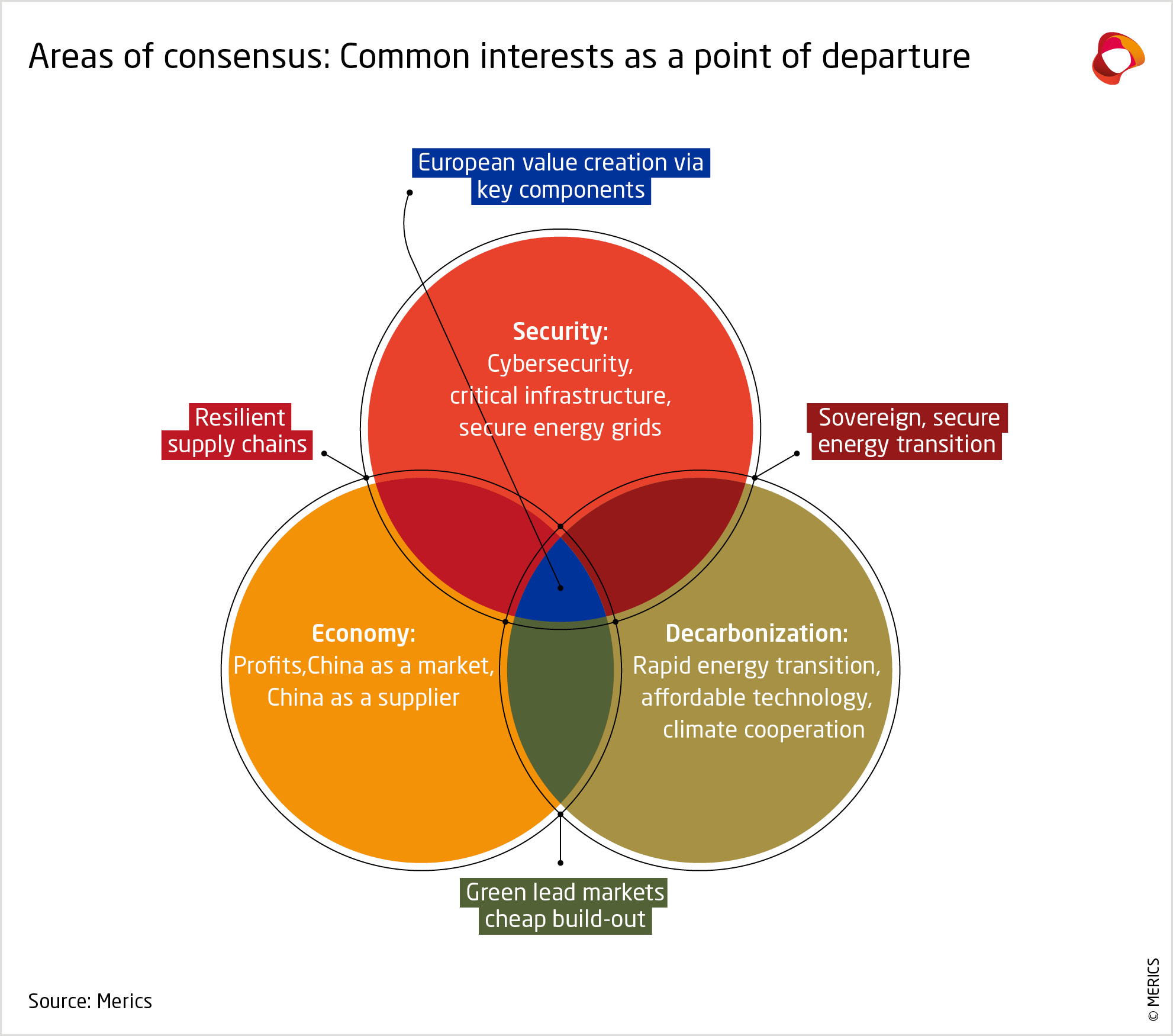
While the triangle organizes stakeholders according to their opposing positions on security, the economy and climate/decarbonization, this Venn diagram highlights where they overlap. Where two or three circles overlap, there is an interest shared by several stakeholders. These areas can be regarded as the starting points for a coherent and consensus-based policy. Measures that address these areas can strengthen Germany and bring together several different stakeholders into one camp.
It is difficult for Germany to serve the sometimes conflicting goals of reducing dependence, maintaining competitiveness and achieving rapid decarbonization optimally and at the same time. Those who reduce macroeconomic dependence pay more in the short term. Those who prioritize corporate profits and the cheapest possible procurement of cleantech deepen dependence. Those who protect local manufacturers across the board make the energy transition more expensive and hinder access to innovation from China.
A coherent policy toward China that takes the entire spectrum of interests into account cannot satisfy all stakeholders equally. It can, however, focus on the areas of overlap between the three key areas: economic interests, security concerns and decarbonization. Crucial to this is a cost-benefit analysis that balances both the socio-economic interests of society and the profit-driven logic of the private sector and industry. Cleantech should be seen as an opportunity to reconcile interests relating to security, economic viability and sustainability, while keeping cooperative relations with China.
Compromises will be necessary. Listed companies are obliged to adhere to principles of economic viability, while policymakers must ensure long-term job security and a reliable supply of public goods. Climate targets are enshrined in law, and decarbonization is therefore binding for all stakeholders. Accordingly, it is essential to find ways to bring corporate interests and political concerns closer together again. The positions outlined above identify four areas that should be the focus of strategic considerations:
Resilient supply chains: Raw materials diversification and recycling
There is broad support among stakeholders surveyed for diversifying supply chains for critical raw materials. Establishing alternative sources of supply for non-Chinese materials or components, building up strategic reserves, and recycling magnets and rare earths are possible avenues. Promoting local innovation and (re)building capacity along the entire supply chain for essential goods ensures security of supply in the event of external bottlenecks. Such measures can support the development of resilient supply chains and would at least limit Beijing’s ability to use export controls as a means of exerting pressure.
However, the investment costs are high, and the measures will only take effect in the medium term, as production outside Chinese supply chains and recycling are more expensive than Chinese imports and require years to set up. German companies that recycle rare earths, for example, are struggling to find markets for their products and are operating well below capacity.24 In May 2026, Heraeus Remloy, Europe’s largest recycling center for rare earths, was sold to a Canadian firm, although keeping it under European ownership would have enabled greater strategic independence for Germany as a cleantech hub.25 Diversification is akin to an insurance policy in which Germany must invest today in order to build long-term resilience and avert continued deindustrialization.
Green flagship markets: Securing investment and demand
Public investment in infrastructure, linked to CO₂ and resilience standards and incorporating localization criteria (procurement exclusively from the EU), can help to significantly boost demand for cleantech and upstream products such as green steel produced with low CO2 emissions.26
Such lead markets, supported by public procurement funds, can help to strengthen demand for European cleantech. Companies gain longer-term planning certainty and the opportunity to scale up their production. The higher costs of decarbonization using European technologies are borne, at least in part, by public sector actors. Compared with import duties, this generates demand for European-produced cleantech, rather than simply making competing products more expensive.
The Industrial Accelerator Act (IAA)27, currently under discussion in the EU, is an attempt to establish CO2 standards and localization criteria for such lead markets. Various factors are currently hampering the effectiveness of the IAA. Among other things, the vague definition of ”made with Europe” is problematic – it refers to the EU and all countries with which trade agreements are in place. Furthermore, for some industries, the IAA might not come into effect until 2029, which could be too late given the urgency of the situation. The Act’s effectiveness could also be limited if the idea gains traction to suspend localization criteria in public procurement, if there is a “disproportionate price increase” of more than 25 percent (and thus also cheaper offers from China).28 To create a reliable domestic market for clean technology manufactured in the EU, bolder and more rapidly deployable instruments are needed.
A sovereign energy transition: De-risking with a sense of proportion and a focus on critical infrastructure
Consistent steps toward de-risking are particularly justified when technology imports pose a security risk. This applies above all to critical infrastructure, such as energy (grids). One example is the planned removal of Huawei and ZTE technology from 5G core networks. However, a clearly differentiated, technology-specific approach is crucial. For many basic components and simpler technologies, such as solar panels or batteries, using Chinese manufacturers will remain the most cost-effective solution without posing serious security risks.29
Successful de-risking builds security where supply bottlenecks and cyber security risks could cause real damage. This will incur additional costs and slow down expansion in some critical areas. The EU cannot afford not to establish its own supply chains or, at the very least, to diversify its procurement in these key technologies. To this end, a strategically coordinated policy – particularly within the EU – is indispensable.
The hard core: European value creation in key components
At the heart of all three areas of interest mentioned above lies the ambitious goal of achieving domestic value creation in strategic bottleneck sectors, such as permanent magnets, green hydrogen and critical raw materials, which are currently sourced mainly from China. This requires a targeted industrial policy through the establishment of so-called IPCEI schemes (Important Projects of Common European Interest: transnational large-scale projects in strategic sectors jointly funded by several EU member states), start-up funding and support for green energy.
Such measures are costly in the short term but offer the greatest benefits for German industry and European independence in the medium term. The benefit achieved would be genuine, albeit limited, technological sovereignty. However, the upfront costs would require a high fiscal outlay initially, and its success would be difficult to measure within a single parliamentary term, making it politically challenging to communicate. Therefore, Germany should focus on a few truly critical bottlenecks such as rare earths and key components of critical infrastructure, rather than on broad-based investment. A European-coordinated policy is also essential in this regard.
Outlook: How to strategically balance interests in dealing with China in cleantech
The following proposed courses of action are based on the positions and interests of the stakeholders presented in this survey. The survey highlights a shared interest in strengthening Germany’s position while simultaneously decarbonizing. All parties expressed interest in maintaining Germany’s position in the cleantech sector while also facilitating a long-term, sustainable partnership with China. This can only be achieved through consensus-based measures.
Stakeholders who align themselves with the three poles of interest outlined in this study will need to be prepared to make compromises. The following strategic steps and guidelines could better balance these diverse interests, promote the strengthening of the German and European cleantech industries, and serve both economic and security interests in equal measure:
- Germany needs a coherent strategy supported by a majority of key economic stakeholders and policymakers. Existing targets must be incorporated into this strategy, as climate targets, energy legislation, CO2 pricing and EU decisions already contain key strategic building blocks. It will not be possible to counter China’s growing dominance over the German cleantech industry if politicians continue to fail to make these targets binding and if the business sector continues to delay its implementation on the grounds of cost.
- To deal with China as a player in the cleantech sector, industry, politics and society need a new agreement to strategically coordinate diverse interests. The EU as a business location must adapt to the new reality in technology and geo-economics, in which framework conditions are partly determined by Beijing.
- This requires an open, non-ideological debate on the necessary measures. “Technological neutrality” cannot remain a blanket excuse for maintaining the status quo; instead, binding targets and regulatory adjustments must create investment certainty and secure markets for future-proof technology. A closely integrated European policy is essential for this.
- The benefits of investing in the higher short-term costs of autonomy and safety measures outweigh, in the medium to long term, the preservation of a high-risk status quo. Germany and its EU partners will have to negotiate just how much they are willing to scale up domestic production of critical goods across the entire supply chain on a case-by-case basis for each technology and supply chain.
- Trade with China is fundamentally beneficial for both sides, but structural conflicts relating to security must be addressed to make trade relations sustainable and mutually beneficial.
- When deciding on partnerships with Chinese firms, technology transfer considerations and job retention criteria should be taken into account.
- Joint ventures and Chinese foreign direct investment (FDI) remain desirable in principle, but the terms should deliver clear added value for the European economy as a whole, not just for the joint venture partners.
- In cleantech, sector-specific agreements with China make sense. Partnerships and trade are important for both sides, but the acceptable limits of interdependence vary greatly depending on the technology and industry.
- Cleantech from China should be seen as an opportunity to make the EU less dependent on fossil fuel imports – particularly from Russia, the US and the Gulf region – and on the associated price shocks. However, when importing key components – such as those for grid control or in the cyber sector – stricter security checks should apply than for standard components.
- Tariffs can protect domestic markets, but they only make sense if they are accompanied by the simultaneous (re)building of European industries, supply chains and innovation. Tariffs buy local manufacturers time, but do not in themselves increase industrial resilience.
- For Germany, it will be crucial to boost sales of products from German companies within the EU. Across the EU, too, many manufacturers are operating well below maximum capacity, and innovative small and medium-sized enterprises are complaining of a lack of demand (for example, in the hydrogen sector).
- Lead markets in cleantech guarantee sales through demand-side regulations, for example in public procurement, which in turn generate investment certainty and price reductions through economies of scale. Procurement rules such as Made in Europe, as contained, for example, in the IAA, must be binding to be effective.
- Endnotes
1 | Fairless, Tom, and Jonathan Cheng (2026). “China Is Devastating the Last Stronghold of German Industry.” The Wall Street Journal. 3 July. https://www.wsj.com/economy/china-is-devastating-the-laststronghold-of-german-industry-c7a98514. Accessed: 25 August 2026.
2 | Cleantech is understood here as a broad category and also includes companies from, among others, the automotive and energy industries, which are not primarily classified within the sector but are relevant to cleantech sub-sectors (e.g. electric mobility)
3 | EU Commission. (2026) “Trade in Goods with China in 2025”. https://ec.europa.eu/eurostat/web/products-eurostat-news/w/ddn-20260410-2. Accessed: 25 August 2026.
4 | Hörhager, Elisa (2026). “Germany Needs to Confront China’s New Reality.” The Wire China. 27 May. https://www.thewirechina.com/2026/05/27/germany-needs-to-confront-chinas-new-reality/. Accessed: 25 August 2026.
5 | Quotes attributed to anonymous experts in this study are paraphrased quotes from confidential conversations.
6 | BitAuto (2025). “Mercedes-Chef Ola Källenius: EU sollte mehr chinesische Autobauer zum Fabrikbau in Europa ermutigen.”; DPA (2025). “Mercedes setzt auf neue Strategie in China”; DPA (2025). “Mercedes adopts new strategy in China.”
7 | Xinhua (2025). “BMW-Vorstandsvorsitzender: China ist ein Schlüssel für BMWs Innovation und Wachstum”. German.xinhuanet.com. 13 September. [German URL not found; English version: https://english. news.cn/europe/20250913/477688d9d62e4b67876d75b758c2eb31/c.html]. Accessed: 25 August 2026.
8 | Xinhua (2025). “Bosch-Chef sieht China als Innovationszentrum und bekräftigt langfristiges Engagement”. German.xinhuanet.com. 8 April. https://german.xinhuanet.com/20250408/713022f72642409da8fe627c026382a8/c.html. Accessed: 25 August 2026.
9 | Krenzer, Daniel (2026). “Absatzkrise drückt China-Produktion deutscher Hersteller auf Tiefstand”. Elektroauto-News.net. 29 July. https://www.elektroauto-news.net/news/deutsche-auto-produktion-china-tiefstand. Accessed: 25 August 2026.
10 | Der Spiegel (2026). “ Carsten Schneider: »Erneuerbare Energien sind Sicherheitsenergien«..” Der Spiegel. 4 March. https://www.spiegel.de/politik/deutschland/bundesumweltminister-carsten-schneider-erneuerbare-energien-sind-sicherheitsenergien-a-72d5c446-c7ea-4d53-a9bd-ed17673bd6a1. Accessed: 25 August 2026.
11 | NDR.de (2025). “Chinesische Turbinen in Windpark vor Borkum: Politik ist alarmiert.”.” NDR. https:// www.ndr.de/nachrichten/niedersachsen/oldenburg_ostfriesland/Chinesische-Turbinen-in-Windpark-vor-Borkum-Politik-ist-alarmiert,spionage200.html. Accessed: 25 August 2026.
12 | Reuters (2025). “China Expands Rare Earths Restrictions, Targets Defence and Chip Users.” Reuters. 8 October. https://www.reuters.com/world/china/china-tightens-rare-earth-export-controls-2025-10-09/. Accessed: 25 August 2026.
13 | Federal Statistical Office (Destatis) (2026). “Mehr als die Hälfte der importierten seltenen Erden kam 2025 aus China”. Press release No. 023. 14 April. https://www.destatis.de/DE/Presse/Pressemitteilungen/2026/04/PD26_N023_51.html. Accessed: 25 August 2026.
14 | Handelsblatt (2026). “BDI: Deutsche Industrie verliert monatlich 15.000 Arbeitsplätze”. Handelsblatt. 26 July. https://www.handelsblatt.com/politik/deutschland/bdi-deutsche-industrie-verliert-monatlich-15.000-arbeitsplaetze/100242937.html. Accessed: 25 August 2026.
15 | Bundesregierung.de (2026). “Pressestatement des Kanzlers vor seinem Abflug nach China: Begegnung mit gegenseitigem Respekt..” Statement by Federal Chancellor Friedrich Merz. 24 February. https:// www.bundesregierung.de/breg-de/aktuelles/statement-abreise-china-2408492. Accessed: 25 August 2026.
16 | Witsch, Kathrin (2025). “Energie: Luxcara entscheidet sich doch gegen Windturbinen aus China”. Handelsblatt. 25 August. https://www.handelsblatt.com/unternehmen/energie/energie-luxcara-entscheidet-sich-doch-gegen-windturbinen-aus-china/100150472.html. Accessed: 25 August 2026.
17 | IG Metall (2024). “IG Metall warnt: Bei Windanlagenbau nicht die Fehler der Vergangenheit wiederholen”. Joint press release with the works councils of Siemens Energy and Siemens Gamesa. 9 September. https://www.igmetall.de/presse/pressemitteilungen/ig-metall-warnt-bei-windanlagenbau-nicht-diefehler-der-. Accessed: 25 August 2026.
18 | N-tv (2025). “EU-Projekte sollen europäische Technologien nutzen..” https://www.n-tv.de/wirtschaft/ wirtschaft_startup/EU-Projekte-sollen-europaeische-Technologie-nutzen-article25746484.html. Accessed: 25 August 2026.
19 | Capp, Catiana (2025) “Manager plädiert für Förderung heimischer Heizungshersteller”. https:// www.handelsblatt.com/unternehmen/energie/viessmann-manager-plaediert-fuer-foerderung-heimischer-heizungshersteller/100165871.html. Handelsblatt. 11 November. Accessed: 25 August 2026.
20 | Luxcara (2025). “Luxcara Selects the World’s Most Powerful Turbine for the German Offshore Wind Project Waterkant.” Luxcara press release. https://www.luxcara.com/press-releases/luxcara-picks-worlds-most-powerful-turbine-for-german-offshore-wind-project-waterkant. Accessed: 25 August 2026.
21 | Tausendteufel, Fanny, and Fritz Vorholz (2024). “Letzte Chance für 15 Millionen E-Autos bis 2030”. Agora Verkehrswende, in collaboration with the Boston Consulting Group. 10 October. https://www. agora-verkehrswende.de/veroeffentlichungen/letzte-chance-fuer-15-millionen-e-autos-bis-2030/. Accessed: 25 August 2026.
22 | Bermingham, Finbarr (2026). “China Signals Openness to Reducing Gaping EU Trade Surplus as Brussels Toughens Stance.” South China Morning Post. 3 July. https://www.scmp.com/news/china/ article/3359222/china-signals-openness-reducing-gaping-eu-trade-surplus-brussels-toughens-stance. Accessed: 25 August 2026.
23 | Lauri Myllyvirta, Belinda Schaepe (2026) “Analysis: Clean energy drove more than a third of China’s GDP growth in 2025”. Carbon Brief. https://www.carbonbrief.org/analysis-clean-energy-drove-morethan-a-third-of-chinas-gdp-growth-in-2025. Accessed: 25 August 2026.
24 | Deutsche Welle (2025). “Warum Deutschland bisher kaum Seltene Erden recycelt”. DW.com. https://www.dw.com/de/seltene-erden-recycling-in-deutschland-china-europa-rohstoffe-elektroschrott-v2/a-73615829. Accessed: 25 August 2026.
25 | Blume, Jakob (2026). “Rohstoffe: Heraeus trennt sich von Recycling-Sparte für seltene Erden”. Handelsblatt. 20 May. https://www.handelsblatt.com/finanzen/maerkte/devisen-rohstoffe/rohstoffe-heraeus-trennt-sich-von-recycling-sparte-fuer-seltene-erden/100226669.html. Accessed: 25 August 2026.
26 | Rolfing, Helen, Eleanor Batilliet, Oliver Sartor, Marie Westhof, and Julia Metz (2024). “Leitmärkte für klimafreundliche Grundstoffe: Potenziale und Politikoptionen”. Agora Industrie, Publication No. 339/03-A-2024/DE. 2 December. https://www.agora-industrie.de/publikationen/leitmaerkte-fuer-klimafreundliche-grundstoffe. Accessed: 25 August 2026.
27 | European Commission (2026). “Proposal for a Regulation of the European Parliament and of the Council Establishing a Framework of Measures for the Acceleration of Industrial Capacity and Decarbonisation in Strategic Sectors” (Industrial Accelerator Act). COM(2026) 100 final, 2026/0068 (COD). 4 March. https://eur-lex.europa.eu/resource.html?uri=cellar:494b6a74-189c-11f1-887001aa75ed71a1.0001.02/DOC_1&format=PDF. Accessed: 25 August 2026.
28 | Industrial Accelerator Act (Proposal), Art. 11(3)(c). See note 28.
29 | Cernicky, Jan (2022). “Energiewende und Protektionismus – Wie gehen wir pragmatisch mit China um?”. Analyses & Arguments No. 491, Konrad Adenauer Foundation. October. https://www.kas.de/documents/252038/16166715/Energiewende+und+Protektionismus+-+Wie+gehen+wir+pragmatisch+mit+China+um.pdf/442ba770-d504-43cc-25f1-eaf7d970dfc1. Accessed: 25 August 2026.
- Interview index
Expert discussion 2: Expert from a security-focused think tank
Expert discussion 3: Expert from an industry-focused think tank
Expert discussion 4: Expert from a German federal ministry
Expert discussion 5: Expert from the wind energy sector
Expert discussion 6: Expert from the Wind Energy Association
Expert discussion 7: Expert from the Wind Energy Association
Expert discussion 8: Expert from the German electrolysis sector
Expert discussion 9: Expert from a German research institute
Expert discussion 10: Expert from a climate-related research institute
This report was funded by Stiftung Mercator.

Author(s)

Lead Analyst

Analyst
Author(s)
Lead Analyst
Analyst
Content