

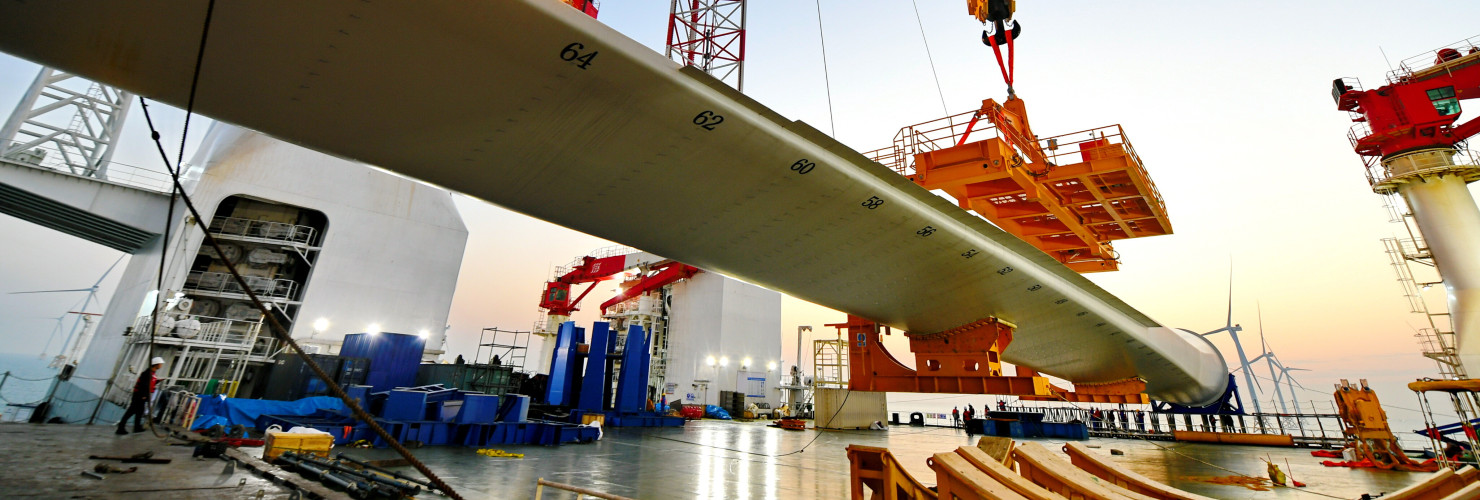
picture alliance / Xinhua News Agency | Lin Shanchuan
Content
Report
Survival of the fiercest: How involution helps China dominate green tech globally
Key findings
- Since 2022, the solar PV, electric vehicle and wind sectors in China have all experienced some degree of destructive competition, referred to as “involution”. Sustained price declines have been triggered by a mix of regulatory changes and aggressive firm behavior.
- Each sector varies in its susceptibility to involution based on market dynamics, product characteristics and company business models. For green tech products, the degree of technological sophistication and design-intensity plays an important role.
- Prolonged price wars in green tech and other sectors are still a risk, even though combating involution has been elevated to a major political priority by the Chinese government, because the political and economic system that makes them possible remains intact.
- The downward pressure on prices further enhances the competitiveness of Chinese firms vis-à-vis foreign companies. Chinese exports of green technologies are being spurred on by involution in the domestic market, with Europe acting as the top destination market.
- China’s leadership in green technologies means it will remain a key partner for Europe in the development and sourcing of green technologies.
- European policymakers and companies must work together to build local capabilities, mitigate strategic dependencies and ensure the security of Europe’s energy infrastructure.
Introduction: Race to the bottom undermines China's green tech industries
China has secured a leading position in most mature green technologies, from solar photovoltaic (PV) modules to wind turbines, batteries and new energy vehicles (NEVs),1 thanks to long-term policy support, scale across the value chain and innovations in these sectors. Yet these sectors also face a paradox: although they feature some of China’s most successful industries in global markets, they are mired by low profitability and a high number of loss-making firms. Many of the sector’s most innovative companies are unable to capitalize financially on the technological advances they have made.
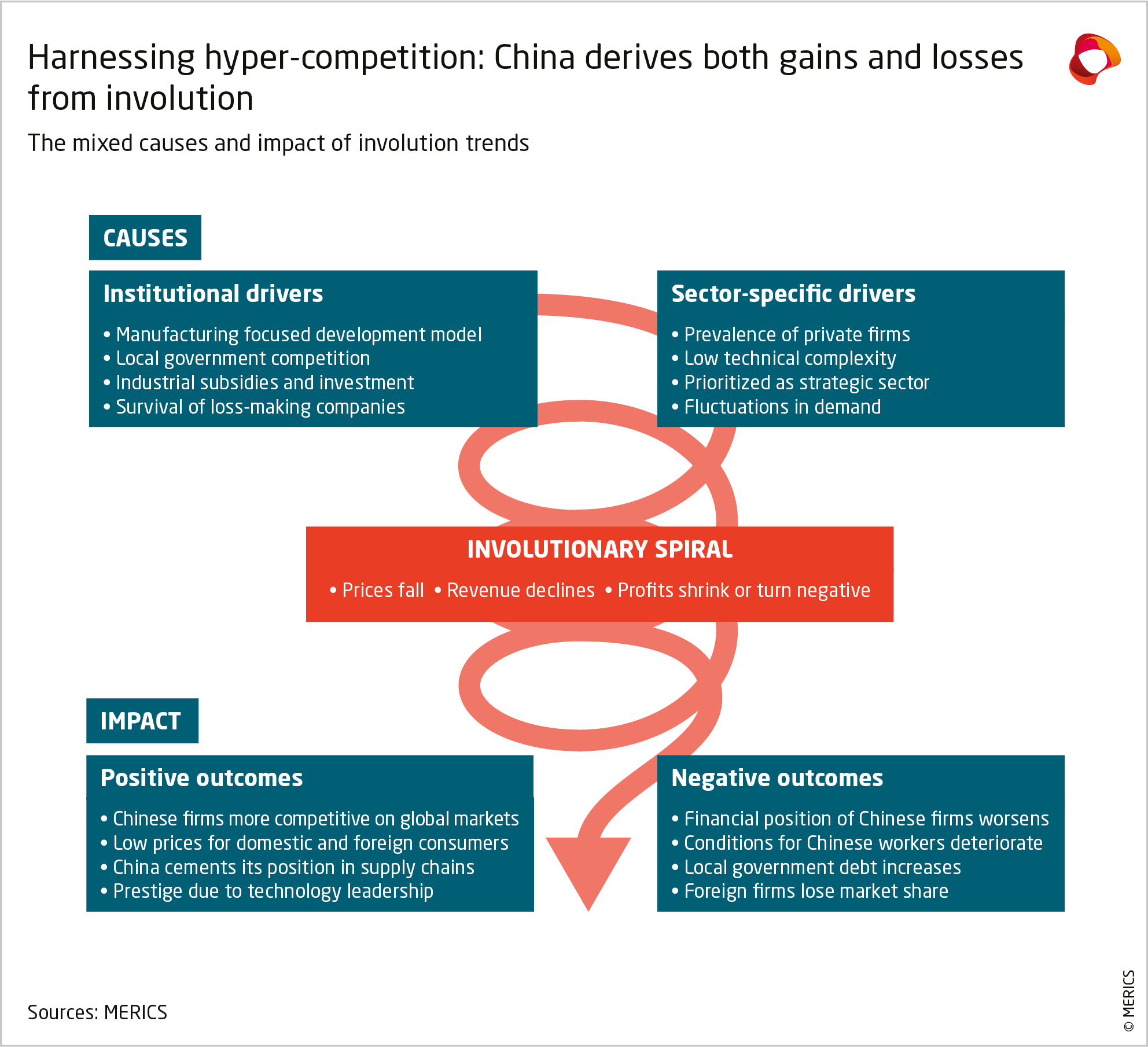
This dynamic is part of a bigger problem: excessive domestic competition drives firms to prioritize holding onto or winning market share above all else. In China, this phenomenon affects a variety of critical sectors and is dubbed “involution”.2 This term is used to describe fruitless competition in society as well as in industries. It represents a race to the bottom where all participants in a system work harder and spend more resources, but for no more gain. Chinese firms can pursue such a strategy for an extended period as public actors are incentivized to provide financing or subsidies regardless of their profitability, in the same way that structural overcapacity is made possible in China.3
Since 2024, Beijing has made combating this cutthroat competition and its negative impact on state finances and corporate profits a strategic priority. Green tech sectors, particularly the solar and NEV industries, are major targets in this campaign. This report investigates the factors that have caused hyper-competition in these two sectors, alongside the wind turbine sector, which has also experienced a degree of involution. It analyzes therestrained government response so far and the impact on corporate strategies, primarily in terms of cutting costs and expanding into foreign markets.
The results show that fostering a degree of excessive competition has become part and parcel of China’s industrial policy playbook in green tech sectors. The downward pressure on prices further enhances the competitiveness of Chinese firms vis-à-vis foreign companies. This means China’s dominance in green technologies is growing even stronger. In some ways, Europe could benefit from this process, as cheaper green technologies sourced from China would lower the costs for its energy transition. But it also risks increasing established and emerging dependencies, hindering Europe’s own industrial ambitions in green tech sectors, and by extension ceding the EU’s autonomy in its energy security and green transition.
Green tech sectors gravitate from productive to destructive competition
Competitive forces go off the rails in green tech industries
When it comes to the production and installation of green technologies, China is in a league of its own. In 2025, Chinese firms supplied at least three-quarters of the solar modules, wind turbines, and electric vehicles sold worldwide, and China accounted for at least 57 percent of global demand for these products. The remarkable growth in both domestic sales as well as exports of green tech products since 2020 has been very significant not only for China’s decarbonization agenda, but also for economic growth, as other parts of the economy, such as the real estate sector, have floundered.
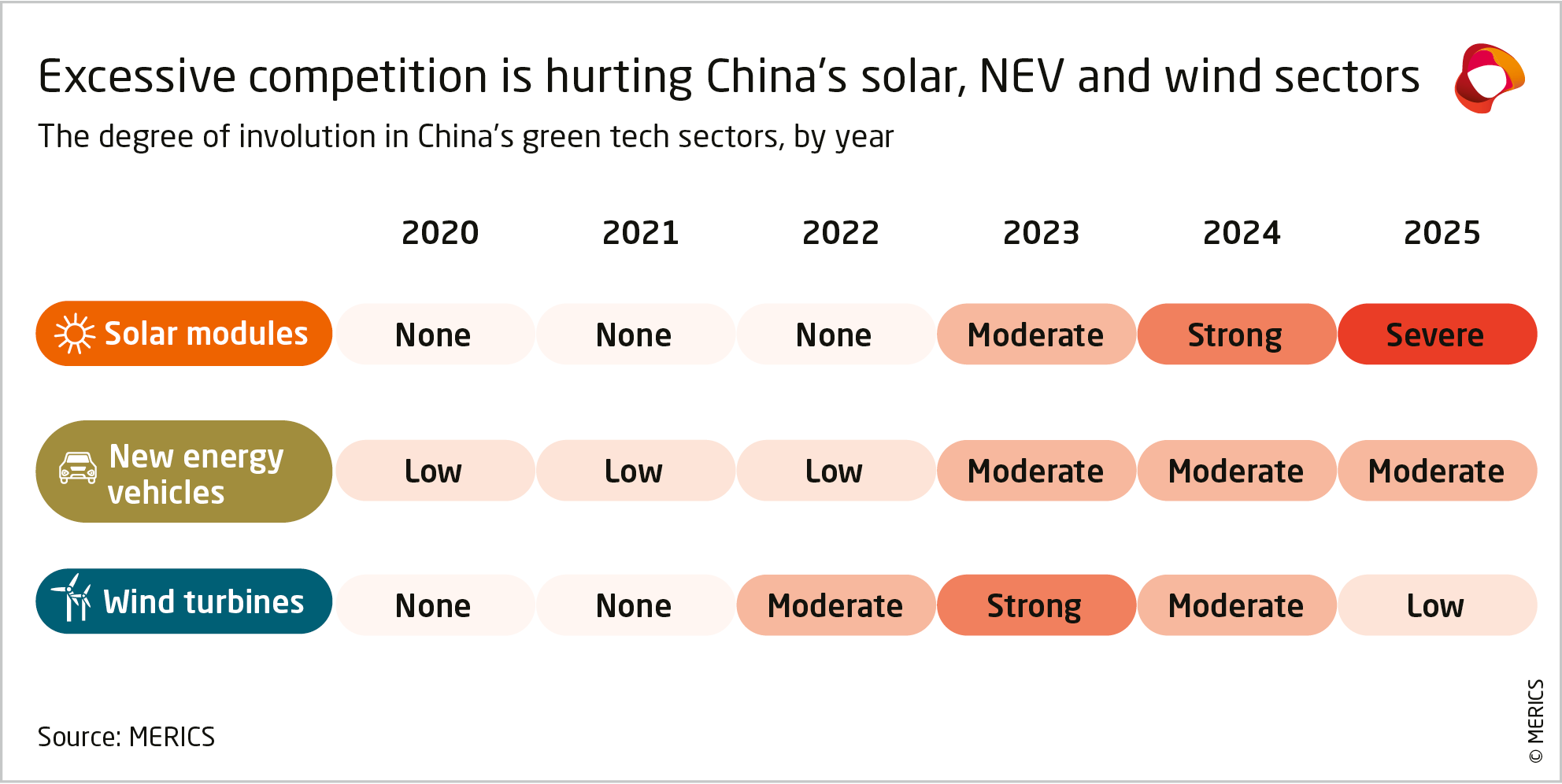
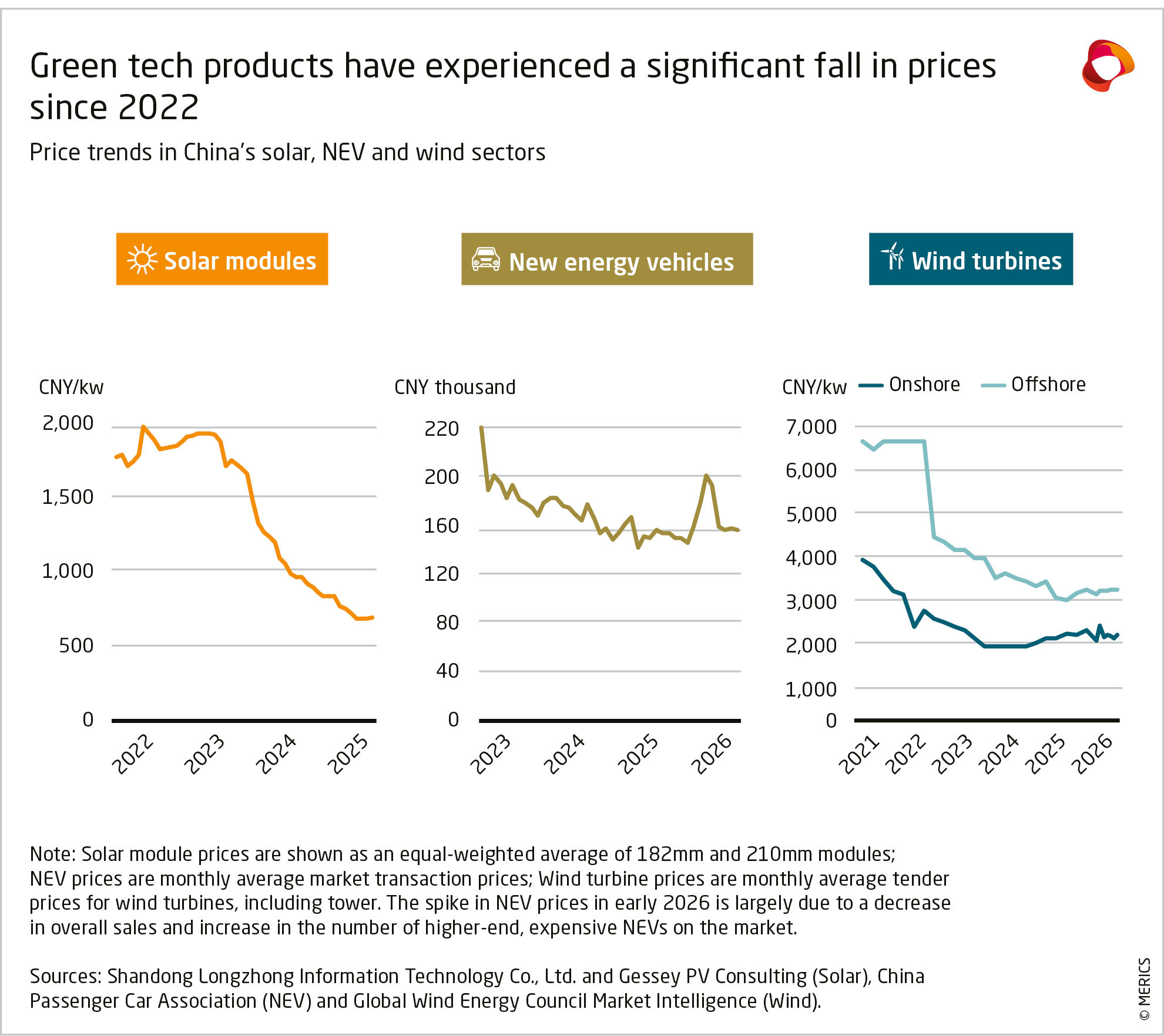
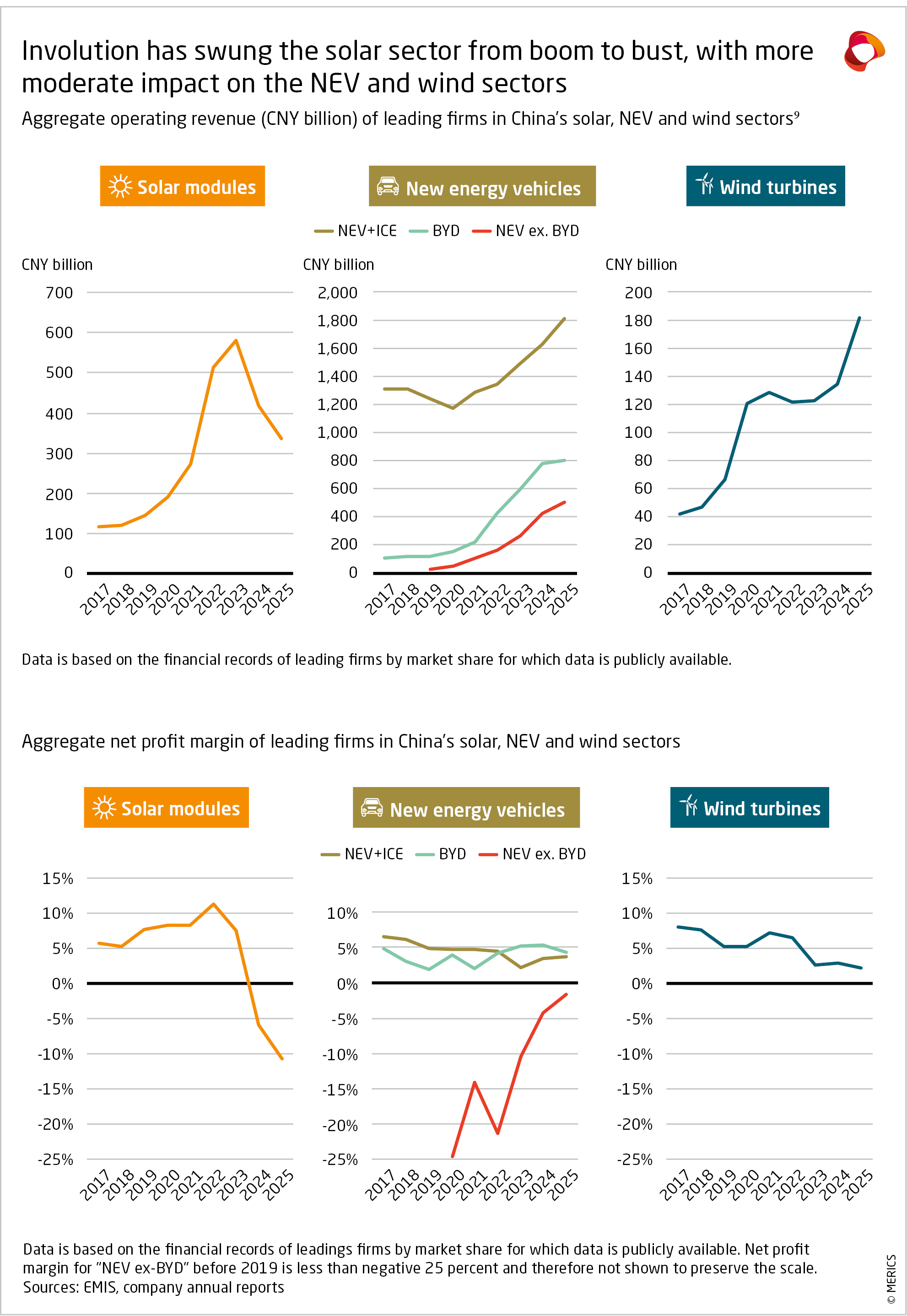
These industries are dominated by private firms, and their dynamism, coupled with the competitive pressure to innovate, has played a key role in their success. Yet fierce competition in recent years has also led to falling prices, profits, and in some cases falling revenue for the top firms in these sectors. Since 2022 or 2023, each sector has experienced a sustained period of price declines, triggered by a mix of regulatory changes and aggressive firm behavior. Exhibit 1 displays an overview of the varying degrees of involution over time for each sector (the details are explored in the second chapter):
- Involution has hit hardest in the solar sector, with losses among its leading firms equivalent to 10.75 percent of revenue in 2025. Despite rising domestic and global demand for solar modules, excess production capacity and an overcrowded market have triggered
destructive price wars. - In the NEV sector, competitive pressure has also been intense and transaction prices have trended downwards between 2023 and 2025. The impact on key players has been mixed. While BYD and large manufacturers of both NEVs and internal combustion engine (ICE) vehicles have maintained healthy profit margins, most smaller firms focused purely on NEV manufacturing are yet to turn a profit.
- Cost pressures in the wind sector heated up after regulatory changes led to a sharp drop in turbine prices in 2022, followed by further decreases in 2023 and 2024. Since the end of 2024, the situation has stabilized, in part thanks to a self-discipline pact signed by China’s major manufacturers pledging to not sell below cost.
While general traits of involution, such as deflation, an increased share of loss-making firms and lavish state support for industrial firms have been visible across the Chinese economy in recent years, the reasons why and to what degree an industry gets entangled in involution are specific to each sector. The mix of private and state-owned firms, fluctuations in domestic and foreign demand, changes in sectoral policies, the level of technical complexity, the degree of vertical integration and diversification of business portfolios, or the state of industrial development – be it an emerging industry or more mature – all play a role.
Depending on their prevalence or absence, these factors can either spur or hinder involution. For instance, more technologically advanced or design intensive products, such as wind turbines, have a higher barrier to entry than simpler products such as solar modules. This makes more sophisticated products less susceptible to competition based only on cost-cutting. The enforcement of higher technical standards can have the same effect, forcing producers of outdated technology to exit the market and thus limiting the ability of firms to compete primarily on cost.
Industrial goals prevent sweeping reforms to curb involution
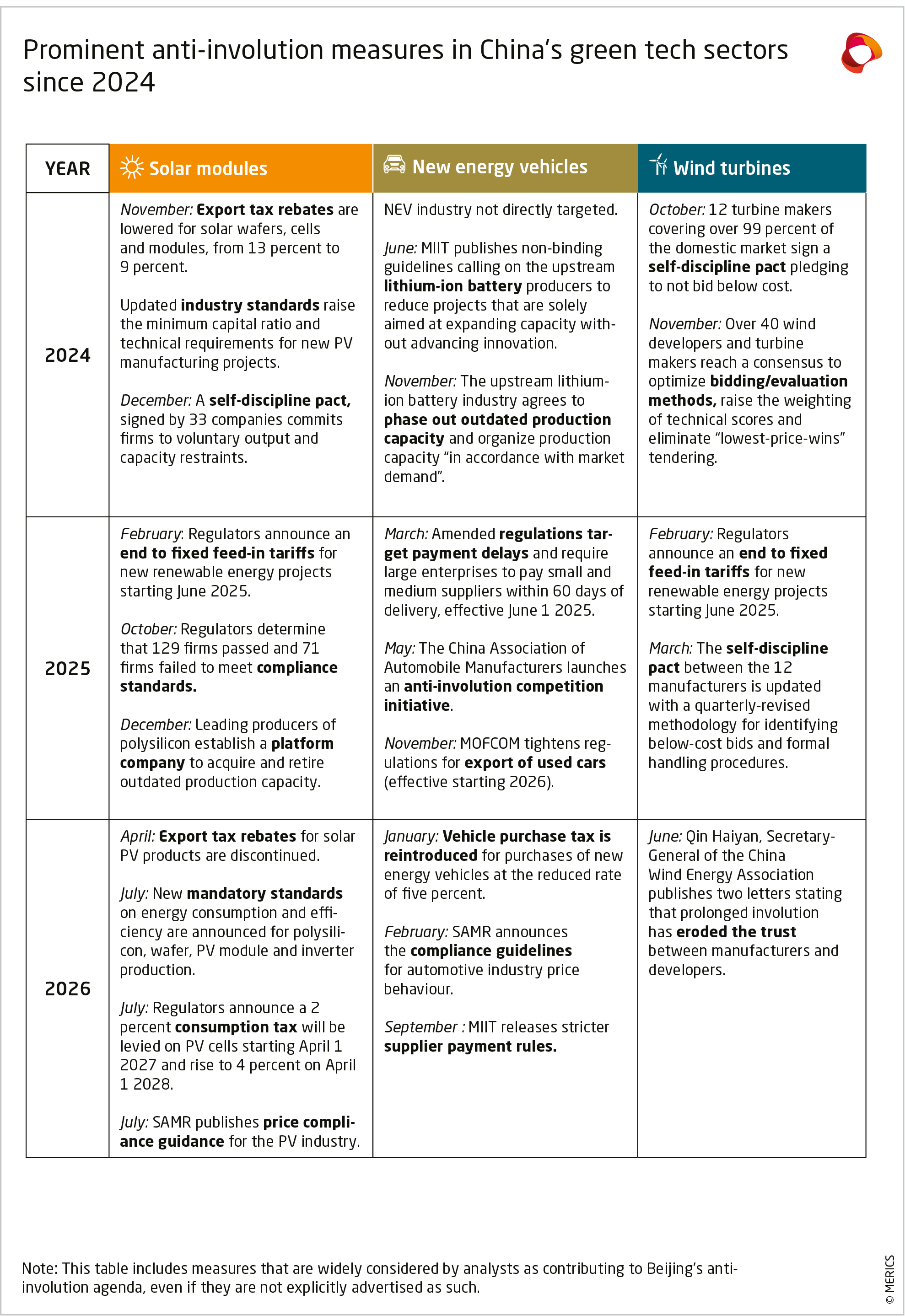
The government’s efforts to combat involution in green tech sectors show that despite recognition of the negative impact of destructive competition, Beijing is not willing to tackle its root causes. Beginning in mid-2024, China’s leaders have repeatedly called for preventing vicious “involution-style” competition and curbing “low-price and disorderly competition” across the economy.4 Top-level government documents state that this will require managing the setting of prices in certain sectors, phasing out outdated and inefficient production capacity, eliminating local protectionism, as well as corporate self-regulation. New and forthcoming legislation, regulations, and closer scrutiny of corporate behavior have followed.5
Most of the measures implemented to date in China’s green tech sectors have been carried out via sector-specific regulations or actions taken by industry associations or individual firms themselves (see second chapter for details). Each sector has followed different pathways to managing destructive competition, from raising standards and reducing financial support in solar, to revising tender practices in wind, to publicly scolding the major players in NEVs. These measures have led to moderate improvements in the NEV and wind sectors but have failed to change the course of the solar industry.
Prolonged price wars in green tech and other sectors are still a risk because the political and economic system that makes them possible remains intact. Local officials are strongly incentivized to support firms in their province or city – particularly those in sectors deemed strategic by Beijing – even if they operate at a loss, since they contribute to GDP growth, jobs and tax revenue. These are important KPIs for officials and more likely to be prioritized than general directives from Beijing to limit protectionist policies.6 In addition, bankruptcy laws are often not enforced and allow firms to continue operating even if they default on payments.7
In many sectors, the intense competition generated by China’s decentralized system of industrial support has proven to be highly effective in building up capacity and has delivered rapid gains in efficiency, scale and quality. Green technologies are highly strategically relevant for both their economic importance and contribution to enhancing China’s energy security. Consequently, even as President Xi publicly laments the uncoordinated behavior of local officials, he has shown no sign of changing the system which pushes them to act in this way.8
So long as ruthless competition helps Chinese firms to acquire global market share and secure China’s position at the center of key industries, Beijing will view this policy approach as a success overall. That is despite the numerous costs involved. Persistent involution will hurt the fiscal position of local governments as they fuel their continued support for firms with additional debt. The money spent on industrial support also means less funds are available for social welfare and other public goods. Employment opportunities are made more precarious by the impulses of firms to expand aggressively and then cut their workforce when prices fall.
The examples of the solar, NEV and wind sectors show that Beijing does not want to eliminate involution altogether but rather contain it. By extension, some degree of destructive competition could also emerge in the industries that the government has outlined as priority areas for the next five years and beyond, such as robots, legacy semiconductors and hydrogen technologies.
Technologies vary in their vulnerability to excessive competition
The following case studies look at the different drivers of involution in the solar PV, NEV and wind turbine sectors in China. Differences in technical complexity, commoditization, production capacity and market structure determine the degree to which these green technologies are affected and their ability to extricate themselves from destructive competition.
For Europe, each technology represents either an established dependence (solar), an emerging challenge (NEVs) or a future challenge (wind turbines). Understanding the domestic dynamics affecting each technology helps explain their technological competitivity and cost-effectiveness.
Solar supply glut turns sour as firms fall deep in the red
Long plagued by structural overcapacity, China’s solar sector has been ravaged by cutthroat competition since 2023, leading to heavy losses for its leading firms even as domestic and global demand for solar has grown strongly. Since 2020, manufacturing capacity utilization has not exceeded 56 percent and in 2025 China could have met global demand while leaving 40 percent of its available production capacity idle.10
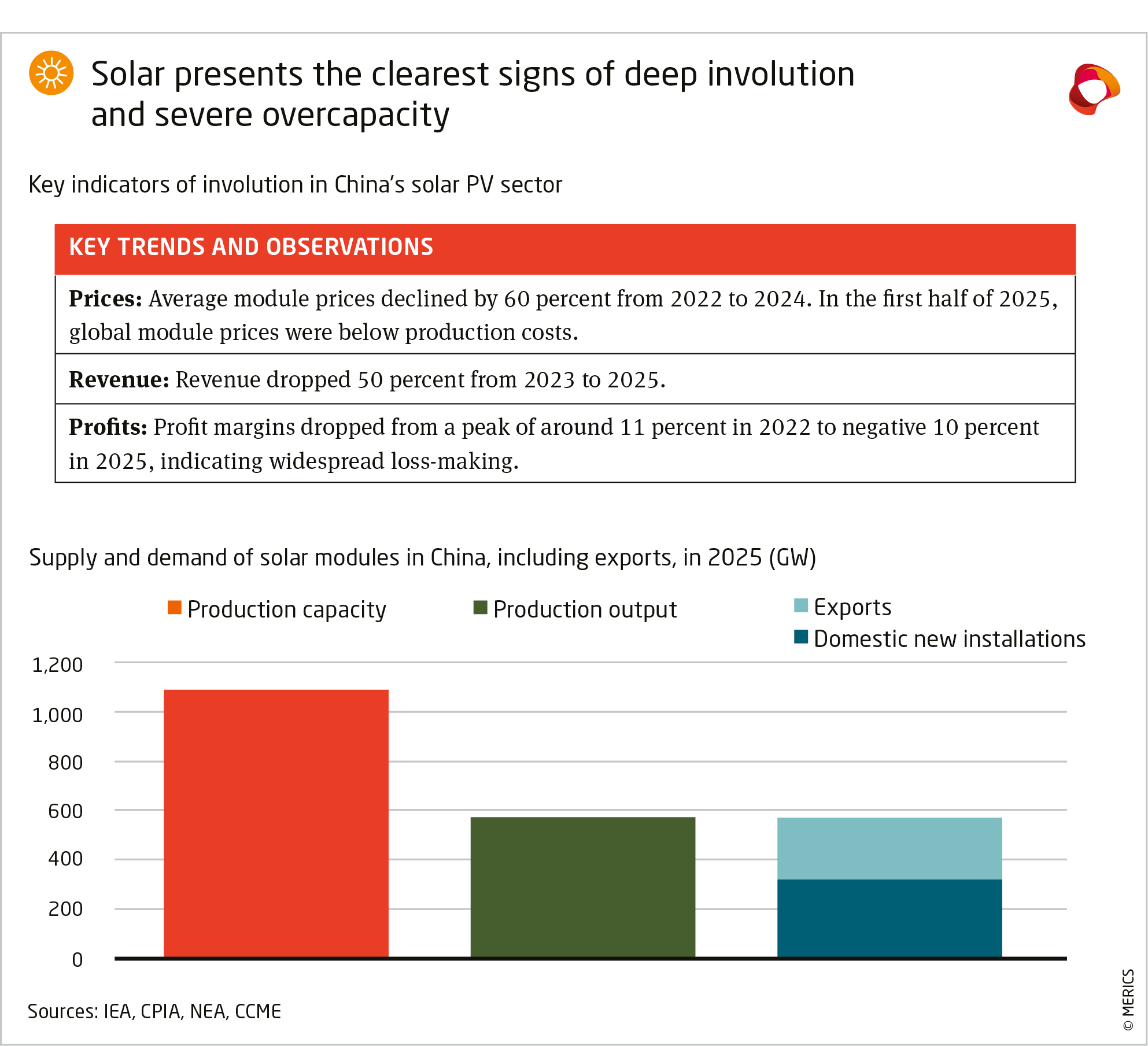
Following China’s 2020 dual-carbon pledge, investment poured into the sector. Local governments offered varied financial incentives as they sought to align themselves with the central government priorities.11 Producers further ramped up production following Russia’s invasion of Ukraine, anticipating a spike in demand.12 While exports in volume terms grew by 38 percent in 2023, the value of exports in CNY terms remained stable. Prices for solar products both within China and abroad (via exports) fell by over 50 percent between 2022 and 2025. Since 2024, over 150 solar firms have filed for bankruptcy or liquidation.13
Low technical barriers to entry make the solar sector more susceptible to overcapacity and hyper-competition. In the lower and mid-tier segments, solar panels are relatively simple and commoditized products that are easily scalable, so long as sufficient capital is available. Technology upgrades generally occur every two to three years, with old equipment often sold, allowing other players to continue producing less advanced products.14 Years of government support for the sector has led to an overcrowded market and manufacturing capacity far overshooting current demand levels. In addition, project developers usually favor the cheapest offer in their tenders, pressuring companies to compete on cost rather than quality.15
Government and corporate-led efforts to streamline capacity in the sector have so far not yielded any clear results. Corporate initiatives to reduce production and set price floors have failed, either due to a major player ignoring the price floor, or to regulatory intervention to prevent monopolistic behavior.16 Regulators have also removed export tax rebates for PV products and raised the threshold for financial strength, technology level and energy efficiency for PV manufacturing projects. In addition, recent change to the pricing for renewable energy projects could slow long-term demand for solar PV installations.17 This could prompt more market exits, help streamline some capacity, and eventually lead to a recovery.
Electric vehicle price wars sting suppliers and small producers
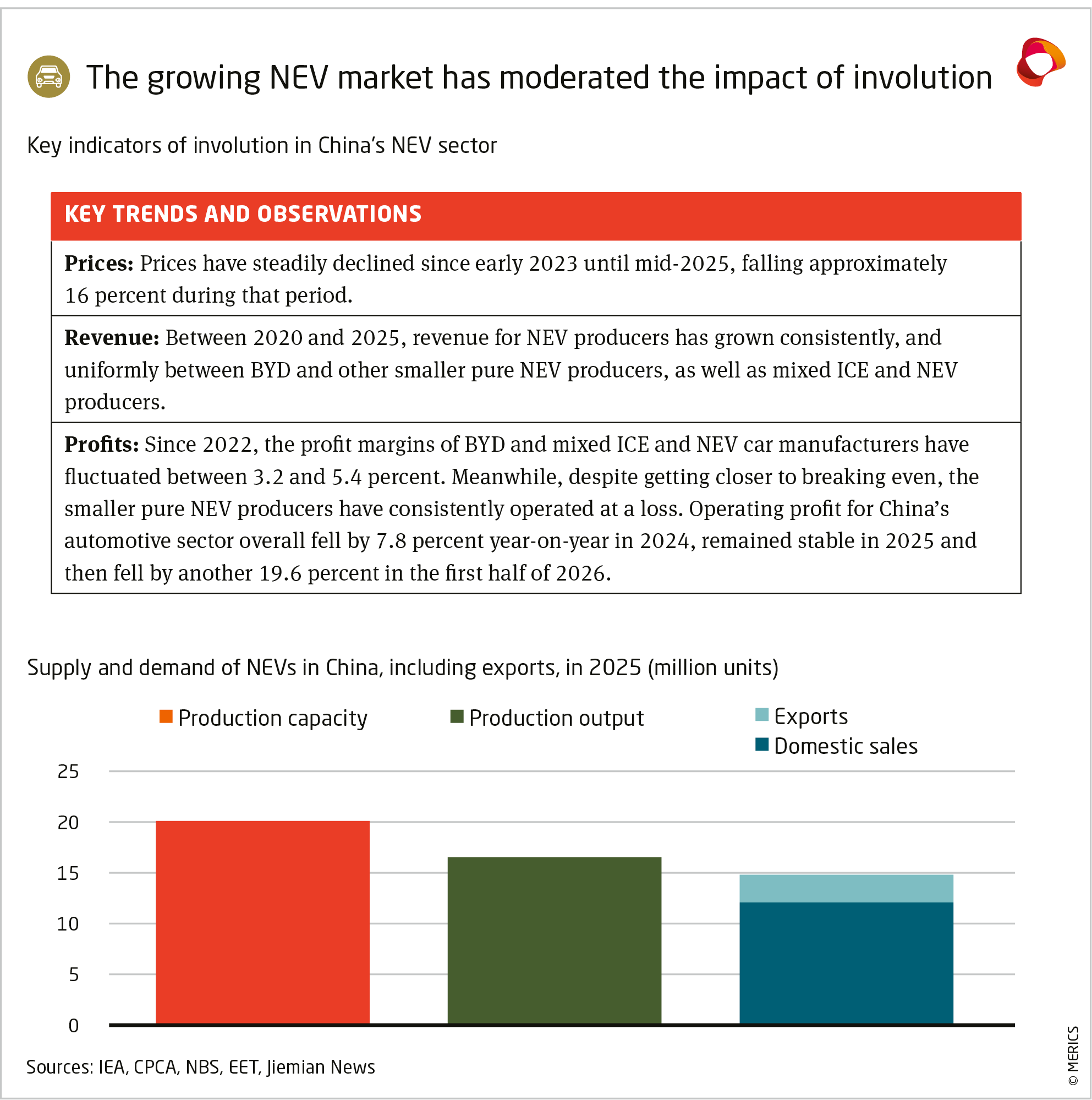
At the start of 2023, larger NEV manufacturers in China initiated a price war to revive sales and expand market share following the removal of purchase subsidies in 2022. The smaller players followed in a race-to-the-bottom.18 While NEV sales have grown strongly in recent years – up 80 percent in 2023, 27 percent in 2024 and 23 percent in 2025 – prices have continued to trend downwards. Smaller NEV manufacturers, who are less capable of taking advantage of efficiencies of scale, and suppliers, facing intense pressures to reduce prices from OEMs, appear to have been most impacted by cost-cutting measures.
The attractiveness of the auto sector to local officials, as well as China’s strengths in technologies related to electric vehicles, have all fueled the large number of players in the market and tendency towards excessive competition. For local governments, NEVs are a prestige product and potential creator of many jobs. Companies in the traditional auto sectors as well as in consumer electronics have used existing competencies to expand into the NEV sector. Technically speaking, electric vehicles are far simpler than internal combustion engine vehicles, making a successful foray into the market possible for more firms, but not guaranteed. By one estimate, as many as 500 NEV companies were active in 2018, and around 100 still existed in 2025.19
Regulators have intervened to prevent the worst cost-cutting excesses by major players, such as delayed supplier payments,20 as well as the growing trade of barely driven vehicles sold abroad as second-hand cars to inflate sales figures and dodge export tariffs.21 Yet beyond this, regulators have taken few concrete measures. New regulatory scrutiny on safety and battery standards for NEVs, announced in mid-2026, could help limit the number of players in the market.22 On the corporate side, an appeal from the industry association appears to have been sufficient to temper the behavior of the market leader – BYD – and restore a degree of moderation to the competition in the industry.23 But there have been no significant efforts to self-regulate.
Key corporate players in wind negotiate an end to harmful spiral
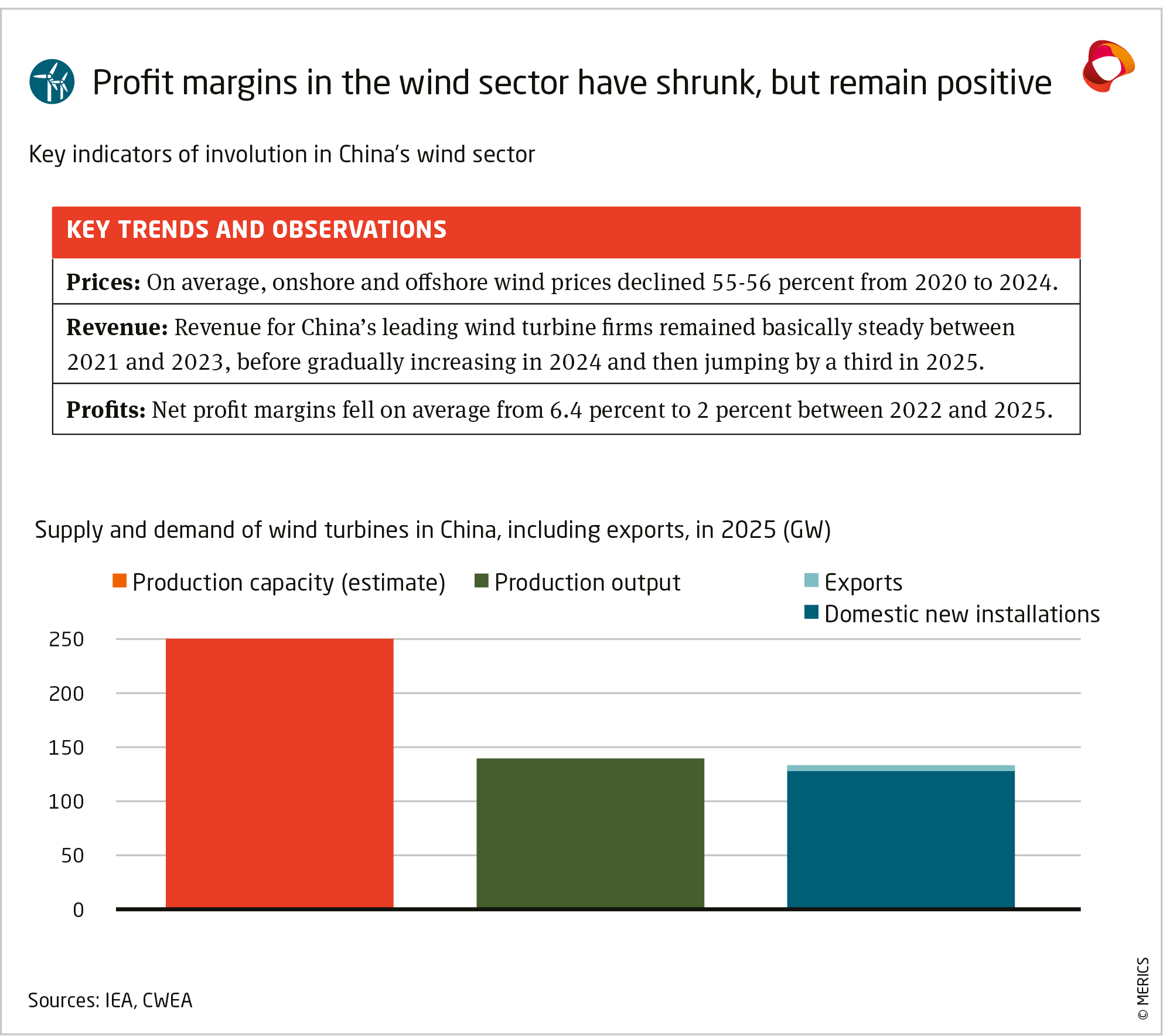
Unpredictable demand cycles have fueled involution in the wind sector. The phasing out of feed-in tariff subsidies in 2021 led to surges in installations as developers rushed to complete projects. This front-loaded demand and fueled investment and manufacturing capacity.24 When new wind installations then fell in 2022, producers were pushed to compete more aggressively on price to not cede market share. In 2023, prices for onshore wind turbines only stabilized, and those for offshore wind turbines continued to fall, even as installations doubled.25
The combination of a limited number of suppliers and disciplined state buyers was crucial in coordinating action to restrain destructive competition in the wind sector. China’s twelve leading wind turbine firms – together accounting for 99 percent of the domestic market – pledged to cease below-cost pricing in a self-discipline pact signed in October 2024.26 Wind project developers then began using a benchmark price for their tenders, to avoid bidders focusing excessively on price competition.27 These measures led to a recovery of prices and slowed down falling profitability.28
The technological characteristics of wind turbines primarily explain why the sector is not as contested and overcrowded as other green tech areas. Wind turbines are design-intensive and less commoditized than solar panels or NEVs. This limits the rapidity at which turbine production can be scaled and capacity can expand. The supply chain for a wind turbine also requires longer lead times and greater coordination with suppliers for each component. Consolidation has gradually occurred in the sector, with the number of manufacturers decreasing from nearly 80 in 2010 to only 10 by 2025.29
While the profit margins of China’s leading wind turbine manufacturers are yet to return to their previous levels, they have avoided running at a loss. Companies are now looking to increase offshore wind turbine production and expand their overseas market sales to shore up margins.30 In addition, changes to energy pricing regulations is expected by industry insiders to create more domestic demand for wind compared to solar in the years to come.31 This could shore up profitability for the sector.
China's global dominance in green tech is set to deepen, not weaken
Chinese firms cut costs at home and seek higher profits abroad
As involution has heated up in China’s green tech sectors, firms have adopted numerous strategies to streamline their operations. Leading solar firms reduced their headcount by almost a third on average in 2024, as profits turned negative in that year, while in the NEV and broader auto sector, some firms also cut staff to reduce the burden of salary payments.32
They have put pressure on suppliers to reduce their prices and delayed payments, causing involution to spread up the supply chain. State media in China has also reported some firms are cutting costs “covertly” by changing materials and production methods to cheaper alternatives, thus sacrificing product quality.33
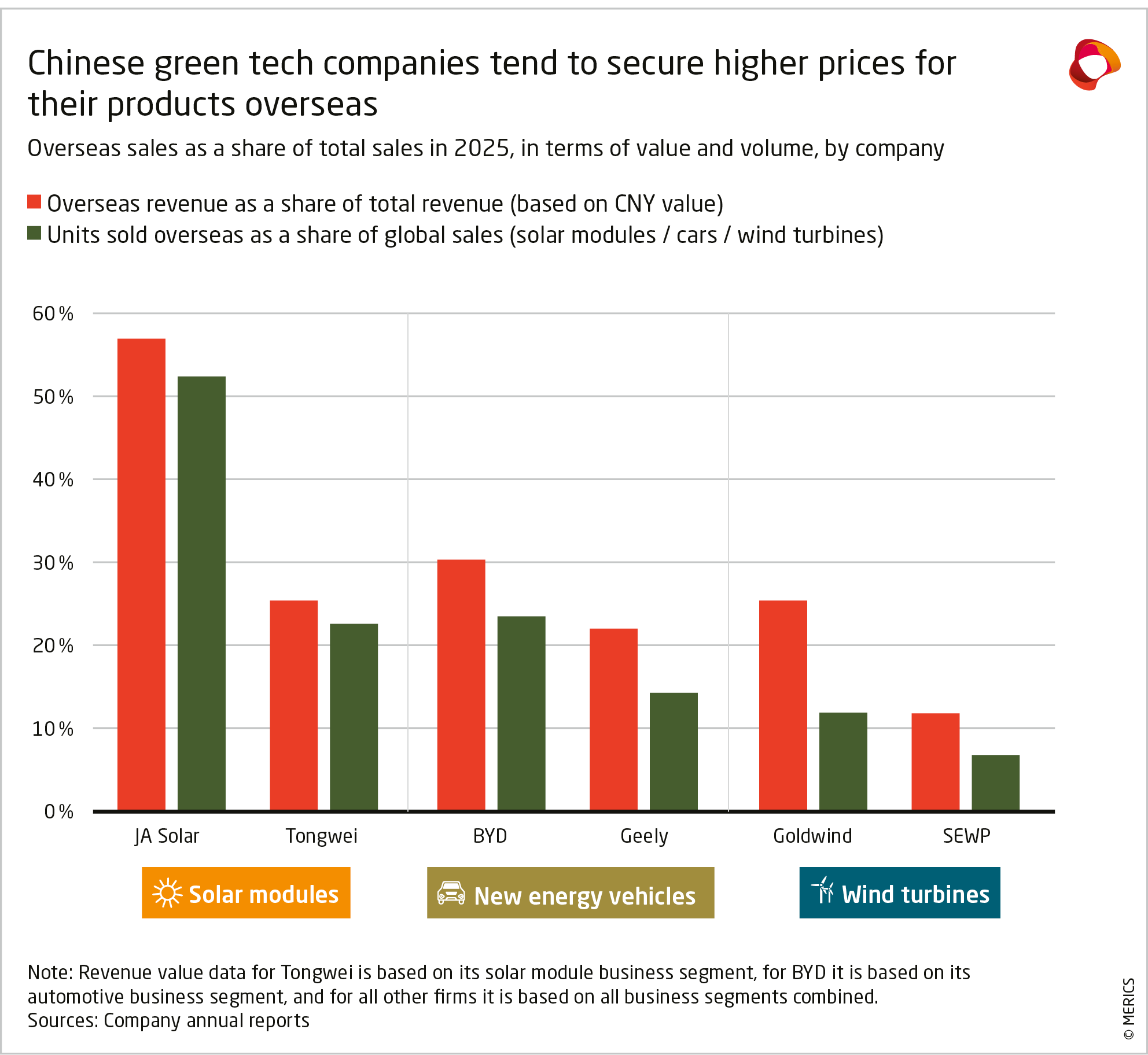
The shrinking of margins in China creates a strong incentive for firms to seek higher returns in foreign markets.34 For instance, the price charged for the same NEV model exported to and sold in Europe is as much as twice as high as the price in China.35 For larger firms that can afford to fund such an internationalization strategy, it may be considered a necessity, rather than an option. The slogan “If you don’t go abroad, you will exit the market” has gained traction among Chinese business leaders since 2024.36
For instance, BYD – China’s leading NEV manufacturer – has made its expansion into Europe a priority. In 2025, over a fifth of BYD’s car sales were made overseas, while almost a third of the revenue from its automotive business was derived from overseas markets.37 The company’s chairman and president, Wang Chuanfu, has highlighted that prices in overseas markets are relatively stable and significantly contribute to the company’s profitability.38 Mingyang – a leading wind turbine maker – is another example of a Chinese clean tech firm with an explicit interest in expanding its business in Europe. While Chinese turbines account for a negligible share of those installed in Europe to date, Mingyang has been looking to invest in a local production facility to serve the market.39
Involution adds fuel to the fire of the China-challenge facing Europe
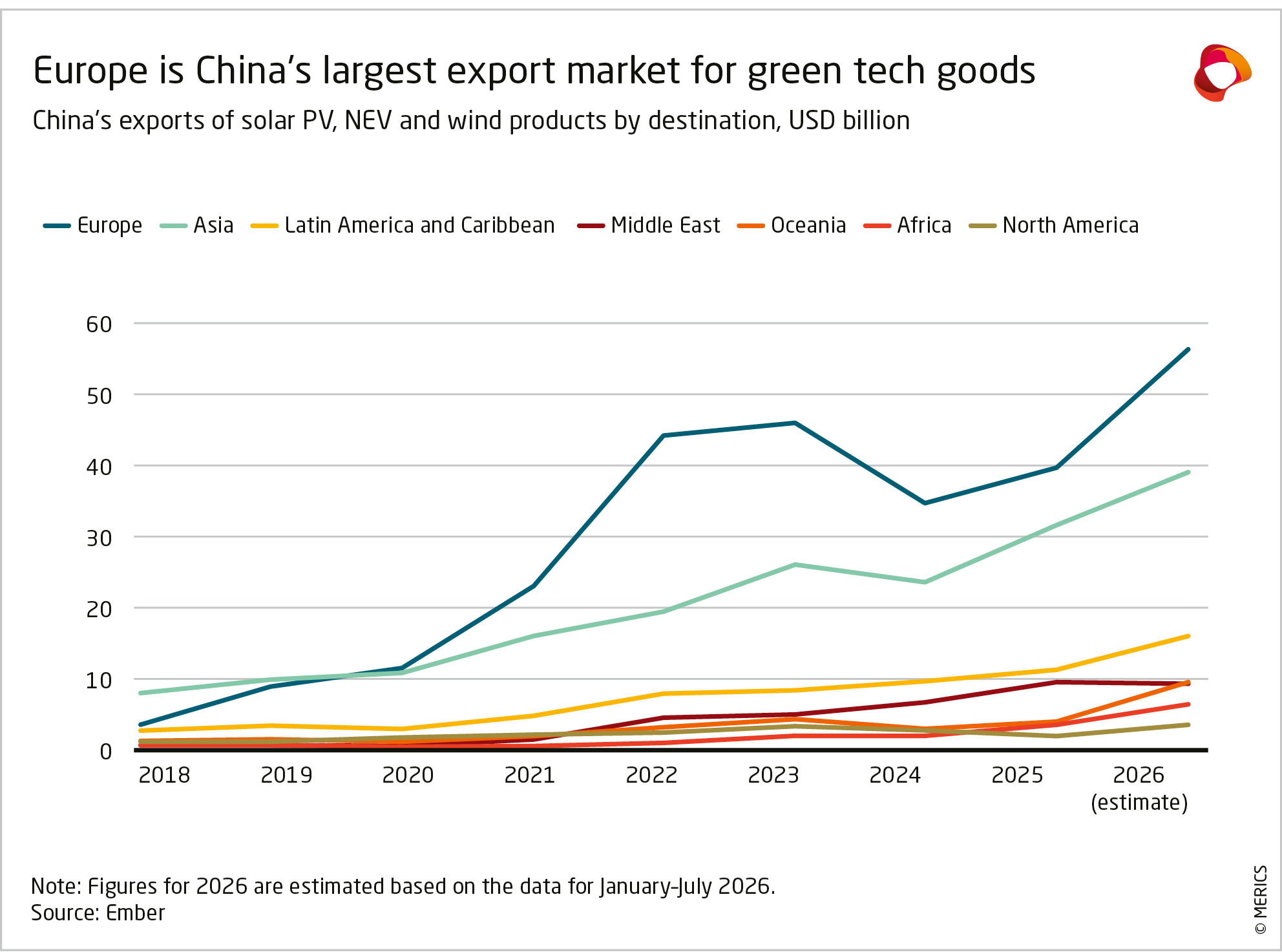
The increased pressure on Chinese green tech firms to tap foreign markets will be most felt in Europe. The continent has been the most important destination for Chinese green tech exports in recent years. In 2021, it surpassed Asia (excluding China), in particular for NEV exports. In the first half of 2026, China’s domestic installations and sales of solar, wind and NEV products slowed, while exports continued to grow apace.40 European firms should expect competition with Chinese firms in third markets as well as in the EU to increase further.
The price gap between the offerings of European firms versus their Chinese competitors for products of comparable quality continues to grow. Today, it ranges from 30 percent to as much as 50 percent cheaper, depending on the technology in question. For many foreign firms, the only viable strategy appears to be to shift more of their own production to China, to tap into the same cost advantages as their competitors. This shows that China’s dominance in green tech sectors is growing ever stronger.
All of these issues related to involution directly challenge Europe’s ambitions in green tech. They threaten the viability of policies such as the Net Zero Industry Act, which seeks to ensure the EU’s position as a supplier of green technologies in the future. The lower the cost of sourcing directly from China, the higher the premium necessary to develop alternative supply chains, either in Europe or elsewhere.
China’s dominant position throughout the supply chain makes it very difficult for Europe to adopt clean technologies without sourcing a significant share of inputs or final products from China, leading to critical dependencies in some areas.41 Reversing these trends will require a ramping up of efforts to support local industries and protect them from Chinese competitors.
While the EU is currently working on related measures, like the Industrial Accelerator Act, their implementation will take years, and their impact will likely be moderate at best.
Policymakers face difficult choices regarding how to best balance the advantages of accelerating the energy transition via cheap imported products, against the risks of long-term dependencies and the security of critical infrastructure.
How Europe can combat the impact of involution
For European governments and companies, formulating strategies on how to engage with and manage pressures emanating from China now requires a clear understanding of the involution phenomenon, and the long-term consequence of current trends. Much like in China, governments and business will need to work together to achieve results.
Without coordination, any actions are likely to prove ineffective. A comprehensive response ought to:
- Engage where useful, but on Europe’s terms: China’s technological leadership in green tech products makes it an indispensable partner in Europe’s energy transition. However, engagement should not come at the cost of dependency. While joint ventures with Chinese firms could serve to promote tech transfer, Europe should also actively partner with other countries where possible and build on its own research capabilities to develop the next generation of green technologies.
- Be pro-active in addressing the economic challenges: The EU should make full use of existing tools to stymie the flow of goods from China sold at below cost prices, when EU interests are harmed. The priority should be to prevent the erosion of existing industries based in Europe. Governments should not expect current trends to change, without concerted action from the EU and its member states. China has made clear that it will not deviate from its current course on trade, and as such negotiated solutions are highly unlikely.
- Set clear minimum requirements for supply chain security and cybersecurity: Green technologies are a part of critical infrastructure. Clear standards and implementable objectives are necessary to build resilience and provide certainty for businesses to invest. Policymakers and companies need to engage in frank dialogue to determine the right boundaries.
- Hold onto lower-end and affordable product segments: European firms should not focus only on the most advanced, cutting-edge products, even if involution increases price pressures. Ceding lower-end product segments to Chinese competitors expands their revenue base and provides them with a foundation to build on and challenge European companies in higher value-added segments. In consumer-oriented sectors like electric vehicles, Europeans companies also need to compete in more affordable, high-volume product segments.
- Carefully assess market and investment opportunities in China: Many European firms are important players in China’s green tech sectors, particularly as suppliers of machinery and components. Companies ought to carefully weigh the risk of rising competition within China amid involution trends, for both mature and emerging green technologies. Using China as a base for exports may also become less viable if trade barriers rise in key foreign markets.
- Endnotes
1 | New energy vehicles (NEV, 新能源汽车) is the umbrella term for battery electric vehicles (BEVs), plugin hybrid vehicles (PHEVs), fuel cell electric vehicles (FCEVs) and range-extended electric vehicles (REEVs). The dominant technology is the BEV, however Chinese policies usually address the entirety of NEVs, which is why this report uses the term NEV.
2 | This report uses destructive competition, excessive competition, cutthroat competition, fruitless competition and hyper-competition interchangeably to refer to involution.
3 | Structural overcapacity refers to firms in a sector maintaining or growing unused production capacity over several years, without concern for the impact on profits, due to the lack of pressure to operate efficiently. It is prevalent in China due to the ample state support afforded to firms. This report considers structural overcapacity and involution as related, but distinct phenomena.
4 | Xinhua, Central Economic Work Conference Held in Beijing; Xi Jinping Delivers Important Speech 中央经济工作会议在北京举行 习近平发表重要讲话, December 12, 2024, https://www.news.cn/politics/leaders/20241212/f47e778630ec4ff6b51c99d55cef6f43/c.html; Xinhua, The Political Bureau of the CPC Central Committee Convened a Meeting to Analyze and Examine the Current Economic Situation and Economic Work, and to Review the ‘Provisions on Rectifying Formalism and Reducing the Burden on Grassroots Levels’ 中共中央政治局召开会议 分析研究当前经济形势和经济工作 审议《整治形式主义为基层减负若干规定》中共中央总书记习近平主持会议, July 30, 2024, https://www.news.cn/politics/leaders/20240730/4c72f-3d27e54447f9793c20d1d577ec2/c.html. Xinhua, Government Work Report 2025 两会受权发布丨政府工作报告 (2025), https://www.news.cn/politics/20250312/a71e63d66967404e8e644f9753c65fc9/c.html; Xinhua, Government Work Report 2026 两会受权发布丨政府工作报告 (2026), https://www.news.cn/politics/20260313/9e24773bf14649f59afe2d62550e48ce/c.html; Xinhua, The Fifteenth Five-Year Plan for National Economic and Social Development of the People’s Republic of China 两会受权发布丨中华人民共和国国民经济和社会发展第十五个五年规划纲要 (2026), https://www.news.cn/politics/20260313/085af5de5a4b4268aa7d87d90817df2f/c.html.
5 | In 2025, revisions to the Anti-Unfair Competition Law and Pricing Law were initiated, with the aim to prohibit below cost pricing to drive out competitors or monopolize the market. NPC, Anti-Unfair Competition Law (Revised in 2025) 中华人民共和国反不正当竞争法(2025年修订)(2026), https://www.cnipa.gov.cn/art/2026/5/20/art_104_206437.html; Xinhua, Draft Amendments to the Pricing Law Open for Public Consultation: Regulating Market Price Order and Tackling ‘Involutionary’ Competition 价格法修正草案公开征求意见 规范市场价格秩序、治理“内卷式”竞争, July 24, 2025, https://www.xinhuanet.com/20250724/1c7a0a14d3124ad5b63f8ec3a0f5f116/c.html; NDRC, Notice on Matters Relating to the Cost Accounting for Unregulated Low-Price Competition in Key Industrial Products (National Development and Reform Commission Price [2026] No. 1303) 关于重要工业品低价无序竞争成本核算有关事项的通知(发改价格〔2026〕1303号) (2026), https://www.ndrc.gov.cn/xxgk/zcfb/tz/202609/t20260910_1407524.html.
6 | China’s leadership is aware of the problem and promotes the development of “new productive forces according to local conditions”. This slogan advocates for each region to specialize in certain strategic sectors and avoid duplication of efforts. However, no clear mechanism has been implemented to facilitate coordination between local governments. Xi Jinping, Developing New Quality Productive Forces in Line with Local Conditions 因地制宜发展新质生产力 (Qiushi, 2025), https://www.qstheory.cn/20251114/1eaed05f562144a3948dd858f25bbcf7/c.html.
7 | Yi Xiong, Understanding China’s “Anti-Involution” Drive (Deutsche Bank Research Institute, 2025), https://www.dbresearch.com/PROD/IE-PROD/PDFVIEWER.calias?pdfViewerPdfUrl=PROD0000000000603307&rwnode=REPORT.
8 | Xinhua, Industrial Development: The General Secretary Stresses That We Must Not Favor the New at the Expense of the Old 产业发展,总书记强调不能喜新厌旧, January 28, 2026, https://www.news.cn/politics/xxjxs/20260128/b55cbf2864fc4138b9ffeb6e6908f649/c.html; Genyuan Zhang, Finding a Path to High-Quality Development Suited to Our Own Circumstances (Ideological Perspectives) 找准切合自身实际的高质量发展路子(思想纵横), December 24, 2025, http://opinion.people.com.cn/n1/2025/1224/c1003-40630703.html.
9 | The solar sector data covers LONGi, Jinko Solar, JA Solar, Trina Solar and Tongwei Solar. In 2025, these five firms accounted for 54.9 percent of the global PV module market, based on data collected by Enerdata. The wind sector data covers Goldwind, Mingyang, Windey, Sany and SEWPG. In 2025, these five firms accounted for 64.8 percent of the Chinese market for wind turbines, based on data published by CWEA. The NEV sector data covers BYD, mixed NEV and thermal engine car manufacturers labelled “NEV + ICE” (Geely, Chery, Great Wall, SAIC, Changan and Dongfeng) and a selection of smaller pure NEV car manufacturers labelled “NEV ex. BYD” (Leapmotor, Seres, Li Auto, Xpeng, and Nio). In 2025, BYD accounted for 27 percent of NEV passenger car sales in China (including both domestic sales and exports), based on data provided by the China Passenger Car Association (CPCA). The “NEV + ICE” companies and “NEV ex. BYD” companies accounted for 33 percent and 13 percent, respectively.
10 | Capacity utilization rate calculated based on historic data on production capacity and output. Chinese Photovoltaic Industry Association.
China Photovoltaic Industry Association, China’s PV Module Production Continued to Expand in 2024, but the Growth Rate Slowed Significantly 2024 年我国光伏组件产量进一步扩大,但增速显著放缓, July 7, 2025, https://www.chinapv.org.cn/StaticPage/Association/content_1655.html; China Photovoltaic Industry Association, In 2023, China’s Photovoltaic Module Production Exceeded 500 GW, Representing a Year-over-Year Increase of More than 75%! 2023 年我国光伏组件产量超过500GW 同比增长超过75%!, July 1, 2024, https://www.ne21.com/news/show-196910.html; China Photovoltaic Industry Association, In 2025, PV Module Production Declined Year-over-Year for the First Time, and the Industry’s Supply-Demand Restructuring Entered a Critical Phase. 2025 年,光伏组件产量首次同比下降,行业供需结构调整进入攻坚期, July 13, 2026, https://www.chinapv.org.cn/StaticPage/Association/content_1852.html; Shizhan Wang, In 2022, China’s Photovoltaic Module Exports Totaled $42.36 Billion, a 72.1% Increase from the Previous Year! 2022 年我国光伏组件出口额为423.6亿美元,同比增长72.1%!, June 25, 2023, https://www.shifair.com/wap/article_details/index/id/146555.html; Xueqiu, Forecast of China’s PV Module Production Capacity and Output for 2025, and Analysis of Leading Companies’ Shipment Rankings 2025 年中国光伏组件产能产量预测及重点企业出货量排名情况分析, September 19, 2025, https://xueqiu.com/2294082574/353547417.
11 | Michael Davidson and Sandy Qian, China’s Solar Industry Is in Upheaval—The Effects Will Be Global, March 12, 2026, https://www.csis.org/analysis/chinas-solar-industry-upheaval-effects-will-be-global.
12 | Kohei Fujimura, China’s Solar Panel Production Cuts Fail to Reverse Price Slump, August 13, 2026, https://asia.nikkei.com/business/energy/china-s-solar-panel-production-cuts-fail-to-reverse-priceslump.
13 | Zitong Dong, Amid a Mix of Delistings and M&A, Listed Solar Companies Are Seeing Accelerated Polarization
退市与并购交织,光伏上市企业加速分化, July 20, 2026, https://paper.people.com.cn/zgnyb/pc/content/202607/20/content_30170405.html.14 | Dazhong Daily, On the Eve of the Tax Rebate Phase-out: Shandong’s Solar Industry’s “Head Start” and Polarization 退税归零前夜:山东光伏的“抢跑”与分化, April 1, 2026, http://www.sd.xinhuanet.com/20260401/8929c64230824226b02c0085de87add9/c.html.
15 | Ye Lei and Deshangyu Li, The Solar Industry Continues to Crack Down on Unregulated Competition; the Phase-Out of Outdated Production Capacity May Be Postponed Until 2026 光伏行业持续整治无序竞争 落后产能出清或延至2026年, August 14, 2025, https://www.stcn.com/article/detail/3091228.html.
16 | A landmark agreement reached in December 2024 by 33 firms accounting for 90 percent of manufacturing capacity set production quotas and a recommended price floor. This was then undermined by a project developer. Efforts to coordinate production cuts and raise prices for polysilicon – a key raw material for solar modules – were struck down by the State Administration for Market Regulation on the grounds of anti-competitive behavior and attempted price manipulation. Gantanhao Keji, Industry Self-Regulatory Measures Promoted by the China Photovoltaic Association—Including Price Caps—Have Been Completely Suspended! 中国光伏协会推动的限价等行业自律,被全面叫停!, January 8, 2026, https://mp.weixin.qq.com/s/pvhuJ_2GTE-aEf5cfTPgMw?mc_cid=2c53a5dc38&mc_eid=f9634e5ef5; Howe Colleen, China’s Polysilicon Giants Set up Acquisition Firm to Tackle Oversupply, December 10, 2025, https://archive.is/vZ6lK; Yujie Xue, Storm Brewing in China’s Solar-Panel Sector Threatens to Spiral out of Control, January 11, 2025, https://archive.is/0yxoW#selection-873.0-873.78.
17 | Document 136, released in February 2025, has shifted the pricing of renewable energy to a more market-based mechanism and slowed demand for solar PV installations in 2026. NDRC, Notice on Deepening Market-Oriented Reform of Feed-in Tariffs for New Energy and Promoting High-Quality Development of New Energy (National Development and Reform Commission Price 2025 No. 136) 关于深化新能源上网电价市场化改革 促进新能源高质量发展的通知(发改价格〔2025〕136号) (2025), https://www.ndrc.gov.cn/xxgk/zcfb/tz/202502/t20250209_1396066.html; Anika Patel, Chart: Why China’s Solar Boom Is Slowing Down, May 6, 2026, https://www.carbonbrief.org/chart-why-chinas-solarboom-is-slowing-down.
18 | Raffaele Huang, China’s ‘Tesla Killer’ Stumbles as EV Price War Takes Toll, June 26, 2023, https://www.wsj.com/business/chinas-tesla-killer-stumbles-as-ev-price-war-takes-toll-beadc04c; Ziyue Wu and Suwan Li, More than 40 Automakers Are Engaged in a Price War, yet the Conversion Rate of in-Store Traffic in the Auto Market Remains Low. 超40个汽车品牌参与价格战,车市终端客流转化率却不高, March 22, 2023,
https://www.yicai.com/news/101709099.html.19 | EVBoosters, 400 Chinese EV Companies Ceased Operations between 2018 – 2025, Only a Few Will Dominate towards 2030, April 29, 2025, https://evboosters.com/ev-charging-news/400-chinese-ev-companies-ceased-operations-between-2018-2025-only-a-few-will-dominate-towards-2030/.
20 | Xinhua, Two Government Agencies Issue Guidelines to Encourage Automakers to Standardize Payments to Suppliers and Optimize Payment Term Management 两部门发文推动车企规范供应商账款支付优化账期管理, September 7, 2026, https://www.xinhuanet.com/20260907/7cfde746ba7a44c89d4bf7f-30c764514/c.html; State Council Information Office, Li Qiang Signs State Council Decree to Promulgate the Revised “Regulations on the Payment of Funds Owed to Small and Medium-Sized Enterprises” 李强签署国务院令 公布修订后的《保障中小企业款项支付条例》 (2025), http://www.scio.gov.cn/yw/lq_/202503/t20250324_888459.html; MEE, Regulations on the Payment of Amounts Owed to Small and Medium-Sized Enterprises (Decree No. 802 of the State Council of the People’s Republic of China)保障中小企业款项支付条例(中华人民共和国国务院令 第802号) (2025), https://www.mee.gov.cn/zcwj/gwywj/202503/t20250325_1104643.shtml; Jeff Pao, Price War Sparks EV Financial Crisis Concerns in China, June 14, 2025, https://asiatimes.com/2025/06/price-war-sparks-ev-financial-crisis-concerns-in-china/.
21 | Zhao Liu, Cutting Off the Gray-Market Profit Chain of “Zero-Kilometer Used Cars” and Maintaining Market Order from Multiple Perspectives 切断“零公里二手车”灰色利益链 多维度维护好市场秩序, May 30, 2025, https://www.stcn.com/article/detail/1851416.html; 21st Century Business Herald, “Zero-Kilometer Used Cars” Phenomenon Sparks Controversy; Industry Calls for Stricter Regulation to Standardize the Market “零公里二手车”现象惹争议 业内呼吁加强监管规范流通, June 4, 2025, https://www.21jingji.com/article/20250604/herald/601d1688207a8c6f7128f315b19c6221.html; China Auto Dealers Chamber of Commerce, Policy Interpretation | “Notice on Further Strengthening the Management of Used Car Exports” 政策解读 | 《关于进一步加强二手车出口管理工作的通知》, November 17, 2025, https://www.cadcc.com.cn/article/2908.html; Mark Rainford, China Tightens Regulations on Used Car Exports to Close
Zero-Kilometre Loophole, July 6, 2025, https://insidechinaauto.com/2025/07/06/china-tightens-regulations-on-used-car-exports-to-close-zero-kilometre-loophole/.22 | Automotive World, China Sets New Accuracy Rules for EV Battery Health Data, August 3, 2026, https://www.automotiveworld.com/news/china-sets-new-accuracy-rules-for-ev-battery-health-data/; Yingying Cao, Tougher Road Tests to Raise NEV Quality Control, August 10, 2026, https://www.chinadaily.com.
23 | BYD and other major manufacturers reportedly started cutting prices again in March 2026. Bloomberg, BYD Discounts Show China’s EV Price War Is Worsening, April 24, 2024, https://www.bloomberg.com/news/articles/2026-04-23/byd-s-car-discounts-show-china-s-ev-price-war-is-getting-worse.
24 | Yujia Han et al., China’s Solar and Onshore Wind Capacity Reaches New Heights, While Offshore Wind Shows Promise, July 2025, https://globalenergymonitor.org/research/chinas-solar-and-onshore-windcapacity-reaches-new-heights-while-offshore-wind-shows.
25 | Some evidence points to onshore wind turbine prices in 2024 falling below 1,300 yuan per kilowatt, lower than the cost line of most enterprises. Mengjiao Wang, “Qin Haiyan, Secretary-General of the China Wind Energy Association, Published Two Articles in Half a Month to Warn That the Price War Is Dragging the Industry to the Edge of Danger. Can Trust Be Rebuilt?,” 36Kr, July 1, 2026, https://eu.36kr.com/en/p/3876353711635072.
26 | Jiying Guo, “Chinese Wind Turbine Makers Sign Truce to End Price War,” Yicai, October 17, 2024, https://www.yicaiglobal.com/news/leading-chinese-wind-turbine-makers-sign-self-discipline-pact-toend-price-wars.
27 | Canbang Liu, “Self-Regulation in the Wind Power Industry Drives a Rebound in Bidding Prices, Onshore and Offshore Market Expansion Enters a Period of Reaping Rewards 风电行业自律推动招标价格回升 ‘两海’市场布局进入收获期,” Securities Times, June 19, 2025, https://www.stcn.com/article/detail/2125796.html.
28 | Shenglu Yin and Nuo Chen, Riding the Wind to Expand into the Ocean: Energy Independence Resonates with Industrial Trends. 2026 Mid-Year Investment Strategy for the Wind Power and Hydrogen Energy Sectors. 乘风拓海,能源自主与产业趋势共振 风电氢能行业2026年度中期投资策略 (Kaiyuan Securities, 2026), https://pdf.dfcfw.com/pdf/H3_AP202605291822993191_1.pdf?1780046826000.pdf.
29 | Yuan Talks, China’s Wind Power Industry Breaks Free from Involution--Style Competition, Prices Stabilize for Over Half a Year, July 18, 2025, https://www.yuantalks.com/chinas-wind-power-industry-breaksfree-from-involution-style-competition-prices-stabilize-for-over-half-a-year/; Jiying Guo, “New Installed Wind Power Capacity in China Reached a Record High Last Year, Exports to Overseas Markets Performed
Exceptionally Well 去年国内风电新增吊装容量创历史新高,海外出口表现亮眼,” Yicai, February 14, 2026, https://www.yicai.com/news/103053245.html.30 | Bloomberg, “Major Chinese Wind Turbine Maker Sees Domestic Price Recovery,” Bloomberg, March 26, 2025, https://www.bloomberg.com/news/articles/2025-03-26/major-chinese-wind-turbine-maker-sees-domestic-price-recovery.
31 | Ye Lei, “After the Breakthrough of Document No. 136, Several Provinces Have Unveiled Their New Renewable Energy Pricing Mechanisms ‘136号’文破局之后,多省新能源电价机制出炉,” Securities Times, January 6, 2026, https://www.stcn.com/article/detail/3572476.html.
32 | Colleen Howe, “China’s Solar Giants Quietly Shed a Third of Their Workforces Last Year,” Reuters, August 4, 2025, https://www.reuters.com/business/world-at-work/chinas-solar-giants-quietly-shed-third-theirworkforces-last-year-2025-08-01/; Reuters, “Chinese EV Upstart Nio Plans to Cut Workforce by a Tenth,”Reuters, November 3, 2023, https://www.reuters.com/business/autos-transportation/chinese-evupstart-nio-plans-eliminate-10-its-positions-2023-11-03/; Reuters, “China’s SAIC Aims to Slash Jobs at GM, VW Ventures and EV Unit, Sources Say,” Reuters, April 1, 2024, https://www.reuters.com/business/autos-transportation/chinas-saic-aims-slash-jobs-gm-vw-ventures-ev-unit-sources-say-2024-03-31/.
33 | Wen Luo, “Thoroughly Address ‘Involution-Style’ Competition to Foster a Healthy Market Environment 深入整治‘内卷式’竞争 营造良好市场环境,” People’s Daily, July 17, 2026, https://paper.people.com.cn/rmrb/pc/content/202607/17/content_30169218.html.
34 | IEA, Global EV Outlook 2026 (IEA, 2026), https://www.iea.org/reports/global-ev-outlook-2026/manufacturing-and-trade.
35 | Jianguang Shen, “‘Go Global or Go Home’, the New Wave of Chinese Companies Expanding Overseas ‘不出海,就出局’,中国企业出海新浪潮,” Caijing, December 3, 2024, https://www.mycaijing.com/article/detail/535762?source_id=40&open_tag=0.
36 | The saying in Chinese is “不出海,就出局”.Jianguang Shen, “‘Go Global or Go Home’, the New Wave of Chinese Companies Expanding Overseas ‘不出海,就出局’,中国企业出海新浪潮”; Cheung Kong Graduate School of Business, “Li Haitao—Misconceptions and the Right Mindset for Going Global 李海涛——关于出海的误区和正念,” Cheung Kong Graduate School of Business, November 18, 2024, https://www.ckgsb.edu.cn/faculty/article/detail/157/7317; Jin Li, “‘Go Global or Go Under’? Chinese Companies Face Survival Challenges 不‘出海’便‘出局’?中国企业遭遇生存挑战,” ESM China, January 21, 2025, https://www.esmchina.com/news/12684.html.
37 | | BYD Company Limited, 2025 Annual Report (BYD Company Limited, 2025), 14, 284, https://www1.hkexnews.hk/listedco/listconews/sehk/2026/0327/2026032703008.pdf.
38 | Phate Zhang, “BYD Changsha Sets Sail, as BYD’s 6th Car Carrier Joins Fleet,” CnEVPost, June 24, 2025, https://cnevpost.com/2025/06/24/byd-changsha-sets-sail/.
39 | Alexander Brown, “Knocking on the Door: Ming Yang Sets Its Sights on European Expansion,” MERICS, December 4, 2025, https://merics.org/en/comment/knocking-door-ming-yang-sets-its-sights-europeanexpansion; Sladjana Djunisic, “Shunned by UK, Mingyang Eyes Other Europe Sites for Turbine Factory - Report,” Renewables Now, May 15, 2026, https://renewablesnow.com/news/shunned-by-uk-mingyangeyes-other-europe-sites-for-turbine-factory-report-1294804/.
40 | National Energy Administration, National Energy Administration Press Conference on Renewable Energy Grid Connection in the First Half of the Year 国家能源局举行新闻发布会 介绍上半年可再生能源并网运行情况 (National Energy Administration, 2025), https://www.nea.gov.cn/20250731/36b5b3b74d344325bb-67f38b8e943c18/c.html; National Energy Administration, National Energy Administration Press Conference on Renewable Energy Grid Connection in H1 2026 国家能源局举行新闻发布会 介绍2026年上半年可再生
能源并网运行情况 (National Energy Administration, 2026), https://www.nea.gov.cn/20260730/bb571bc20d7445e5ae7d9dc51c3f700d/c.html; China Automobile Dealers Association, National Passenger Car Market June 2026 Analysis 2026年6月份全国乘用车市场分析 (China Automobile Dealers Association, 2026), https://www.cada.cn/Trends/info_91_10533.html.41 | Romain Zissler, Progress in Diversifying the Global Solar PV Supply Chain (Renewable Energy Institute, 2024), https://www.renewable-ei.org/pdfdownload/activities/REI_SolarPVsupplychain2024_en.pdf.
Author(s)



Author(s)
Content


Topics