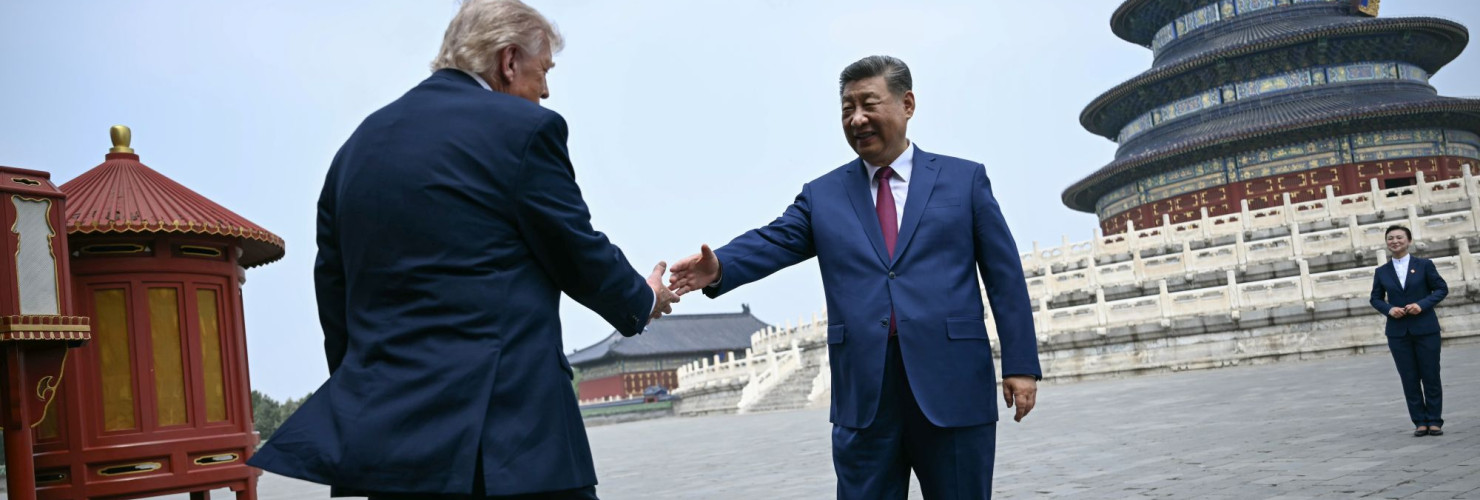
picture alliance / ASSOCIATED PRESS | Brendan Smialowski
Comment
Xi Jinping brings his "A-Game" to Donald Trump’s Washington
On the eve of his second summit with the US president in four months, China’s head-of-state is at the peak of his powers of summitry. Andrew Scobell explains Xi’s brand of "head-of-state diplomacy."
Xi Jinping wields much more power and influence over the foreign relations of the People’s Republic of China (PRC) and is far more activist than any of his predecessor paramount leaders. Of course, a country’s topmost political leader is always its seniormost de facto diplomat, but this truism risks underappreciating Xi’s degree of dominance in shaping the direction, style and active involvement in the formulation and execution of twenty-first century PRC foreign policy. Even Mao Zedong was less hands-on diplomatically than Xi and delegated the practice of foreign relations to others, most notably Zhou Enlai.
Head-of-state diplomacy
While the scope of Xi’s impact on contemporary China’s foreign relations is expansive, I focus on his ‘head-of-state diplomacy’—Xi’s foreign policy involvement in his capacity as PRC president. Mao Zedong, for most of his tenure, did not hold the formal topmost posts of political power in the ruling Chinese Communist Party (CCP) nor in the government, and Deng Xiaoping never held the most senior positions in either the CCP or PRC during his tenure as paramount leader. In fact, the position of head-of-state did not rise to a level of prime political significance or diplomatic importance until the mid-1990s, when China’s seniormost leader began simultaneously to occupy the highest leadership posts in the country’s three most consequential bureaucratic systems: the party, the state, and the armed forces. The Chinese term used for PRC head-of-state is 主席. The word is usually translated as ‘president’, but a more accurate translation would be ‘chairman.’
Serious PRC head-of-state diplomacy was first launched by Jiang Zemin (1993-2003) and furthered by Hu Jintao (2003-2013). But it was Xi who since 2013 upgraded, elevated and refined the mission well beyond anything ever practiced by his two predecessors. Since 2013, Xi has traveled internationally far more than any of his predecessors and hosted many more foreign leaders at home than any prior paramount leader. Xi has also raised the profile of head-of-state diplomacy and expanded the pageantry and spectacle of these events.
Greater away game activism; upgrading Beijing’s home game
Xi Jinping has visited more foreign countries, attended more overseas summits and participated in more multilateral forums than any of his paramount predecessors. Mao only ever made two trips overseas as top leader (both to Moscow), while Deng visited five countries on three separate trips as paramount leader—all during the first two years of his tenure. Meanwhile, during their respective tenures as PRC president, Jiang visited 71 countries during 39 different overseas trips, while Hu traveled to 69 different countries over the course of 50 international trips. Xi is on course to surpass Jiang’s record, to date having visited 71 countries on more than 50 separate excursions beyond PRC borders. Moreover, Xi’s meeting this week with US President Donald Trump will be his seventh trip to the United States as China’s head-of-state and will distinguish him as the only PRC president to make two state visits to Washington.
Yet, in recent years, Xi’s overseas travel has tapered off. This slowdown coincides with intensifying domestic challenges and a deterioration in China’s relationships with an array of countries. Xi seems to approach foreign trips very selectively. Annual trips to attend the Shanghai Cooperation Organization (SCO) summit—usually held in Central Asia—seem obligatory, as do other high-profile multilateral forums such as the BRICS summit—this year held in India. All trips are intended to burnish China’s image as a major global power and friend of the Global South – Xi’s recent visit to Egypt was timed to commemorate the 70th anniversary of ambassador-level ties with the PRC’s oldest diplomatic partner in the Middle East. Xi is loath to travel to countries where his visit might provoke contentious official dialogues or hostile public protests. Hence, Xi’s 2024 European tour consisted of three countries: two with pro-China governments (Hungary and Serbia) and a third (France) with a head-of-state trying hard to court Xi.
Xi has also hosted more foreign leaders to China than any of his predecessors. While the PRC has a long history of rolling out the red carpet to impress leaders from countries large and small, under Xi China has upped its game. In 2017, for example, President Trump became the first foreign leader in modern times to dine in the Forbidden City. Beijing aims to overawe visitors by highlighting the enduring wonders of ancient Chinese civilization and the stunning economic and technological accomplishments of modern China while showering them with elaborate hospitality. Since the Covid pandemic, Xi has noticeably devoted greater effort to hosting foreign leaders. For Xi, the home court advantage is significant: stage management is much easier in an environment where the CCP can orchestrate every detail from the moment a foreign leader arrives at the airport.
Multilateral forums and first lady power
Of course, the ostensive purpose of diplomacy is to advance national interests and deliver tangible benefits to a country. Nevertheless, national leaders leverage it to burnish their images as statesmen and enhance their political standing. Xi’s head-of-state diplomacy has surpassed that of his predecessors. He has leveraged photo-ops on the world stage to elevate his stature at home and bolster the legitimacy of the CCP in the eyes of the Chinese people through raising the profile of two Sinocentric forums: the SCO and the BRICS. Furthermore, China’s first lady has routinely accompanied Xi abroad to an extent unprecedented for a Chinese leader and played hostess at home. In 2026, for example, photogenic Peng Liyuan escorted Xi on visits to North Korea and Egypt and will accompany Xi to Washington this week.
The PRC now possesses a highly capable and professional corps of career diplomats unmatched in the post-1949 era. Meanwhile, at the apex of power, Xi’s head-of-state activism has remade the face of Chinese diplomacy in his image and its practice in Xi’s own style. The contrast with a below strength US Department of State and an erratic Trump-style foreign policy is hard to overlook.
The views expressed in this piece are those of the author.
Author(s)
Senior Associate Fellow
Author(s)
Senior Associate Fellow