picture alliance / CFOTO
Tracker
China Economic Indicators
China pushes ahead with AI adoption and prepares for a possible jobs crisis
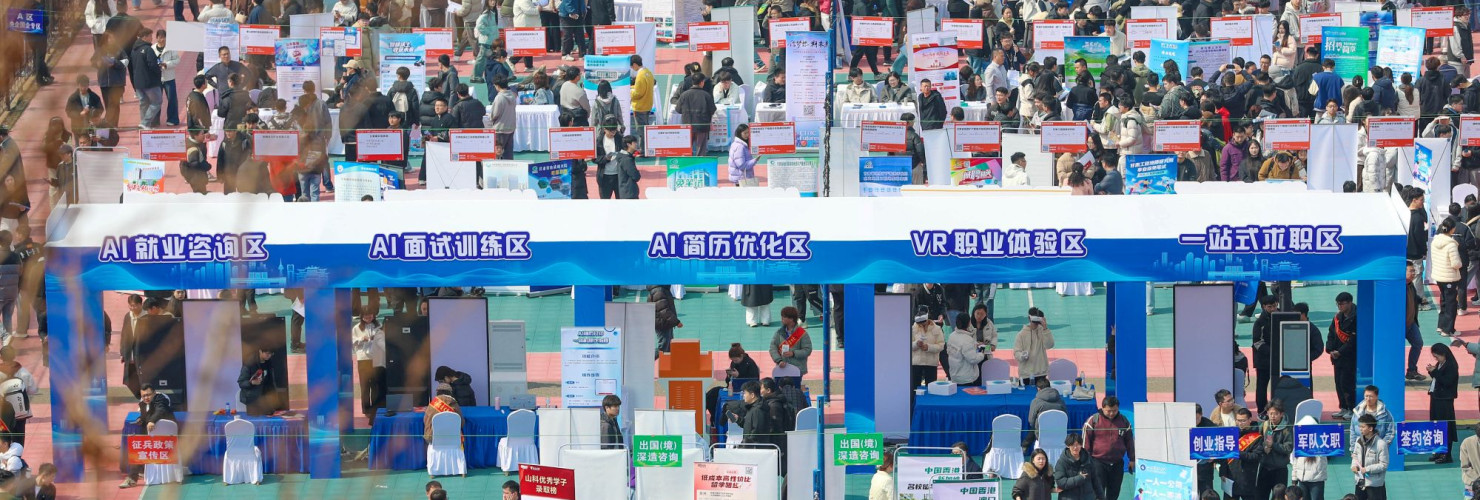
For fresh graduates and low-skilled workers, many already struggling to find steady employment, the government’s aggressive promotion of AI poses yet another potential hurdle. China’s rapid deployment of AI makes it an important case study for other countries when monitoring the impact on employment. China is not yet facing an AI-driven jobs crisis, but it is already preparing for the possible fallout.
Beijing’s preference for high-tech industries has restricted overall jobs growth
China’s push toward a growth model focused on high-tech industry has left its labor force in a difficult position. The youth unemployment rate has remained persistently high for years; in August it again hit 18.9 percent, a peak last seen a year earlier in August 2025. Among fresh graduates, competition for entry-level positions has become fierce as they join the ever-increasing pool of newly-minted, educated jobseekers. A university education and strong work ethic are no longer the ticket to a stable job and comfortable income. China’s real estate crisis has also wiped away families’ hard-won asset values, and left workers with no clear pathways to accumulate wealth.
Despite China’s growing trade surplus and continued investment, the overall number of industrial sector jobs has remained basically flat since the end of the harsh zero-Covid policy of rolling lockdowns in December 2022. Strong job growth in sectors such as cars and equipment production has failed to compensate for losses in other sectors like textiles and coal mining (see exhibit 1). Employment opportunities in the service sector have been muted by weak consumption. Lower investment in the construction sector has also dampened job creation: the share of migrant workers employed in construction fell from 19 percent to 13.8 percent between 2021 and 2025.
Exhibit 1
As steady, full-time employment has become harder to obtain, workers are increasingly turning to “flexible employment” to make ends meet. According to the China New Employment Forms Research Center, the “flexible” workforce is set to reach 320 million this year, or about 40 percent of urban employment (see exhibit 2). With very limited prospects for career development and only basic social services coverage, the growth of this cohort is fueling inequality and undermining social stability.
AI threatens further major disruption to job creation
China is accelerating AI adoption. Success in this endeavor could boost productivity and be beneficial, viewed from a policy-making level, as the now-abandoned One-child Policy has shrunk the working age population as a share of the total. However, widespread application of AI may also intensify the pain already being caused by shifts in China’s labor market. It is too early to say how disruptive AI will be – so far there has been no collapse in jobs due to the technology. Although major tech companies such as Alibaba, Baidu and BYD made substantial cuts to their workforces in 2025, those layoffs were mainly attributed to broader economic pressures rather than any AI transformation.
Most policies and official statements focus on AI’s positive implications for jobs, emphasizing new jobs and retraining. For example, the Implementation Plan for the Employment-First Strategy focuses on AI’s potential to promote employment and entrepreneurship. The emergence of one-person companies (OPC), where AI agents perform functions that would traditionally be carried out by several employees, has received backing via supporting policies in more than 20 provinces.
China’s determination to fast track AI adoption means it may be headed for a difficult transition period. Major changes are inevitable to fulfill official targets of 70 percent AI tool adoption across key sectors by 2027 and 90 percent by 2030. According to Citibank, approximately 9.6 percent of jobs in China—equivalent to roughly 70 million positions—are at high risk from AI adoption, with younger workers facing greater impacts. As the younger generation is already grappling with a difficult job market, AI adoption might diminish their employment prospects further and fuel social tensions.
The key question for China, as for all other countries confronting AI adoption, is what the net outcome will be for jobs, both lost and created. Greater efficiencies and reduced costs for providing goods and services could generate more demand and hence boost jobs in related sectors; this already appears to be true for some professions in the United States, such as AI engineers, software developers or data center construction workers.
Yet it is equally possible that AI may simply replace humans without creating new roles for them to take over. This is a clear danger in sectors like robotaxis and courier services. The deployment of Baidu’s Apollo Go robotaxis in Wuhan has triggered protests by taxi drivers. Similar tensions may emerge in other sectors as more AI applications are introduced.
Beijing will respond if AI proves to be a job killer
China’s leaders consider employment a key foundation for social stability so large-scale layoffs due to AI would demand their attention. Beijing has shown it wants to avoid this result. At the end of last year, a national standard was released on evaluating the social impact of generative AI technology, including employment. This year the Ministry of Human Resources and Social Security announced it was drawing up measures to address the impact of AI on employment. In April, the AI Plus Education Action Plan emphasized the need to align university majors and academic programs with changing industrial structures and to establish new interdisciplinary programs that integrate AI.
Ironically, officials have even implied they could leverage AI to better mitigate the risks to employment caused by AI. A plan to integrate AI into human resources and social security services released in July aims to boost labor rights protection and enhance the monitoring of illegal employment behavior.
Together, these announcements point to greater government scrutiny of AI’s impact on employment. If layoffs begin to snowball, then it is almost certain to intervene with more concrete action. Under China’s labor contract law, the dismissal of 20 or more employees in one go must be reported to the local labor administration departments, allowing them to exert influence on the outcome.
In practice, most firms opt to terminate employment contracts by mutual agreement, to avoid the reporting requirement. Several court rulings have prevented firms from dismissing employees solely on the grounds that AI could perform their work more cost-effectively. In a recent case in Hangzhou, a fintech company demoted and dismissed an employee, claiming AI could replace their work. The Hangzhou Intermediate People’s Court ruled that the dismissal violated the law and ordered the company to pay compensation.
Beyond such legal measures, another option for local and provincial governments would be to ramp up incentives to retain staff or use other methods to prevent companies from firing people. The government could also direct state-owned enterprises to increase hiring, while pressuring private firms to do the same as part of a renewed push for “Common Prosperity”. Ultimately, new measures to strengthen protection for workers in the gig-economy may even be necessary.
This leaves Chinese firms confronting conflicting pressures, urged and incentivized to accelerate AI adoption, yet potentially admonished for cutting jobs. Small and medium-sized firms may be able to downsize their workforce without attracting attention, if they choose to. But larger firms, particularly listed companies, will not be able to avoid scrutiny. Their only choice, if they view AI adoption as key priority, may be slow-roll the pace of any restructuring.
Autor(en)

Senior Analyst

Analyst
Autor(en)
Senior Analyst
Analyst