picture alliance / REUTERS | Evelyn Hockstein
Comment
Art of the struggle meets great power competition: Beijing’s approach to Trump 2.0
Claus Soong says Beijing has so far blended pragmatic bureaucracy with steadfast ideology to navigate both competition and cooperation during the US president’s second term.
Since the start of US President Donald Trump’s second term – “Trump 2.0” – the tone of the Chinese government towards Washington has routinely come to embrace both confrontation and cooperation – sometimes in the same breath. Only recently, for example, a Foreign Ministry spokesman declared that “China stands ready to work with the US” to develop bilateral ties, before seamlessly moving on to remind assembled foreign journalists that Beijing “at the same time will firmly defend its sovereignty, security and development interests.”
China’s messaging demonstrates both confidence and strategic calculation
This dual messaging demonstrates both confidence and strategic calculation, reflecting Beijing’s desire to engage with Trump 2.0 while asserting itself as a global power on equal footing. Despite preferring stability in relations, China is signaling that it is willing to compete with the US and to confront it, when necessary, increasingly seeing itself as a peer in the so-called G2 group of the world’s two superpowers. This aligns with Xi Jinping’s narrative that “the East is rising, the West is declining,” which invokes his view of a shift in the balance of global influence.
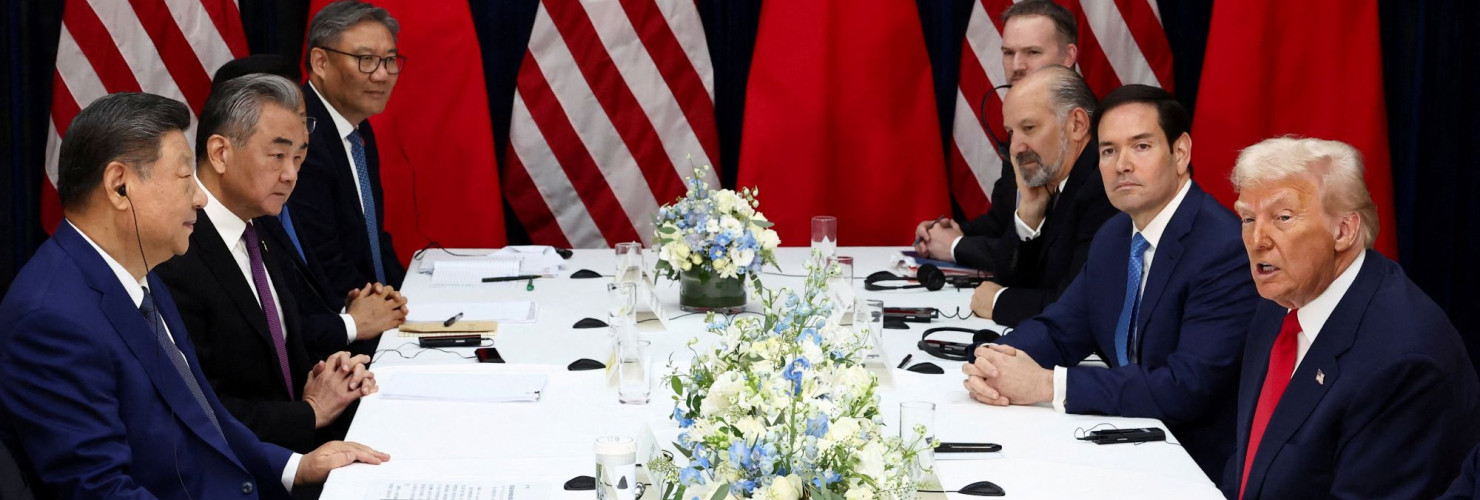
In this context, the key personnel who accompanied Xi to his first meeting with the US president during Trump 2.0 are revealing. Present in South Korea at the end of October were Minister and Executive Vice Minister of Foreign Affairs, Wang Yi and Ma Zhaoxu; Vice Premier of the State Council, He Lifeng; the Director of the National Development and Reform Commission, Zheng Shanjie; and Minister of Commerce, Wang Wentao – all, of course, senior members of the Chinese Communist Party (CCP), but also representatives of institutional government logic.
To Xi’s right sat Cai Qi, a member of the seven-man Politburo Standing Committee of the CCP, making him one of the most powerful officials in China and the highest-ranking delegation member after Xi. Serving as First Secretary of the Secretariat and Director of the General Office of the Party Central Committee, Cai functions effectively as Xi’s chief of staff within the CCP and is regarded as an absolute loyalist. A powerful behind-the-scenes domestic figure, his presence was meant to underscore how the CCP’s ideological cohesion also shapes foreign policy.
These men have helped Xi adopt a deliberately transactional approach to some of China’s dealings with Washington, tailoring its engagement to match Trump’s deal-making style. For example, Chinese officials have cooperated on lower-stakes issues such as TikTok, even offering concessions or recognition. In such instances, Beijing seems determined to manage ties pragmatically and keep relations stable. Chinese Foreign Ministry documents repeatedly emphasize the need for both countries to remain “partners” and “manage competition.”
Beijing is more confident about resisting Trump’s coercive measures
But rewarding flexibility on minor issues has also allowed Xi to preserve leverage on major ones. Maintaining stability has long been a core principle of Chinese foreign policy, at least on paper. During Trump’s first term, China made major concessions, such as the “Phase One” trade deal in 2020, agreeing to purchase billions of dollars of US goods and implement structural reforms. Today, with Xi’s power fully consolidated, decision-makers in Beijing are more confident about resisting Trump’s coercive measures – as demonstrated by the use of rare-earth export controls.
These shifts between defensiveness and assertiveness could reflect the influence of different officials, as much as strategic choices. It is not clear how Beijing formulates policy – driven exclusively from the top down by senior leaders, or also shaped from the bottom up by more junior officials. What seems most likely is that Xi sets the strategic direction and then coordinates officials through his chairmanship of the CCP’s Central Foreign Affairs Commission. The state bureaucracy then determines how Xi’s guidance is translated into practical policy.
The presence of He, Zheng and Wang Wentao at Xi’s meeting with Trump reflected the central challenges in current US–China relations under Trump 2.0, economic issues including tariffs, rare-earth export controls, agricultural products and US technology restrictions. All high-ranking officials with economic portfolios, the three men lead Beijing’s economic, industrial and trade bureaucracies directly engaged with US policy and so are best positioned to craft practical policy responses to US measures – crucial to Xi’s defensive, reactive approach to Trump 2.0.
Despite less frequently showing up in the foreign policy front, Cai is heavily involved in CCP organization, discipline, ideology and security. Unlike his Politburo Standing Committee colleague Wang Huning, the party’s “ideology tsar,” who makes more public statements on party theory and speaks more openly about “struggle,” Cai’s role is more about operationalizing Xi’s vision within the party state. This intertwining of foreign policy and security could help explain why China has taken both a more defensive posture towards some of Trump’s agenda and more assertive approaches and policy tools to other US actions.
“Fighting without breaking the foundations”
This aligns with the what analysts in China have come to call “fighting without breaking the foundations” (斗而不破) in managing US-China relations: As competition is inevitable and a total breakdown in ties unthinkable, “struggle” becomes synonymous with coexistence. In this spirit, China has remained largely reactive to Trump’s measures rather than tabling issues of its own. But what Xi and Trump agreed – the US lowering or rolling back tariffs in return for China suspending its quid-pro-quo export controls – shows that Beijing did not yield.
Now that China has demonstrated its ability to withstand Trump’s pressure, a crucial question is whether Beijing will take a more proactive role in shaping the bilateral agenda. Xi’s late-November phone call with Trump may signal such a shift. Beijing’s readout stated that Xi told Trump that “Taiwan’s return to China is an important component of the postwar international order,” suggesting an effort to move to active agenda-setting. In this context, Xi and Trump’s next meeting, scheduled for April 2026 in Beijing, will be the key event to watch.
For an analysis of US President Donald Trump's approach to China in his second term in office, read here the article by MERICS Senior Fellow George Yin, "Art of the deal meets great power politics: Trump 2.0’s approach to China".
Author(s)
Analyst
Author(s)
Analyst