
picture alliance / REUTERS | Dado Ruvic
Comment
Defeatist Europe is set for growing dependence on China without decisive action
Europe's executives and politicians need to recognize that only huge financial and geopolitical sacrifices today will save the region from greater pain tomorrow, says Jacob Gunter.
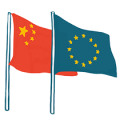
European trouble with the US since the start of the year is driving some in Europe to recklessly consider counterbalancing the EU’s relations with China. That may be necessary in some areas, but whether the mercurial Trump administration decides to play nice or act the bully does not somehow take away from the material problems that China continues to send towards Europe. Instead, leaders must consider what actions are necessary to protect critical European interests that should be taken in response to China’s ongoing behavior irrespective of what the US is up to.
Two immediate concerns come to mind: First, Beijing’s stranglehold on rare earths threatens Europe’s ability to make anything from chips and electronics to missiles and radar systems. Second, China’s long overinvestment in manufacturing and its ensuing industrial overcapacity, which is already threatening Europe’s industrial base via a flood of cheap electric vehicles (EVs), machinery, chemicals and a sweep of other products.
Key member states are failing to advance de-risking
Surely the possibility of Beijing shutting down Europe’s economy and thwarting its attempts to re-arm Ukraine and its own militaries should induce some helpful urgency – and even forgivable panic – in Europe’s political and business elites? Instead, Brussels is only offering a few small steps forward to reduce reliance on China, including a mere 3 billion euros to support up to 30 strategic projects. Meanwhile, key member states are failing to advance the de-risking they advocate, instead courting Chinese investment in their own countries.
One reason for this is the silence of corporate leaders, who presumably fear their shareholders might realize how vulnerable their investment has become due to the C-suite’s failure to factor any modicum of risk into their supply-chain strategies. According to the German Chamber of Commerce in China, 56 percent of German companies are considering increasing their engagement with Chinese partners, illustrating a shocking propensity to carry on regardless, even if a silent minority appears to be having second thoughts.
Another reason is that political leaders appear happy to draw the wrong conclusions about whether China is a partner or competitor. Its manufacturing overcapacity led to a 36 percent rise in cars shipped to Europe in the first half of 2025, according to the European Automobile Manufacturers’ Association. But rather than confronting China about this looming glut, politicians from Madrid to Budapest to Berlin talk of the need to attract Chinese investment – especially in EVs and EV batteries – to ”boost the continent’s industrial base".
Europe still has choices
Responding to Beijing’s ability to strangle European supply chains with inaction, only to then ask Chinese companies to reindustrialize Europe as a way to counter the very deindustrialization they are causing, is surely the strategy of madness – a madness that is a symptom of defeatism. The antidote lies in executives and politicians recognizing that Europe actually still has choices: Either take admittedly painful and costly action on its own terms today – or have Beijing to dictate even more painful and costly measures on its terms tomorrow.
Europe needs to secure its supply of rare earths and other critical raw materials (CRMs) by thinking big, as the US has done. A minor Marshall Plan would be a good start – just as an injection of capital rebuilt a destroyed Europe, a much smaller sum of billions could rebuild destroyed CRM supply chains outside of China. Luckily, Europe would not need a Manhattan Project to pursue major breakthroughs – it already has the technology to replace Chinese suppliers. All Europe needs to do is plow money into the problem and rebuild capabilities.
But there will also be geopolitical costs. Europe needs credible deterrence to prevent China from continually tightening export controls to coerce concessions. Currently, China’s choking of rare-earth exports can cause such acute pain that Europe has no option but to buckle. But the Anti-Coercion Instrument would let the EU strike back by blocking China’s access to the single market. But this nuclear option could also harm Europe just as badly, crippling industries dependent on Chinese components and driving consumer-prices higher.
Europe needs to identify critical chokepoints in China
This problem throws a light on the elegant asymmetry of export controls. Beijing was able to weaponize rare-earth restrictions from April to November this year as they accounted for a tiny share of exports for China, but were irreplaceable for importers. The same is true of US controls on advanced computer chips – minimal pain for the US, maximum pain for China. Europe needs to adopt the same approach, identifying critical chokepoints in China, which would maximize leverage abroad while minimizing domestic manufacturing disruption.
Beijing has plenty of pain points Europe could credibly threaten to exploit for deterrence. China relies on German machine tools, French metrology instruments, Dutch lithography machines and their European supply chains, as well as avionics products from all over the continent, to name just a few examples. The problem is that the EU would find it much harder to bring export controls on them into line with World Trade Organization (WTO) rules. The US and China invoked fears about national security to justify their measures – something that cannot be as easily argued for machines that shape metal or instruments that measure.
This makes deterrence by export controls a taboo for many in rules-based Europe. But Europe must recognize that constraining itself while China’s steadily erodes the liberal trading system risks condemning Europe to death by a thousand cuts. To defend the rules-based order that underpins European trade, Brussels must single out actors like China as violators who cannot hide behind these rules only when convenient. Europe would be fully justified in asserting: free trade is for fellow free traders – and China is not one of them.
This article was first published by China.Table on February 9, 2026.
Author(s)

Head of Program
Author(s)
Head of Program