picture alliance / ROPI | Michailidis/EUC
MERICS Briefs
MERICS Europe China 360°
China and the EU-US rift + Economic security + Car imports from China
ANALYSIS
China sees EU-US rift as an opening for EU re-engagement – on its own terms
By Grzegorz Stec
Chinese think tanks and policy commentators have described tensions over Greenland as a radical stress test of the transatlantic security bargain and a pivotal moment for the EU’s strategic autonomy in both security and economic terms – one that may augur an opening of EU-China relations. But some would like the EU to pay a price for the privilege: the abandonment or scaling down of its de-risking policy.
In many ways, their assessment is a logical extension of a long-held Chinese view: Washington is increasingly pursuing “predatory hegemony” and routinely pressures Europe to do its bidding. This is seen as a key factor shaping Europe’s China policy. As transatlantic relations crumble, many experts believe, Europe will be more inclined to diversify away from the US and reinvigorate economic ties with China.
Europe’s predicament from China’s perspective
The EU’s reluctant but apparent readiness to stand up to Washington on Greenland and potentially deploy the Anti-Coercion Instrument seems to have caught the Chinese experts partially by surprise, prompting comments about European countries “repositioning their role in the competition of great powers.”
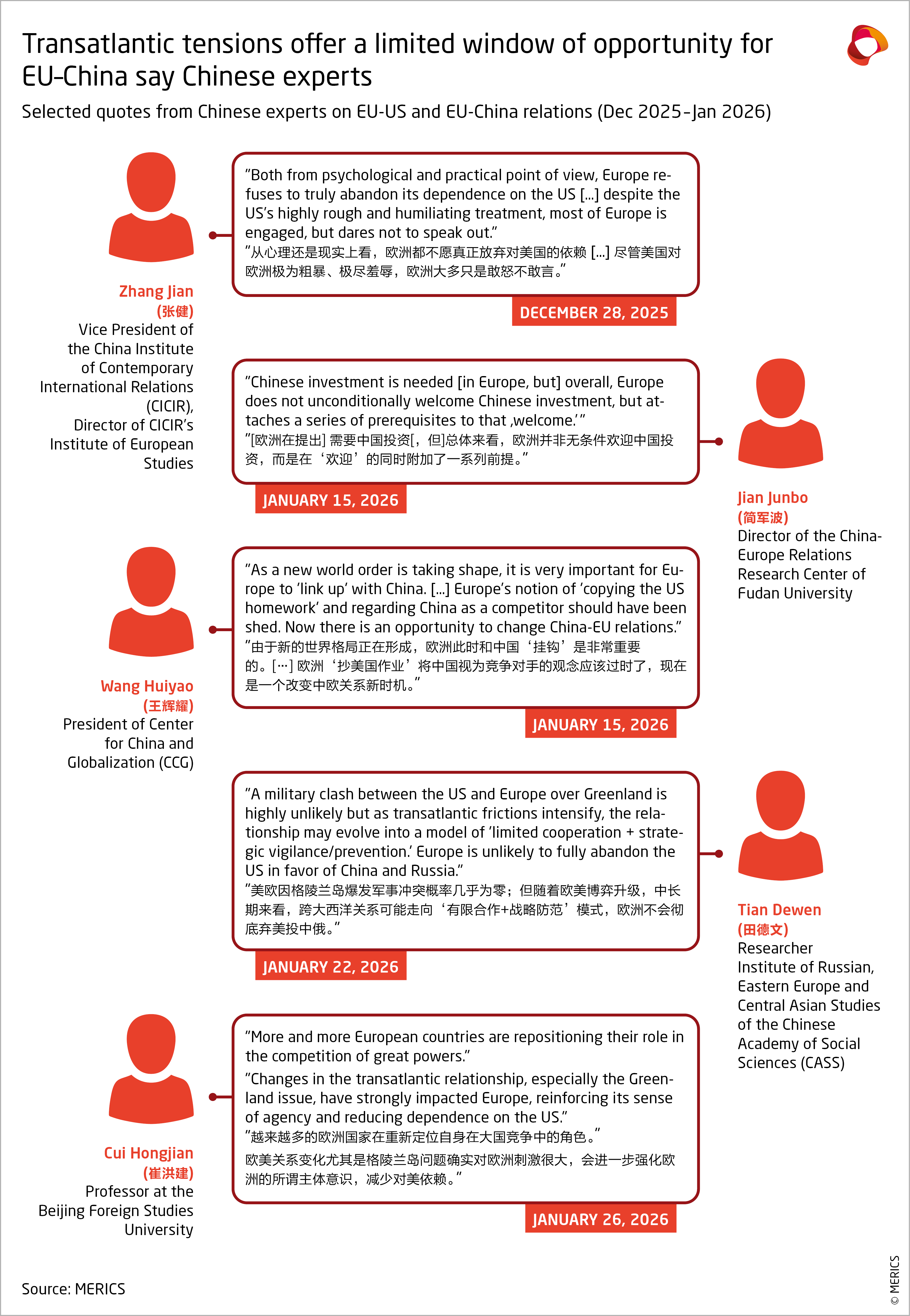
But the overall dependence argument will likely continue to shape Chinese expectations that Europe’s room for geopolitical maneuver will remain narrow and malleable. Many point out that the EU’s ambition for strategic autonomy – which continues to be discussed in China almost exclusively as autonomy from the US -and geopolitical agency continues to be constrained by overdependence on the US in the areas of security, tech and the economy. For instance, Zhang Jian (Vice-President of CICIR) assessed that so far the EU “dares not to speak up,” even in the face of “the US’ highly rough and humiliating treatment.”
But some, like He Zhigao (Researcher at the Institute of European Studies, Chinese Academy of Social Sciences) argue that the EU should know by now that it is useless to try to “curry favor with the Trump administration by sacrificing interests in relations with China,” a likely reference to Brussels’ attempts to cooperate with Washington for instance on rare-earths dependencies throughout last year. Because US pressures on Europe have continued unabated despite its continued outreach to the US President, there is then supposedly little to lose in engaging Beijing (though this may later be reassessed in view of Washington’s pressure on Canada over its re-engagement with China).
Consequently, they believe the EU may now be open to intensifying engagement with China. As Cui Hongjian (Professor at Beijing Foreign Studies University and long time Europe observer) puts it, transatlantic fracture and American “resource imperialism” that was visible over the Greenland question means that the EU and China could cooperate on rebuking the US by “jointly advancing the green transition and achieving resource independence, and jointly resisting hegemony in the resource domain.” Similar proposals tend to overlook the significant trust gap that persists in EU-China relations.
Re-engagement and abandoning de-risking
Several Chinese experts point to the economy-focused re-engagement between China and Canada and China and South Korea in recent weeks as an example of how Trump’s volatility could facilitate a shift in EU-China relations.
French President Emmanuel Macron’s statement at the World Economic Forum in January in Davos are another case in point: “China is welcome, but what we need is more Chinese foreign direct investments in Europe, in some key sectors, to contribute to our growth, to transfer some technologies, and not just to export towards Europe.” This came on top of his calls to rebalance trade relations during his visit to China in December, one of several high-profile China trips by European leaders in the recent weeks.
However, implied in the analyses, op-eds and media interviews of most of the Chinese experts is that such a re-engagement should have a price tag. The prescription in the Chinese debate is that a reset requires Europe to loosen or abandon de-risking.
China has routinely criticized the policy, which aims to make the EU less vulnerable to economic dependencies and national security risks stemming from China. The Chinese experts tend to portray de-risking as an illogical over-securitization that harms Europe’s competitiveness, raises costs, and slows the green and digital transitions by forcing the replacement of cost-effective Chinese products in European supply chains. Chinese nationalistic media’s English-language Global Times concluded in an editorial that “what European policymakers call ‘de-risk’ has devolved into ‘de-development’” and that is a policy that “Brussels is gradually tightening under pressure from the US”.
Implications for the EU
EU decision-makers should read these debates as an approximation of Beijing’s assumptions and likely bargaining posture. For example, the argument that frictions over Greenland mean Europe should pursue autonomy by loosening constraints on China, especially de-risking.
Beijing is therefore likely to test whether Europe’s transatlantic shock translates into regulatory and political flexibility and to treat Europe’s search for investment as leverage. The sense of Europe’s desperation means Beijing is unlikely to offer tangible concessions, but will rather likely lead to softened rhetoric.
Also, there remain blind spots on China’s side. The narratives tend to overlook or underappreciate that de-risking policy is a result of the EU’s own assessment of relations with China, and the fact that many of the EU’s concerns about China are systemic or structural in nature, as is the case for instance in tensions between the EU’s competition-focused and China’s state-guided economic setups. They also have little appreciation for the EU’s assessment of the threat posed by Russia. Some commentators have even urged the EU to normalize relations with Russia.
The EU must avoid excessive issue linkage that trades resilience for short-term stabilization, as may be the case with China offering investments in exchange for lifting security-related restrictions. A limited agenda for cooperation on global-system stabilization may be possible when interests align – as proven by past collaboration during the first Trump administration when the EU cooperated with China to keep the WTO appellate body, JCPOA or Paris Agreement operational despite US withdrawal. But such initiatives are unlikely to alter structural disputes over economic models or approaches to global governance. Tactical re-engagement between the EU and China should not cloud the EU’s thinking about the long-game in which limiting dependencies and boosting domestic competitiveness is key.
Takeaways for the EU
- China continues to interpret its relationship with the EU through the lens of the EU’s relationship with the US. It discounts that the EU makes its own assessment of this relationship, informed by structural and systemic differences.
- China underestimates the significance of the threat from Russia for Europe’s readiness to re-engage with China.
- Beijing is likely to see Europe as eager to revitalize bilateral relations and expect concessions. The EU should not expect major offers from China beyond symbolic or isolated gestures.
- It is paramount for the EU to ensure that the search for new investment avenues does not erode de-risking policies. Showing resolve and assertiveness can improve the EU’s bargaining power.
- In that context, China will take note of how Europe manages Greenland and other tensions with the US as a test of the EU’s commitment to assertiveness.
Read more:
- Quote 1: Wang Huiyao at Guoshi Express: The so-called "China shock" is actually a "future shock"
- Quote 2: Cui Hongjian at Sina News: China faces a diplomatic boom at the beginning of the year, why is the European leaders "diplomatic offensive" so fierce
- Quote 3: Zhang Jian at Guangming Daily: Europe: Finding the way forward in a difficult situation
- Quote 4: Tian Dewen at Europe Times: Will conflict break out between Europe and the United States over Greenland?
- Quote 5: Jian Junbo at Sina Finance: Macron "conditionally" welcomes Chinese investments
UPDATE
Commission gets bold on economic security
As Beijing and Washington race for technological leadership, disregarding rules and weaponizing supply chains, Brussels is proposing nothing short of a Copernican revolution in the bloc’s geoeconomic posture – from defensive to assertive, and from reactive to anticipatory. Last year closed with an ambitious Joint Communication from the European Commission and Parliament laying out a vision for strengthening the EU’s economic security. It came just as the bloc had been struggling to translate its 2023 strategy of de-risking from China from paper to action.
What you need to know:
- Revamping existing tools: The Joint Communication proposes revamping existing tools and introducing new measures – from preventing “high-risk entities” from accessing EU funds to preempting foreign takeovers of critical tech startups and incentivizing the use of locally sourced supplies and components in critical sectors, like defense and energy. The proposals reflect a new kind of risk assessment with respect to economic and technological interdependencies – including with China.
- De-risking, Nexperia edition: One leitmotif is the urgency for Europe to reduce high-risk dependencies. This has been a long time coming, considering the hard lessons of a global pandemic and a war in Europe, but recent events have added urgency. For example, the halting of shipments from Dutch chipmaker Nexperia’s fabs in China to its European customers brought the global auto industry to its knees. The move came in response to the extraordinary measures taken by the Hague to stop Nexperia’s Chinese parent from hollowing out the company’s European production.
- Chinese tech risks in focus: While Beijing’s response has arguably been defensive, larger issues are at play. Nexperia’s saga highlights how Chinese companies’ investments abroad often intersect with state-driven industrial master plans. It also shows that China’s centrality in many technology supply chains, coupled with Beijing’s growing appetite to impose export controls, can create chokepoints. Aside from import dependencies, the Joint Communication implicitly references Chinese technology in the context of each of the high-risk areas it singles out.
- Governance of economic security: But to identify, assess, and respond to risks, the EU must collectively overcome information asymmetries. This is a weak link in the bloc’s economic security, which the Commission is looking to fix by improving the underlying evidence base, intelligence capabilities, and technical expertise. Tearing down the information walls between capitals, as well as between industry, science and government, is going to be crucial if Europe is to balance cooperation and competition with China’s techno-industrial system.
Quick take: The new logic is: If companies do not diversify, they will be forced to do so. And the communication has a lot to show for, not least its accompanying ReSourceEU Action Plan, designed to cut reliance on China-sourced critical raw materials. However, the EU’s internal power politics and geopolitical events could throw a wrench into the plans.
For example, some EU countries may be strongly opposed to giving the Commission carte blanche to ban designated vendors such as Huawei from IT infrastructure. As they are scrambling to formulate joint responses to Trump’s tariffs and his threat to annex Greenland, their will and bandwidth for common China policy measures is limited.
Read more:
EUROPE-CHINA DIPLOMATIC TRACKER
European capitals intensify visits to Beijing
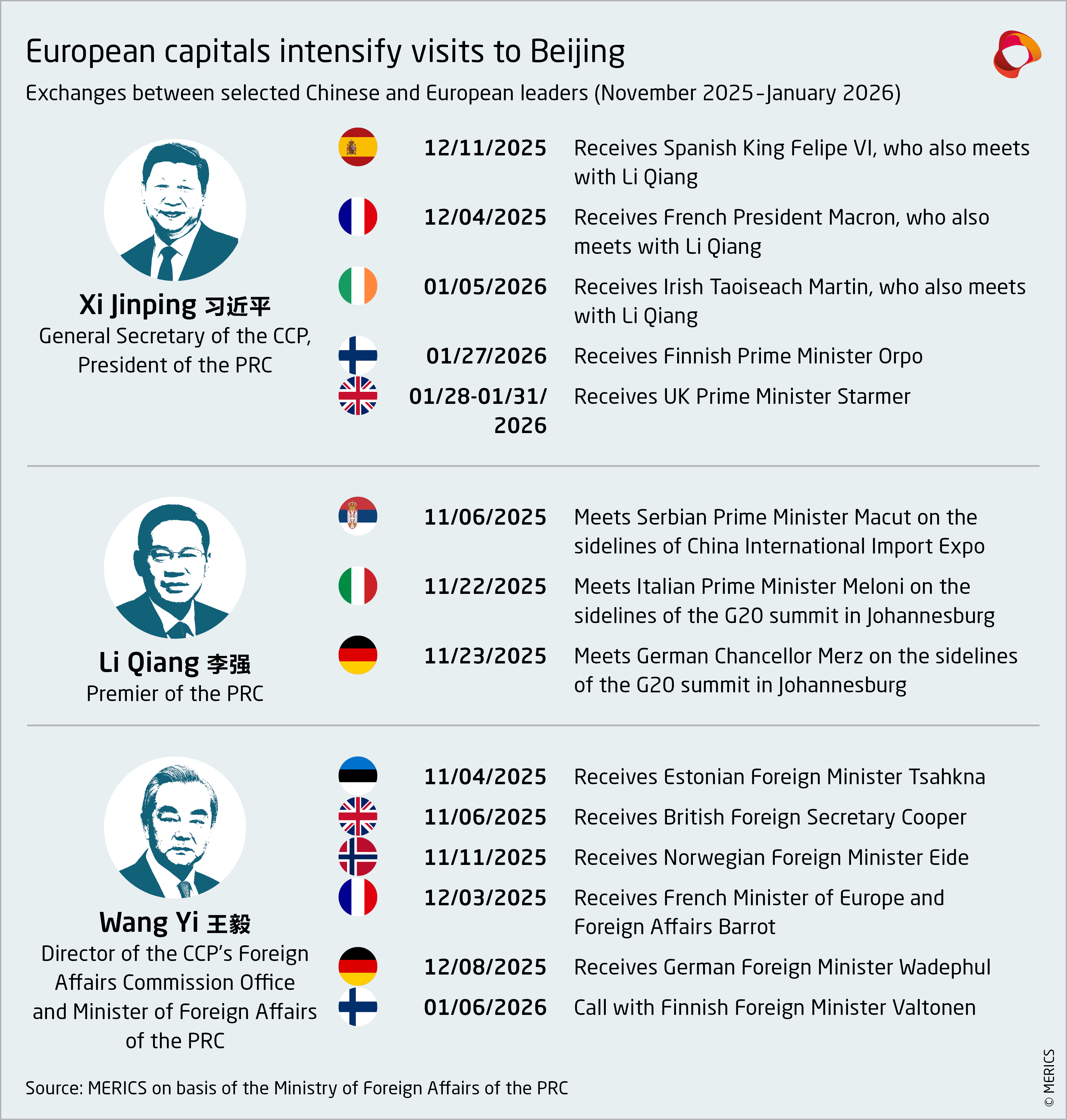
A pipeline of high-level European state visits has been shaping the tone and bandwidth of Europe–China relations over the past few weeks.
- French President Emmanuel Macron’s Beijing trip in December 3-5 centered on signaling a shared interest in global stability and multilateralism, along with calls to “re-balance” EU-China economic relations. France and China released four joint statements on different topics: global governance, Ukraine and Palestine, climate and environmental cooperation, and the peaceful use of nuclear energy. However, the visit has not featured major trade deals but instead has led to 12 undisclosed sectoral cooperation agreements.
- German Foreign Minister Johann Wadephul’s visit – postponed from November over diplomatic tensions – took place on December 8-9 and prepared the ground for Chancellor Friedrich Merz’s first China trip, expected in late February. Compared to Macron’s visit, the Wadephul’s visit more explicitly raised concerns about rare-earths, and Beijing in turn pushed Germany on respecting China’s position on Taiwan.
- UK Prime Minister Keir Starmer is visiting China on January 29-31 in an apparent bid to boost economic relations. In the week preceding the visit, close to 30 British companies – including HSBC and Swire Group –met with top Chinese officials. The visit is likely to be a diplomatic balancing act for Starmer who recently said he recognized the “national security threats” stemming from China while at the same time approving the opening of China’s “mega-Embassy” in London. The visit is further complicated by reports of alleged cyberespionage targeting the British Prime Ministers’ aides between 2021 and 2024 released hours before the visit started.
Beijing is likely to lean into capital-to-capital diplomacy during this period, seeking targeted concessions and improved atmospherics with key member states, in hopes that transatlantic tensions will offer diplomatic openings.
- Speaking at Davos on January 20, Chinese Vice-Premier He Lifeng voiced support for economic globalization and multilateral economic governance –implicitly contrasting China’s “stability” with US disruptions. Further, in an apparent reaction to partners’ concerns, He argued that China “never deliberately pursued” a trade surplus and vowed a pivot toward domestic demand. He said this is at the “top of its economic agenda” and that Beijing aims to rapidly boost consumption. However, a similar speech by President Xi Jinping in 2017 in Davos, frequently referenced and echoed by He, brought little change. So, this messaging intended for a foreign audience should be taken with caution.
- Engagement between China and EU institutions has been comparatively low in recent weeks, except for a technical export-control dialogue channel for managing practical frictions around rare earths licensing. This points to a wider problem: The last EU–China summit showed little scope for a bilateral agenda, with Beijing limited willingness to substantively engage the EU on its concerns. This has raised doubts in Brussels about the effectiveness of such dialogue formats and shifted its focus to enforcement and defensive instruments.
- Beijing continues to send mixed signals. On the one hand it lowered immediate pressure on the politically sensitive agricultural sector, by concluding its anti-dumping investigation into EU pork with duties below provisional levels (ultimately 4.9-19.8 percent). On the other hand, it opened a new investigation into European dairy products (with provisional duties at 21.9-42.7 percent), sustaining leverage and uncertainty for EU exporters with the final decision expected in February.
SOAPBOX MERICS DATA HIGHLIGHT
EV and hybrid car imports to the EU from China
 | The Soapbox-MERICS Data Highlight offers visualizations of EU-China economic relations. In this issue, MERICS Senior Associate Fellow Rafael Jimenez Buendía, author of the weekly China trade newsletter “Soapbox”, zooms in on the latest developments with regard to European tariffs on electric vehicles made in China. |
“EU guidance on minimum prices for Chinese electric cars is not a proof of a deal”
The European Commission has published guidance for Chinese electric vehicle (EV) exporters on how to propose pricing, including model-specific minimum import prices and possible volume or investment commitments. China has presented this as a deal on minimum prices to replace EU tariffs on Chinese EVs. The EU says it is a procedure, not a settlement. While this is a pathway to replacing duties for approved exporters, it is not proof that the two sides have already agreed on minimum prices.
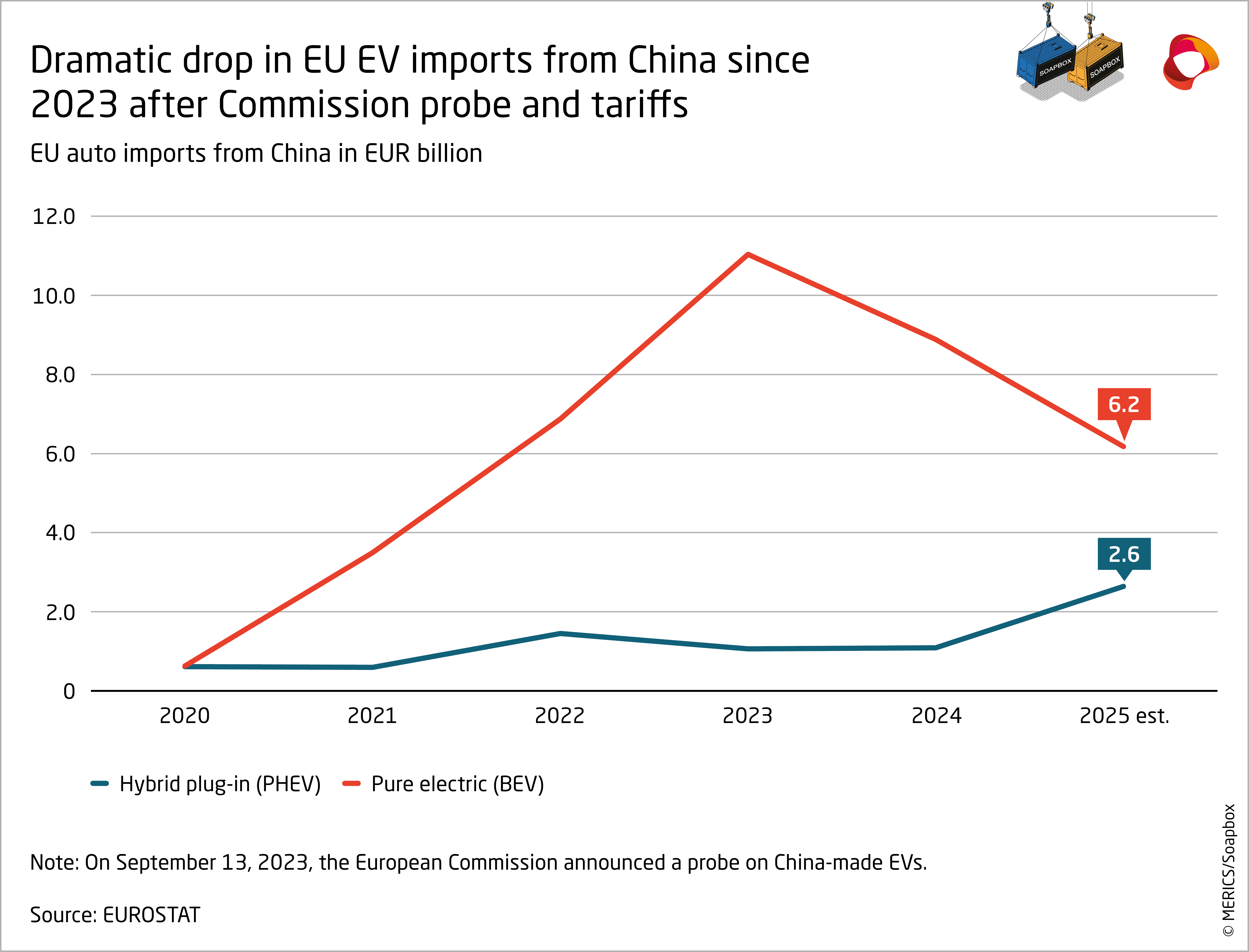
Crucially, the EU says this would require an Implementing Decision and an amendment of the regulation imposing the existing measures (with member state voting). The Commission’s investigation of unfair subsidies and subsequent higher tariffs on electric cars, Tesla’s decision to build a factory near Berlin, along with consumer preferences, have driven down China’s electric car exports to the EU. In 2025, we estimate the value of these exports were 44 percent below their 2023 peak. At the same time, plug-in hybrid imports from China were up 143 percent year on year.
The EU response seems to be both policy- and tariff-based. On the policy side, the EU is considering allowing sales of some combustion-engine cars beyond 2035. On the trade side, the surge in Chinese plug-in hybrids is drawing policymakers’ attention, and, as with electric cars, higher tariffs may end up on the table. This adds pressure to China’s need to boost exports, encouraging Beijing to present the EU’s new guidance as a tariff agreement, even though it is essentially guidance for individual firms.
SHORT TAKES
The European Commission is mulling a mandatory phase-out of components and equipment from high-risk suppliers in cybersecurity-sensitive critical infrastructure across the EU. This would affect in particular Chinese telecoms like Huawei and ZTE, and would be part of the Commission’s revisions of the Cyber Security Act.
- Reuters: EU plan to phase-out high-risk tech draws fire from China's Huawei
- SCMP: EU moves to force Huawei out of networks, opening door to wider Chinese tech bans
In a move targeting cheap Chinese e-commerce providers like Temu or Shein, the EU agreed to introduce a EUR 3 customs duty on low-value packages entering the EU’s single market. The duties will be introduced from July 2026 and will remain in place until a broader solution for duty exemptions on low-price packages is found.
On January 20, the UK government approved plans for the China’s contested “mega-Embassy” in London, the biggest in Europe. The process has stalled for three years amid protests of local residents, human rights activists and concerns over potential usage of the new facility for espionage.
The German Trade & Invest agency expects China to drop out of Germany’s top five export destinations in 2025/2026, falling behind the UK and Italy to number seven. The shift reflects economic challenges from weak domestic demand in China, reshoring of German production and the impact of de-risking. At the same time, Germany's trade deficit with China will hit a record EUR 87 billion.
On December 30, Warsaw asked the European Commission to investigate TikTok after the rapid spread of AI-generated content calling for “Polexit,” the withdrawal of Poland from the EU. While evidence points to Russian disinformation efforts, the incident reflects growing political sensitivity to TikTok’s potential impact on elections in Europe.
Author(s)

Head of Brussels Office/Senior Analyst

Head of Program (Co-lead)
Author(s)
Head of Brussels Office/Senior Analyst
Head of Program (Co-lead)