
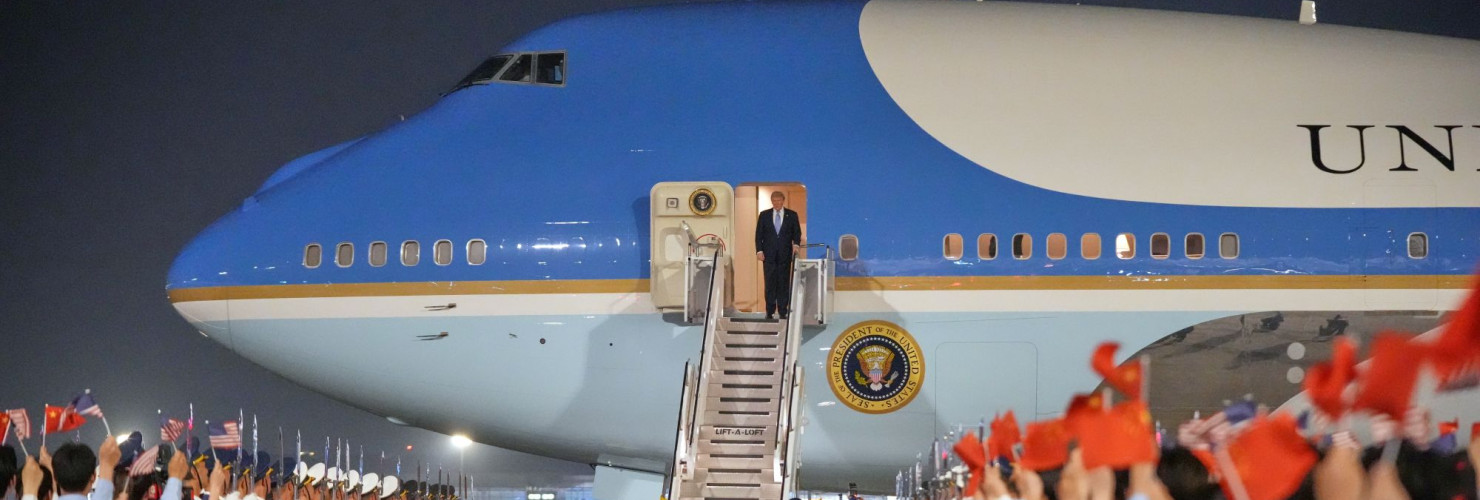
picture alliance / ASSOCIATED PRESS | Mark Schiefelbein
Comment
Xi seeks to buy time as he meets Trump in Beijing
With a grand bargain highly unlikely, the US and China face a choice between a marginal deal or no deal at all, argue Helena Legarda and Jacob Gunter.
The imminent meeting of Chinese President Xi Jinping and his US counterpart Donald Trump has inevitably triggered speculation about who will come out on top. A “grand bargain” covering the fundamentals of trade, technology, Taiwan and other geopolitical tensions (like Iran) is highly unlikely. Instead, one appealing option for the world’s two most powerful leaders is to make a marginal deal on immediate challenges like maintaining China’s access to the US market and stabilizing China’s export controls on rare-earth flows to the US.
The main goal of the summit for Xi is to stabilize China’s relationship with the US and buy time – to keep the US from again ratcheting up tariffs, export controls and other measures which he believes are being used to contain China’s rise. Buying time is crucial for the sweeping self-reliance efforts that have been a hallmark of Xi’s agenda – reducing dependence on foreign technology, finance, and supply chains while strengthening China’s ability to withstand external pressure. From energy security and technological breakthroughs aimed at overcoming US chokeholds on China to fully modernizing the military, Xi needs time.
Trump’s goals shift from day to day, but can generally be understood as aiming to reduce the US trade deficit with China, secure access to China-made rare earths until US diversification efforts bear fruit – and bring home a deal that bolsters sentiment ahead of the congressional midterm elections in November. Trump is in the driver’s seat when it comes to setting the agenda and the tone of the summit, largely because Washington still controls many of the tariffs and export controls dominating the relationship.
Even a marginal deal that prevents escalation will be seen as a victory in Beijing
China’s effort to buy time means that even a marginal deal that comes with some costs for Beijing but prevents escalation will be seen as a victory. Xi can hand Trump some visible “wins” like those contained in the 2020 “Phase One” Deal from Trump’s first term, which included large Chinese purchasing commitments for US agricultural and manufactured goods. This time, concessions could include new pledges to buy commodities, commitments to control fentanyl precursors or better market access for US investors. Xi could also loosen export controls on rare earths – after all, he could always tighten them again, should the need arise.
The proposed “Board of Trade” to manage US-China trade is theoretically possible, but would likely have a limited remit. For managing trade in goods for public procurement or for commodity purchases, it could in principle function. But for most B2B trade between private companies and certainly for anything purchased by consumers, having to obtain approval from a Board of Trade would functionally break global value chains and be unworkable.
Such tactical concessions would help distract from the strategic points on which Xi will not budge. To meet Trump’s demands for deep rebalancing of the trade deficit, China would have to reverse course on the economic model that Xi has built. Beijing prioritizes investment in industry over boosting household incomes and, as a result, relies on exports to absorb excess production. With stagnant income growth, Chinese consumers can’t afford to buy more US goods. Beijing can order its state-owned enterprises to buy more US commodities. But other than such symbolic gestures to help “fix” the US trade deficit, China won’t do much.
Economic frictions reflect the clash of two very different political economies
All of this underlines the core issue at stake: any deal that is imaginable for both sides to accept is likely to be too limited to address the deeper forces driving the relationship. Economic frictions reflect the clash of two very different political economies. The US remains committed to (relatively) open markets, private capital and limited state intervention, while Xi has moved China in the opposite direction — toward greater state control, industrial policy, subsidized national champions and tighter political oversight of the economy. Whatever the marginal outcomes of the summit, those fundamentals will persist.
Agreement will also be hard to reach on geopolitical points of friction – wars in the Middle East and Ukraine, panic on global energy markets, instability between China and Taiwan and also with Japan. Like in the economic sphere, a summit outcome favorable to the US would require Beijing to fundamentally change its posture towards the Indo-Pacific, slow military modernization and rethink its foreign policy. Trump will again demand that China push Tehran to reopen the Strait of Hormuz and could criticize China’s nuclear buildup and pressure on Taiwan. Xi, meanwhile, will try to get Trump to change or soften US language on Taiwan, possibly in exchange for help on Iran. A shift in US Taiwan policy would be extremely significant; but it seems unlikely. Even without that, just keeping Iran and Taiwan largely off the agenda – or limiting the discussion to an exchange of positions – would be enough of a win for Xi.
Beijing looks set to continue implementing its Trump playbook
Beijing, in short, looks set to continue implementing its – so far successful – Trump playbook by playing for time while strengthening its own position. While watching the US-China Summit, Europeans should ask themselves what they expect from their own relations with China. Collapsing exports to China and the surge in imports driven by China’s manufacturing overcapacity are threatening deindustrialization. Meanwhile, Beijing continues to support Russia in ways that allow its war on Ukraine to continue. When European leaders next make their own visits to Beijing, they should recognize that time is not on their side either.
Even the smallest “shared victory” – a US carve-out from China’s export controls on rare earths, say, in return for US pledges on technology and tariffs – would free Washington and Beijing to redirect themselves elsewhere. That could mean Trump coming after Europe again, and Xi renewing his efforts to derail European Union ambitions to cut its economic dependence on China. And if, instead, China-US talks broke down and the trade and tech war escalated again, Europe would be caught in the crossfire of likely renewed tariff escalation, expanded export controls on chips, AI and critical materials, and supply-chain fragmentation.
Author(s)

Head of Program

Head of Program
Author(s)
Head of Program
Head of Program