
picture alliance / CFOTO
Content
MERICS Briefs
MERICS China Industries
Climate goals for officials + Textile sector + Alcohol industry
MERICS' Top 5
1. New State Council measures tie officials’ careers to climate goals
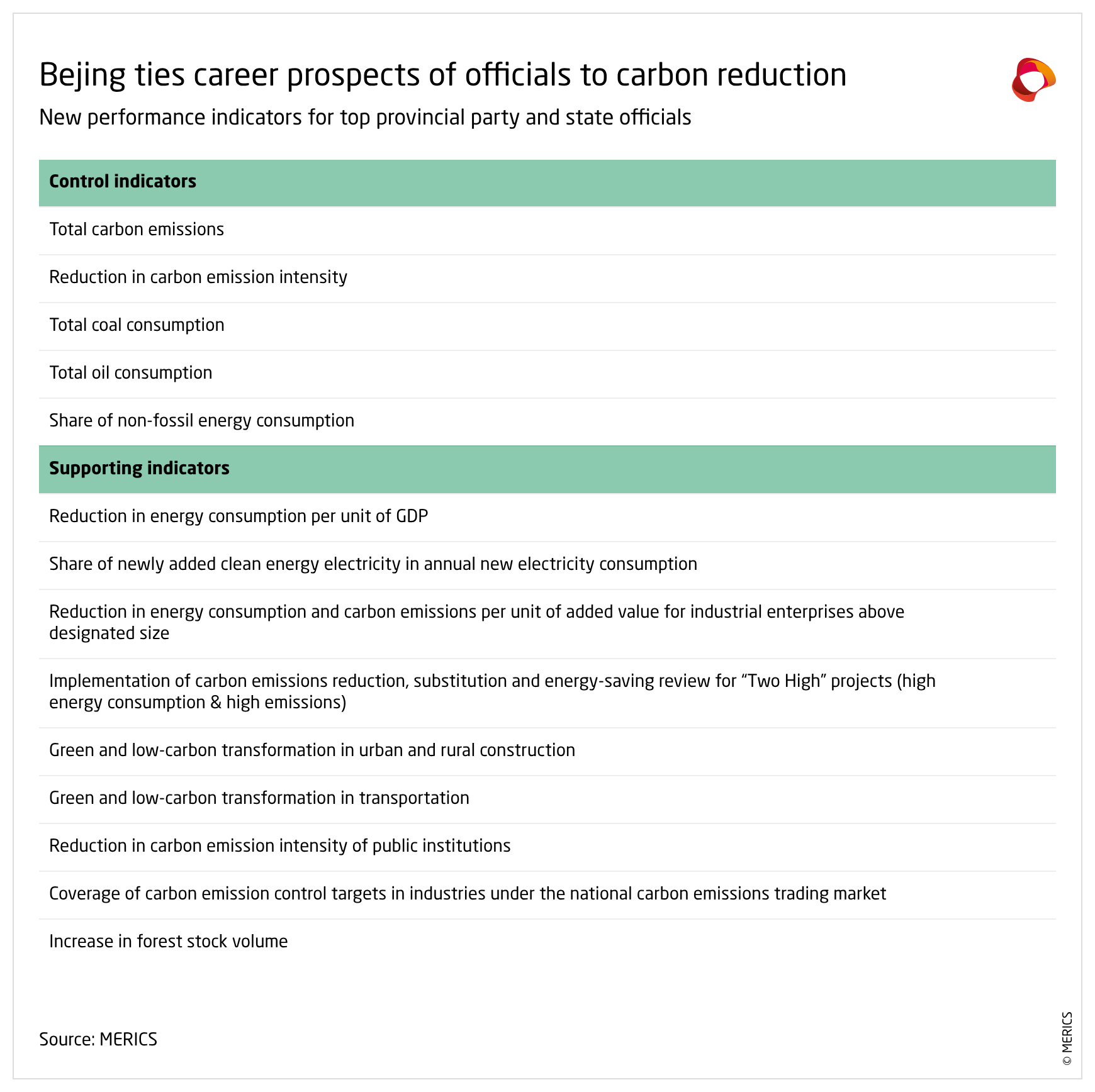
At a glance: The State Council has released measures to evaluate progress on carbon reduction at the provincial level during the 15th Five-year Plan (2026-2030). A new accountability system ties the career prospects of top provincial party and state officials to carbon reduction. Key features include:
- The introduction of five control indicators, e.g., total carbon emissions, carbon emission intensity and total coal consumption, plus nine supporting indicators, including green transportation (see exhibit 1)
- Provinces that miss one control indicator or three supporting indicators in annual assessments must propose corrective actions within 30 days. Senior officials who fail to comply will face disciplinary interviews
- Annual assessment results will be part of senior provincial officials’ performance reviews
- Officials showing gross violations of duty will face disciplinary action from, for instance, the Central Commission for Discipline Inspection (the party-state’s main body for investigating corruption).
MERICS comment: China’s performance evaluation system for public officials contains complex and sometimes contradictory indicators. They include economic growth, innovation, social stability and security, public services provision, sustainable development, environmental protection and political loyalty. For decades, economic growth has been the most important benchmark, despite some regional variations over time. A 2025 meta-analysis of more than 60 studies found economic performance correlated mostly strongly with cadre promotion, while environmental performance had only secondary effects and the impact of social stability was negligible.
The State Council’s new measures may pressure local officials to pay more attention to environmental criteria. However, they might deliver less than they seem to promise. They do not impose strict, pre-defined blanket targets across regions. Instead, provincial leaders must draft annual action plans to be reviewed by the National Development and Reform Commission (NDRC). The provincial drafts will be assessed against national goals. One major goal was to cut carbon emissions intensity by 65 percent between 2005 and 2030. Carbon emissions intensity in 2020 was already 48 percent lower than in 2005, so China can probably hit the 2030 goal without significant extra efforts. The upshot is that provincial leaders are likely to keep on prioritizing economic indicators, unless they see punishments for their counterparts in other provinces linked to these new measures.
However, European companies may face tighter environmental rules in China. They would do well to monitor the provincial-level action plans and any regulations that result from them.
Article: Measures for the Comprehensive Evaluation and Assessment of Carbon Peaking and Carbon Neutrality (碳达峰碳中和综合评价考核办法) (Link)
Issuing body: State Council
Date: April 23, 2026
2. Textile sector exemplifies how China keeps lower-value industries inside the country
At a glance: The Ministry of Industry and Information Technology (MIIT) announced it would coordinate the development of geographic clusters in the textile industry to reinforce China’s competitiveness. Provincial authorities were invited to identify eligible textile and apparel clusters by the end of June 2026. After evaluation, the selected clusters can benefit from support measures which include:
- Promotion of regional brands to strengthen the cluster’s competitive advantages and to support local skills and talent
- Support to take part in exhibitions and other activities to match supply with demand, and support to expand market share
- Training on digitalization, AI and green transformation
MERICS comment: The announcement is part of Beijing’s push to upgrade traditional industries, which features in the 15th Five-Year Plan. The leadership has pledged it will not “abandon traditional industries”, but will leverage “new productive forces” to upgrade them and build hyper-modern factories. There are similar measures in the 2026–2028 action plan on standards to upgrade the textile industry. The goal is that low-end sectors and value chains should stay within China, instead of moving to lower-wage economies as often happens when a country moves up the value chain. The MIIT’s plans for textiles are emblematic of the government’s vision for low-end industries in general. The economy cannot afford to lose jobs amidst pressure on employment. The plans also conform with a broader national security focus on keeping entire supply chains within China.
The document distinguishes two types of clusters: production-oriented “characteristic industrial clusters,” which are restricted to Inland China (central, western, and northeastern regions), and “creative design” clusters, which have no geographic limitations. This fits with a broader strategy of upgrading production capacity in inland regions (including Xinjiang, the focus of repeated human rights concerns), while encouraging higher-value design capabilities to develop in wealthier coastal regions.
The document also mentions leveraging cross-border trade with these future clusters, which suggests neighboring countries may experience greater competition from Chinese textiles.
Article: Notice of the General Office of the Ministry of Industry and Information Technology on the construction of textile industry clusters in 2026 (工业和信息化部办公厅关于开展2026年度纺织产业集聚区建设工作的通知) (Link)
Issuing body: MIIT
Date: April 16, 2026
3. Beer, wine, and liquor: China is keen to keep spirits high
At a glance: China has released a new 2026–2030 policy framework to upgrade its alcohol industry. With 21 subsections, the framework sets out measures to structure and improve the entire value chain, from growers to drinks marketing. Beijing aims to cultivate at least three competitive traditional liquor production areas by 2028, worth CNY 100 billion each, and to build more than 10 brewing industrial parks worth CNY 10 billion:
- At the cultivation stage, the framework supports the development of higher-yield plant varieties, aims to support farmers and encourages breweries to form long-term production-marketing relationships with growers.
- Industrial upgrading is addressed through support for technological innovation, including AI and green transformation and internationalization. Brewery firms, equipment manufacturers and research institutions are also being encouraged to form clusters.
- Market development is tackled with new production-sales models and quality and safety systems. Cultural storytelling is emphasized, alongside brand-building, talent development and consumer-facing promotion.
MERICS comment: The document shows China’s comprehensive approach to industrial policy is now being extended beyond traditional manufacturing. The Chinese government clearly views its approach as successful, hence it now applies the same methods it used for the actual manufacturing sector, including technological upgrading and creating industrial clusters, to other fields outside of traditional manufacturing. Its approach typifies how the current leadership envisages party-state involvement, guidance, coordination and support in every step of the process, even in non-strategic fields.
The emphasis on branding, cultural messaging and publicity suggests Beijing’s goal is to invest in strengthening of domestic products, which may lead to the sidelining of imported foreign goods. European exporters need not fear for their existing market share anytime soon, as middle- and upper-class Chinese lovers of French wine will stay loyal to its cachet. However, Chinese consumers who do not currently consume European alcohol are going to have more domestic options to choose from, which might crowd out segments European exporters may view as possible growth markets.
Article: Guiding Opinions on the Quality and Upgrading of the Brewing Industry (2026-2030) (三部门关于印发《酿酒产业提质升级指导意见(2026—2030年)》的通知) (Link)
Issuing bodies: MIIT, MOHRSS, SAMR
Date: February 14, 2026
4. Higher launch prices could make Chinese innovative drugs more profitable
At a glance: The State Council released new guidance for setting pharmaceutical prices. The document outlines planned changes to the initial pricing mechanism for newly-marketed drugs, taking different approaches to innovative drugs, improved new drugs and generic drugs. The rules allow pharma firms to determine initial drug prices taking account of factors such as clinical value, supply and demand and affordability, subject to state supervision and peer review. The policy calls on regulators to:
- Support price-setting for innovative drugs that reflects the high research and development costs and risks, and maintain price stability for a set period
- Promote a diversified payment system and reasonable pricing for innovative drugs, by expanding commercial health insurance and broadening the payment channels for innovative drugs
- Optimize the rules for the medical insurance catalogue, and negotiate prices with pharmaceuticals companies that reflect the drugs’ clinical value, provided the medical insurance fund can afford it
MERICS comment: Higher launch prices will enable innovative firms to recoup more of their investment first in the commercial market, and eventually in public healthcare schemes. While new rules mark a departure from the government’s previous focus on driving prices down, they also confirm that centralized drug procurement will remain in place for generic drugs.
Beijing is promoting commercial insurance schemes to increase domestic access to innovative treatments, which may otherwise be forbiddingly expensive for out-of-pocket payments. Domestic and multinational pharmaceutical firms alike are set to benefit from this trend. The new Commercial Health Insurance Innovative Drug List (CHIIDL), first released in December 2025, included 19 drugs. About half were from foreign firms such as Pfizer, Eli Lilly and Bristol-Myers Squibb.
However, progress is likely to be slow. As it stands, commercial health insurance currently covers only 3 percent of expenditure on innovative drugs and medical devices. The CHIIDL is a catalogue of recommended drugs, so those it lists are not automatically included in commercial insurance schemes. Local authorities and individual insurance companies with low risk tolerance may be slow to expand their coverage, waiting for price comparisons or seeking to manage cost increases.
Article: Several Opinions on Improving the Mechanism for Determining Drug Prices (国务院办公厅关于健全药品价格形成机制的若干意见) (Link)
Issuing body: State Council
Date: April 14, 2026
5. China aims for global leadership in hydrogen
At a glance: The MIIT and two other departments published a pilot workplan to expand the application of hydrogen energy in various fields. Key goals and features include:
- Achieve a drop in the average price of hydrogen to below 25 CNY/kg and raise the number of fuel cell vehicles in China to 100,000 units by 2030
- Select some urban areas with good industrial foundations as pilot areas to expand the application of hydrogen energy
- Designate hydrogen application scenarios for the pilot areas, including fuel cell vehicles, green ammonia, hydrogen-based chemical raw material substitution, hydrogen metallurgy and hydrogen-blended combustion
- Reward individual pilot areas with up to CNY 1.6 billion over four years, to be used exclusively to support the hydrogen industry
MERICS comment: Hydrogen promises advances in decarbonization, including in energy intensive sectors, like steel- and aluminum-smelting, and business opportunities in electrolyzer manufacturing and storage technologies. In transport, it looks especially promising for commercial vehicles like buses and trucks. This is why hydrogen is listed as a strategic future industry in the 15th Five-year Plan (2026-2030).
China is moving quickly to lead in the global hydrogen industry in hopes of replicating its success with EVs. Global hydrogen production was 100 megatons in 2024, with China’s share at around 30 percent, compared to less than 10 percent for Europe. There is a similar picture in electrolyzer manufacturing, where China accounts for more than half of global capacity, compared to one fifth in Europe. Green hydrogen, derived from electrolysis rather than gas or coal, make up less than one percent of global hydrogen so far. Even so, the bulk of green hydrogen is currently produced in China, where it has considerably lower production costs than elsewhere.
Europe is struggling to take on the challenge. The European Union has a goal for green hydrogen output to reach 10 megatons by 2030 but realizing it remains some way off. Europe reportedly led in global hydrogen investment in 2025, at around EUR 12 billion, but meeting its target would require a total of EUR 263 billion by 2030. It is crucial to increase public funding across member states, expand manufacturing capacity for electrolyzers and narrow the cost gap with China.
Article: Notice on Carrying out the Pilot Work of the Comprehensive Application of Hydrogen Energy (工业和信息化部 财政部 国家发展改革委关于开展氢能综合应用试点工作的通知) (Link)
Issuing bodies: MIIT, Ministry of Finance, NDRC
Date: March 25, 2026
Noteworthy
Policy news
- March 3: The MIIT and five other departments released guiding opinions on the comprehensive utilization of photovoltaic (PV) modules. Goals for 2027 include making the production of PV modules greener, more recycling and breakthroughs in key technologies, such as surface structure dismantling, efficient separation of laminated parts, and component extraction. (MIIT opinions)
- March 20: The MIIT and three other departments published a plan for the development of the energy-saving equipment industry. Goals for 2028 include breakthroughs in electric motors and load equipment, transformers, industrial heat pumps, industrial refrigeration and heating equipment, water electrolysis hydrogen production equipment and information and communication equipment. (MIIT notice)
- March 31: The MIIT and eight other departments released an action plan to promote the development of the Internet of Things industry. Goals to be achieved by 2028 include breakthroughs in key technologies such as sensing, networking, communication, and data processing, as well as a market size of CNY 3.5 trillion (about EUR 440 billion). (MIIT notice)
- April 2: The MIIT announced special actions to support the development of small and medium-sized enterprises (SMEs) with access to sufficient computing power. It strives to build an inclusive computing power service system with wide coverage and low costs by 2028 to aid SMEs in sectors such as manufacturing, education, agriculture and finance. (MIIT notice)
- April 3: The MIIT and six other departments issued an action plan to upgrade equipment in the petrochemical industry, focused on 2026 to 2029. The aim is to reduce the safety and environmental risks from older plants and to establish an annual rolling system for equipment assessments. (MIIT notice)
- April 28: The MIIT and National Data Administration published a notice on promoting synergies between artificial intelligence (AI) models and data resources in diverse fields, such as the chemical industry, non-ferrous metals, building materials, industrial machine tools, automobiles, ships, aerospace and medicine. The idea is to construct industry data sets to feed into AI models and increase their effect in driving efficiency gains. (MIIT notice)
Corporate news
- March 4: The European Commission proposed local-content rules under its Industrial Accelerator Act to strengthen manufacturing and reduce dependence on Chinese imports in sectors such as EVs, wind turbines, and steel. The plan would tie public support to European sourcing and could reshape market access for Chinese suppliers. (Reuters)
- April 1: In the first two months of 2026, China’s venture capital fundraising totaled a record CNY 86 billion, driven by heavy state-backed fundraising and a policy push into strategic technologies such as AI and robotics. Local governments, state funds, and major public institutions are steering capital toward innovation despite concerns about distortion and bubbles. (Reuters)
- April 8: TikTok said it will invest EUR 1 billion in a second Finnish data center, part of a broader European data-sovereignty push. The new facility in Lahti will expand storage for European users and reflects both regulatory pressure and the company’s effort to localize infrastructure in Europe. (Reuters)
- April 10: The China Securities Regulatory Commission has introduced a fourth set of listing standards for ChiNext, Shenzhen’s startup growth board, to make it easier for technology start-ups in emerging industries to go public. The move is part of Beijing’s broader effort to channel more funding into homegrown innovation. (Reuters)
- April 28: Chinese luxury carmaker Hongqi, owned by FAW, is in talks with Stellantis to produce vehicles at one of its Spanish plants. The plan would give Hongqi a Western European manufacturing base and speed its entry into the EU market through a Chinese-EU industrial network. (Reuters)
- April 30: Volkswagen is considering sharing European factory capacity with its Chinese joint-venture partners and bringing China-developed cars into Europe. CEO Oliver Blume framed the idea as a response to excess plant capacity and a way to compete in segments where VW is weak. (Reuters)
Author(s)



Author(s)
Content