
picture alliance / Newscom | EyePress News
Comment
Xi softens his Taiwan messaging, setting a potential trap for Trump in Beijing
China is now emphasizing its opposition to Taiwanese independence over its goal of “reunification”. Claus Soong says Beijing will read US silence on the issue as a tacit endorsement.
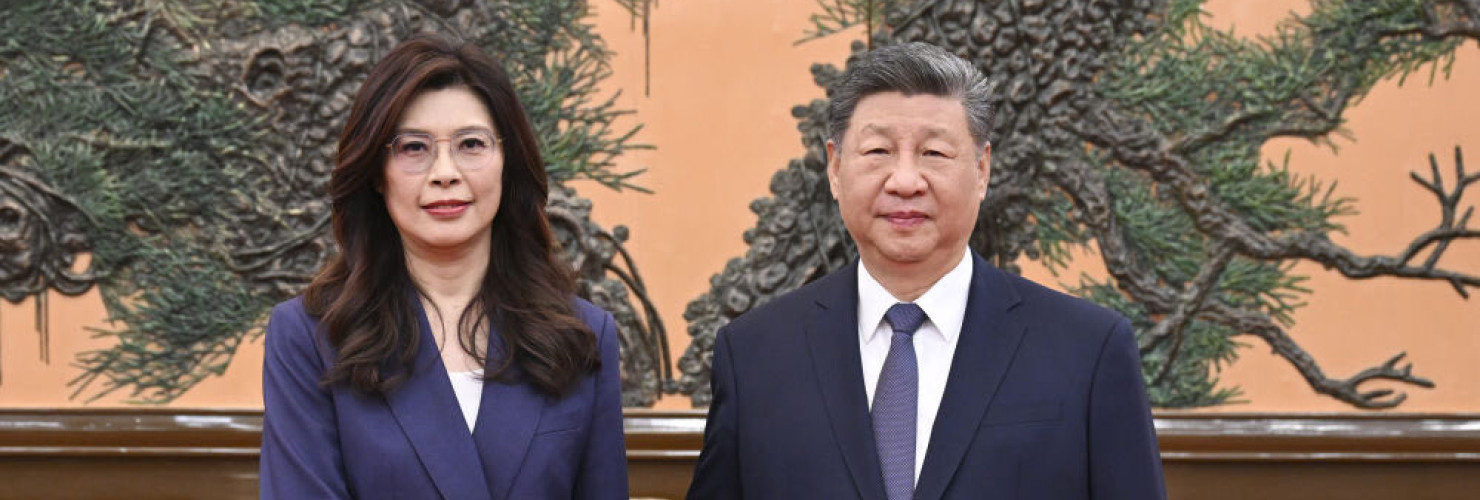
Xi Jinping’s recent meeting with Taiwan’s KMT opposition leader Cheng Li-wun signaled a tactical shift in Beijing’s “One China” narrative. The emphasis was no longer solely on “reunification”, but on opposing Taiwanese independence, a framing designed to sound less coercive and more appealing to moderate audiences in Taiwan and abroad. The shift could put US President Donald Trump in an interesting position when he visits Beijing in May: While Washington has never accepted China’s claims to sovereignty over Taiwan, it also opposes formal Taiwanese independence. Trump now risks echoing Beijing by simply restating longstanding US policy.
China is recasting its Taiwan policy
China is recasting its Taiwan policy to sound less like a maximalist demand and more like a mainstream international position. Unlike the last meeting of KMT and Chinese Communist Party (CCP) leaders in 2015, Xi avoided traditional references to “unification” or “one country, two systems” when describing the two parties’ “1992 Consensus.” These terms have become unpopular in Taiwan, especially after imposition of the National Security Law on Hong Kong and China’s aggressive military posture around Taiwan. Instead, Xi adopted more abstract language, depicting China and Taiwan as “one family” and a “community of the Chinese nation.”
Beijing has insisted on the 1992 Consensus as the foundation of cross-Strait relations – and that it will engage only with Taiwanese parties that accept it – since the pro-independence Democratic Progressive Party (DPP) returned to power in Taiwan in 2016. The Consensus was a verbal agreement that established the principal of “one China, different interpretations” (一個中國、各自表述) that allowed the CCP to emphasize the first and the KMT the latter part of the formula, enabling pragmatic cross-Straits engagement without resolving sovereignty.
Beijing sees that pushing for unification too hard is backfiring
But with the pro-independence DPP winning three consecutive presidential elections and incumbent Lai Ching-te happy to emphasize Taiwan’s de facto sovereignty, Beijing appears to have decided that pushing reunification too hard is backfiring across the Strait. Since the start of the decade, Taiwanese support for unification has remained steadily frozen below 5 percent, while support for independence has edged beyond 30 percent, according to long-running National Chengchi University surveys. The fact that the CCP and the KMT leaders are now jointly emphasizing anti-independence suggests that Beijing sees the need to break the latter trend as the priority.
Crucially, Xi gave Cheng enough political room to present her self-styled “peace mission” to Beijing as a success. Despite her well-known pro-Beijing position, Cheng’s trip did not turn into the kowtowing show of a political puppet. During her visit, she proposed that both sides built on their “1992 Consensus and opposition to Taiwan independence” to establish a “peaceful development of cross-Strait relations” and eliminate all incentives for friction. While she did not detail how such a mechanism would work, Cheng highlighted that a return to pragmatic engagement with Beijing could reduce tensions and foster peace.
This in turn allowed Beijing to show that it still holds the upper hand in cross-Strait dynamics: Despite tensions between the CCP and DDP, amicable dialogue is still possible – as long as China’s interlocutors accept key prerequisites, such as opposition to Taiwanese independence.
Cheng’s visit shows that even as Beijing and the DDP administration in Taipei refuse to engage, China can still cultivate ties with Taiwanese politicians more closely aligned with its agenda. This is meant to undercut the perception that Beijing’s political agenda has no market in Taiwan.
Beijing wants to underline that it can still engage with Taiwan directly
Critics might argue that Cheng is making a deal with the devil, as Taiwanese President Lai Ching-te warned when he said “making compromises with an authoritarian regime at the expense of sovereignty and democracy will bring neither freedom nor peace.” But with leaders from like-minded democracies such as France, Germany, the UK and Canada having visited Beijing one after another in recent months, pragmatic engagement appears to be winning over strategic rivalry. In an increasingly chaotic and fragmented international order caused by Washington’s waywardness, maintaining communication with Beijing appears to be the safer option.
By hosting Cheng so generously, Beijing also wants to underline that it can still engage with Taiwan directly without the need for Washington as a mediator. Cheng’s visit was carefully staged by Beijing ahead of the upcoming Xi–Trump meeting. Her and Xi’s joint emphasis on curbing pro-independence sentiment in Taiwan framed relations as a domestic rather than an international matter. Even if the US president says nothing about Taiwan when next in Beijing, his silence could be interpreted as tacit approval of this new narrative – and this would make it easier for Beijing to push its opposition to Taiwanese independence internationally.
Author(s)

Analyst
Author(s)
Analyst