picture alliance / Xinhua News Agency | Joan Gosa
Content
MERICS Briefs
MERICS China Essentials
EU-China trade talks + Academic espionage + Gender gap
Top Story
EU-China talks test Beijing’s resolve as EU leaders weigh tougher trade tools
The EU and China are edging towards a trade confrontation as holdouts Germany and Spain signaled they could back stronger trade measures over Chinese state subsidies and industrial overcapacity, which Brussels says make it hard for European companies to compete. Amid Chinese warnings that it would “respond firmly” to any new restrictions, EU Trade Commissioner Maroš Šefčovič was preparing to meet Commerce Minister Wang Wentao in Beijing on October 8-9 for the last high-level talks before European member states discuss responses to Chinese market distortions at a summit one week later.
French President Emmanuel Macron and German Chancellor Friedrich Merz, on October 5, sent Commission President Ursula von der Leyen a proposal to give the EU “a powerful instrument that allows for decisive and systemic reaction” against countries that systematically distort competition – including a last-resort restriction on their access to the European single market, which could only be blocked by a qualified majority. Five days earlier, Spanish Prime Minister Pedro Sánchez, hosting Macron in Madrid, had said that the EU should “seek an agreement that allows us to establish common minimum standards for our relations with third countries and major economic powers, such as China” – despite his administration’s continued push for more Chinese investment.
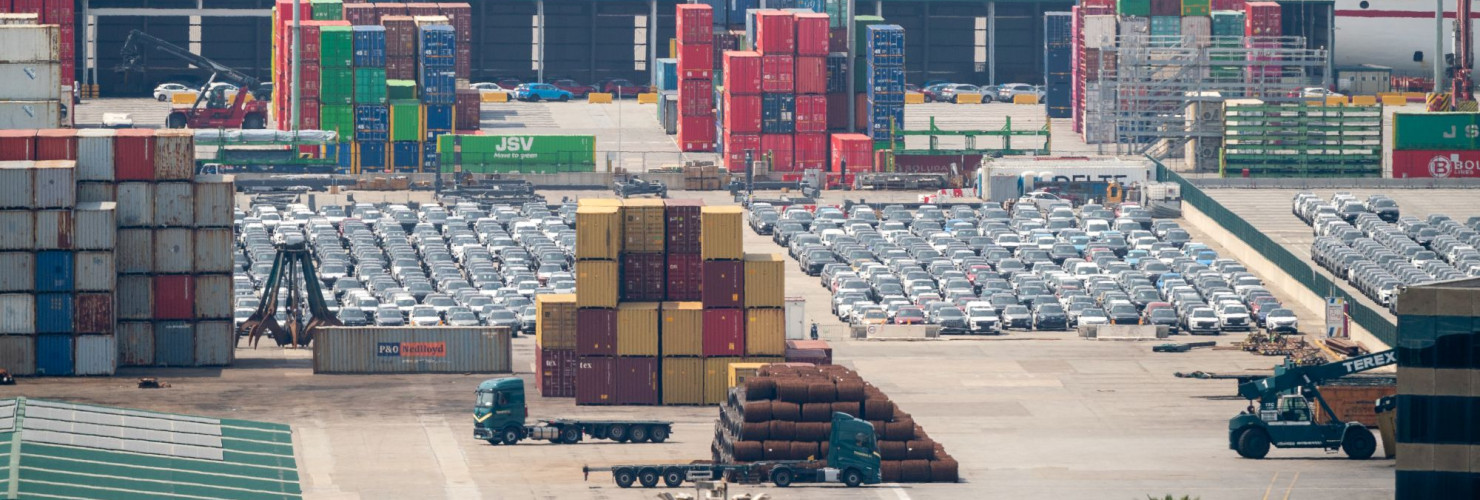
These shifts in Berlin and Madrid came against the background of China’s new customs data indicating that its goods-trade surplus with the EU had risen 13 percent year on year to 36.5 billion EUR in July 2026, driven in part by a near doubling of its surplus with Germany. Beijing has reportedly signaled its willingness to discuss reducing this imbalance but still rejects Brussels’ view that this is due to Chinese state support for industry, resulting overcapacity and barriers to European companies' access to China’s market. Wang has reportedly been willing to explore purchase agreements for European goods. But this would not address the EU’s fundamental concerns – and would echo the first Trump administration’s “Phase One” trade deal with China, whose purchase commitments Beijing ultimately missed.
“The EU and China both face substantial risks: China needs EU demand to absorb overcapacity, while the EU can’t afford China-induced de-industrialization. Finding a compromise in this dynamic remains unlikely, which is why the new trade powers championed by France and Germany could help break the deadlock and help the EU push for a change. If EU leaders back the new measures in October, proposals may take shape by December, setting up sharper tensions with China in 2027.”
Grzegorz Stec, Head of Brussels Office/Senior Analyst, MERICS
Media coverage and sources:
- POLITICO: French-German non-paper on strengthening European resilience, addressing global macroeconomic imbalances and market distorting practices
- SCMP: Last chance saloon: EU presses China for a sign to prove trade talks can work
- MOFCOM (CN): MOFCOM Spokesperson answers questions regarding media reports about EU member states promoting the European Commission to create a European version of the "301" tool
METRIX
25,204,000
This is the number of domestic train trips made on October 1, the start of China’s week-long National Day holiday, also known as Golden Week. Although a surge in travel is typical during this period, this year’s tally set a new single-day record. One reason may have been that National Day dovetailed with the Mid-Autumn Festival holiday in late September, giving savvy employees the chance to stitch together 13 consecutive days off work while sacrificing only three days of annual leave. (Source: Xinhua)
TOPICS
More tit-for-tat retaliation against European de-risking ahead of China-EU talks
The recent salvo of anti-dumping investigations between the EU and China intensifies competing narratives ahead of trade talks this week – with the EU faulting China’s economic model for distorting markets and China defending its interests against European protectionism.
China’s Ministry of Commerce (MOFCOM) on October 3 opened an anti-dumping investigation into imports from the EU of p-nitrotoluene (used in dyes and pesticides), mentioning three recent EU chemical investigations and highlighting what it perceives as a campaign against China’s chemicals industry. The EU initiated probes in September into cellulose ether, polyvinyl chloride (PVC) and acetylsalicylic acid (aspirin) imports from China.
MOFCOM framed its retaliation as necessary to rebalance because EU protectionist measures have disrupted the status quo ante. Europe is likely to see the move as an escalation after its attempts to deal with China’s export surge on the back of overproduction in state-subsidized industries. Ahead of EU-China trade discussions, and with a more concerted push by France and Germany to bolster the EU’s trade defense tools, both sides are likely to hedge their bets on successful negotiations.
“The EU and China are eyeing each other closely as they seek to defend themselves against what they perceive as disruptions to the status quo. As the EU discusses measures to boost its competitiveness and rebalance its trade with China, leaders should expect continued retaliation from China and persistent tensions.”
Sophia Pradels, Analyst, MERICS
Media coverage and sources:
- Xinhua (EN): China launches anti-dumping probe into EU p-Nitrotoluene imports
- Ministry of Commerce (CN): 商务部新闻发言人就对原产于欧盟的进口对硝基甲苯发起反倾销调查答记者问 (MOFCOM Spokesperson addresses initiation of antidumping investigation into EU imports of p-Nitrotoluene)
- Financial Times: China launches anti-dumping probe into European chemical exports
Europe tightens scrutiny over risk of inadvertent transfer of research results
Two recent European research-security incidents show how academic co-operation increasingly risks inadvertently channeling strategically important information to the Chinese state. The UK security service MI5 late September warned academic institutions that financing from the China General Technology Research Institute (CGTRI) could support its “primary purpose” of funding “research that directly improves the Chinese Ministry of State Security (MSS)’s technical capability for espionage.” In an alert the Chinese embassy in London called “baseless”, MI5 said “some” of “more than 100 UK-linked academics” who had contributed to projects “funded by MSS via CGTRI,” including work on AI and cybersecurity, may have been unaware of CGTRI’s involvement.
The warning is symptomatic of a growing wariness among European governments that research in China is increasingly tied to state objectives, including tech competition and economic security. German Research Minister Dorothee Bär a few days earlier told a parliamentary hearing that “the existing rules and systems” of the renowned CISPA Helmholtz Center for Information Security “were not suitable” for preventing research ending up in the wrong hands – including through potentially insufficiently vetted partners from China.
The disclosures by Germany and the UK mark a shift from relatively close cooperation in AI and information technology. UK-based researchers between 2017 and 2022 co-authored 17,266 AI papers with Chinese partners, while German-based ones jointly wrote about 4,400, as MERICS research has shown.
“European governments are tightening their scrutiny of research ties with China amid growing espionage concerns. Even longstanding academic partnerships that look uncontroversial are likely to face tougher questions – researchers should take note and check or double-check the partners they work with.”
Ru-Tung (Elizabeth) Sun, Analyst, MERICS
More on the topic: AI entanglements: Balancing risks and rewards of European-Chinese collaboration – MERICS Report
Media coverage and sources:
- BBC: China funding UK research and sending it to Beijing's spies, MI5 warns
- MI5: Espionage Alert
- Chinese Embassy in the UK: Press statement
- SR: Cispa-Prüfbericht offenbart Sicherheitsmängel
- Bundestag: Short statement on review of Cispa case
China inches up in gender-gap ranking, but family policies don’t yet jibe with equality goals
China made the top 100 of the World Economic Forum’s gender-gap ranking, indicating some gains in women’s equality even as the government campaigns to make marriage and family more attractive to young people. But as long as caregiving remains unequal and largely the domain of women – 76 percent of mothers being mainly responsible for children's everyday care according to a national survey – the government may have trouble reconciling these conflicting goals without more support for working families.
China outperformed other Asian countries like South Korea, Japan and India in the rankings, and its particular strength in “economic participation and opportunity” is about 10 percentage points higher than in 2006 when it last made the top 100. This suggests that women have gained ground over 20 years in the formal economy.
At the same time, China’s government is trying to respond to falling birth rates over the last decade by making it easier to get married and start a family. The government’s current Five-Year Plan combines incentives to boost births with campaigns to foster "a positive outlook on marriage and childbearing." Central authorities have also linked declining birth rates to the need for stronger child-support policies such as state-sponsored childcare, extending maternity leave and adding parental leave.
Yet, according to a recent report from the International Labour Organization, parenting care burdens in China primarily fall on women and sharing of childcare responsibilities are not adequately dealt with in social policies. The report shows women spend almost twice the amount of time as men doing unpaid work. While marriage is essential to Beijing’s desired baby boom, government policies will also have to address the unequal burden of care for children and the elderly to achieve this goal.
“China’s economic and demographic goals are not inherently at odds. But if women continue to bear most of the cost of childbearing and caregiving, efforts to raise marriage and birth rates could stymie further gains in women’s economic participation.”
Alexander Davey, Analyst, MERICS
More on the topic: When giving birth is a national duty: Beijing’s struggle to reverse demographic decline – MERICS Report
Media coverage and sources:
- SCMP: China returns to top 100 in gender parity ranking for first time since 2016
- World Economic Forum: Global Gender Gap Report 2026
- Xinhua [CN]: As of end of August, localities nationwide have processed over 920,000 marriage registrations under “nationwide portability”
- International Labour Organization Report: Balancing work and family in China’s ‘new’ economic and demographic context
- China Women’s News [CN]: Fourth survey on the social status of women in China
GRAPHIC OF THE WEEK
As the US has increasingly closed its market to Chinese goods, China has redirected its exports to other markets. Exports to the EU grew 17 percent in the first half of 2026 and reached levels unseen since 2022. Exports to ASEAN grew 26 percent, Africa 26 percent and Latin America 13 percent. But China’s relationship with these trade blocs varies. ASEAN’s growing importance reflects deeper regional production networks, with bilateral trade in intermediate goods now accounting for around two-thirds of China–ASEAN trade. Latin America, Brazil and several other regional markets primarily absorb Chinese machinery, electronics and vehicles for domestic consumption and investment, whereas Mexico also imports components for manufacturing and onward export, particularly to the US.
You can find more graphics and analyses on the topic on the MERICS China Overcapacity Monitor.
MERICS CHINA DIGEST
Volkswagen, China’s Gotion Deepen Europe Battery Partnership (Caixin Global)
PowerCo SE and Chinese battery maker Gotion High-tech Co. Ltd. have initiated agreements to establish three joint ventures in Spain, Slovakia, and Morocco. The collaboration comes into play while the EU is considering strengthening foreign investment requirements in strategic sectors, including batteries (26/10/2).
JD.com set to win EU approval for Ceconomy deal, source says (Reuters)
Chinese e-commerce firm JD.com expects to secure USD 2.5 billion bid for German electronics retailer Ceconomy. The European Commission has launched an investigation of the deal to clarify whether JD.com was granted financial advantages by Beijing to get better benefits (26/10/2).
China plans late entry into WHO leadership race, sources say (Reuters)
China has proposed Song Li as late candidate for the race towards WHO leadership. The withdrawal of US funds and Donald Trump’s public criticism of the organization gives Beijing a chance to gain influence within the UN health agency (26/10/6).
Last Friday, Russian President Vladimir Putin attended military exercises conducted in the Urals, just a day after Moscow threatened with nuclear weapons use if NATO dared to block Kaliningrad. The training involved contingents from different countries, including China (26/10/2).
China's Xi talks economy, Taiwan at reception marking National Day (Reuters)
On the 77th anniversary of the founding of the People's Republic, the Chinese presidency affirmed its opposition to Taiwan's independence and called for collective efforts to achieve economic goals. According to Xi, China should "promote the peaceful development of cross-Strait relations and advance the great cause of national reunification" (26/9/30).
US accuses California woman of spying for China, surveilling Taiwan president's son (Reuters)
The FBI arrested a woman called Wanying Zhang at LA International Airport. The U.S. accuses Zhang of being an unregistered foreign agent, spying for China. Zhang apparently surveilled the son of Taiwan´s president Lai Ching-te, Lai Ting-yu, in 2025. Beijing has not officially responded yet (26/10/5).
Huawei and Qualcomm announce broad patent license agreement (Qualcomm)
Huawei and Qualcomm announced a multi-year patent cross-licensing agreement covering 5G, computing, AI and networking. Qualcomm will also purchase certain Huawei-held US patents in computing, AI, networking and other technologies (26/10/5).
DeepSeek set to net over USD12 billion in new fundraising, source says (Reuters)
Chinese AI startup DeepSeek is set to raise more than CNY 80 billion (USD 11.9 billion) in a new funding round that could reach CNY 100 billion, according to sources familiar with the matter. The round is expected to close in October (26/10/6).
Content