
picture alliance / ASSOCIATED PRESS | Ng Han Guan
Embodied AI: China’s ambitious path to transform its robotics industry
By Wendy Chang, Rebecca Arcesati and Altynay Junusova
Please note that this report is embargoed until April 30, 2026, 10 am CEST.
Key Findings
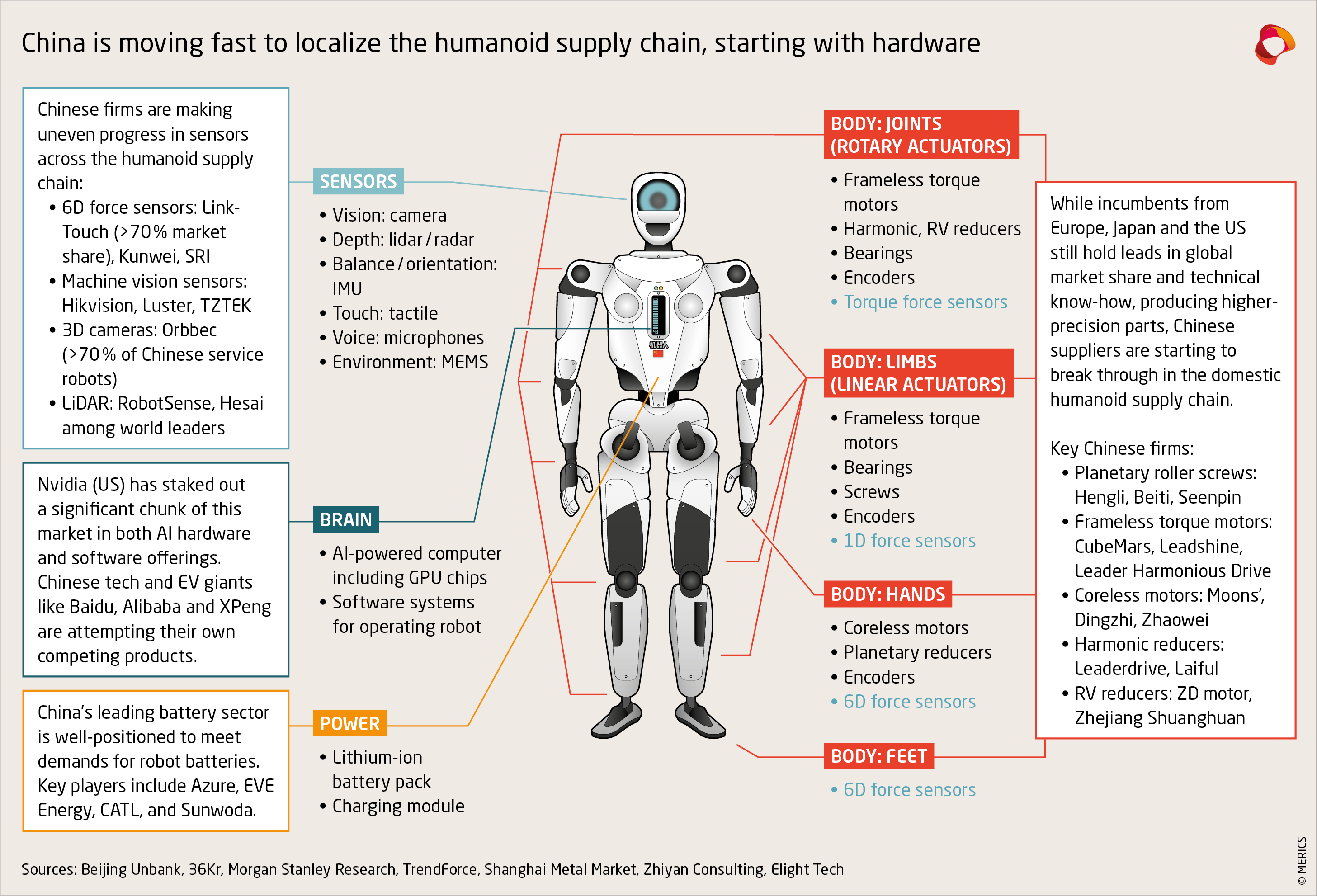
- With the world’s largest installed base of industrial robots, China is now actively exploring humanoid robotics. The sector is dependent on Nvidia’s AI chips and software ecosystem, but rapidly localizing its hardware supply chain.
- Xi Jinping’s techno-solutionism to economic, social and governance problems has created an array of national policies and funds to promote robotics, support research and development, and assist startups. Core policies envisage AI technologies and tools being diffused throughout society.
- China’s big industrial robotics sector and lead in EVs gives it an edge in developing so-called embodied AI. As the EV-makers’ supply chains already contain batteries, sensors and other components, many EV firms have added robotics to their repertoire.
- China’s humanoids still lack precision and dexterity and are mostly deployed in limited tasks and in site-specific trials. They remain far from being fully autonomous machines capable of perceiving and responding in real time in the physical world.
- China’s humanoids are cheaper than those of western competitors but still far too expensive for widespread deployment. For commercial viability, the costs would have to fall by at least half.
- China’s government is pressing ahead with its vision despite structural risks to the labor market that could jeopardize economic growth and strain the Chinese Communist Party’s social contract. It sees AI diffusion as a solution and competitive gain that is worth the risks.
- European firms could easily find themselves facing a repeat of the race for EVs, outpaced by China’s blend of industrial capacity and state support. As the sector evolves, Chinese firms may also find solutions to the high-end components they currently rely on western and Japanese firms to provide.
Embodied Intelligence: a test case for Beijing’s techno-solutionism
At this year’s Consumer Electronics Show (CES), a major industry event, which took place in January in Las Vegas, physical artificial intelligence (AI) took center stage. In the humanoid robotics section, more than half the exhibitors were from China. Meanwhile, US AI chip giant Nvidia unveiled new foundation models – AI neural networks trained on massive unlabeled datasets to handle a wide variety of tasks – and simulation platforms for AI-powered robotics.1 This is a division of labor that could shape the global economy for decades.
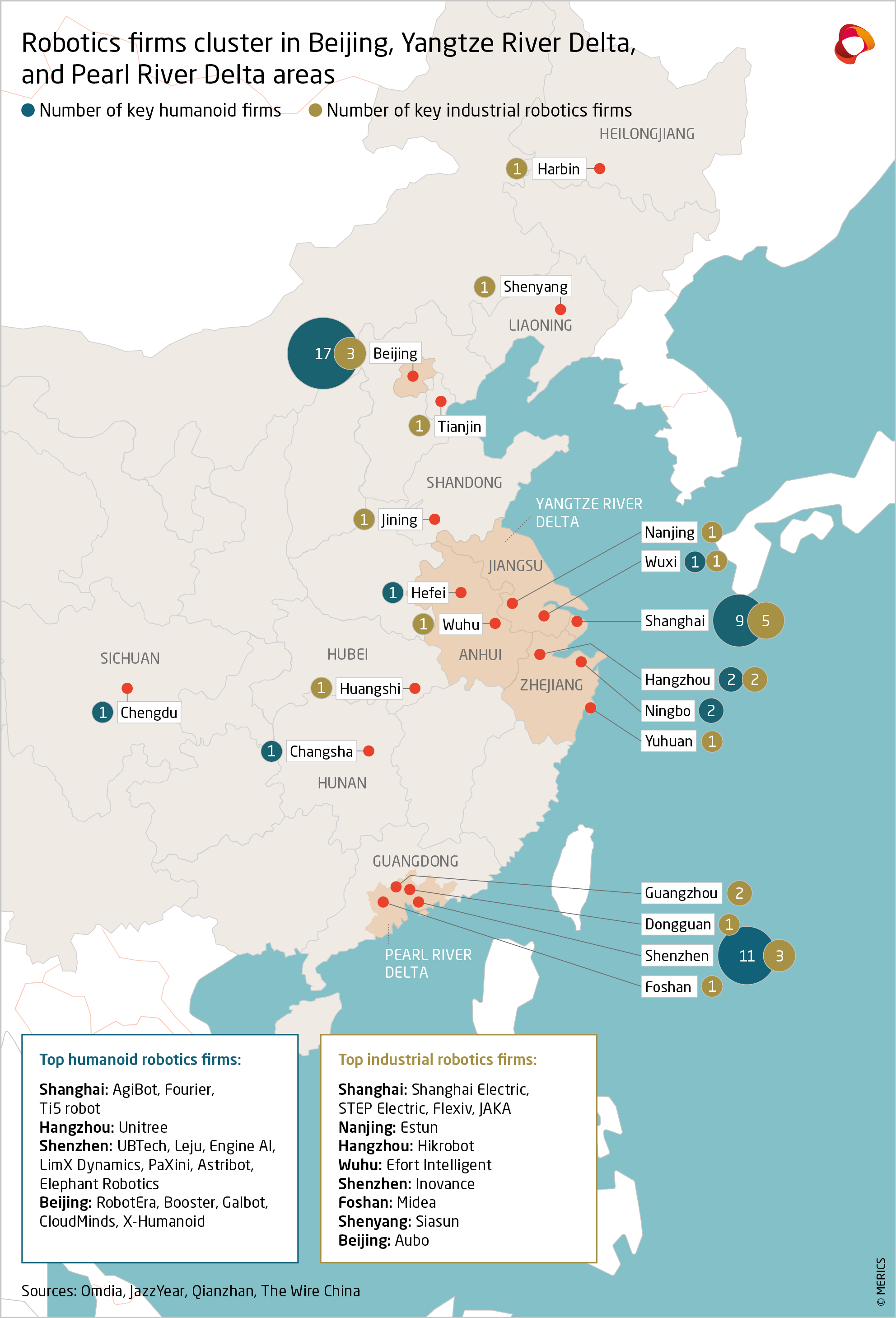
Key drivers behind China’s robot expansion include a manufacturing chain dominated by automobiles and electronics as these sectors provide easy technical crossovers, plus the economic, social and political pressures of a growing labor shortage, rising labor costs and ambitious state policies aiming to keep entire industrial value chains within China.
Physical AI enables autonomous agents to perform complex actions in the real world. For China’s policymakers, this kind of “embodied” (具身)2 artificial intelligence (EAI) is an appealing conduit for AI’s “deep integration” (深度融合) in the economic and social fabric.3 Perceived benefits include driving growth, augmenting economic and military power and (possibly) achieving artificial general intelligence (AGI).4 EAI’s strategic importance to the Chinese Communist Party (CCP) was clear from its inclusion in the 2025 annual government work report.5 It even features as a priority in the newly released 15th Five-Year Plan for China’s socioeconomic development until 2030.6
President Xi Jinping has consistently emphasized two things; that emerging digital technologies should contribute to the “real economy” (实体经济)7 and they should enable a “smart society” (智慧社会)8 under “smart governance” (智治).9 Diffusing cognitive, human-like AI within the physical world to fix domestic challenges, such as replacing a shrinking workforce, closing gaps in Beijing’s powerful surveillance infrastructure, or modernizing military systems would be consistent with this vision. China is scaling up the competition for everyone, but internally it is also staking its future on this technology.
China’s vast, diverse manufacturing base gives it an advantage in industrial robotics. The “AI Plus” national strategy (AI+) envisions robots as one of the “intelligent terminals” diffusing AI throughout China’s economy.10 Chinese robotics firms are focused on integrating AI to build robots that can think, learn, and work alongside humans.
If they succeed, the future could look like this: components from Germany and Japan go into smart robots made in China that work autonomously inside dark factories, producing massive quantities of the goods that German and Japanese companies used to make best, such as cars – with unmatched precision and at a fraction of the cost. China could then replace imports of components, software, and machine tools with its own supply chains, becoming more self-sufficient in robotics.
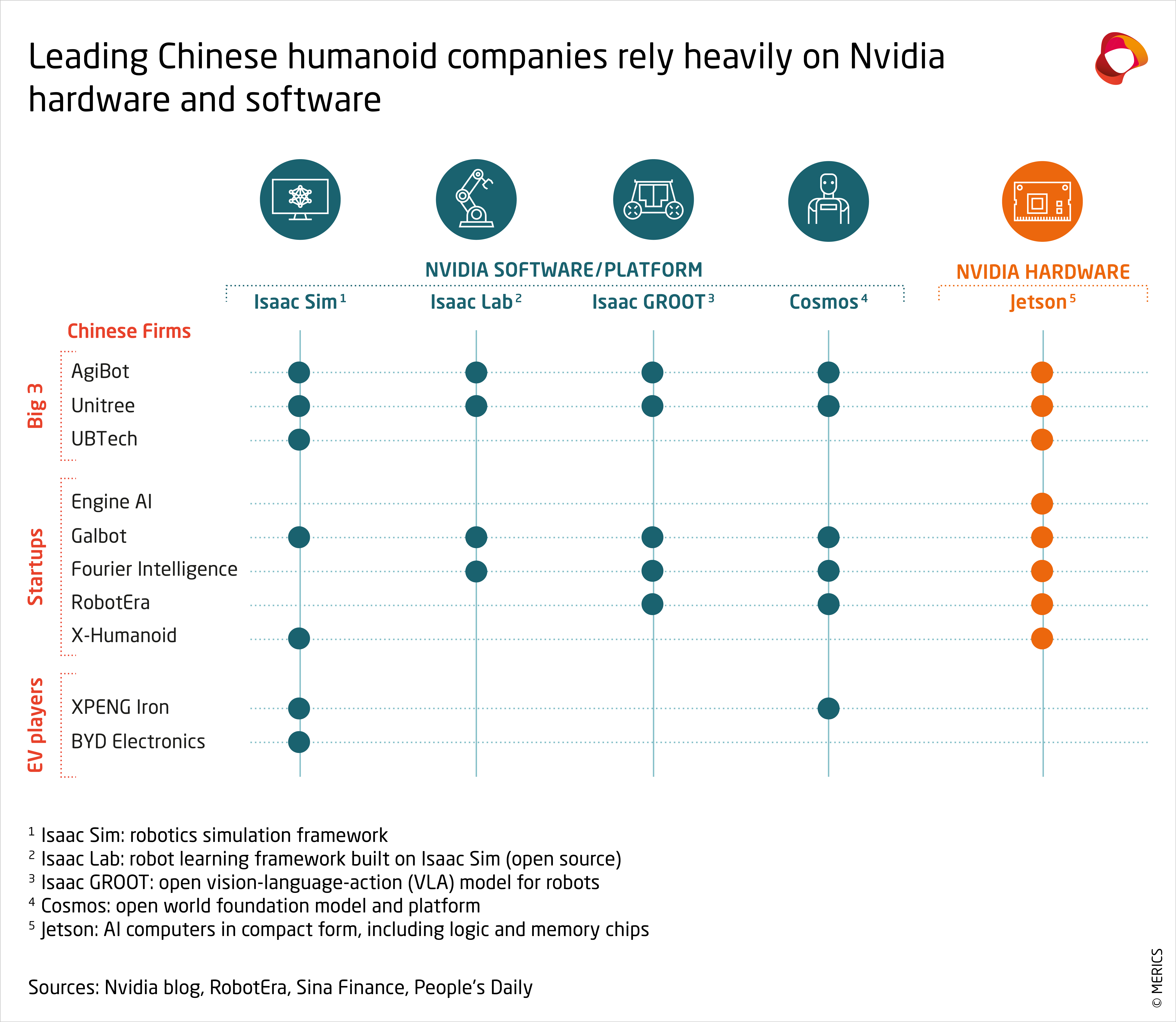
While humanoids are the shiniest face of AI embodiment, the seamless collaboration between humans and machines that Beijing envisions goes much deeper. Foundation models are reinventing robot training, as increasingly advanced AI models are being developed that understand, predict, and operate within the physical world. This field is not yet mature, but Chinese firms and research institutes are actively exploring it. However, Chinese robotics and humanoid firms remain reliant on the physical AI stack of a US technology company, Nvidia.11
AI embodiment is likely to create challenging disruptions that could strain the CCP’s social contract. China’s domestic debate on the risks to employment, and hence ultimately to growth, is becoming increasingly lively.
For Europe, the world’s boldest experiment in AI diffusion raises competitive challenges and monitoring it is vital. With its strong industrial base, leading position in robotics, and young physical AI startups,12 the continent is still very much in the game. This short report surveys China’s latest technological experiments in developing and applying EAI, focusing on industrial robotics and physical AI models. It also examines China’s advantages, weaknesses and the key risks along the way.
Towards intelligent industrial robotics: China leverages its large market and supply chains
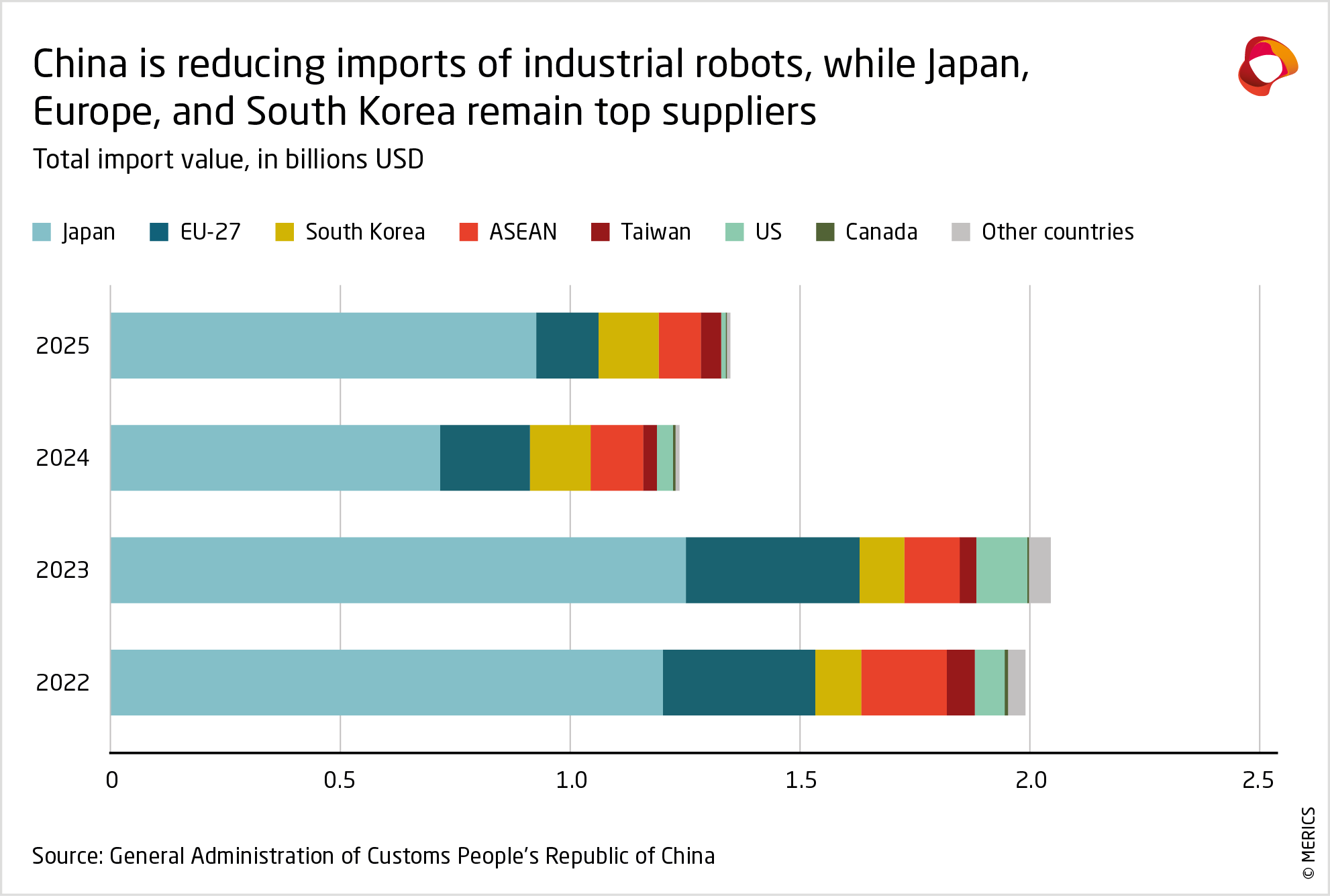
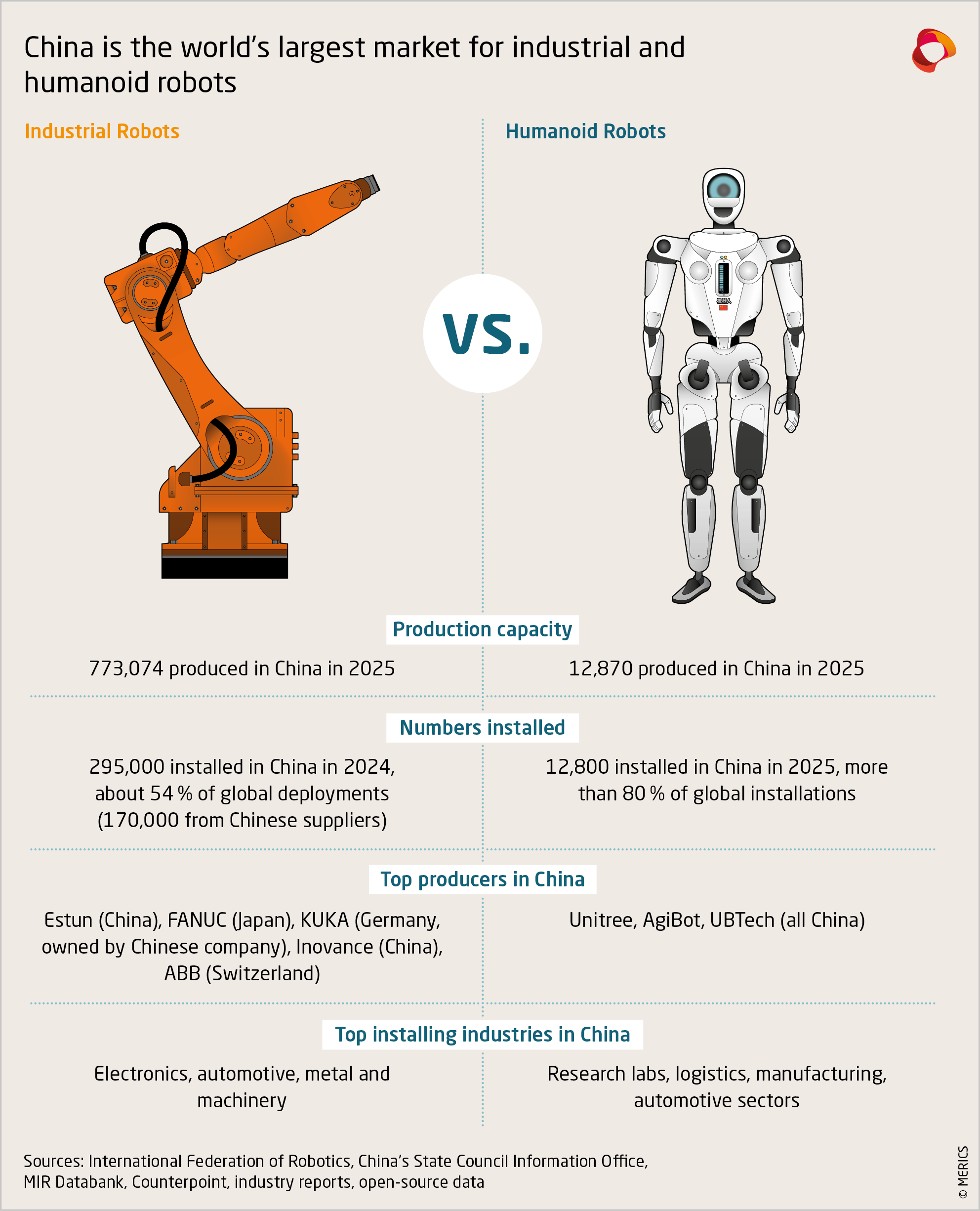
China’s industrial robotics industry is catching up to foreign competitors in both innovation and deployment. The country is already the world’s largest market for industrial robots: factories in China installed more industrial robots over the last five years than all other countries combined. The domestic market is also shifting decisively in favor of homegrown manufacturers: Chinese companies supplied over 57 percent of the domestic market in 2024, overtaking foreign competitors for the first time.13
The mass number of industrial robots deployed across Chinese factories today are quite different from the embodied AI envisioned by policy. Most are fixed, single-purpose machines built for precision in tasks like assembly, inspection, material handling, picking, and sorting. Despite being featured prominently at global tech events, humanoid robots make up a tiny segment of overall robot production.
In 2025, China produced 12,800 humanoids, about 90 percent of the global total, mainly for use in training centers, research labs, logistics, and manufacturing settings.14 It was a sharp increase over 2024, but dwarfed by annual production of industrial robots (556,000 units).15 Replacing workers with humanoids remains difficult – humanoids in Chinese factories are still “only half as efficient as humans,” according to the founder of the leading Chinese humanoid-maker UBTech. They lack dexterity and rarely exceed human performance.
Startups focused on AI-driven robotics are currently testing their prototypes in industry and not yet deploying them at full scale. Leading domestic players like Kepler Robotics’ K2 robot handles simple logistics tasks, such as carrying loads up to 30 kg.16 Similarly, UBTech is testing the Walker series humanoids in EV factories where they perform limited, task-specific functions, such as quality inspections, simple component assembly and sorting materials.17 Last year, Midea’s six-armed humanoid, MIRO U, was deployed to support assembly at its washing machine plant in Wuxi.18
China’s policy initiatives on embodied AI seek to achieve global leadership
Beijing has launched major state policies to support robotics and AI integration in industrial settings: the “Robot+” (机器人+) initiative and “AI + Manufacturing” roadmap aim to build humanoid robot pilot lines and double China’s manufacturing robot density by 2030.19 The Ministry of Industry and Information Technology (MIIT) set up the Standardization Committee for Humanoid Robots to oversee rule-setting.20 Provincial and municipal governments are pursuing different approaches, too: Shanghai’s “Action Plan for the Development of the Embodied Intelligence Industry 2025-2028,” for example, targets “algorithmic breakthroughs” in EAI.21 The central leadership has made EAI a national priority, listing it in 2025 as a target for accelerated development and as a top “new industry track” in the 15th Five-Year Plan (2026-2030).22
Central government is using a range of policy tools to hasten deployment. The recently launched National Venture Capital Guidance Fund and three regional funds (Beijing-Tianjin-Hebei) allocated CNY 1 trillion (EUR 120 billion) of investment over the next 20 years to back domestic robotics companies and other emerging technologies.23 The MIIT and local governments in Beijing, Shanghai and Shenzhen have launched innovation and testing centers for industrial applications.24 By linking academia, startups, and industrial players, the government is cultivating a full-stack ecosystem for EAI. Some provinces and municipalities subsidize up to 30 percent of project costs for innovation in automation technologies, or discounts for purchases of humanoids.25 Large robotics training centers are coordinating training data for startups in Beijing, Shanghai, and Hefei.
Beijing’s strategic, domestic security and military objectives also provide a strong supportive ground for the robotics industry, even though many firms try to distance themselves from non-civilian applications. China has a history of supporting military robotics and unmanned systems,26 with increased interest in AI platforms in recent years.27 As the national strategy of “military-civil fusion” strongly shapes innovation and technology production, companies may find it increasingly challenging to avoid defense or police ties.28
China’s policies and investments suggest it aims to become a global leader in robotics and industrial automation. As Unitree CEO Wang Xingxing has said, “Robotics is where EVs were a decade ago, a trillion-yuan battlefield waiting to be claimed.”29
Developing smart robots: hardware strengths, software weaknesses
China’s manufacturing strength in industrial robots and EVs provides a major advantage in developing embodied AI. Major EV-makers have become robotics manufacturers too, as technological overlaps enable components to be repurposed for robotics applications. EV-derived batteries are used in GAC’s GoMate robot and Spirit AI’s Xiaomo.30 Lidar and cameras developed for autonomous driving can be applied to robotics. XPeng’s Iron robot uses sensors with autonomous-driving algorithms for navigation.
China’s dominance of the EV supply chain gives domestic manufacturers a cost advantage: it controls 63 percent of the key companies in the global supply chain for humanoid-robot components.31 These include many types of actuators (components responsible for motion) and rare earths needed for high-strength permanent magnets used in actuators and robotic motors. Hardware-forward companies like Unitree can therefore develop products at less than half the price of international competitors. However, China has weaknesses in at least three areas:
First, software, particularly software for AI training, sensing, and control, remains dominated by foreign firms such as Nvidia.
Second, China remains heavily dependent on European and Japanese companies for high-end robotic components; for example, Germany’s Schaeffler and Japan’s THK and NSK provide 90 percent of special ball screws used for precise positioning applications in robotics.32 A Chinese report from ZY&YR Innovation Hub on overall competitiveness in key components (including motors, reducers, screws, sensors) ranks Japan as “A”, China and Europe as “B”, and the United States as “C”.33
Cost is an obstacle to widespread adoption of industrial humanoids, as China’s average CNY 300,000-500,000 each (EUR 36,000 – EUR 62,500). Even domestically made components remain expensive. Guotai Securities calculates humanoid’s commercial viability threshold at CNY 160,000 based on annual labor costs of CNY 80,000 and a two-year ROI period.34 China’s robotics industry needs to prioritize cost reduction, despite already having more cost-effective humanoids than western competitors. Unitree’s G1 costs around €11,650, compared to Boston Dynamics' Atlas (~ €120,000+) and Tesla Optimus (~ €25,800), comparable models.35
The third challenge is precision. Foreign industrial robot-makers like Swiss-Swedish group ABB and Japanese multinational FANUC still dominate the high-end market, whereas Chinese firms lead in low- and mid-range segments.36 Chinese humanoids struggle with multi-step coordination, fine manipulation, and hand-eye coordination tasks like cable assembly or small-part insertion.37
Today, most humanoids are used in “small-scale, single-point trials,” usually performing limited, auxiliary tasks.38 Mass deployment would require cost reduction or efficiency improvements, plus extensive scenario-based training. China’s huge manufacturing base, and policy support, could give its robotics sector an edge by evolving more testing grounds.
Kickboxing robots look good but are far from being truly autonomous
Sleek corporate videos often create the impression breakthroughs in humanoids are imminent. Many show humanoids moving freely - dancing, kickboxing, and performing tasks requiring dexterous hand movements. These impressive demonstrations are misleading as the robots are seldom acting autonomously in real time, but either preprogrammed or teleoperated.39 They remain far from being general-purpose intelligent robots that continuously take inputs from their environment then decide on actions in the physical world.
It was the rise of generative AI and large language models (LLMs) that foregrounded the idea of imbuing robots with artificial intelligence. Around 150 Chinese companies are making humanoid robots, according to the National Development and Reform Commission (NDRC).40 It is a large and varied group, focused on different aspects of robotics, whether creating humanoids with superior motor skills or large AI models of the physical world to train robots in autonomous working. Some focus on the building blocks of robotics companies, such as software development platforms and key hardware components. The field is competitive, nascent with fast developments in many directions, but characterized by active dialogue to determine the next major direction.
Autonomous robots: there is a gap between scripted automation and embodied AI
China’s robot industry (and arguably the global one too) is still in the early phases of exploring the robotic brain, or the ability to process sensor data to interact with the environment in real time. For breakthroughs in AI intelligence, it still looks to US-based research, for instance on visual-language-action (VLA) models. The ZY&YR ranking awards US companies an “A” for overall competitiveness in computation, data processing, and communication modules, and in modules such as robot hands, ahead of Chinese ones.41
The rise of LLM and multi-modal models has given robotic intelligence a new direction: end-to-end “vision-language-action” (VLA) models that can take input, feed it to a language model to interpret, then take immediate robotic actions.42 Google DeepMind originated VLA with its RT-2 model and remains a leader with Gemini Robotics. Other notable players are Nvidia’s GR00T and Stanford’s OpenVLA Figure AI’s humanoids are powered with their Helix VLA.
Chinese teams are accelerating VLA efforts, making progress in targeted areas but still lacking foundational generalist models. Leading companies include AgiBot, Galbot, and AI² Robotics. AgiBot announced its first general model GO-1 in 2025, which uses a visual-language model but is not a full VLA.43 Galbot has an intelligence-first approach and aspires to reliable, fully autonomous mobile pick-and-place tasks. Its G1 robot’s three models have narrow remits that illustrate the difficulty of building fully autonomous robots: GraspVLA for dexterous robot hands, TrackVLA for navigation and GroceryVLA for retail scenarios.44
Another developing frontier for embodied AI is the concept of world models, based on the idea that smart cars and robots need a representation of the world around them to interact with it. Although broad and ill-defined, many practitioners see world models as the way forward in EAI, beyond the predictive capabilities of LLMs. World Labs, founded by AI pioneer Fei Fei Li in San Francisco, has launched Marble to generate 3D worlds based on text and image input.45 Famed AI researcher Yann LeCun founded AMI Labs in Paris to explore his own learning framework.46 Google DeepMind, Meta, Nvidia and other leading companies are pursuing similar projects. In China, many research entities are delving into developing world models. Prominent corporate players include SenseTime,47 Huawei, and XPeng.
Gathering data to train autonomous robots is notoriously difficult, as they require multiple types of data (image, language, touch, spatial) which remain scarce, unlike the large text corpus for training LLMs. Datasets are also difficult to share, as there is little standardization in either the software or hardware models. Strategies to overcome the lack of data include attempts to use human video content to aid robot understanding. AgiBot builds dedicated facilities to generate training data by deploying robots in different scenarios.48 Galbot prefers synthesized data. Its DexGraspNet is a simulated dataset for robotic hand grasps, built using Nvidia’s Isaac Sim software.49 Unitree trains its robots in complex actions in simulation, using Nvidia’s reinforcement training framework Isaac Lab.
US company Nvidia has positioned itself as a major player in the robotics space, providing key tools for development work. Most major Chinese players are working with its products in some way.50 Nvidia’s Jetson modules are designed to be embedded in AI robots, combining its Blackwell GPUs, Isaac development platform, plus other capabilities such as sensor signal processing. Chinese robotics companies UBTech, Galbot, Unitree, EngineAI and AgiBot were among the first to receive the latest Jetson Thor module.51 Nvidia is gaining traction as an essential supplier of key building blocks of the oncoming robotics revolution, as it has in generative AI.
The strong dependence on the Nvidia ecosystem poses risks for the nascent industry in China. The GPUs used in Jetson modules have strong computation powers but relatively low memory bandwidth and lack the ability to connect to other chips, capabilities that are crucial for model training in data centers. These types of edge computing chips have not been the focus of the US export control scheme, but as they become more powerful, and as the robotics revolution wears on, that may yet change.
There is an explosion of activity in China’s autonomous robotics field, with players angling to enter the market with varied technology and market strategies. Despite lagging behind in foundational software, China’s strength in hardware could still enable economies of scale that would trigger widespread use across manufacturing and give China market dominance in the long run.
The EV race unfolded in a similar fashion. One leading Western player (Tesla) competed with many Chinese players who enjoyed state support and figured out how to make cheap vehicles; those players gradually became technologically competent and are now poised to conquer the global market.
China’s journey to embodiment carries risks – also for Europe
China’s progress and ambitions in EAI are at the heart of an important strategic question: Will the CCP’s techno-solutionist gamble pay off? President Xi Jinping has outlined an era of “tripartite integration between people, machines and objects” (人机物三元融合).52 Policy documents hail AI diffusion and EAI as panaceas for many things - industrial upgrading, efficient healthcare and elderly care, consumption stimulus and even stronger interpersonal relationships. This optimistic outlook has been a consistent feature of PRC AI policy.53
The relationship between humans and AI is mostly discussed in collaborative terms, with early AI governance principles stressing “human-machine harmony” (人机和谐).54 An August 2025 NDRC policy document about AI’s impacts on employment invites PRC citizens to think about “empowerment” (赋能范式) rather than substitution” (替代范式).55
Anxiety around embodied AI’s impact on jobs grows
For all the official talk of collaboration and harmony, the numbers tell a different story, and citizens know it. The public increasingly worries about job security amid estimates that robots could replace at least 70 percent of China’s manufacturing jobs.56 Production targets of 10,000+ humanoid units by 2025, projections of halving robot prices and China’s aggressive automation trajectory conjure an uneasy future for its workforce. Chinese experts seem concerned, especially given the country’s weak social safety net.57
Several studies conclude AI will displace jobs in China much faster than it creates them, straining employment, wages and the social security system.58 Superficially, EAI may seem the perfect fix for the aging population and shrinking labor force, but these are complex problems requiring deep economic, social, and institutional adaptation.
China’s nearly 300 million migrant workers, who typically have precarious jobs and no social safety net, could be especially vulnerable to automation.59 Another structural imbalance is the AI industry’s talent shortage of 5 million, even as youth unemployment remains high at around 17 percent and China graduates more STEM researchers than any other country.60
Policy documents, including the newly released 15th Five-Year plan, contain signs that the government, traditionally worried about social stability, is now paying more attention to potential AI-driven job losses.61 But as Xi's administration has no intention of building a welfare state, the policy solutions will need to be found elsewhere.
Beijing still bets on embodied AI as a productivity driver
Altogether, Beijing will continue to bet on EAI as a productivity driver. Its approach presupposes massive robotics investments will translate into greater manufacturing competitiveness. The CCP’s embrace of EAI rests on the core idea that AI would be an economic input. For now, the reality looks different with lots of humanoid robot companies waging a price war and burning money in an R&D-intensive industry not fully ready for commercialization.
Robotics is already linked to the wider concern about “involution” (内卷), a term describing China’s familiar cycle of self-defeating competition and low profits fueled by excessive production and a prevailing lack of standardization.62 Officials are starting to recognize the problem. Tellingly, an NDRC representative acknowledged publicly that an overcrowded humanoid market could generate overcapacity and reduced R&D funding.63 The MIIT’s new standardization committee may precipitate a cull.
But risk mitigation has a long way to go, especially given the scale of potential socio-economic disruptions. Chinese experts forecast the scale and potential impact of AI-related risks will massively increase as machine intelligence gets integrated with physical and biological agents at scale, connecting with systems like military infrastructure and power grids.64
Yet capability development is vastly outpacing safety research.65 To fill this gap, in September 2025 a team from Shanghai AI Lab, East China Normal University and Tsinghua University proposed a roadmap for “safe and trustworthy embodied intelligence” (安全可信具身智能).66
How China approaches this exercise in complex systems engineering - where the information, physical, biological and social domains intersect - will be vital to watch. The party state has some experience, having applied Chinese cybernetics in the construction of hyper-surveilled smart cities powered by digital technologies.57 Moving up from testbeds and localized applications to large-scale AI embodiment is where the major challenge will lie.
China’s hardware-first robotics revolution poses strong competition for European incumbents
Even as China’s existing industrial robotics sector grows market share domestically and abroad, Beijing is directing the field to develop AI-empowered humanoid robots at scale. European companies should monitor the supply chain and be especially alert to Chinese firms working to replace components traditionally supplied by Western or Japanese manufacturers.
China’s leading humanoid robot companies have made a strong start, building competitive robots at relatively low prices compared to Western ones. European observers should also take note of the strong collaboration between robotics companies and other industries, such as EV and battery-makers, which furthers the development of smart robots and their industrial integration.
- Endnotes
1 | Fink, Charlie (2026). “CES 2026 Closes with Robots, China, and AI Everywhere.” Forbes. January 10. https://archive.is/b4WjG. Accessed: March 23, 2026.
2 | Zhao, Xiaoguang 赵晓光 (2025). “从机器人到具身智能:人工智能的“具身化”演进.” (From Robots to Embodied Intelligence: the "Embodiment" Evolution of Artificial Intelligence). Beijing People's Congress Magazine. https://archive.is/zrrAG. Accessed: March 23, 2026.
3 | Zhai, Wei 翟伟, Hanqi Meng Hanqi 孟含琪, and Chen Song宋晨 (2025). “习近平总书记关切事丨“人工智能+”,助力产业向新行——人工智能赋能高质量发展观察之一.” (Artificial Intelligence Plus Helps Drive Industrial Transformation and Upgrading).” Xinhua News Agency. February 13. https://archive.is/g474s. Accessed: March 23, 2026; Xu, Jianwen 许建文 (2025). “抢抓人工智能发展的历史性机遇——深刻领会习近平总书记关于人工智能的重要论述.” (Seizing the Historic Opportunity for the Development of Artificial Intelligence—Deeply Understanding General Secretary Xi Jinping's Important Expositions on Artificial Intelligence). 12371.cn. February 24. https://archive.is/DwzdR. Accessed March 23, 2026; 12371.cn 共产党员网 (2026). “新引擎 向未来具身智能 大有可为” (New Engine, Toward the Future: Embodied Intelligence is Promising). 12371.cn. January 1. https://archive.is/h4XYs. Accessed: March 26, 2026.
4 | Zvenyhorodskyi, Pavlo and Scott Singer (2025). “Embodied AI: China’s Big Bet on Smart Robots.” Carnegie Endowment for International Peace. November 24. https://carnegieendowment.org/research/2025/11/embodied-ai-china-smart-robots. Accessed: March 23, 2026; Hannas, William C., Huey-Meei Chang, Valentin Weber, and Daniel H. Chou (2025). “China’s Embodied AI: A Path to AGI.” Center for Security and Emerging Technology. December. https://cset.georgetown.edu/publication/chinas-embodied-ai-a-path-to-agi/. Accessed: March 23, 2026.
5 | National Development and Reform Commission 发改委 (2025). “加速布局未来产业 打造经济发展新增量” (Accelerating the Layout of Future Industries to Create New Growth Points for Economic Development). December 4. https://archive.is/9CtJb. Accessed: March 23, 2026.
6 | State Council of the People’s Republic of China 中华人民共和国国务院 (2026). “中华人民共和国国民经济和社会发展第十五个五年(2026—2030 年)规划纲要(草案).” (Outline of the 15th Five-Year Plan (2026–2030) for National Economic and Social Development of the People's Republic of China (Draft)). https://npcobserver.com/wp-content/uploads/2026/03/15th-Five-Year-Plan-Draft_NON-FINAL.pdf. Accessed: March 25, 2026.
7 | Xi, Jinping (2022). “不断做强做优做大我国数字经济” (Continuously Strengthen, Optimize and Expand China's Digital Economy). January 15, 2026. https://web.archive.org/web/20220115112220/http:/www.qstheory.cn/dukan/qs/2022-01/15/c_1128261632.htm. Accessed: March 23, 2026.
8 | Cyberspace Administration of China 网信办 (2018). “智慧社会的美好愿景” (A Beautiful Vision of a Smart Society). December 2. https://web.archive.org/web/20250121154723/https://www.cac.gov.cn/2018-12/02/c_1123794825.htm. Accessed: March 23, 2026.
9 | Bernot, Ausma and Susan Trevaskes (2021). “Yearbook Chapter 1: Smart Governance, Smarter Surveillance.” Australian Centre on China in the World. 2021. https://www.thechinastory.org/yearbooks/yearbook-2021-contradiction/chapter-1-smart-governance-smarter-surveillance. Accessed: March 23, 2026; CMP Staff (2021). “Smart Governance 智治.” (Smart Governance). China Media Project. April 16. https://chinamediaproject.org/the_ccp_dictionary/smart-governance/. Accessed: March 23; Drinhausen, Katja and John Lee (2021). “The CCP in 2021: Smart Governance, Cyber Sovereignty and Tech Supremacy.” MERICS Papers on China. June 15. https://merics.org/en/ccp-2021-smart-governance-cyber-sovereignty-and-tech-supremacy. Accessed: March 23, 2026.
10 | China Ministry of Ecology and Environment中华人民共和国生态环境部 (2025). “国务院关于深入实施‘人工智能+’行动的意见.” (Opinions of the State Council on Deepening the Implementation of the “Artificial Intelligence +” Initiative). August 27. https://www.mee.gov.cn/zcwj/gwywj/202508/t20250827_1126207.shtml. Accessed: March 23, 2026; Chang, Wendy (2025). “China’s ‘AI+’ Drive Aims for Integration Across Sectors: A Wake‑Up Call for Europe.” MERICS. October 2. https://merics.org/en/comment/chinas-ai-drive-aims-integration-across-sectors-wake-call-europe. Accessed: March 23, 2026; Arcesati, Rebecca (2026). “China’s Next Five‑Year Bet on AI: Self‑Reliance, Diffusion, and a Lot of Hype.” MERICS Comment. February 26. https://merics.org/en/comment/chinas-next-five-year-bet-ai-self-reliance-diffusion-and-lot-hype. Accessed: March 23, 2026.
11 | Cheung, Sunny (2025). “New Gains in PRC Robotics Software & Hardware.” Jamestown Foundation. October 17. https://jamestown.org/new-gains-in-prc-robotics-software-hardware/. Accessed: March 23, 2026.
12 | Zeff, Maxwell (2025). “Yann Lecun Raises $1 Billion to Build AI That Understands the Physical World.” Wired. June 12. https://www.wired.com/story/yann-lecun-raises-dollar1-billion-to-build-ai-that-understands-the-physical-world. Accessed: March 23, 2026.
13 | International Federation of Robotics (2025). “China Tops World Record of 2 Million Factory Robots.” International Federation of Robotics Press Release. September 25. https://ifr.org/downloads/press_docs/2025-09-25-IFR_press_release_China_in_English.pdf. Accessed: March 23, 2026.
14 | Bloomberg News (2026). “Chinese Firms Dominated Global Humanoid Robot Shipments in 2025.” January 8. https://www.bloomberg.com/news/articles/2026-01-08/chinese-firms-dominated-global-humanoid-robot-shipments-in-2025. Accessed: March 23, 2026; The Robot Report (2026). “AGIBOT makes its U.S. debut with more than 5,100 robots shipped.” January 12. https://www.therobotreport.com/agibot-makes-u-s-debut-with-more-than-5100-robots-shipped/. Accessed: March 23, 2026.
15 | Pan, Junqiang 潘俊强 (2025). “中国连续12年保持全球最大工业机器人市场.” (China Has Maintained the World’s Largest Industrial Robot Market for 12 Consecutive Years). People’s Daily Overseas Edition人民日报海外版. August 4. https://web.archive.org/web/20250805184239/https://paper.people.com.cn/rmrbhwb/pc/content/202508/04/content_30092740.html. Accessed: March 23, 2026.
16 | Keplerbot 开普勒 (n.d.). “Industrial Applications.” https://archive.is/OMHan. Accessed: March 23, 2026.
17 | Junusova, Altynay (2026). “UBTech: Humanoid Robots for the Future of Manufacturing.” MERICS. March 4. https://merics.org/en/comment/ubtech-humanoid-robots-future-manufacturing. Accessed: March, 2026.
18 | Midea Group 美的 (2025). “美的超人形机器人’美罗U’首曝,六臂协同引领工业智造变革.” (Midea's Super Humanoid Robot ‘Meiluo U’ Makes Its Debut, With Six Arms Working Together to Lead the Transformation of Intelligent Industrial Manufacturing). Midea. December 4. https://www.midea.com.cn/zh/about-midea/news/news12. Accessed: March 24, 2026.
19 | Ma, Si (2026). “China Sets 2027 Goal for Breakthrough in Core AI Tech.” China Daily. January 7. https://www.chinadaily.com.cn/a/202601/07/WS695e42f2a310d6866eb32854.html. Accessed: March 24, 2026; State Council of the People’s Republic of China (2017); Webster, Graham, Rogier Creemers, Paul Triolo, and Elsa Kania (2017). “Full Translation: China’s ‘New Generation Artificial Intelligence Development Plan’ (2017).” Stanford University. August 1. https://digichina.stanford.edu/work/full-translation-chinas-new-generation-artificial-intelligence-development-plan-2017. Accessed: March 25, 2026; Xinhua News Agency 新华通讯社 (2026). “China Unveils Plan to Deepen Integration of Industrial Internet, AI.” China’s State Council Information Office. January 7. https://english.www.gov.cn/news/202601/07/content_WS695e450cc6d00ca5f9a0878b.html. Accessed: March 24, 2026; Luo, Yunpeng (2026). “Shenzhen Releases ‘Artificial Intelligence +’ Advanced Manufacturing Action Plan.” Science and Technology Daily. February 13. https://www.stdaily.com/web/gdxw/2026-02/13/content_474060.html. Accessed: March 24, 2026; Shenzhen Municipal Bureau of Industry and Information Technology深圳市工业和信息化局 (2026). “关于印发《深圳市“人工智能+”先进制造业行动计划(2026-2027年)》的通知.” (Notice on Issuing the “Shenzhen ‘Artificial Intelligence +’ Advanced Manufacturing Action Plan (2026–2027)”). February 9. https://www.stdaily.com/web/gdxw/2026-02/13/content_474060.html. Accessed: March 24, 2026.
20 | China Ministry of Industry and Information Technology工业和信息化部 (2025). “场景化、图谱化推进重点行业数字化转型的参考指引(2025版)”. (Reference Guidelines for Promoting Digital Transformation in Key Industries through Scenario-Based and Map-Based Approaches (2025 Edition)). September 9. https://archive.is/7iCfx. Accessed: March 24, 2026; Beijing Economic-Technological Development Area Management Committee北京经济技术开发区管理委员会 (2025). “5家企业代表入选人形机器人标准化技术委员会委员名单.” (Five Enterprise Representatives Selected for the Humanoid Robot Standardization Technical Committee). December 1. https://archive.ph/K2s0q. Accessed: March 24, 2026.
21 | Shanghai Municipal Science and Technology Commission上海市科学技术委员会 (2025). “《上海市具身智能产业发展实施方案》2025–2028.” (Implementation Plan for the Development of the Embodied Intelligence Industry in Shanghai, 2025–2028). August 6. https://archive.ph/KSdJH. Accessed: March 24, 2026.
22 | State Council of the People’s Republic of China 中华人民共和国国务院 (2026). “中华人民共和国国民经济和社会发展第十五个五年(2026—2030 年)规划纲要(草案).” (Outline of the 15th Five-Year Plan (2026–2030) for National Economic and Social Development of the People's Republic of China (Draft)). https://npcobserver.com/wp-content/uploads/2026/03/15th-Five-Year-Plan-Draft_NON-FINAL.pdf. Accessed: March 25, 2026.
23 | Xinhua News Agency 新华社 (2025). “国家创业投资引导基金启动.” (National Venture Capital Guidance Fund Launched). December 26. https://archive.is/KBE9W. Accessed: March 24, 2026; National Development and Reform Commission 中华人民共和国国家发展和改革委员会 (2026). “专家解读文章之二 | 国家创业投资引导基金是推动创业投资高质量发展的重要驱动力.” (Expert Interpretation Article No. 2: The National Venture Capital Guidance Fund Is an Important Driver for Promoting High-Quality Development of Venture Capital). January 5. https://www.ndrc.gov.cn/fggz/202601/t20260105_1403047.html. Accessed: March 24, 2026.
24 | Qianlong News 千龙网 (2026). “我国人工智能企业数量超6000家.” (The Number of AI Enterprises in China Exceeds 6,000). Sina Finance. January 22. https://archive.is/Er3Ss. Accessed: March 24, 2026.
25 | Feng, Coco (2025). “Beijing’s E-Town Offers Subsidies to Robot Buyers as China Embraces Humanoids.” South China Morning Post. August 4. https://archive.ph/yrhzw. Accessed: March 24, 2026.
26 | Ray, Jonathan, Katie Atha, Edward Francis et al. (2016). “China’s Industrial and Military Robotics Development.” Report Prepared on Behalf of the U.S.-China Economic and Security Review Commission. October. https://www.uscc.gov/sites/default/files/Research/DGI_China%27s%20Industrial%20and%20Military%20Robotics%20Development.pdf. Accessed: April 8, 2026.
27 | Sabbagh, Dan (2025). “Nuclear triad and ‘robot wolves’: parade shows off array of Chinese weapons.” The Guardian. September 3. https://www.theguardian.com/world/2025/sep/03/nuclear-triad-robot-wolves-china-weapons-parade. Accessed: April 8, 2026.
28 | Tang, Jane (2025). “‘The Robot Dog’s Time to Kill’: at China’s Star Robotics Firm, the Military Ties Keep Mounting.” Kharon. July 16. https://www.kharon.com/brief/unitree-robotics-china-pla. Accessed: April 8, 2026.
29 | Chen, Caiwei (2025). “China’s EV giants are betting big on humanoid robots.” MIT Technology Review. February 14. https://www.technologyreview.com/2025/02/14/1111920/chinas-electric-vehicle-giants-pivot-humanoid-robots. Accessed: March 24, 2026.
30 | Deng, Iris (2025). “China’s CATL marks trailblazing deployment of humanoid robots at scale on the factory floor.” South China Morning Post. December 18. https://www.scmp.com/tech/big-tech/article/3336939/chinas-catl-marks-trailblazing-deployment-humanoid-robots-scale-factory-floor. Accessed: March 24, 2026.
31 | Jonas, Adam, William J. Tackett, Sheng Zhong, Daniela M. Haigian, and Elizabeth J. Tso (2025). “The Humanoid 100: Mapping the Humanoid Robot Value Chain.” Morgan Stanley Research. February 6. https://advisor.morganstanley.com/john.howard/documents/field/j/jo/john-howard/The_Humanoid_100_-_Mapping_the_Humanoid_Robot_Value_Chain.pdf. Accessed: March 24, 2026.
32 | Jinyuan Sunan Fund 金元顺安基金 (2025). “丝杠:工业传动系统的‘隐形关节’,如何撬动千亿市场?” (Lead Screws: The “Invisible Joints” of Industrial Transmission Systems—How to Leverage a Hundred-Billion Market?). Sina Finance 新浪财经. August 6. https://web.archive.org/web/20260320230211/https://finance.sina.com.cn/money/fund/jjzl/2025-08-06/doc-infiztfy0863498.shtml. Accessed: March 24, 2026.
33 | Smart Computing Chip World 智能计算芯世界 (2025). “2025中国具身智能产业星图.” (2025 China Embodied Intelligence Industry Star Map). EE Times China 电子工程专辑. November 26. https://archive.is/Rv59I. Accessed: March 24, 2026.
34 | Sina Finance Market News 新浪财经市场资讯 (2025). “宁德时代打样,人形机器人变身流水线‘蓝领’,2035年市场空间或破480亿.” (CATL Sets an Example: Humanoid Robots Become Assembly Line “Blue-Collar” Workers, Market Space May Break 48 Billion by 2035). Sina Finance 新浪财经. December 18. https://archive.ph/I4nTz. Accessed: March 24, 2026.
35 | Unitree Robotics 宇树科技 (2026). “Unitree G1.” https://shop.unitree.com/en-de/products/unitree-g1?srsltid=AfmBOooYskAedYJ7O_uDrErExYpUCPxc_eKStO4j0nfXteOWxOihrXtI. Accessed: March 24, 2026; Fankhauser, Dean (2026). “Boston Dynamics Atlas Review: Specs, Price & Full Analysis.” Robozaps. March 22. https://blog.robozaps.com/b/boston-dynamics-atlas-review. Accessed: March 24, 2026.
36 | Bank United Information Network 银行联合信息网 (2025). “我国工业机器人制造业发展现状评估与前景预测研究.” (Research on Development Status Assessment and Prospect Prediction of China's Industrial Robot Manufacturing Industry). Bank United Information Network 银行联合信息网. September 17. https://web.archive.org/web/20260319092917/http:/www.unbank.info/static/pages/2063/318104.html. Accessed: March 24, 2026; Zhou, Qiang 周强, Sun Fei 孙飞, and Yuxuan Chen陈宇轩 (2025). “从‘替代人’到‘助力人’ 人形机器人或迎‘量产元年’.” (From “Replacing People” to “Helping People”: Humanoid Robots May Usher in the “First Year of Mass Production”). Xinhuanet 新华网. February 17. https://web.archive.org/web/20260302112136/https://www.news.cn/tech/20250217/518481b0ce41486ea534fbfad1a411fa/c.html. Accessed: March 24, 2026.
37 | Guotai Haitung Securities. “新一代“蓝领”:人形机器人如何站上工厂流水线——具身智能产业深度研究(七)” (The New Generation of "Blue-Collar Workers": How Humanoid Robots Are Getting Onto Factory Assembly Lines – In-Depth Research on the Embodied Intelligence Industry (Part 7)). VZkoo. December 17, 2025. https://www.vzkoo.com/document/4615306037593903104.html. Accessed: March 24, 2026.
38 | Guo, Qian 郭倩 (2025). “机器人的新工作——2025年人形机器人从‘上舞台’到‘下工厂’.” (Robots’ New Jobs: Humanoid Robots from “Stage” to “Factory” in 2025). Xinhuanet 新华网. December 23. https://archive.is/HFuAf. Accessed: March 24, 2026.
39 | Ze, Yanjie, Chen Zixuan, João Pedro Araújo et al. (2025). “TWIST: Teleoperated Whole-Body Imitation System.” arXiv. https://archive.is/w69bd. Accessed: March 25, 2026.
40 | Li, Chao 李超 (2025). “国家发展改革委11月份新闻发布会文字实录.” (Transcript of the National Development and Reform Commission’s November Press Conference). National Development and Reform Commission 国家发展和改革委员会. November 27. https://web.archive.org/web/20260107062033/https:/www.ndrc.gov.cn/xwdt/wszb/11yxwfbh1/wzsl/202511/t20251127_1401983.html. Accessed: March 24, 2026.
41 | Smart Computing Chip World 智能计算芯世界 (2025). “2025 中国具身智能产业星图.” (2025 China Embodied Intelligence Industry Star Map). EE Times China 电子工程专辑. November 26. https://archive.is/Rv59I. Accessed: March 24, 2026.
42 | Sapkota, Ranjan, Cao Yang, Konstantinos I. Roumeliotis, and Manoj Karkee (2025). “Vision-Language-Action Models: Concepts, Progress, Applications and Challenges.” arXiv. May 7. https://arxiv.org/html/2505.04769v1#S3. Accessed: March, 2026.
43 | AgiBot 智元机器人 (2025). “人形机器人自主控制新突破!VLA 驱动全身协同,行走与操作同时完成.” (New Breakthrough in Humanoid Robot Autonomous Control! VLA Drives Full-Body Coordination, Walking and Manipulation Completed Simultaneously). AgiBot 智元创新. December 17. https://archive.is/5A0XB. Accessed: March 25, 2026.
44 | Galbot 银河通用机器人 (2025). “官宣:银河通用完成新一轮11亿融资.” (Official Announcement: Galaxy General Completes a New Round of 1.1 Billion Yuan Financing). Galbot. June 23. https://archive.is/11Uwe. Accessed: March 25, 2026.
45 | Bellan, Rebecca (2025). “Fei-Fei Li’s World Labs speeds up the world model race with Marble, its first commercial product.” TechCrunch. November 12. https://techcrunch.com/2025/11/12/fei-fei-lis-world-labs-speeds-up-the-world-model-race-with-marble-its-first-commercial-product. Accessed: March 25, 2026.
46 | Chen, Caiwei (2026). “Yann LeCun’s new venture is a contrarian bet against large language models.” MIT Technology Review. January 22. https://www.technologyreview.com/2026/01/22/1131661/yann-lecuns-new-venture-ami-labs. Accessed: March 25, 2026.
47 | Wang, Xiaogang 王曉剛 (2025). “商湯王曉剛:世界模型將加快AI從數字空間進入物理世界,「悟能」想做那個橋樑.” (SenseTime’s Wang Xiaogang: World Models Will Accelerate AI’s Transition from Digital Space to the Physical World, “Wuneng” Aims to Be That Bridge). Huashengtong 華盛通. August 12. https://www.hstong.com/news/hk/detail/25081216155251756. Accessed: March 25, 2026.
48 | Tian, Zhe 田哲 (2025). “走进智元机器人上海中心,看机器人如何像人一样学习.” (Inside Agibot’s Shanghai Center, Robots Learn to Master Tasks in Human-Like Ways). 36Kr 36氪. February 3. https://kr-asia.com/inside-agibots-shanghai-center-robots-learn-to-master-tasks-in-human-like-ways. Accessed: March 25, 2026.
49 | Oliveri, Ben (2024). “Spotlight: Galbot Builds a Large-Scale Dexterous Hand Dataset for Humanoid Robots Using NVIDIA Isaac Sim.” NVIDIA Technical Blog. November 6. https://developer.nvidia.com/blog/spotlight-galbot-builds-a-large-scale-dexterous-hand-dataset-for-humanoid-robots-using-nvidia-isaac-sim. Accessed: March 25, 2026.
50 | Meng, Chen 梦晨 (2025). “黄仁勋像押注OpenAI一样押注中国机器人,英伟达首批Jetson Thor芯片给了他.” (Jensen Huang Bets on Chinese Robots Like He Bet on OpenAI: NVIDIA’s First Batch of Jetson Thor Chips Given to Him). QbitAI 量子位. August 11. https://archive.is/rTfPM. Accessed: March 25, 2026.
51 | Meng, Chen 梦晨 (2025). “售价2万5!英伟达推出机器人‘最强大脑’:AI算力飙升750%配 128GB大内存,宇树已经用上了.” (Price 25,000! NVIDIA Launches Robot “Strongest Brain”: AI Computing Power Soars 750% with 128GB Large Memory, Unitree is Already Using It). QbitAI 量子位. August 25. https://archive.is/mFXDK. Accessed: March 25, 2026.
52 | Xi, Jinping 习近平 (2021). “(受权发布)习近平:在中国科学院第二十次院士大会、中国工程院第十五次院士大会、中国科协第十次全国代表大会上的讲话.” (Authorized Release: Xi Jinping’s Speech at the 20th Academician Conference of the Chinese Academy of Sciences, the 15th Academician Conference of the Chinese Academy of Engineering, and the 10th National Congress of the China Association for Science and Technology). Xinhuanet 新华网. May 28. https://web.archive.org/web/20260318141917/https://www.xinhuanet.com/2021-05/28/c_1127505377.htm. Accessed: March 25, 2026.
53 | Webster, Graham, Rogier Creemers, Paul Triolo, and Elsa Kania (2017). “Full Translation: China’s ‘New Generation Artificial Intelligence Development Plan’ (2017).” Stanford University. August 1. https://digichina.stanford.edu/work/full-translation-chinas-new-generation-artificial-intelligence-development-plan-2017. Accessed: March 25, 2026.
54 | Arcesati, Rebecca (2021). “Lofty Principles, Conflicting Interests: AI Ethics and Governance in China.” MERICS China Monitor. June 24. https://merics.org/en/report/lofty-principles-conflicting-incentives-ai-ethics-and-governance-china. Accessed: March 25, 2026.
55 | Wang, Chunchao 王春超 (2025). “以人工智能赋能高质量充分就业.” (Empowering High-Quality and Sufficient Employment with Artificial Intelligence). National Development and Reform Commission 国家发展和改革委员会. August 29. https://archive.is/r5qQ0. Accessed: March 25, 2026.
56 | Chen, Meiling (2025). “Experts Warn of Social Security Challenges in Age of Automation.” China Daily. March 16. https://www.chinadaily.com.cn/a/202503/16/WS67d6e831a310c240449db0a5.html. Accessed: March 25, 2026; Tencent Research Institute 腾讯研究院 (2025). “中国公众对生成式AI的看法与使用行为|年度调研.” (Chinese Public Views and Usage Behavior on Generative AI | Annual Survey). September 24. https://archive.is/56QSZ. Accessed: March 25, 2026; Frey, Carl B. and Michael A. Osborne (2017). “The future of employment: How susceptible are jobs to computerization?” Technological Forecasting and Social Change 114: 254-280. Amsterdam: Elsevier; Chow, Vincent (2025). “China’s DeepSeek makes rare public comment, calls for AI ‘whistle-blower’ on job losses.” South China Morning Post. November 9. https://archive.is/DcEkh. Accessed: March 25, 2026.
57 | Cai, Fang 蔡昉 (2024). “怎样看待AI就业冲击?” (How to View the Impact of AI on Employment?). Translated by CSIS Interpret: China. July 15. https://interpret.csis.org/translations/how-to-view-the-impact-of-ai-on-employment. Accessed: March 25, 2026; Sun, Luna (2025). “As AI Disrupts China Jobs, Could a Dedicated Insurance Fund Protect Workers?” South China Morning Post. March 4. https://archive.is/FQmYx. Accessed: March 25, 2026.
58 | Lu, Yan 卢艳 and Lincui Gui 桂林翠 (2025). “人工智能技术对我国就业及收入的影响分析.” (Analysis of the Impact of Artificial Intelligence Technology on Employment and Income in China). Bulletin of the Chinese Academy of Sciences 中国科学院院刊 40(4): 642-651. May 23. https://archive.is/LlDTW. Accessed: March 25, 2026; Giuntella, Osea, Yi Lu, and Tianyi Wang (2025). “Will robots replace workers? Lessons from China.” VoxDev. March 31. https://voxdev.org/topic/technology-innovation/will-robots-replace-workers-lessons-china. Accessed: March 25, 2026.
59 | Li, Ling 李玲 (2025). “只留能用AI的人?他发声!” (Only Keep People Who Can Use AI? He Speaks Out!). Southern Metropolis Daily 南方都市报. March 9. https://archive.is/ypUOS. Accessed; March 25, 2026.
60 | Arcesati, Rebecca (2024). “China's AI future in a quest for geopolitical, computing and electric power.” MERICS. December 18. https://merics.org/en/comment/chinas-ai-future-quest-geopolitical-computing-and-electric-power. Accessed: March 25, 2026; Sina Finance 新浪财经 (2026). “AI人才缺口超500万近五年超400所高校新设人工智能专业.” (AI Talent Gap Exceeds 5 Million, over 400 Universities Established AI Majors in Past Five Years). Finance Headlines 财经头条. January 23. https://cj.sina.com.cn/articles/view/7879848900/1d5acf3c401902o2oo. Accessed: March 25, 2026; Gunter, Jacob, Eva Seiwert, Wendy Chang, and Nis Grünberg (2025). “China in 2026.” MERICS. November 27. https://merics.org/en/merics-briefs/china-2026. Accessed: April 8, 2026.
61 | Both the Five-Year Plan and the “AI+” Action Plan state that China should assess AI’s impact on jobs. The State Council of the People’s Republic of China 中华人民共和国国务院 (2026). “中华人民共和国国民经济和社会发展第十五个五年(2026—2030 年)规划纲要(草案).” (Outline of the 15th Five-Year Plan (2026–2030) for National Economic and Social Development of the People's Republic of China (Draft)). https://npcobserver.com/wp-content/uploads/2026/03/15th-Five-Year-Plan-Draft_NON-FINAL.pdf. Accessed: March 25, 2026; The State Council of the People’s Republic of China 中华人民共和国国务院 (2025). “国务院关于深入实施“人工智能+”行动的意见” (Opinions of the State Council on the In-depth Implementation of the "Artificial Intelligence +" Action). August 26. https://www.gov.cn/zhengce/content/202508/content_7037861.htm. Accessed: March 25, 2026.
62 | Qin, Sheng 秦盛 (2025). “从‘表演’到‘生意’,人形机器人行业转折点已到来?” (From “Performance” to “Business”: Has the Turning Point for the Humanoid Robot Industry Arrived?). The Paper 澎湃新闻. December 3. https://archive.is/qjtjD. Accessed: March 25, 2026; Yu, Yan 喻琰 and Rui Zhao 赵蕊 (2025). “人形机器人年销量还不足两万台,为何已经掀起了价格战?” (Why Has a Price War Started When Annual Humanoid Robot Sales Are Still Under 20,000 Units?). The Paper 澎湃新闻. November 6. https://archive.is/Dzloi. Accessed: March 25, 2026; Yu, Kai 俞凯 (2025). “姚期智院士:人工智能要从局部技能到全身协同.” (Academician Yao Qizhi: AI Must Move from Local Skills to Full-Body Coordination). ScienceNet.cn 科学网. December 15. https://archive.is/1ruLR. Accessed: March 25, 2026.
63 | Teng, Han 滕晗 (2025). “国家发改委:着力防范重复度高的具身智能产品‘扎堆’上市、研发空间被压缩等风险.” (National Development and Reform Commission: Focus on Preventing Risks such as “Piled-up” Listing of Highly Repetitive Embodied Intelligent Products and Compressed R&D Space). The Paper 澎湃新闻. November 27. https://archive.is/LByRD. Accessed: March 25, 2026; Li, Chao 李超 (2025). “国家发展改革委11月份新闻发布会文字实录.” (Transcript of the National Development and Reform Commission’s November Press Conference). National Development and Reform Commission 国家发展和改革委员会. November 27. https://web.archive.org/web/20260107062033/https:/www.ndrc.gov.cn/xwdt/wszb/11yxwfbh1/wzsl/202511/t20251127_1401983.html. Accessed: March 24, 2026.
64 | Zhang, Yaqin 张亚勤 (2024). “各国要在全球智能领域共同合作,将人工智能红线作为社会风险共同应对.” (Countries should cooperate globally in the intelligence field and jointly address AI red lines as social risks). Tsinghua University News. March 25. https://archive.is/3ql67. Accessed: March 26, 2026; Zhang, Yaqin 张亚勤 (2025). “人工智能发展的一些观点.” (Some Views on the Development of Artificial Intelligence). Tsinghua University Institute for AI Industry Research 清华大学智能产业研究院. June 6. https://archive.is/hyDVK. Accessed: March 26, 2026.
65 | Xing, Wenpeng, Minghao Li, Mohan Li, and Meng Han (2025). “Towards Robust and Secure Embodied AI: A Survey on Vulnerabilities and Attacks.” Ithaca, NY: arXiv. https://arxiv.org/abs/2502.13175. Accessed: March 26, 2026.
66 | Tan, Xin, Bangwei Liu, Yicheng Bao et al. (2025). “Towards Safe and Trustworthy Embodied AI: Foundations, Status, and Prospects.” OpenReview. September 12. https://openreview.net/pdf/a3b0eb5349f3c0dd92e21b43b04037add70c669a.pdf. Accessed: April 8, 2026.
67 | Chin, Josh and Liza Lin (2022). Surveillance State: Inside China’s Quest to Launch a New Era of Social Control. New York: St Martin’s Press.
Ackowledgements
The authors would like to thank MERICS interns and student assistants Brady Foshay, Mohammad Ali Mojtahedi and Ru-Tung Sun for their research support.