
picture alliance / Long Wei / Costfoto
Ireland: Interlocking factors shape the approach to China in science-tech innovation
You are reading the Ireland chapter of the 2026 report of the European Think Tank Network on China (ETNC) "Fragmented Europe: Dealing with China as a technology and innovation power". Go back to the main page.
By Alexander Davey, MERICS, and Niall Duggin, Department of Government and Politics, University College Cork
Ireland’s approach to China in science, technology and innovation is shaped by several interlocking factors. At its core is Ireland’s open, FDI-driven economic model. This approach is further informed by a growing set of government strategies focused on security and competitiveness, designed both to bolster that model and to support a gradual shift toward industrial policy and deeper integration within the EU single market. It is also shaped by pressure to diversify amid uncertainty surrounding the current US administration, as well as by wider efforts to build resilience in response to geopolitical instability.
Recent developments: Meeting in Beijing, open to collaboration
In January 2026, Ireland and China’s leaders met for the first time in 14 years in Beijing. Both Taoiseach Micheál Martin and President Xi Jinping made speeches about the bilateral relationship. In terms of technology, Martin highlighted Ireland’s exports to China of medical equipment, pharmaceuticals and computer services. From the Chinese side, Xi singled out artificial intelligence, the digital economy, and pharmaceuticals and health as areas for cooperation.
The readout of Xi’s speech also includes areas where the Irish side has stated it is willing to cooperate with China; in terms of science and technology, it mentions biomedicine, renew-able energy and artificial intelligence. After returning from China, Martin framed Ireland’s economic and trading relationship with China as being informed by support for accelerating the “market diversification agenda,” suggesting that diversification is an important driver of the relationship.
Ireland’s science and technology collaboration with China
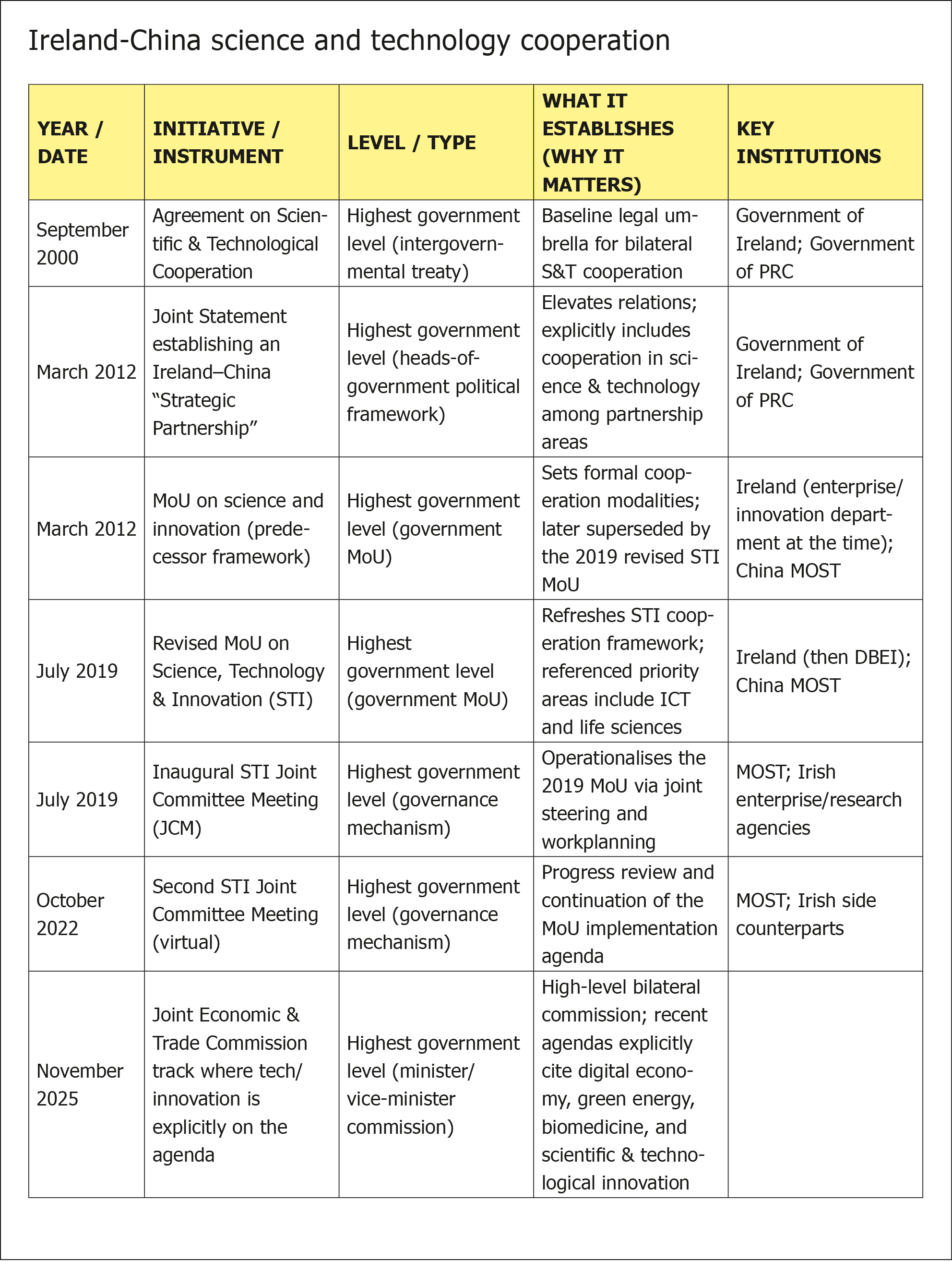
Since July 2019, Ireland and China operate a revised Memorandum of Understanding (MoU) on science, technology and innovation (STI) cooperation, with an associated Joint Committee Meeting (JCM) mechanism bringing together China’s Ministry of Science and Technology (MOST) and Irish enterprise/research agencies to steer priorities and implementation. It replaces the 2012 MoU to promote science, technology and cooperation (see Table 1).1
A notable modality since the mid-2010s is co-funded joint research calls, led on the Irish side by Science Foundation Ireland (SFI) and on the Chinese side by the National Natural Science Foundation of China (NSFC), designed explicitly to support collaborative projects in agreed priority areas.2
In 2018, several Irish higher-education institutions signed agreements with Chinese universities to deepen collaboration through joint research centres, staff exchanges, and shared funding efforts. The deals also expanded education links via new joint colleges and dual-degree programs in fields such as computer science, engineering, AI/robotics, and design.3
As a state-backed “commercialisation and scaling” channel complementing academic co-operation, a 2018 EUR 150 million cross-border growth fund was designed to support IoT/ hardware and software domains such as big data, robotics, and AI. It was established by Ireland Strategic Investment Fund (ISIF) and China’s CIC Capital to back high-growth companies seeking market access in Ireland/Europe and China, building on the earlier China–Ireland technology fund model launched in 2014 under ISIF’s predecessor (the NPRF) with China Investment Corporation (CIC).4
In terms of company-led collaboration modalities, in critical infrastructure, Irish power-systems innovation engages Chinese-linked partners mainly through international utility networks rather than formal Ireland–China bilateral frameworks. Electricity Supply Board (ESB) Networks participates in “open innovation” programs such as Free Electrons – now in its tenth year – where ESB collaborates with utility partners including China Light & Power (Hong Kong) alongside EDP, E.ON, Hydro Québec, and Origin Energy.5
Focus areas: Pharmaceuticals, drugs, Irish outward FDI to China
Pharmaceuticals and biotech: The central point of Ireland-China collaboration
The pharmaceutical sector is included here as a technology sector because Ireland has developed a strong position in high-value pharmaceutical, biotech and biopharmaceutical manufacturing, as well as in contract research expertise for clinical trials. Pharmaceutical production, particularly in biologics, involves the translation of laboratory knowledge into reproducible, regulated and globally scalable manufacturing processes. China is becoming a major global hub for biologics, biotech and advanced clinical research driven by heavy investment. In this sense, Ireland’s pharmaceutical trade with China is about Ireland’s applied technological capability and the position it inhabits in global life-science technology chains, creating opportunities for Irish and Ireland-based companies in this sector.
The pharmaceutical sector and biotech/bio medical sector have been an area of focus un-der China’s 14th and 15th Five-year plan6 with the Chinese state also attempting to develop its R&D capacity in these sectors. China has rapidly increased its clinical development infrastructure7 and has attempted to internationalize its R&D in these sectors8 under its 14th plan. China has developed many of the clinical development infrastructure that Ireland lacks and has access to a diverse patient population due to its large population size. This would make China an attractive partner to Ireland as it attempts to develop its own R&D sector. However, as much of the Irish life science sector is owned by US multinationals,9 US-China relations to a large extent would determine how much cooperation Ireland and China can have in innovative life science production.
Pharmaceuticals and biomedicine are key areas where Ireland and China’s cooperation interests overlap. Ireland is a leading actor in pharmaceutical manufacturing and plays a significant role in biotech and the wider life science sector with Ireland being the world’s third-largest exporter of pharmaceuticals.10 Ireland is home to 90 pharmaceutical companies, employing around 50,000 people of which 30,000 are employed by US companies.11
With increased pressure for Ireland-based US companies to reshore pharmaceutical and other life science production, including both R&D and manufacturing, Ireland has attempted to move up the value chain towards an innovative pharmaceutical production future by developing an “ecosystem in biotechnology and biopharma innovation.”12 While Ireland has a strong foundation for R&D in pharmaceutical and biotech, it lacks some of the clinical development infrastructure (specialist trial networks, central labs, bio banks etc) of larger actors in this area such as the US or Switzerland. This is reflected also in China’s investment in Ireland’s pharmaceutical sector, for example, WuXi Biologics’ investment in the Irish pharmaceutical sector and its focus on manufacturing with only a small R&D function.
Weight loss drugs and the China growth market
Pharmaceutical and medical products made up a 53 percent share of Ireland’s total goods exports in 2025 at EUR 138.6 billion.13 Ireland’s role in the GLP-1 boom is not only as a manufacturing location, but potentially as part of the commercial architecture through which multinational pharmaceutical companies serve global demand, including China. Eli Lilly already produces the active pharmaceutical ingredients for Zepbound and Mounjaro at its Kinsale site in County Cork, after investing USD 800 million there earlier in the decade to prepare for rising demand; sales of the two drugs more than doubled year on year in the first quarter of 2025, reaching just over USD 6 billion.14
It appears Novo Nordisk’s Athlone plant will export its Wegovy weight-loss pill into the Chinese market. Their CEO Mike Doustdar said his company will seek Chinese regulatory approval its Wegovy weight-loss pill. As oral forms of GLP-1 medicines are moving from development into commercial rollout, Novo Nordisk is committing EUR 432 million to expand its Athlone tabletting facility for oral GLP-1 products, with the company saying that the investment will increase its ability to supply present and future demand outside the United States.15
The same Athlone plant is expected to manufacture tablet Wegovy for non-US markets, at a time when oral forms of GLP-1 medicines are moving from development into commercial rollout.16 China is one obvious market where this expanded non-US capacity could matter: at least ten injectable and oral weight-loss medicines are reportedly seeking regulatory approval there, the country’s GLP-1 market is forecast to reach about USD 14 billion by 2030, and Eli Lilly has filed for Chinese approval of Orforglipron while also expanding man-ufacturing capacity in Suzhou.17
The evidence does not show that Irish sites are being built specifically for China, but it does suggest that Ireland is becoming a key production base for multinational GLP-1 supply outside the United States just as China is opening into a major growth market. If Eli Lilly and Novo Nordisk succeed in China, Ireland could benefit twice: first through high-value manufacturing activity, and second through corporation tax receipts if profits linked to these companies’ global operations continue to be booked in Ireland.
Ireland’s outward FDI: Investing in R&D in China to overcome limitations
During Martin’s visit to China, he met with client companies of Ireland’s agencies that support both outbound and inbound FDI. One such company is Orbsen Therapeutics, a regenerative medicine company with a focus on improving outcomes in diseases where inflammation drives organ damage, such as diabetic kidney disease. The meeting between Martin and Orbsen looked at potential partnerships. In 2023, Orbsen was looking to intensify efforts to secure partnerships or licensing deals to support Phase 3 development and commercialization. Orben’s presence in China is likely an evolution of these efforts.
Another company Martin met with is healthcare company Solvotrin, who – during the Taoiseach’s trade visit to China – announced a new exclusive agreement with Shanghai-based Nuance Pharma to distribute Active Iron in China,18 marking a fresh push into the Chinese market, superseding an earlier arrangement. Solvotrin makes innovative oral iron supplements for women’s reproductive health, patients with anemia or chronic disease and those who have difficulty swallowing pills – aligning with key goals of the Chinese government, namely women’s reproduction and supporting its ageing society.19
These companies’ efforts in China fit into a wider narrative of Ireland’s efforts to develop successful innovative life science companies, though this has been limited to cases such as Nuritas. To increase its role in innovative pharma and life sciences, Ireland would need future development of national centres, biotech facilities, digital adoption, as well as a radical reform of its regulatory authority capacity to speed up the overall process. This would require increased investment both in terms of capital but also state capacity.20
Ireland faces further natural challenges due to its small population size such as not having a diverse patient population and would require having strategic partnerships to overcome this limitation on its R&D potential. The result is that Ireland will always need to have inter-ational cooperation to develop an innovative life science sector and therefore would need an international trade system to ensure open and free trade.
Outlook: Geopolitical instability could put Irish sci-tech cooperation with China under pressure
Cooperation between Ireland and China in areas such the pharmaceutical sector, biotech/ bio medical sector and in green tech are set to continue to grow in the near future. The CCP has set the pharmaceutical sector and biotech/bio medical sector as priority areas for growth over the next five years and in terms of manufacturing Ireland is a key hub for these sectors, which may push the two countries to cooperate in this area. Ireland under its Government’s Action Plan on Market Diversification see China as a key market. Minister for Foreign Affairs Helen McEntee has framed diversification as a response to current trade pressures, including tariffs, arguing that Ireland needs to make greater progress in sectors such as medical technology by exploring new markets.28
However, the Irish sector is dominated by foreign multinational companies whose own states may have increased tension with China. The result is that the Irish Government will come under increased pressure to ensure there are safeguards to reduce risk that these companies may face from Ireland’s cooperation with China in this area. Irish-Chinese collaboration in AI may also fall under this framework, with Irish industry involvement in the different aspects of AI development also being dominated by foreign multinational companies.
As one of the most energy import dependent countries in the EU with limited diversity of supply,29 the need to invest in diverse renewable energy resources means that Ireland is likely to increase its green tech cooperation – particularly in solar and wind energy – with China. In these areas China is a leading provider, and as the Irish energy grid is state owned there are fewer external factors to manage. However, Ireland will by 2028 have a direct connection to the French energy grid,30 and an increase in offshore windfarms will make this issue more complex.
The cooperation in science and technology reflects Ireland’s wider relationship with China, attempting to balance between a security focus and a competitiveness focus. Moving forward, Ireland’s policy towards China will be faced with this balancing act.
- Endnotes
1 | “Signing of the Ireland-China MOU to Promote Science, Technology and Innovation Cooperation,” Gov.ie, July 15, 2019, https://www.gov.ie/en/press-release/e86ed7-signing-of-the-ireland-china-mou-to-promote-science-technology-and-i/
2 | Science Foundation Ireland, “Science Foundation Ireland–National Natural Science Foundation of China International Partnership Programme,” February 13, 2017, https://www.sfi.ie/funding/ funding-calls/sfi-nsf-china-partnership/21-SFI-NSFC-Partnership-2017-Call-Document.pdf
3 | “Irish Universities Open AI Research Doors to China with Signing of Agreements,” IDA Ireland, November 2, 2018, https://www.idaireland.com/latest-news/press-release/irish-universities-open-ai-research-doors-to-china-with-signing-of-agreement
4 | National Treasury Management Agency, “ISIF and China’s CIC Capital Announce €150 Million Fund to Focus on High-Growth Companies Seeking Access to Irish and Chinese Markets,” Ireland Strategic Investment Fund, March 16, 2018, https://isif.ie/news/isif-and-chinas-cic-capital-announce-150-million-fund-to-focus-on-high-growth-companies-seeking-access-to-irish-and-chinese-markets
5 | Nicholas Tarrant, ESB Networks Innovation 2026 (ESB Networks, 2026), https://www.esbnet-works.ie/docs/default-source/database-documents/esb-networks-consultation-innovation-2026--innovation-to-deliver-networks-for-net-zero.pdf
6 | PRC Government, “Outline of the 14th Five-Year Plan for National Economic and Social Devel-opment and the Long-Range Objectives to 2035 of the PRC,” March 13, 2021, https://www.gov. cn/xinwen/2021-03/13/content_5592681.htm PRC Government, “Outline of the 15th Five-Year Plan for National Economic and Social Development of the PRC,” March 13, 2026, https://www.gov.cn/yaowen/liebiao/202603/content_7062633.htm
Biomedicine is named as one of the strategic emerging industries for the government to develop and strengthen in the new five-year plan. The clinical application of innovative drugs also features as part of the plan’s development of strategic products and services.7 | “How China Is Changing the Clinical Development Landscape,” DIA Global Forum, October 1, 2019, https://globalforum.diaglobal.org/issue/october-2019/how-china-is-changing-the-clinical-development-landscape Bruce Liu et al., “China’s Trial Advantage: Tracking Nation’s Growth in Pharma Innovation and Global Investment,” PharmExec, May 21, 2026, https://www.pharmexec.com/view/chinas-trial-advantage-tracking-nation-s-growth-in-pharma-innovation-and-global-investment
8 | Institute of Drug Regulatory Science at Tsinghua University and PharmaCube, “China’s In-novative Drug Industry from a Global Perspective: A Decade of Review and Outlook,[CN]” PharmaCube, March 17, 2025, https://bydrug.pharmcube.com/report/detail/3ca5bf61e7c-f45a787c99df045386f12 Bruce Liu et al., “Navigating Cross-Border Pharma Deals: Key Trends and Lessons Out of China,” PharmExec, February 12, 2025, https://www.pharmexec.com/view/navigating-cross-border-pharma-deals-key-trends-and-lessons-out-of-china
9 | John FitzGerald, The Irish Pharmaceutical Sector (ESRI, 2025), https://doi.org/10.26504/rn20250301.
10 | “Key Players in Ireland’s Pharmaceutical Manufacturing Space,” IDA Ireland, July 9, 2025, https://www.idaireland.com/latest-news/insights/pharmaceutical-manufacturing-companies-ireland
11 | Brian O’Donovan, “Why the Pharmaceutical Sector Is So Important to Ireland,” RTÉ News, April 1, 2025, https://www.rte.ie/news/business/2025/0401/1505311-pharma-sector/
12 | IDA Ireland, “The Future of Biopharma in Ireland,” December 3, 2025, https://www.idaireland.com/latest-news/insights/the-future-of-biopharma-in-ireland
13 | Central Statistics Office, “Key Findings: Goods Exports and Imports December 2025,” CSO, February 17, 2026, https://www.cso.ie/en/releasesandpublications/ep/p-gei/goodsexportsandimportsdecember2025/keyfindings/
14 | John Campbell, “Weight Loss Drug Demand in US Drives Ireland’s Exports,” BBC News, June 19, 2025, https://www.bbc.com/news/articles/c23gkrej2y0o
15 | Catherine Eckford, “Novo Nordisk Expands Oral GLP-1 Manufacturing Capacity in Ireland,” European Pharmaceutical Review, March 2, 2026, https://www.europeanpharmaceuticalreview.com/news/novo-nordisk-expands-oral-glp-1-manufacturing-capacity-in-ireland/1131739.article, Andrew Silver, “Novo Nordisk to Seek Approval Soon to Sell Wegovy Pill in China,” World, Reuters, June 16, 2026, https://www.reuters.com/world/novo-nordisk-seek-regulatory-approval-wegovy-pill-china-soon-says-ceo-2026-06-16/
16 | John Campbell, “Weight Loss Drugs: €400m Tablet Factory to Be Built in Ireland,” BBC News, March 2, 2026, https://www.bbc.com/news/articles/cx24g89ewmeo
17 | Julie Zhang, “China’s Obesity Drug Makers Take on Global Giants as Novo Nordisk Patent Expires,” South China Morning Post, March 26, 2026, https://www.scmp.com/business/china-busi-ness/article/3347869/chinas-weight-loss-drug-makers-take-global-giants-novo-nordisk-patent-expires
18 | Emer Walsh, “Cork’s Solvotrin Therapeutics and Nuance Pharma Partner to Launch Iron Supplement in China,” Irish Examiner, January 8, 2026, https://www.irishexaminer.com/business/companies/arid-41772131.html
19 | Dominic Coyle, “Supplements Group Solvotrin Raises €6.7m to Fund China, US Expansion,” The Irish Times, November 2, 2020, https://www.irishtimes.com/business/health-pharma/supplements-group-solvotrin-raises-6-7m-to-fund-china-us-expansion-1.4397018
20 | Dermot O’Leary, The Irish Pharmaceutical Sector in Ireland (Goodbody, 2026), https://www.goodbody.ie/corporate-news-and-media-insights/the-irish-pharmaceutical-sector-in-ireland/
21 | Department of Enterprise, Tourism and Employment, “Public Consultation on National Life Sci-ences Strategy,” Gov.ie, October 24, 2025, https://www.gov.ie/en/department-of-enterprise-tourism-and-employment/consultations/public-consultation-on-national-life-sciences-strategy/
22 | Department of Enterprise, Trade and Employment, Silicon Island: Ireland’s National Semicon-ductor Strategy, May 19, 2025, https://enterprise.gov.ie/en/publications/publication-files/silicon-island-a-national-semiconductor-strategy.pdf
23 | Department of Enterprise, Tourism and Employment, “Powering Prosperity: Ireland’s Offshore Wind Industrial Strategy,” March 8, 2024, https://enterprise.gov.ie/en/publications/powering-prosperity.html
24 | Department of Defence, “National Maritime Security Strategy 2026–2030,” Gov.ie, February 25, 2026, https://www.gov.ie/en/department-of-defence/publications/national-maritime-security-strategy-20262030/
25 | Department of Climate, Energy and the Environment, “Critical Raw Materials Act Enters into Force,” Gov.ie, May 23, 2024, https://www.gov.ie/en/department-of-climate-energy-and-the-envi-ronment/press-releases/critical-raw-materials-act-enters-into-force/
26 | Houses of the Oireachtas, “Critical Infrastructure Bill 2026, No. 37 of 2026,” Houses of the Oireachtas, April 8, 2026, https://www.oireachtas.ie/en/bills/bill/2026/37
27 | Government of Ireland, Government Action Plan on Market Diversification (August 2025), https://enterprise.gov.ie/en/publications/publication-files/government-action-plan-on-market-diversification.pdf
28 | Helen McEntee, “Trade Promotion, Thursday, 26 March 2026, Parliamentary Questions, 34th Dáil,” Houses of the Oireachtas, March 26, 2026, https://www.oireachtas.ie/en/debates/question/2026-03-26/75
29 | Department of Climate, Energy and the Environment, “Energy Security in Ireland to 2030,” Gov. ie, November 14, 2023, https://www.gov.ie/en/department-of-climate-energy-and-the-environment/publications/energy-security-in-ireland-to-2030/
30 | “Celtic Interconnector,” EirGrid, accessed May 22, 2026, https://www.eirgrid.ie/celticinterconnector