
picture alliance / CFOTO
Comment
China moves to unite national market to curb cut-throat competition at home
Alexander Davey says Beijing is finally tackling entrenched fragmentation, creating both immediate and long-term opportunities for Europe. This article is part of our series on China’s 15th Five-Year Plan, which the National People’s Congress is scheduled to adopt in early March.
The Chinese Communist Party’s (CCP) leadership has elevated the creation of a “unified national market” from a technocratic slogan to a top-tier political priority – and the National People’s Congress (NPC) looks to set enshrine this goal in its 15th Five–Year Plan (FYP) in March. Policymakers are positioning themselves to cut the Gordion knot of national, regional and communal interests that has left China a jumble of dozens of provincial markets and hundreds of local ones – an economic patchwork at odds with a unitary political system.
The CCP’s Central Committee pledged to “eliminate local protectionism and market segmentation” and “ensure that the underlying institutions and rules of the market are unified across the nation” when it issued its recommendations for the 15th FYP in October 2025. In doing so, it has given China’s party state a timely playbook for a world of rising trade barriers: Unifying the domestic market is meant to shift economic demand and adjustment inward, allowing excess supply, labor, and capital to be reallocated nationally rather than shielded locally, reducing over-competition, domestic price wars and the reliance on exports.
Easing cut-throat competition within China is needed to boost the domestic economy
Easing so-called economic involution would boost China’s domestic economy by consolidating industry, creating room for healthier pricing of goods and services, and higher wages. It would also reduce pressure on China from countries whose industries are threatened by its export glut. European Commission President Ursula von der Leyen warned about the EU’s problems with “overcapacity in China’s economy” – specifically in steel, solar panels, electric vehicles (EVs), batteries – at the EU-China Summit in Beijing in July 2025.
China’s overcapacity problem is stark. According to the International Energy Agency (IEA), it accounted for 60 percent of global water-electrolyzer production capacity (for making hydrogen) in 2023, about 25 gigawatts per year, compared with demand of only 2.5 GW. The country was also home to 85 percent of global battery-cell production capacity of about three terawatt-hours in 2024, almost three times the global EV stationary storage demand. On top of that, the OECD found in 2025 that China’s steel makers receive subsidies at ten times the level seen in OECD countries, incentivizing commercially unviable investment and excess capacity.
Yet overcapacity is less the result of national policy than a side-effect of how the Chinese state functions, a problem with roots stretching back to the earliest years of reform and opening. Since the 1980s, local officials have been judged primarily on their ability to deliver economic growth, creating strong incentives to protect and promote homegrown champions. Local governments set up economic barriers to stop scarce resources from flowing into other regions and to discourage or block products from other regions from being sold locally.
Gap between central goals and local interests remains a problem
The persistent gap between central aims and local actions has become a defining feature of China’s political economy. Fiscal reform in 1994 only compounded the problem by allocating a larger share of tax revenues to the central government, leaving local governments scrambling to make up for this structural shortfall. One popular way to raise funds was to sell land-usage rights to developers for property construction – and it was successful until the subsequent valuation bubble burst at the start of the decade. That saw local governments turn to private and state-owned companies as the main drivers of local economic growth.
This symbiotic relationship has created a slew of regionally protected national champions. Local tax breaks, subsidies and regulatory leniency helped these companies succeed. But they also foster zero-sum competition among regions, with localities undercutting each other to create artificial cost advantages, fragmenting what should be a huge national market. China’s National Development and Reform Commission has since April 2025 revised or repealed some 2,300 local or regional rules for non-compliance with national laws.
With trading partners increasingly concerned about China’s export glut, Beijing now has strong incentive to reduce its reliance on external demand by finally making its domestic market more integrated, efficient and competitive. Wang Bohua, Honorary Chairman of the China Photovoltaic Industry Association recently spelled out the costs of continued market fragmentation: "Without rigorous rectification of vicious involutionary competition, China cannot establish a unified domestic market, nor effectively stimulate domestic demand, leaving us ill-prepared to navigate the volatile global political-economic landscape.”
Xi remains intent on unifying China’s market as well as regulatory systems
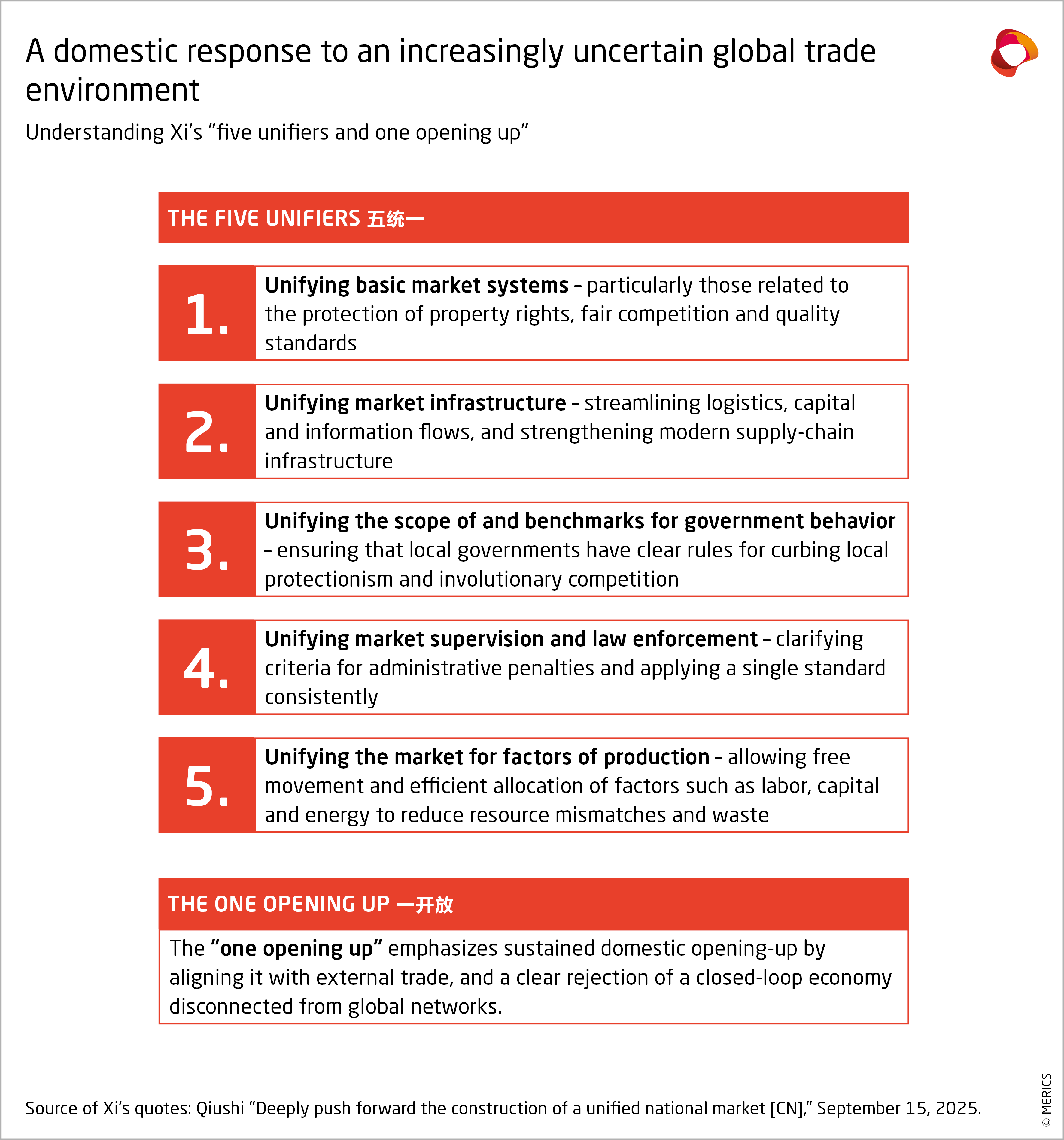
The new top-level slogan – “five unifiers and one opening up” (Exhibit 1)– has since mid-2025 signaled Xi Jinping’s intent to unify not only China’s market, but also its legal, fiscal, technological and regulatory systems. He knows this is needed to shift to a growth model that relies more on domestic consumption, efficient resource allocation and innovation. Direct instructions from the CCP to local and regional cadres as well as legal campaigns and implementing rules from Beijing show his resolve – and the persistence of the problem.
Europe should, for the moment, pursue a two-track response – preference and stockpile. It needs to sharpen industrial strategy to support priority sectors as they contend with China’s export wave. But instead of viewing China’s overcapacity solely as a problem, Europe should also see it as an opportunity to leverage China’s cut-throat price competition and secure strategically important goods at bargain prices. But this window will close at a speed proportional to Beijing’s success in unifying its domestic market. This should lead to the price of Chinese goods rising again and the pressure on European companies diminishing.
Author(s)

Analyst
Author(s)
Analyst