

picture alliance / NurPhoto | Ying Tang
Comment
China’s next five-year bet on AI: Self-reliance, diffusion, and a lot of hype
Artificial Intelligence is set to be a key theme in the 15th Five-Year Plan. For Beijing, it is unlike any other general-purpose technology. But the all-in embrace of AI is no guarantee of success, says Rebecca Arcesati. This article is part of our series on China’s 15th Five-Year Plan, which the National People’s Congress is scheduled to adopt in early March.
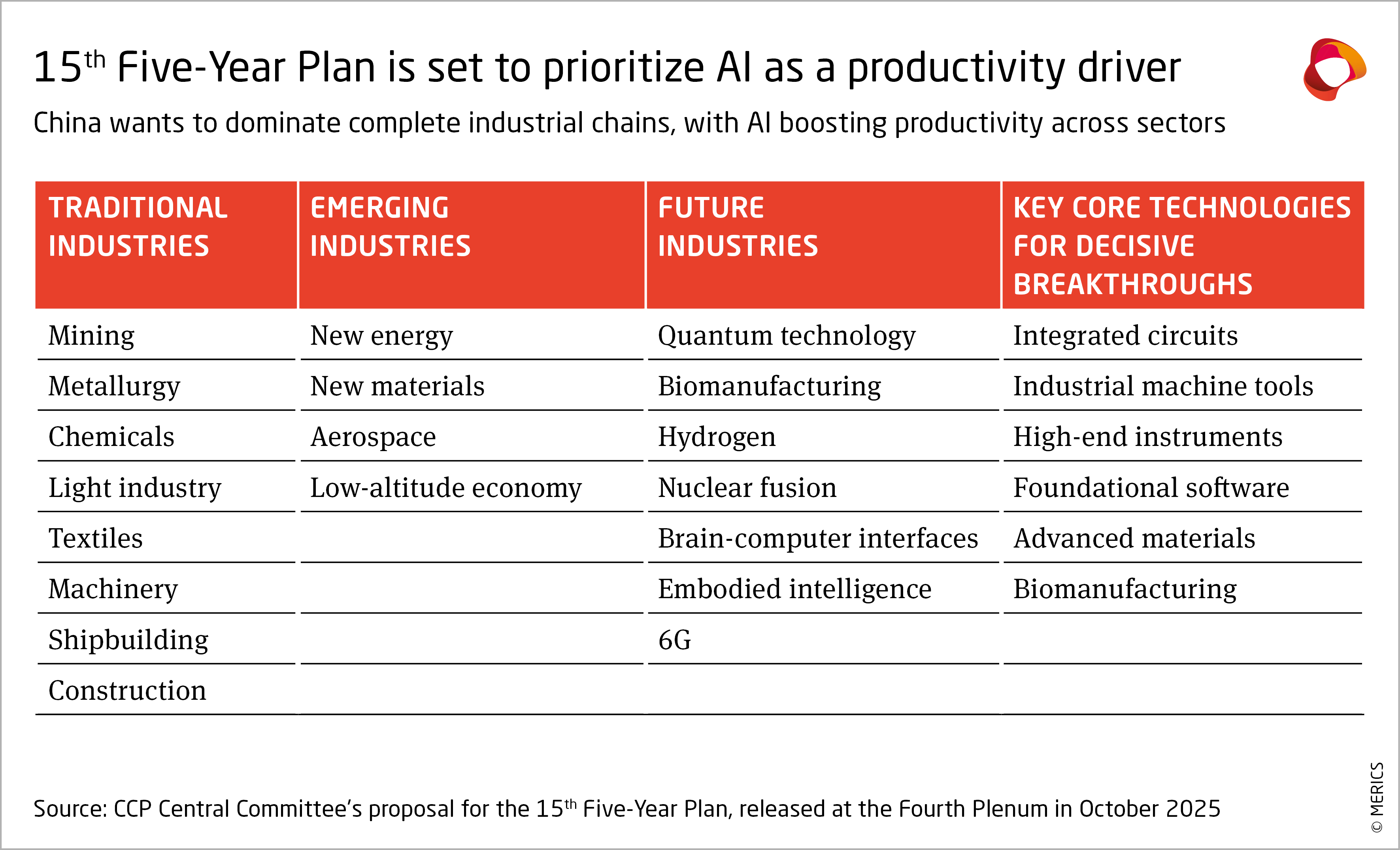
Over the next five years, China’s planners will bet big on AI systems such as robots, humanoids, and brain-computer interfaces. AI is set to be a leitmotif in the 15th Five-Year Plan (FYP), linking industrial, science and technology (S&T), innovation, energy, data, and education policies. For the leadership of the Chinese Communist Party (CCP), it is unlike any other general-purpose technology. Woven into every sector of China’s “real economy” (实体经济), society, and governance structures, AI is to be the leading productivity driver and a major source of national competitiveness.
But this all-in embrace of AI is no guarantee of success. Although Beijing expects AI to solve all kinds of domestic problems, from demographic decline to the climate crisis, issues with the labor market, sustainability, institutional adaptation, and economic returns loom large.
Which countries successfully implement AI in the coming years will determine who leads the AI revolution. China’s focus on diffusing this powerful technology for use in specific sectors of the economy is often credited for its pragmatism. In contrast, the United States is pouring billions into the quest for superintelligence. Meanwhile, Washington’s recent relaxation of semiconductor export controls could facilitate China’s path toward self-reliance in designing and producing the chips it needs to operate enormous AI data centers. We can expect the FYP to direct massive support toward the semiconductor industry – even if powerful US-designed chips are now available.
Diffusing AI to boost industries and science
The “AI Plus” (人工智能+) action plan, released in August 2025, will set the tone for AI policy under the coming FYP, with lofty targets for AI integration across China’s economy. AI devices, agents, and applications should reach 70 percent penetration by 2027, 90 percent by 2030, and ubiquitous deployment by 2035. That these are aspirational goals rather than actionable KPIs is clear. Sectoral and provincial planning documents provide more detailed roadmaps and, as some observers point out, these numbers function as signals rather than actual targets: They tell CCP cadres and firms where the central government expects them to channel their efforts.
One big focus will be industrial AI, hailed as a driver of total factor productivity – one way of measuring an economy’s ability to do more with less. Policies are likely to prioritize the “deep integration” (深度融合) of AI technologies into traditional industries, such as manufacturing, mining, and chemicals. Instead of letting go of traditional sectors as the economy climbs up value chains, China’s leader Xi Jinping wants it all: Strong future industries (think embodied AI and nuclear fusion energy powering data centers), self-sufficiency in foundational technologies like semiconductors, and an upgraded manufacturing base bolstered by AI.
We will also see continued efforts to harness AI in science, which could lead to exciting breakthroughs. Frontier research labs across the country have been building large language models (LLMs) and compute clusters to support scientific research, from climate science and medicine to nuclear energy and astrophysics. Chinese scientists are developing AI models that can control plasma during nuclear fusion, map the universe, and autonomously intuit physics principles. As the CCP’s proposed content of the next FYP states, China should “lead a paradigm shift in scientific research with AI.”
Doubling down on self-reliance
The other major AI policy theme will be self-reliance, particularly in semiconductors. As the government is incentivizing data centers to switch from US to local AI chips, chip designers such as Huawei and Cambricon will take as much support as Beijing’s state capitalist machinery can provide. According to Bloomberg, the government plans to shower semiconductor companies with up to EUR 60 billion (CNY 500 billion) in additional subsidies. Breakthroughs in 3–5nm and 7–10nm processes are a priority.
Contrary to arguments that selling advanced US AI chips to China will help entrench the country’s dependency on Nvidia, self-reliance remains Beijing’s top goal. This may explain why Xi was not exactly jubilant when the Trump administration greenlighted Nvidia’s sale of the powerful H200 accelerators to vetted China-based customers. Instead, a careful mix-and-match strategy for the country’s computing power infrastructure is emerging, allowing the controlled use of foreign chips for more advanced tasks while helping struggling national champions like Huawei gradually catch up and capture market share. This is all very good news for China’s compute-constrained AI companies.
Therefore, we can expect the FYP to double down on policies that seek to build massive AI infrastructure increasingly independent of foreign technology, leveraging China’s scale advantage and low energy prices. There will also be efforts to promote indigenous software and algorithms and to ensure an efficient market for AI training data.
Hopes and hype
Underlying these initiatives is a “techno-solutionist” mindset. The CCP under Xi has celebrated AI as a panacea for China’s domestic challenges, from predicting crime and protests to coping with population aging, stimulating consumption, and tackling climate change. In Beijing, AI is framed at once as a global public good and the ultimate weapon in international competition. It is meant to be “embodied” (具身) within the physical world – cities, factories, even the human body, leading China to national rejuvenation.
This bullish vision begs two questions. First, will it work? Exceedingly fast automation could disrupt the labor market and exhaust natural resources. Unemployment risks from AI have slowly moved into official debates, and the government is keenly aware of the rising demand for electricity and water from AI data centers. Moreover, like in other countries, institutional readiness will be key to integrating AI into organizations and the economy at large – including bureaucratically rigid and not-so-tech-savvy government agencies and state-owned enterprises.
Second, if the plan works, how will we know? It is possible that the economic returns will eventually justify the hype, but they will hinge on effective implementation. Cash-strapped local governments are jumping on the AI Plus bandwagon, while many Chinese AI companies are struggling to book profits. Even if we do begin to see widespread AI adoption across industries in China, what matters is whether it translates into sustained productivity gains. For example, increased productivity per worker in each industry would probably be a more telling success metric than how many robots have been deployed.
Ultimately, the country’s performance at turning tech investments into actual social and economic dividends over the next five years will determine whether the CCP’s huge bet on AI pays off. But the hype and open questions about AI diffusion should raise a few skeptical eyebrows.
Author(s)

Head of Program (Co-lead)
Author(s)
Head of Program (Co-lead)