
picture alliance / Xinhua News Agency | Chen Sihan
Comment
Deciphering the 15th Five Year Plan
China’s 15th Five Year Plan, spanning 2026-2030, was approved by the National People’s Congress in its March 2026 session. The plan, a good 80,000 Chinese characters long, offered few major surprises. This is for two reasons, says MERICS Senior Associate Fellow Bert Hofman: one, there is a lot of continuity with the 14th, and even the 13th Plan, and two, the “guidance” that the central committee of the communist party provided last October was, as expected, duly incorporated.
Still, the Plan is worth a thorough review—first and foremost for aspiring Chinese bureaucrats, but also for those who that want to understand where the Chinese economy is heading, which new technologies we can expect coming out of China, and whether China will finally manage to rebalance its economy and reduce its increasingly contested trade surpluses.
Today’s plan is a far cry from the original Soviet style 5-year plans first introduced in 1953. Gone are the days of the thousands of tons of steel, the millions head of cattle and bushels of grain. Instead, the plan can best be understood as a strategic guide to the Chinese party, government and people, and a communication tool for the party leadership to coordinate individual actions across the vast economy of 1.4 billion people. The transition from Soviet to Strategic plan took place in the 1990s, with the 9th Five Year Plan, after China had declared itself a “socialist market economy” at the 14th National Party Congress.
The “Outline of the 15th Five Year Plan (2026-2030) for National Economic and Social Development of the People’s Republic of China” as it is formally called is an “Outline” in the sense that it is an Apex plan sitting on top of many other plans. Each Ministry, agency, province, and municipality has their own 5-year plan based on the national plan. The main indicators plan a role in shaping these plans, but they do more than that: these indicators help shape the key performance indicators of the government officials and party cadre and central and local level. Meeting those targets is key for promotion, and a powerful mechanism to steer the ship of government.
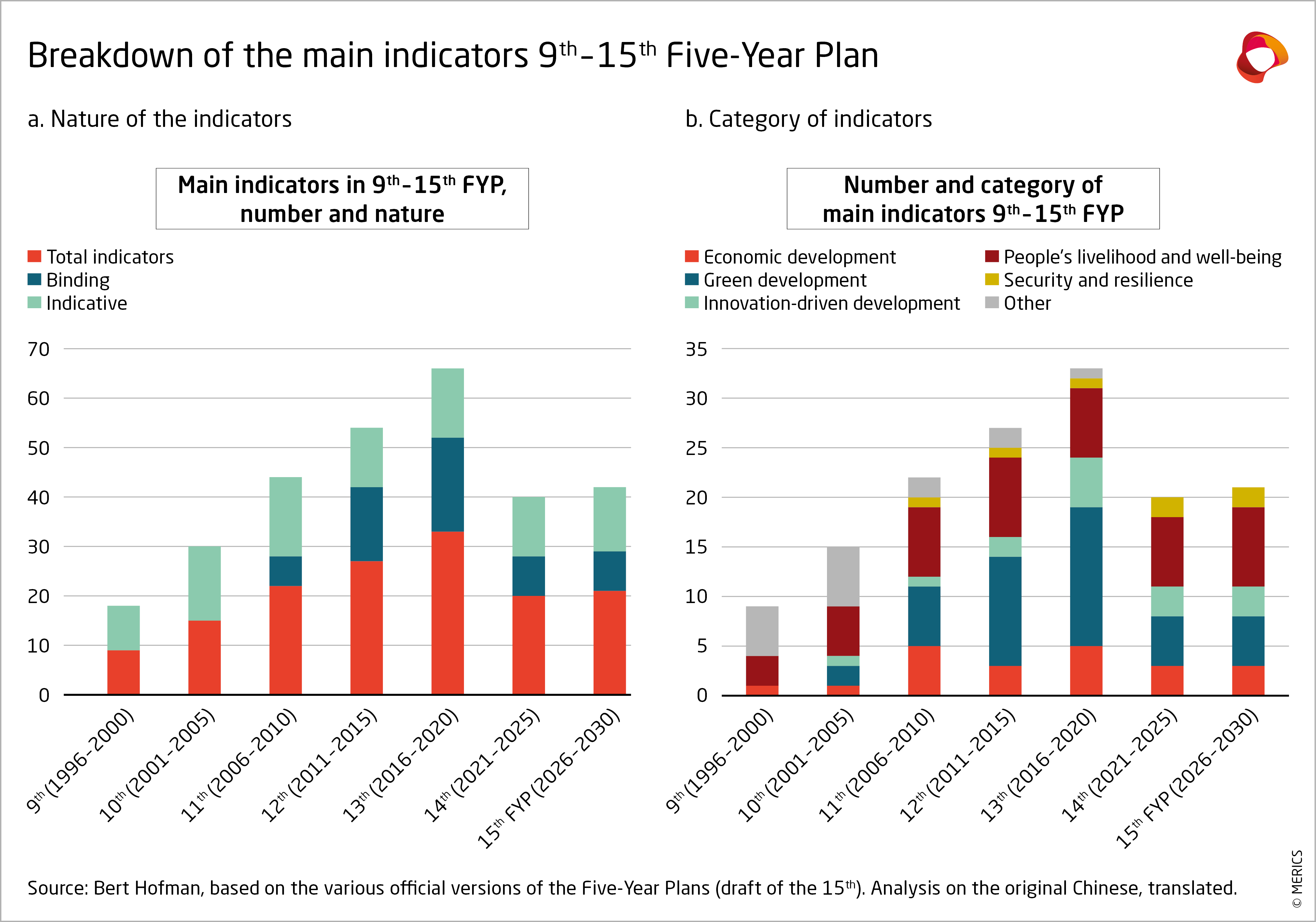
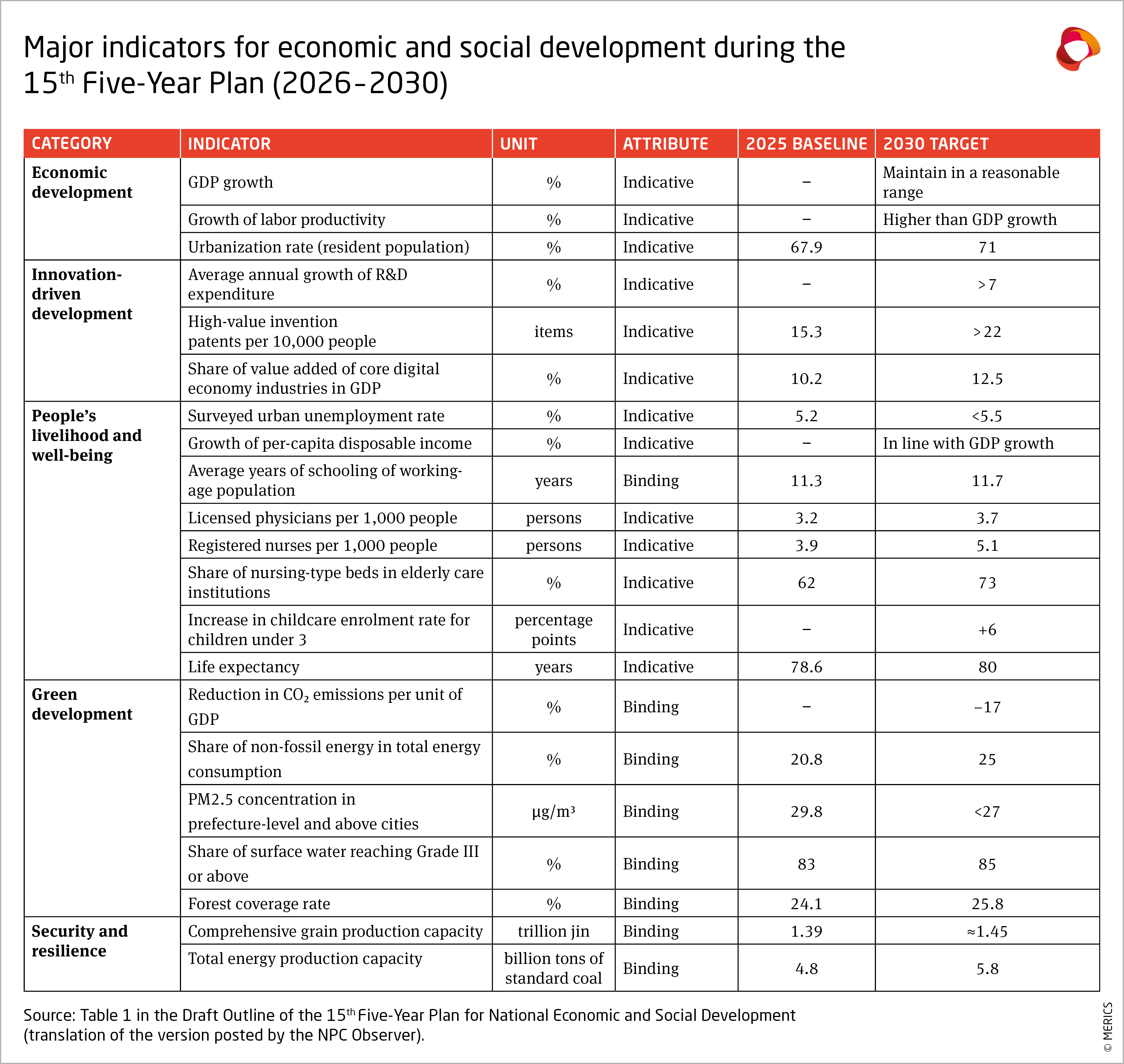
The Plan still has targets, such as for GDP growth, the growth in spending on Research and development, air pollution etc. But most of these targets are indicative—only 1/3 of the indicators in the table of Key Indicators are mandatory (Annex Table). The development of key indicators over time suggests a somewhat reduced role of the indicators compared to the past (Exhibit 1a). The number of indicators peaked at 33 in the 13th Five Year Plan, with almost 60 percent binding. In the 15th plan the total is 21, and less than 40 percent is binding. Breaking the indicators down by the categories as per the 15th Plan (Exhibit 1b), suggests a growing emphasis on innovation and people’s livelihood, and, after peaking in the 13th Plan, somewhat less focus on environment, perhaps because much has been achieved since. Notably, a new indicator on carbon intensity of the economy was introduced in the 15th plan, replacing an indicator on energy intensity. This indicator links well to the government “twin carbon” goal: peaking before 2030, and net zero by 2060.
The target for GDP growth is no longer a real target since the last plan. It merely states that growth should be maintained “within a reasonable range.” The formulation as it came about in 2021 would have been convenient in the middle of the COVID-19 pandemic, when growth over the next 5 years was anybody’s guess. But it also emphasized the policy shift away from simply growth to what the authorities now dub “High Quality Development.” Nowadays, the growth target is set annually, in chambers during the Central Economic Work Conference in December, and publicly revealed at the opening of the National People’s Congress in the prime minister’s work report. For this year, it is to be 4.5-5 percent, a bit less than last year’s 5 percent, but still enough to stay on track for the informal goal to double GDP from 2020 to 2035.
High Quality Development, the overarching objective of the Plan, is defined as being innovative, coordinated, green, open and shared. The “toolkit” for achieving High Quality Development is the “New Development Philosophy (or Paradigm), The New Development Philosophy includes Supply-side structural reforms, the New Quality Productive Forces, Dual Circulation, Common Prosperity, and Ecological Civilization, elements that were included over time. In Xi Jinping’s words: “Accelerating the construction of a new development pattern is the strategic basis for promoting high-quality development.” The 14th Five Year Plan (2021-25) started to take a stab at translating concepts into policy, and the 3rd Plenum of the 20th Party Congress spells out a number of specific policy reforms many of which will have an impact on the goal of High-Quality Development.
How does all this party ideology translate into the 15th Five Year Plan?
To get a grip on that I like word counts. I took a count on the main policy terms in the past 3 plans to determine what is in, what is out and what is the focus of the authorities in the coming 5 years (Exhibit 2). Clear winners in the word count are the innovation and technology related terms: Artificial Intelligence (人工智能) has the highest count followed by high-quality development (高质量发展), and scientific and technological innovation (科技创新). National security (国家安全) has been very stable from the 13th-15th plan at about 20 occurrences. This reflects one of the major shifts in focus under Xi Jinping, who has consistently argued that national security is the basis for development—and vice versa!
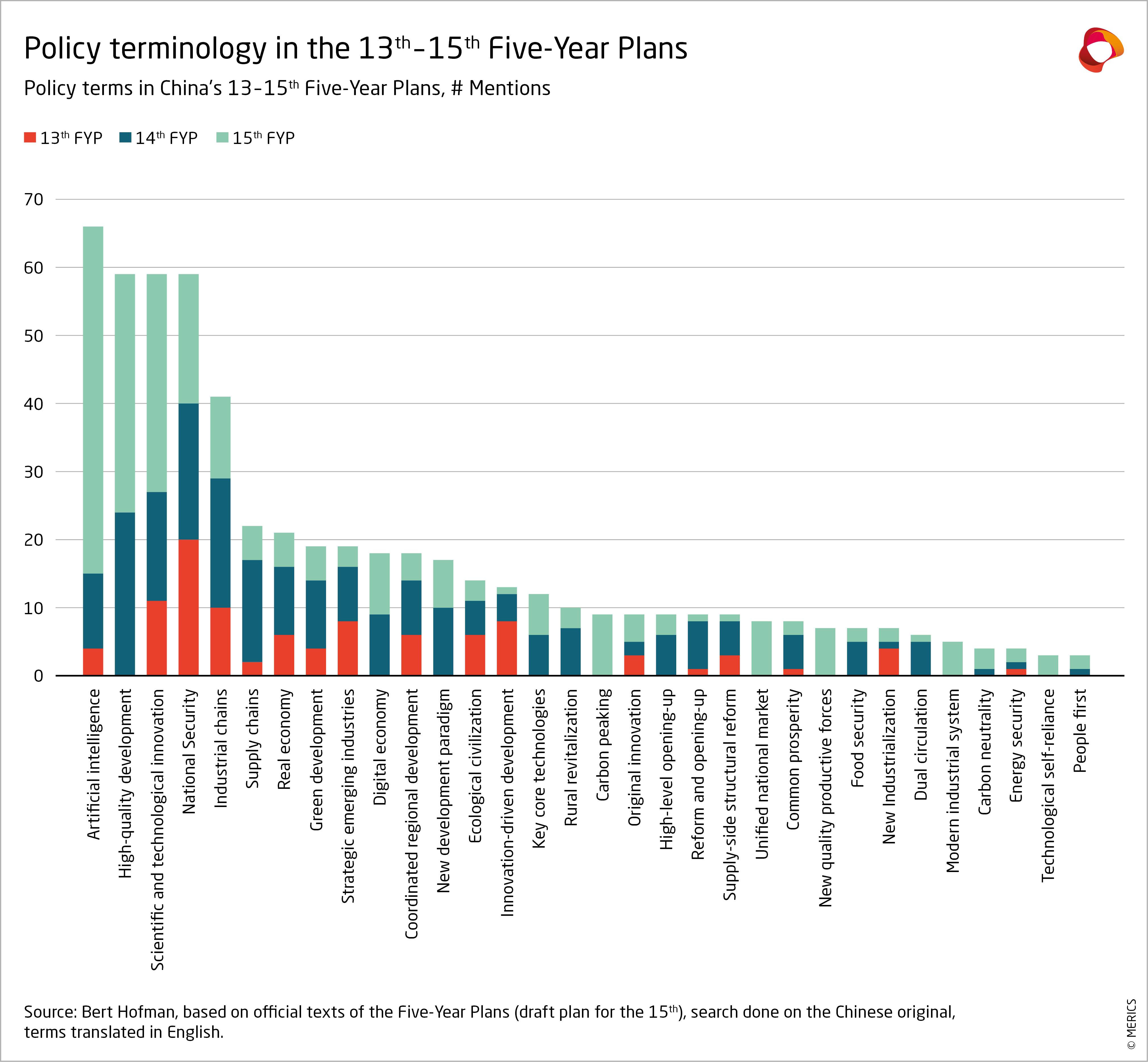
New terms in the 15th Plan are New Quality Productive Forces (新质生产力), unified national market (全国统一大市场), modern industrial system (现代化产业体系), and technological self-reliance (科技自立自强), and carbon peaking (碳达峰). While none of the key terms that were included in the 14th plan disappeared completely from the 15th plan, several saw a major drop in word count, including: Reform and Opening Up, Industrial Chains, Supply Chains, and strategic emerging industries, ecological civilization, rural revitalization, common prosperity, and dual circulation (双循环) which was absent in the 13th, peaked in the 14th, and is only mentioned once in the 15th plan.
Overall, the word count suggests a continued strong emphasis on innovation and technology, reduced emphasis on reform and opening (and market development), and still limited attention to "people first" and common prosperity. The Plan suggests also stronger emphasis on basic research, and a stronger link between technological innovation and growth. The link is the first and foremost the “Modern Industrial System” a term new to the 5 Year Plan, but which had been circulating for some time. Also, the AI+ initiative of the government, based on a plan issued last year fall, receives abundant attention. It sees the main value of AI in its application, and in particular in its application to industry and business. The open access approach that China’s tech companies such as DeepSeek have taken fits this well and could lead to more rapid adoption of AI than in countries that rely on proprietary systems.
The greater adoption of technology and more unified market should, in the Plan’s philosophy, lead to higher productivity. Labour productivity is, as in the past plans, included as a key indicator. “Total factor productivity,” concept that refers to the overall efficiency of resource use in a society, is considered as a key objective, and has been mentioned several times by Xi Jinping in his speeches. Nevertheless, it is not included in the main indicator table, which is understandable, given the issues of measurement and methodology of the concept. Meanwhile, the investment in basic research should pay out in future technologies, the “new quality productive forces” and the plan mentions a range of them, from brain-computer interface to quantum computing to fusion energy.
Will the Plan solve China’s Domestic Demand Issue?
The Plan, as well as the government work reports and the central economic work conferences in the past few years, have made domestic demand a priority. Rightfully so, as growing supply with insufficient demand would further increase trade surpluses, and trade tensions. Perhaps more importantly, the authorities want growth to translate into more consumption and “people’s needs.” In fact, the 19th National Party Congress made this the central “contradiction” or challenge for the Party.
Higher domestic demand will have to predominantly come from consumption and perhaps form government investment. As Alicia Garcia Herrero, Chief Asia Economist for Natixis, an investment bank, has argued, corporate profits are now too low to finance much growth in investment. Moreover, the government’s “anti-involution policy” is targeted at the excessive investment that local governments pursue. Furthermore, with much better technology, AI, and robotization, industrial growth may simply require less investment. And finally, the property sector, previously a major investment destination, is still in the doldrums, and given the modest policy plans, is unlikely to bounce back. Lower investment growth would be good for total factor productivity, if indeed wasteful investments are reduced. But it would further suppress domestic demand.
Common prosperity and “people first” still receive relatively limited attention. Lots of initiatives are mentioned in the text, including further aligning the urban and rural pension and health system, the development of a “fertility friendly” society (free kindergartens, child money), and the objectives for greater equality in service delivery across regions would all contribute, but it is hard to see that they add up to a major shift in consumption power for households. In the Plan’s (and the Party’s) thinking better employment, more education, “investment in people” and a growing middle class is the way to common prosperity, not income redistribution.
The Plan states the objective to increase the household consumption rate, though that is not a main indicator. What is in is that per capita income should develop in line with GDP, so apparently the authorities count on a lower household savings rate. With the continued slump in property prices, a lacklustre labour market and modest improvements in social safety and insurance, it is hard to see how household consumption could majorly contribute to higher domestic demand as a share of GDP.
Government spending, either investment or consumption, could take up the slack. Whether the next five years will the major reforms needed to shore up government finances and make the fiscal system ready for high quality growth remains to be seen. Reform initiatives are sprinkled throughout the Plan, but putting public finances on a solid footing requires a comprehensive plan at par with the 1994 fiscal reforms.
This article was first published in Bert's Newsletter on Substack on March 13, 2026.
- Endnotes
1 | 中华人民共和国国民经济和社会发展第十五个五年规划纲要
2 | The plan table says 20, but one indictor has 2 elements, so we count it as 2.
3 | Xinhua, 2023, When Xi Jinping attended the review of the Jiangsu delegation, he stressed that we must firmly grasp the primary task of high-quality development. Xinhua, 2023-03-05. Accessible: https://www.gov.cn/xinwen/2023-03/05/content_5744877.htm
Author(s)

Senior Associate Fellow
Author(s)
Senior Associate Fellow