
picture alliance / CFOTO
Content
MERICS Briefs
MERICS China Essentials
China is "securitizing" its economy
Beijing expands security-first economic policy as shocks from global crises grow
Beijing is yet again doubling down on its “security first” approach to economic policymaking – with Xi Jinping likely feeling vindicated by global crises and unlikely to be dissuaded by any trade talks with the US or EU. The State Council in April published two sets of regulations that ramp up the country’s ability to protect supply chains, deter de-risking by foreign companies and shore up China’s economy against potential sanctions by other governments. In parallel, China’s chief economic planner praised efforts to boost technological and industrial self-reliance but warned that foreign governments and companies still had the power to “strangle” critical areas of the Chinese economy.
The “Regulations on Industrial and Supply Chain Security”, in force since April 7, and the “Regulations on Countering Improper Extraterritorial Jurisdiction by Foreign States”, in force since April 13, give the government new powers to target Chinese and foreign companies – within and outside China – for a variety of perceived infractions (see the next two articles). Both are part of the growing national and economic security toolkit, giving China more legal footing to retaliate against unwanted behavior and coerce compliance. As a result, foreign companies may find themselves increasingly torn between the economic security and derisking regimes in their home markets and China.
These moves were flanked by an article on Beijing’s economic-security thinking in the People’s Daily on April 20. Zheng Shanjie, head of the National Development and Reform Commission (NDRC), said China had prepared well, if imperfectly, for the current energy crisis and ongoing trade conflict with the US. But he noted that “reliance on external procurement for some commodities” continues to make China vulnerable to supply-chain disruptions, and that limited access to some technologies still creates “the risk of being ‘strangled’ in crucial areas”. He called for even stronger macroeconomic resilience, even greater reductions in dependencies on commodities and advanced tech, and an even bigger policy toolkit to prevent de-risking—and, if necessary, retaliate.
“The extent to which China is ‘securitizing’ its economy is arguably one of the most extreme examples in modern history. This has been a policy since Xi Jinping came to power, and the intensity of the effort to succeed has only increased. A leadership that takes such an extreme approach is not one that is likely to change course, either on its own or through negotiation with others.”
Jacob Gunter, Head of Program for Economy and Industry, MERICS
Media coverage and sources:
- NDRC Chief’s People’s Daily article: Continuously enhance the country's economic security capabilities to safeguard the new development pattern with a new security framework
- Tracking People’s Daily: NDRC Chief Calls to Build Fortress Economy Amid Era of Great Power Competition
METRIX
50m 26s
This is the time it took a humanoid robot to win a half-marathon in Beijing – three times quicker than last year’s robot winner and about seven minutes faster than the fastest human ever to run the distance. Designed by Chinese smartphone maker Honor, “Lightning” beat 12,000 human and 300 non-human athletes. This year’s robots were not only more numerous, up from 21 in 2025, but also uniformly faster. While most were still operated remotely by humans, four in ten were autonomous. Such tech face-offs are becoming more common as Beijing pushes companies to develop strategic technologies, including robotics. (Sources: Xinhua, ESM China)
China boosts supply chain security to stop tech capabilities moving abroad
The State Council’s sweeping moves to boost supply chain security formalize a broader shift already evident in Beijing’s ongoing investigation into US tech giant Meta’s acquisition of China-founded startup Manus AI. Even though the company now operates out of Singapore, Chinese authorities have reportedly banned Manus’ founders from leaving China, apparently worried about tech capabilities and other know-how leaking to the US acquirer. These parallel developments are part of a long effort by Beijing to build “secure and controllable” (安全可控) industrial value chains and prevent critical innovation capacity from leaving the country amid growing international tensions.
Some of the new provisions, such as those concerning monitoring and early warning, mirror the economic security approaches adopted by the EU and G7 countries. But the most notable elements set out potential penalties for companies for vaguely formulated infringements. These include unauthorized collecting of supply chain and other data in China, discriminating against China in global supply chains, disrupting transactions with Chinese organizations or individuals, or committing acts that are deemed to have caused or threaten substantial damage to the country’s supply chain security. As a result, foreign companies may find it increasingly difficult to diversify their supply chains to reduce their reliance on China.
“The vague wording of the new regulations suggests that even normal commercial decisions, like conducting an audit or relocating production overseas, could be perceived as threatening China’s industrial security – and, by extension, its national security. Beijing is in effect codifying its ability to prevent foreign companies from leaving or de-risking China-centric supply chains on their own terms.”
Rebecca Arcesati, Head of Program Science, Technology and Innovation (Co-lead), MERICS
More on the topic:
- MERICS: Keeping value chains at home
Media coverage and sources:
China fights foreign extraterritorial jurisdiction – by extending its own long-arm reach
The new regulations on “countering improper extraterritorial jurisdiction by foreign states” expand – without acknowledging the irony – China’s legal reach and retaliatory toolkit against foreign governments, individuals and companies. Presented as measures to defend China’s interests and international law, they are in fact more expansive: They not only create a mechanism to identify “improper” measures, such as those deemed to breach the “basic norms of international relations” or damage China’s sovereignty, security or development interests; they also assert China’s right to exercise long-arm jurisdiction over any acts “appropriately connected to China”. Organizations or people can now be added to a new “malicious entities list” (恶意实体清单) and may face sanctions like restrictions on doing business.
Foreign organizations and people doing business in or with China will face significant new risks. Chinese authorities will be able to target a wide range of actions within and outside China – not only those that assist the implementation of foreign measures deemed unjustified by Beijing, but also those considered undesirable, such as foreign companies taking steps to disentangle supply-chain ties with China. The vague language of the rules will only increase uncertainty over which actions may trigger a response from Beijing. Foreign companies and individuals will increasingly find themselves caught between their home countries’ export controls and other policies, and Beijing’s demands not to comply with them, under the threat of countermeasures.
“These new regulations did not emerge in a vacuum. They follow the 2021 Anti-Foreign Sanctions Law and other regulations, and they are part of Beijing’s ongoing bid to boost its own long-arm jurisdiction and restrict international actions it views as damaging – despite criticizing other countries for doing the same.”
Helena Legarda, Head of Program Foreign Relations, MERICS
Media coverage and sources:
Tighter control of industries and supply chains is part of years-long security drive
China’s energy policy illustrates how “securitizing” a sector – treating it as a security priority, not just an economic issue – can boost resilience to external shocks. By diversifying away from fossil fuels to renewable energy, China has partially insulated itself from global oil and natural-gas price spikes caused by the Iran war. Beijing is now applying the same logic to all other important industrial supply chains, which it sees as a key strategic asset.
Beijing’s new rules to protect critical industries and supply chains and new measures to counter foreign countries extending their legal reach into China are part of a broader, years-long effort to increase economic resilience to boost national security. Given systemic competition with the US, Xi is pushing security as a central logic for policymaking. Hardening industrial supply chains and insulating the economy against foreign interference is central to China’s 15th Five-Year Plan (FYP), issued in early March. The document mentions “security” over 150 times – underscoring how central this objective has become in practically every field – and identifies „improving self-reliance and control over industrial [value] chains” as major objectives until late 2030. The new rules also expand the role of the State Council, strengthening the apparatus that will enforce the new regulations.
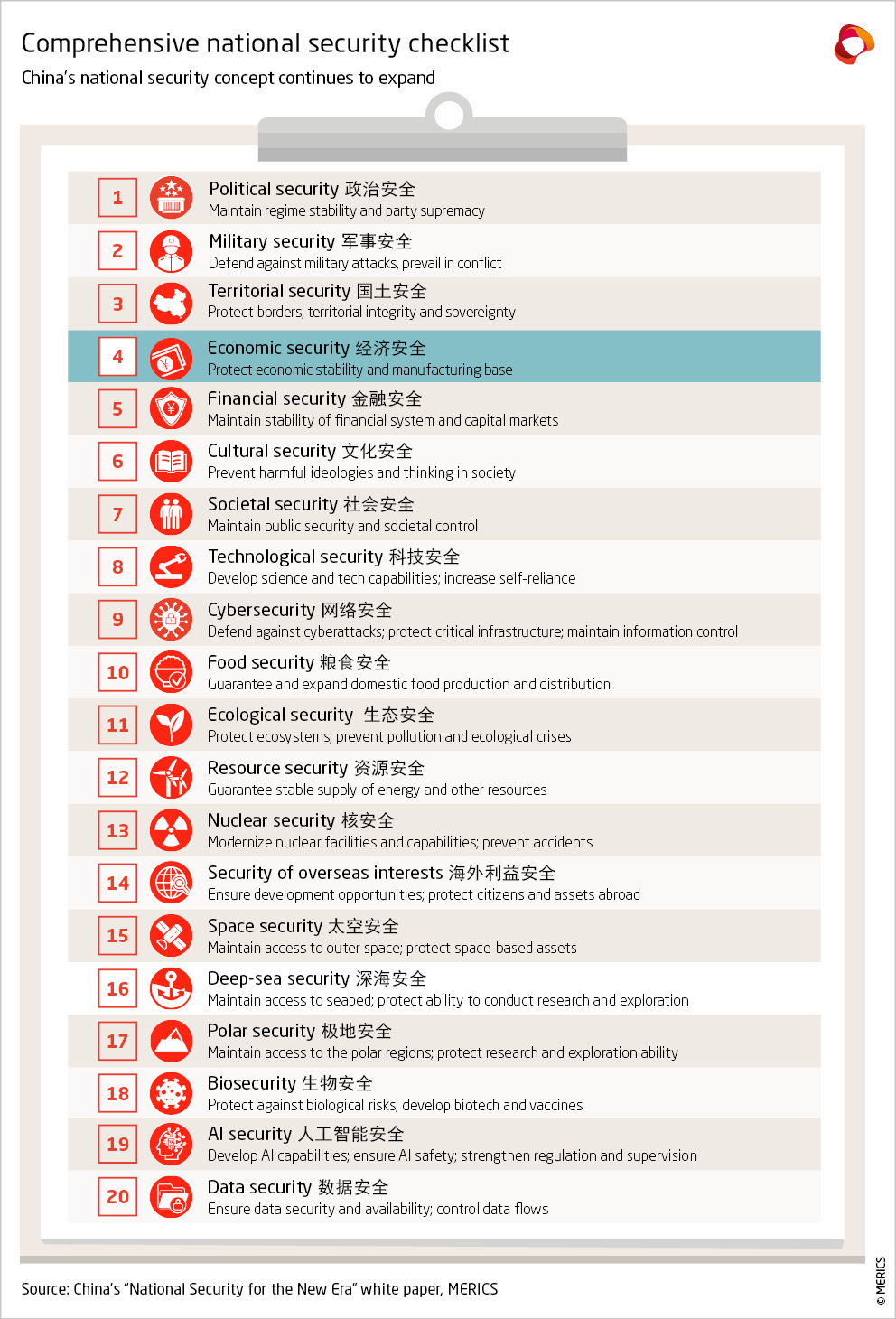
China has expanded the idea of national security to about 20 different areas, including technology and resources.
“The new measures underscore China’s systematic push to securitize its economy. More measures and regulations can be expected that will boost China’s self-reliance and foreign- and trade-policy toolkit to defend its interests in other fields.”
Nis Grünberg, Lead Analyst, MERICS
More on the topic:
Media coverage and sources:
- NPC Observer [CN]: 中华人民共和国国民经济和社会发展第十五个五年规划纲要 (Draft of the 15th Five-Year Plan)
MERICS CHINA DIGEST
Student allegedly jailed in China for joining protests in Australia (The Guardian)
A Chinese international student from the University of Sydney had taken part in pro-democracy protests in Australia. After returning to China in 2024, he was allegedly arrested and recently sentenced to six years imprisonment. Human rights lawyers call on Western governments to better protect Chinese overseas students from political repressions by the Chinese government. (26/04/21)
China’s most recent food safety scandal is linked to more deep-seated economic issues (CNN)
After nation-wide investigations, Chinese regulators uncovered more than 67,000 so-called “ghost-vendors”. Regular vendors on large online delivery platforms like Pinduoduo and Alibaba would sell customer orders to such ghost-vendors that provide even cheaper services at much lower quality. Economists have attributed this recent scandal to the cut-throat competition across Chinese industries, also known as involution. (26/04/22)
Politburo member Ma Xingrui under investigation over ‘serious violation of law and discipline’ (Reuters)
Ma marks the third member that is purged from China’s current Politburo. The former rocket scientist and party chief of Xinjiang had rapidly risen through the ranks yet has not appeared in public since last October. According to the Central Commission for Discipline Inspection, Ma Xingrui is now undergoing a disciplinary review and supervisory investigation. (26/04/03)
Taiwanese opposition leader visits Beijing (Reuters)
Chairwoman of the Kuomintang Cheng Li-wun visited Beijing in early April. She called her trip a peace mission, aimed at reducing tensions in the Taiwan strait since the PRC has recently increased military pressure against the island. Xi Jinping on the other hand called for “reunification” and attributed tensions to unacceptable demands for Taiwanese independence. (26/04/15)
Spanish prime minister Pedro Sánchez’s visit to China (AP News)
Last week, Sánchez visited China for the fourth time in three years, as Spain seeks to strengthen its political and economic ties with Beijing. Especially since the recent rift with the Trump administration over the war in Iran, Spain views its ties to Beijing as an opportunity to diversify relations to major global powers besides the US. (26/04/13)
China praises blocking of Taiwan president's Africa trip (Reuters)
Mauritius, Seychelles and Madagascar denied Taiwanese president Lai Ching-te entry to their airspace, forcing him to cancel a visit to Eswatini, one of the few remaining countries with diplomatic ties to Taiwan. Lai accused Beijing of using economic coercion against these three countries to effect their cooperation. (26/04/22)
Content