picture alliance / Win McNamee/Pool Getty Images AsiaPac via AP
Content
MERICS Briefs
MERICS China Essentials
Trilateral talks + Climate call-out + Espionage affair
Top story
Putin gets the spotlight and Trump the red carpet as Xi runs the summit on his terms
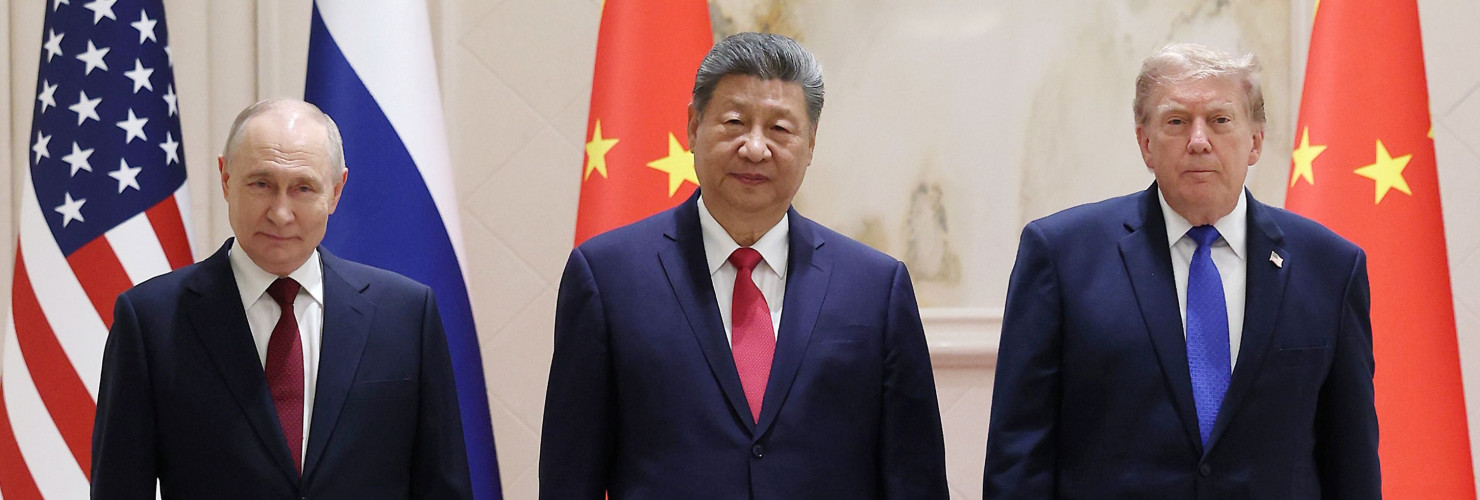
The US-China-Russia summit in Shenzhen was a diplomatic win for Russian President Vladimir Putin, but Xi Jinping emerged as the bigger winner, successfully managing a meeting that risked overshadowing the APEC summit China was hosting in the same city. For Putin, isolated by the West over Russia’s near five-year war of aggression against Ukraine, the meeting offered an easy opportunity to project the image of a leader still welcome at the highest level of international diplomacy. For Xi, China’s careful stage management of two unpredictable guests paid off, with the summit neither producing a “Yalta-style” agreement on Ukraine, as Moscow had favored, nor binding Beijing into nuclear-arms reduction talks, as US President Donald Trump had suggested.
The three leaders did agree to “engage in dialogue on reducing nuclear risks and preventing nuclear proliferation,” according to a joint statement released by the Russian government after the meeting, but this should not undermine Beijing’s established position that the US and Russia must make substantial reductions to their much larger arsenals before China joins any talks. Xi, Putin and Trump also committed to reforming the UN and agreed to increase oil production. Perhaps most painfully for Western countries that uphold the rules-based international order, the statement also said immunity for state officials was “fundamental” and that the International Criminal Court, which issued an arrest warrant for Putin in 2023, must not abuse its authority.
This latter point will reinforce European concerns that the US president is more aligned with Beijing and Moscow on several issues. But the fact that the future of Ukraine did not feature in the official conclusions spared Europe from worse. After Moscow itself had raised expectations for the trilateral, Putin appeared keen to save face over this lack of progress on Ukraine, stressing that he had discussed the war separately with Xi and Trump. The optics in Shenzhen also did not suggest a new “G3” of equal countries. Xi once again called Putin his “old friend” at what was their 50th in-person meeting, but did not receive him at the airport as he did Trump. Xi’s bilateral meeting and lunch with Trump on Thursday ran so long that Putin was left waiting for the trilateral to begin.
"The most significant thing may have been that the trilateral took place at all. Xi gave Putin the spotlight he sought, while reserving the red-carpet treatment for Trump. In doing so, he successfully managed a potentially risky meeting.”
Eva Seiwert, Senior Analyst, MERICS
More on the topic:
- Why Xi may have his own reasons to avert a US-Russia-China summit – MERICS Comment by Eva Seiwert
Media coverage and sources:
METRIX
1,042,590,000,000
This is China’s trade surplus in the first ten months of 2026, in US dollars. The surplus broke the USD 1 trillion mark in October, one month earlier than in 2025, putting it on track to exceed last year’s record annual surplus of USD 1.2 trillion. A surge in foreign demand for electric vehicles, technology and AI-related products has seen exports outpace imports, even though the latter are themselves growing rapidly. Exports of computer parts were up 235 percent, those of semiconductors up 110.8 percent, and those of vehicles up 52.2 percent. (Source: General Administration of Customs)
GRAPHIC OF THE WEEK
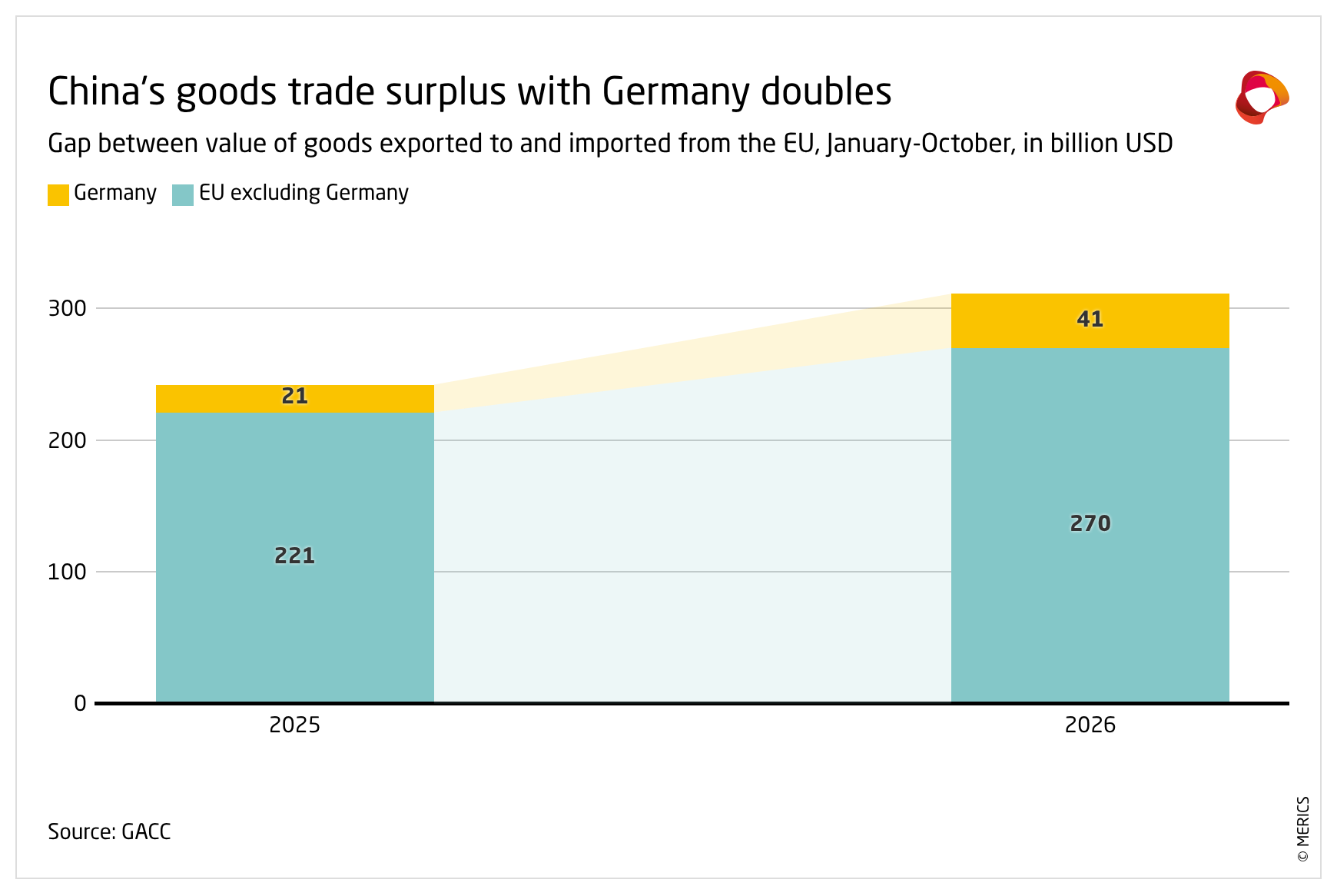
China exported 41 billion USD more goods to Germany between January and October 2026 than it imported from Europe’s largest economy – almost twice the trade surplus recorded in the same period last year. As the latest issue of the SOAPBOX newsletter on China reported, citing Chinese customs data, this increase accounted for nearly one third of the 69 billion USD increase in China’s trade surplus with the EU as a whole.
China’s surplus with Germany grew almost five times as fast as the 22 percent rise in its surplus with the rest of the EU, which reached USD 270 billion. This highlights Germany’s deep economic ties with China – and its resulting exposure to Chinese competition. As China sells more higher-value products abroad and increasingly sources components domestically, Germany faces a big double squeeze: rising imports and falling exports.
SOAPBOX is a weekly newsletter on EU-China trade relations compiled by Rafael Buendia Jimenez and Ilaria Perla. You can subscribe to the newsletter for free here.
TOPICS
China uses COP31 to showcase Europe’s dilemma on climate and trade
China’s clear position at November’s UN climate change conference in Türkiye stood in stark contrast to Europe’s growing dilemma between its climate ambitions, defensive trade policy toward China and growing reluctance to commit more financing for developing countries dealing with global warming.
Before COP 31, Beijing had emphasized the need to discuss “old issues” of insufficient climate financing and “new challenges” of unilateralism and protectionism, which were harming “collective efforts to address climate change.” But in the end, it was the African Group that proposed putting climate-related trade and climate finance on the agenda. Their contention that Europe’s additional levy on carbon-intensive imports is unfair to Africa reinforced China's argument that European protectionism is undermining global climate cooperation.
The EU objected to these proposals, which included the tripling of finance pledges, but did not block the Climate Finance Work Programme – a process to work out how developed countries meet their climate finance obligations to developing nations – as a separate agenda item.
The bloc is under pressure to fill a US-sized financing gap after US President Donald Trump’s withdrawal from the Paris agreement. Domestic opposition to a larger pledge is growing, as the EU is already one of the largest donors worldwide. Europe’s reluctance to step up, together with a lack of high-level European leaders at the conference stands in a stark contrast to China’s dominant cleantech offer to the world.
"The EU faces a dilemma: decarbonization is needed to fight climate change, but Chinese cleantech dominance and exports to the EU are a geoeconomics challenge. As the EU grapples with this, China’s proposed solution – more Chinese cleantech and more climate funding from developed countries – is gaining momentum.”
Johanna Krebs, Analyst, MERICS
Media coverage and sources:
- Xinhua (CN): 以“双碳”为牵引加快全面绿色转型——生态环境部介绍我国应对气候变化工作成效
- Down to Earth: COP31 Adopts Climate Finance Work Programme Amid Tensions Over Adaptation Funding and Trade
- Carbon Brief: COP31: Agenda adopted! - Conversations / Policy
- Carbon Brief: Interactive: Who wants what at the COP31 climate change summit
- Euronews: ‘More than just a photo opportunity’: Why are key EU leaders skipping the COP31 Leaders’ Summit?
Nvidia’s espionage drama could backfire on Chinese AI ambitions
Revelations that the chief executive of US chipmaker Nvidia, Jensen Huang, had an affair with an alleged Chinese spy could deal another blow to China’s AI industry, which is already grappling with an economic slowdown and Beijing’s push for labs to switch to less powerful domestic hardware such as chips designed by Huawei. The US government is openly split between advocates of continued commercial engagement and national-security hawks who want to cut off Chinese access to US AI technology. But pressure from lawmakers in Washington for tighter controls is mounting – and Congress could ultimately override any presidential veto of legislation covering foreign trade. China’s AI stocks, already caught in China’s broader market correction, have slumped again.
Huang has not just been Nvidia’s guiding light since co-founding the company in 1993, but he also successfully lobbied US officials, including President Donald Trump, over the last two years to relax chip export controls. US lawmakers now want to crack down on smuggling networks that supply China with the most advanced US-designed AI chips and on schemes that give Chinese companies remote cloud access to powerful chips via data centers located in third countries. The Commerce Department will also soon require companies to obtain licenses for advanced semiconductor exports, re-exports and transfers to data centers in Indonesia, Malaysia, Singapore, Thailand and Brazil. Data centers anywhere in the world will need permission to service Chinese companies.
"China's AI future is deeply tied to policy decisions made in Washington, which the networks and choices of a few tech CEOs can shape in fundamental ways. Huang was one of the most influential advocates of maintaining the flow of US AI chips to China. But the espionage allegations will make that position much harder to defend – and leave China’s AI industry with even fewer options.”
Rebecca Arcesati, Head of Program (Co-Lead) Science, Technology and Innovation, MERICS
Media coverage and sources:
- The New York Times: The Fall of Jensen Huang
- Reuters: US to curb China's access to AI chips as Trump heads to Asia
- Bloomberg: Nvidia Stops Selling AI chips to China Despite US Approval
Xi tightens his grip on local party committees – in good time for a fourth term
Xi Jinping’s third term as General Secretary of the Chinese Communist Party (CCP) ends in the second half of 2027, but it looks like he is not going anywhere. The CCP’s Central Committee on November 7, 2026, issued revised regulations on the work of local party committees for the first time since 2015. The new rules are meant to improve decision-making by cadres in provinces, cities and counties to make sure central directives are implemented. Maintaining a strong chain of command from the center down to the local level is of paramount importance to the CCP’s ability to meet its goals – and to securing Xi’s position at the apex of the party, making a fourth term increasingly likely.
Xi and the other then 22 members of the Politburo had announced the review of the regulation in March. They require officials to shoulder “political responsibility” for ensuring that the Central Committee’s policies are effectively implemented. Contradicting the leadership’s directives, engaging in local protectionism, pursuing prestige projects designed to demonstrate political achievements and improperly increasing local government hidden debt are expressly forbidden. Local party committee members are subject to “lifelong accountability” for rule violations and decision-making errors. Although permanent responsibility already applies to environmental and certain major administrative decisions, this is a significant extension of the mechanism.
"The ideologies of Marx, Lenin and Mao have been removed from the regulations, while Xi’s status as ‘core leader’ has been codified. His latest instructions and speeches are now the first item on the agenda at local party meetings. Xi wants to put cadres’ feet to the fire and make sure they get the job done the way he wants it. He looks like a leader who expects to keep a close eye on them for a while yet.”
Alexander Davey, Analyst, MERICS
Media coverage and sources:
- SCMP: Communist Party lays down the internal discipline law for local leaders
- Xinhua (CN): 《中国共产党地方委员会工作条例》 (Regulations on the Work of Local Committees of the Chinese Communist Party)
- Communist Party Member Network (CN): 《中国共产党地方委员会工作条例 (2015)》 (Archived version of the previous 2015 regulations)
- Lianhe Zaobao Singapore (CN): Revised work regulations of local party committees bans "vanity" projects and "prestige" projects
China successfully targets rich to boost income-tax revenue
China appears to be having considerable success in taxing its richer residents more. Revenues from personal income tax surged 90 percent in October 2026 from a year earlier, after tax authorities in July introduced rules requiring Chinese residents to pay tax on assets transferred into offshore trusts and on income generated by them. Taxpayers – mostly the country’s ultra-rich – had until late October to comply, effectively closing a loophole used to protect assets from the Chinese state. Tax revenue linked to offshore trusts reached CNY 160 billion in the first ten months of 2026, which suggests personal income-tax revenue from January to October 2026 is likely to have already exceeded the 2025 full-year total of CNY 1.62 trillion (about EUR 221 billion).
China’s overall tax revenue has been rising over the past year, spurred in particular by securities trading. But with China’s AI bubble deflating and share prices falling, the additional personal income tax revenue from offshore trusts is a welcome boost to state finances. Personal income tax accounts for only a portion of total tax revenue. At 9 percent, it carries less weight than value-added tax, which accounts for 39 percent of revenues, or corporate income tax, which accounts for 23 percent. But the increased flow of revenues from taxing offshore trust assets and income will provide additional fiscal room by offsetting declines in land-tax and consumption-tax revenue.
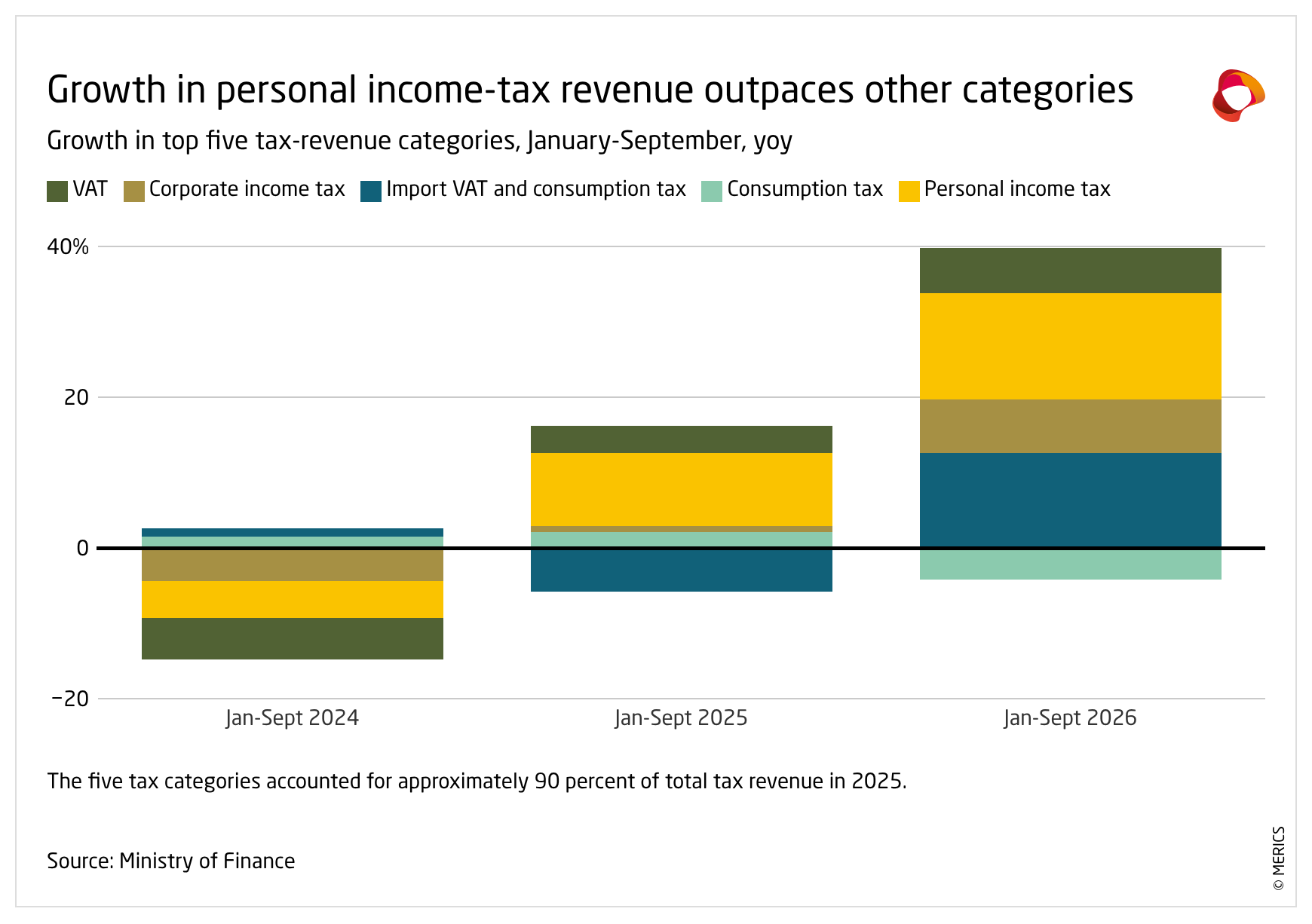
“The surge in personal income tax takings is the latest sign of China’s push to expand its tax base and strengthen public revenues. The recent focus on taxing offshore trusts, most of which are owned by high-net-worth individuals, also opens up other opportunities. It allows authorities to exercise greater oversight over capital outflows and potentially redistribute wealth more evenly.”
Sophia Pradels, Analyst, MERICS
Media coverage and sources:
- Xinhua (CN): 离岸信托收益征税平稳有序推进 (Offshore Trust Income Taxation Is Progressing Smoothly and Orderly)
- Yicai: China’s Personal Income Tax Haul Nearly Doubles in October on Offshore Trust Windfall
- Financial Times: China warns of ‘severe’ punishment for offshore trust tax evaders
MERICS CHINA DIGEST
China's economy falters as factory output, retail sales undershoot expectations (Reuters)
Chinese retail sales grew just 0.4% year-on-year in October, down from 1.1% in September, while industrial production growth slowed to 4.8%. (26/11/16)
China's Singles Day sales rise 4.8% to USD 1.78 trillion; AI takes larger role (Reuters)
China's Singles Day shopping generated CNY 1.78 trillion in revenues, but annual sales growth slowed to 4.8% from 14.2% in 2025 despite weeks of promotions. (26/11/12)
China’s passenger car sales fall 27% as exports rise 69% (Caixin)
Domestic passenger car retail sales fell 27.1% year-on-year in October to 1.64 million vehicles, while exports rose 68.5% to 928,000. (26/11/10)
China's October new bank loans shrink for third time this year (The Standard)
New yuan loans fell by CNY 100 billion in October, marking the third monthly contraction this year, the PBOC said in its quarterly monetary policy. (26/11/13)
WuXi AppTec taken off Pentagon’s Chinese military firms List (Bloomberg)
The US removed Chinese pharmaceutical company WuXi AppTec from its list of entities linked to the Chinese military, following an August US court injunction. (26/11/10)
Hong Kong activate facial recognition in AI-enabled cameras (Hong Kong Free Press)
The Hong Kong Police Force activated facial recognition tools across its surveillance network, which includes 5,000 police cameras and 6,000 third-party feeds. (26/11/16)
Content