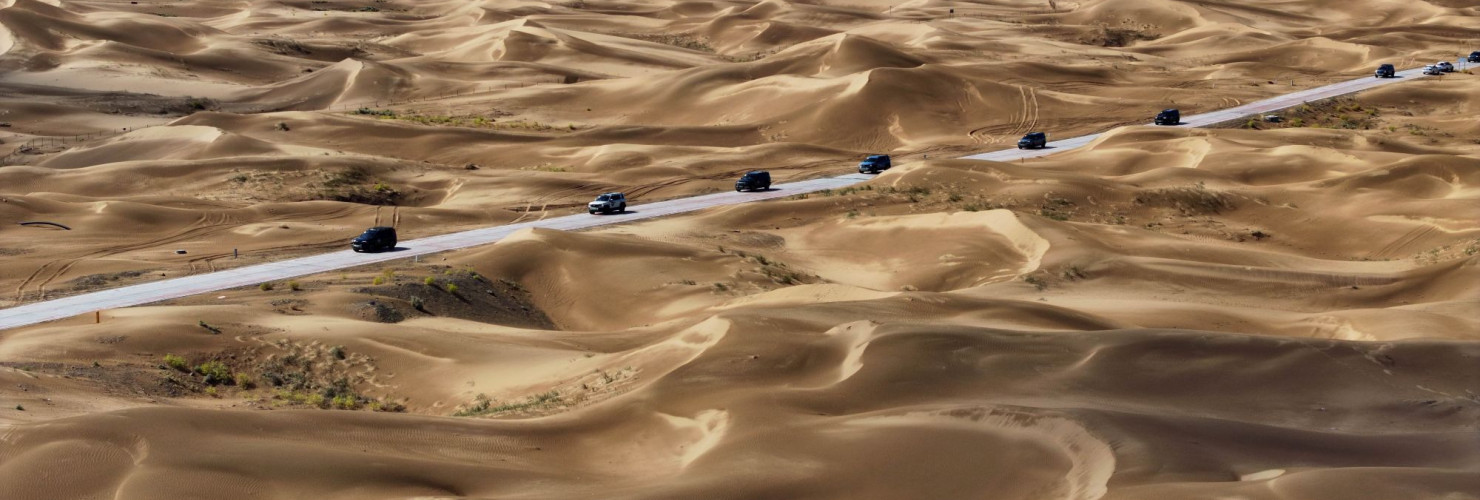
picture alliance / Xinhua News Agency | Wang Peng
Inhalt
MERICS Briefs
MERICS China Industries
New energy vehicles + pharmaceutical industry + SMEs
In this issue of MERICS China Industries Brief, we cover the five-year plans for five key industries:
- Beijing’s automotive policy moves from EVs to autonomous driving
- China will ramp up pharmaceutical innovation to close gap with Europe and US
- Beijing focuses on “little giants” to protect jobs and develop new technology
- Sectoral Plan for Industrial Foundations
- China strives to take its lead into the next generation of battery technologies
At a glance: Beijing regards intelligent connected vehicles (ICVs) as the main dynamo of transformation in the automotive industry. The new five-year plan (FYP) for intelligent connected new energy vehicles (NEVs) released by the Ministry of Industry and Information technology (MIIT) and eight other departments sets the following goals and tasks:
- Increase the market share of NEVs to 70 percent of new passenger vehicle sales and 40 percent of new commercial vehicle sales in China by 2030
- Achieve large-scale use of highly autonomous driving on expressways, urban expressways and some city roads by 2030, with autonomous driving systems substantially safer than human drivers
- Position several Chinese supplier companies in the global top hundred by 2030 and drive innovation in batteries, engines, fuel cells, smart chassis, advanced materials, and auto chips
- Encourage Chinese-foreign automotive joint ventures to use China as an export base
MERICS comment: The plan’s timeframe for widespread autonomous driving looks ambitious. In 2026, the share of new passenger vehicles with L2 combined driver assistance, where the driver must still hold the steering wheel, reached 70.5 percent. China is still a way off from achieving large-scale highly autonomous driving (L4). Changan and BAIC received conditional approval for L3, where the vehicle handles all driving but the driver has to stay ready to take over, in privately owned cars in 2025, while L4 systems are in limited commercial use through Apollo Go’s and Pony.ai’s robotaxis. But Chinese firms are ahead of their European competitors. Mercedes-Benz and BMW have shelved their L3 programs for cost reasons and Volkswagen is developing L3 and L4 systems mainly through its partnership with China’s Horizon Robotics. European carmakers are either falling behind in ICVs or overly dependent on Chinese tech to keep up.
European suppliers may also come under growing pressure. The plan targets components Western firms still lead in globally, including steering, braking, and chassis technologies. Some companies are responding by localizing deeper into China. For instance, Aumovio has moved R&D resources to China and ZF has localized steering technologies. Ironically, this route risks their operations becoming more embedded within China to ward off challenges from Chinese competitors, a pattern that is true for major German companies more generally.
Article: 15th Five-Year Plan for the Development of the Intelligent Connected New Energy Vehicle Industry (工业和信息化部等九部门关于印发《智能网联新能源汽车产业发展“十五五”规划》的通知) (Link)
Issuing bodies: MIIT and eight others
Date: September 10, 2026
At a glance: The five-year plan for the pharmaceutical sector calls for a leap in competitiveness and innovation to propel China’s pharma industry to the forefront globally. Key goals to reach by 2030 include:
- Achieve revenue of CNY 3.5 trillion (EUR 474 billion) for big pharma companies; over USD 1 billion in annual global sales for at least five products; and establish 20 industrial parks at the CNY 100 billion scale (EUR 13.5 billion)
- Gain at least 25 percent global share of first-in-class (FIC) drugs; reach at least ten percent average R&D intensity across listed pharma firms; and approve at least 200 innovative medical devices
- Develop frontier technologies, including space-based manufacturing, quantum computing and next-generation brain-computer interfaces
- Maintain competitive advantages, including production of raw materials and high-end excipients and packaging, and green production technologies
MERICS comment: Over the last few years, China has emerged as a crucial link in global pharma innovation. It already dominates upstream and midstream pharma inputs, producing an estimated 40 percent of global supply, and is a major innovator. China’s biotech out-licensing increased tenfold between 2021 and 2025. The plan aims to move China up the pharmaceutical value chain by adding development of cutting-edge drugs and technologies to its strong manufacturing base for active pharmaceutical ingredients. The goal is a biomedical sector that is a globally competitive “emerging pillar industry.”
Autor(en)



Autor(en)
Inhalt