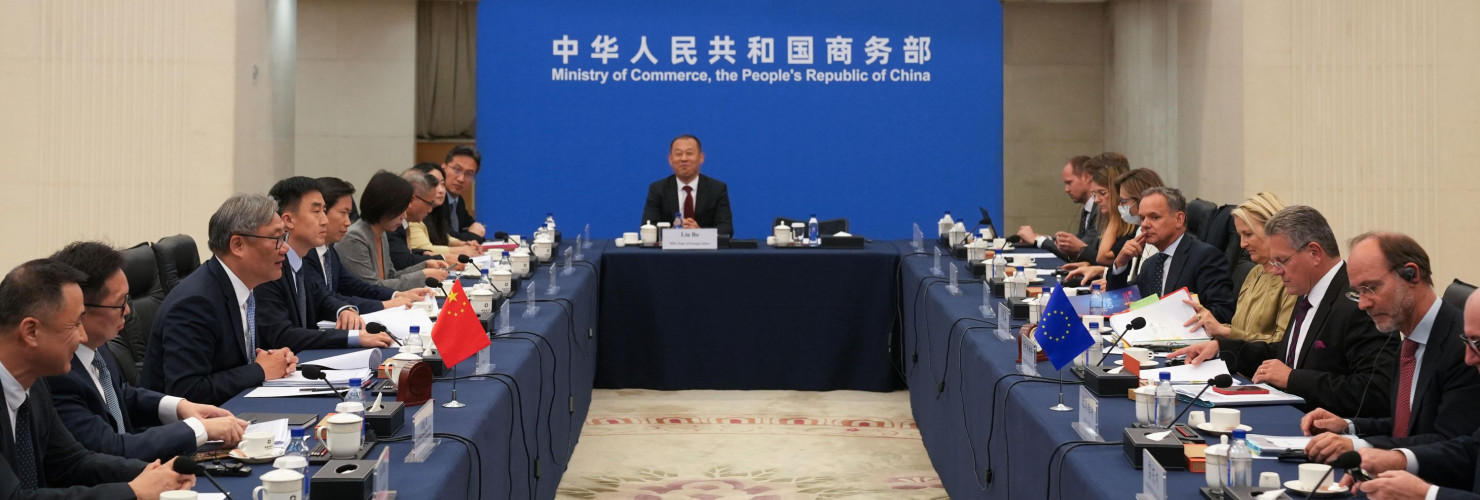
picture alliance / Hans Lucas | POOL UNION EUROPEENNE / AGENCE HANS LUCAS
Inhalt
MERICS Briefs
MERICS Europe China 360°
Chinese expert debates on EU-China economic frictions + Gotion-PowerCo deal + Electric car exports
In this issue of Europe-China 360°, we cover the following topics:
- Chinese experts are betting on restraint from Brussels in EU-China relations
- VW’s PowerCo and China’s Gotion High Tech move on joint venture even before the EU makes rules
- EU-China Diplomatic Tracker: China’s high-level engagement was limited in recent months
- SOAPBOX-MERICS Data Highlight: The EU’s share of China’s fully electric car exports is steady so far in 2026 despite tariffs
By Grzegorz Stec
Recent analyses and media statements from Chinese think tank and academic experts have focused on concrete approaches to economic frictions, which they now see as an enduring feature of EU–China relations. This is a shift in focus from the spring when many experts merely dismissed EU concerns that China’s unbridled overproduction was flooding global markets. In May and June, experts had blamed these concerns on the EU’s own lack of an industrial policy. But this new acceptance of competition does not mean they agree with Europe’s diagnosis China’s unfair competition practices are causing trade imbalances.
The expert comments came in the context of the 8–9 October Trade and Investment Consultations, which produced an “understanding” on curbing exports of Chinese-made hybrid vehicles to Europe, alongside other commitments. Several said they expected trade interdependence, the risk of retaliation for restrictive measures and divisions among European member states to constrain Brussels and allow the relationship to settle into some form of competitive coexistence. Yet they diverged on how this may happen.
In the week after the consultations, the European Council called for broader use of EU trade defense instruments and urgent additions to the EU toolbox. The Commission said it would propose a DiversifyEU instrument and a Solidarity Mechanism in December to align member states against external coercion or retaliation. Building on a key Franco-German paper published on October 5, the Commission said it would also work on conceptualizing a new instrument to act as a “kill-switch” restricting market access. The idea would be for the EU to have a defensive tool with which it could quickly disrupt China’s and others’ access to the single market. Chinese experts are taking note of the EU’s dual-track approach where efforts to defuse trade tensions are paired with intensifying preparation of assertive tools.
Chinese experts expect managed tensions
Yu Xiang, a researcher at the Chinese Academy of Social Sciences’ Institute of American Studies, framed China–US–Europe relations as moving toward “competitive coexistence.” This would mean that “the focus of tripartite competition will shift from commodity trade to institutional power,” he said – thus it not just focusing on market share but also revolving around the power to define rules for the green and AI transition as well as what constitutes legitimate protection of critical supply chains and fair subsidies.
A broader group of Chinese experts also appears to view China as well-positioned to compete with Europe. This is reflected both in published analyses and in exchanges with Chinese think tank experts held in Brussels in September and October. While describing a trade war with Europe as undesirable, these experts have sought to project confidence in Beijing’s ability to withstand one. Several participants cited what they saw as Beijing’s success in standing firm against the Trump administration and securing Washington’s acceptance of China’s preferred framing of “strategic stability.”
Autor(en)

Leiter Büro Brüssel/Senior Analyst

Analyst
Autor(en)
Leiter Büro Brüssel/Senior Analyst
Analyst
Inhalt