
picture alliance / Xinhua News Agency | Xie Huanchi
Tracker
China Economic Indicators
Beijing’s “support for demand” is more about investment than consumption
MERICS China Economic Indicators Q4/2025
This analysis is part of the Q4/2025 MERICS China Economic Indicators, our quarterly analysis of China’s economic data. You can find the most recent data here.
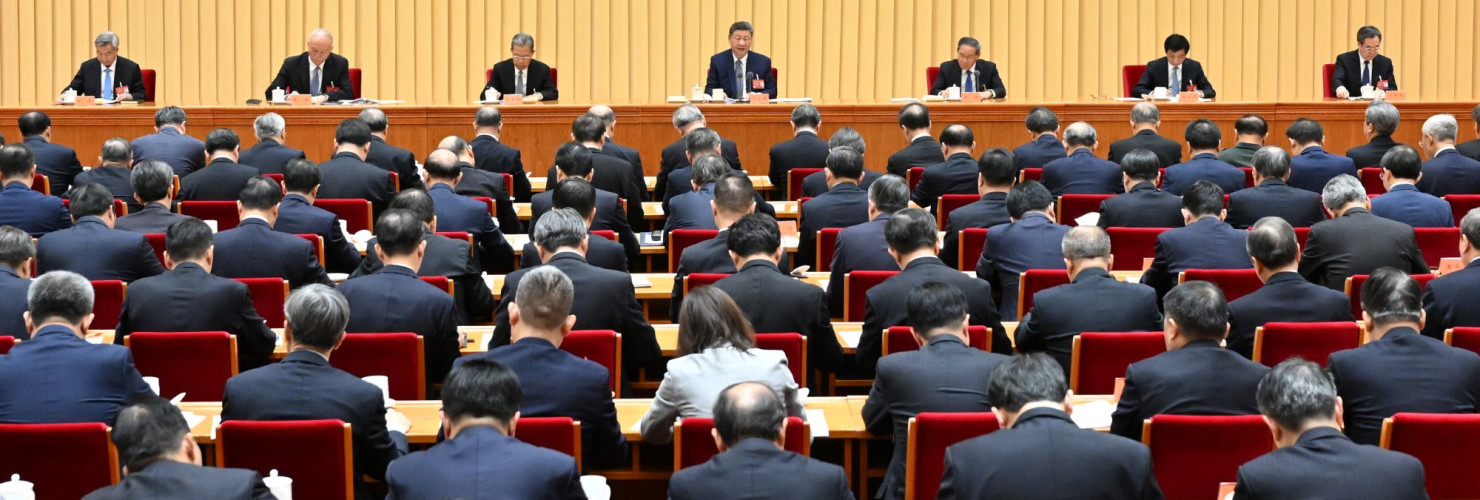
Chinese officials were recently tasked with policy priorities which can seem outright contradictory, but that is not quite how party-state officials will understand these signals. To grasp how Beijing will advance its economic ambitions in 2026 and beyond, we examine the December 2025 Central Economic Work Conference (CEWC) and consider what its details might mean.
The 2025 CEWC, held in Beijing in December, listed eight priorities for economic work in 2026. Most of these could be grouped around two seemingly competing goals – to support demand and to support investment (particularly investment in innovation, industry, and infrastructure). To classically-trained economic observers, these two sets of goals are often in tension, with every yuan channeled to consumption meaning less funds for investment and vice-versa.
For state planners steeped in Marxist-Leninist economic thinking, these goals appear not contradictory but compatible: it is this mindset that will shape how they implement policy.
The CEWC does not list supporting ‘consumption’ (消费) as the number one priority; it puts supporting ‘domestic demand’ (内需) at the top. And when thinking like a state planner, domestic demand is not limited to household consumption; it extends to demand up-and-down the value chain to ensure, at each point, that supply and demand are broadly balanced. Especially important is to ensure sufficient demand for the upstream technologies and industries Beijing is most supportive of.
This understanding of demand was articulated at the March 2025 National People’s Congress (NPC) in Premier Li Qiang’s Government Work Report, when he listed the year’s top priority as, “[We must] vigorously boost consumption and improve investment efficiency to comprehensively expand domestic demand.” (大力提振消费、提高投资效益,全方位扩大国内需求).
Household consumption is not the sole meaning of supporting demand
From this viewpoint, unlocking household consumption to support demand is important, but it is neither the top priority nor the sole meaning of supporting demand. China’s state planners view each step within any given value chain as a point where demand should be supported, so as to coordinate with the upstream supply. Recalling the “Dual Circulation Theory”, first promulgated in May 2020, when President Xi Jinping called for China’s growth to be increasingly driven by domestic demand, hindsight shows the policy slogan did not amount to a switch towards prioritizing household consumption. Rather, it reflected a more comprehensive sense of demand being a priority at every step, all of them ideally located within China’s own industrial ecosystem.
For example, supporting households as the end user consumers of EVs is a clear priority. But so too is supporting EV-makers to ensure strong demand for domestic EV battery-makers. They in turn need support to guarantee strong demand for inputs such as cathodes, anodes, materials. All these sustain demand for machine tools and industrial robots to manufacture such inputs and for industrial software to run it all. This is why, in the CEWC readout, we see a) support for generating demand by boosting incomes and hence consumption (or, in the language of CCP planners, by “formulating and implementing plans to boost urban and rural incomes” (制定实施城乡居民增收计划)) together with b) support for demand by promoting the reversal and stabilization of [declining] investment (推动投资止跌回稳).
The CEWC readout also urges support for demand by “expanding the supply of high-quality goods and services” (扩大优质商品和服务供给). This kind of framing is increasingly common; it implies consumption and demand are not materializing because of a lack of appropriate goods and services for those downstream. This standpoint offers China’s officials two potential explanations, and policy cures, for weak consumption data like that of December 2025, when retail sales growth for consumer goods dropped to 0.9 percent. It could be down to lackluster income growth or household uncertainty. Or it could equally stem from insufficient supplies of the right goods at the right price, since high household savings rates mean consumers theoretically have the resources to make purchases but are choosing not to.
Supporting demand also means implementing the “Two New” (两新) policy to support large scale equipment upgrades for producers and for trade in programs for consumer goods like EVs and home appliances. That unlocks consumption options for factories and households who might not otherwise be ready to demand those products. But they also create demand for the machinery and the consumer goods hand-picked by state planners so that demand is going to the right kinds of products and technologies as determined from the top-down.
Similarly, demand is to be generated by working on the “Two Priorities” (两重) which refers to programs that fall within “implementing major national strategies” (国家重大战略实施) and “the development of security capabilities in key areas” (重点领域安全能力建设). These initiatives qualify for the new ultra-long-term special treasury bonds to ensure sufficient financing.
Looking forward, observers should keep in mind China’s understanding of demand
For many in European capitals, financial markets and corporate headquarters, these and similar measures hardly fall under “supporting demand”. But for China’s state planners and the framework through which they analyze the economy, a wide range of supply-side measures are also demand-side measures.
Observers should consider the perspective of their Chinese counterparts when examining the Q4 2025 economic data release. Or in the run up to the NPC in March, and the release of the 15th Five-Year Plan. Understanding their mindset and training might dampen expectations that any significant reallocation of resources away from producers and towards households is about to take place. Over the coming years, data trends and policy measures will continue to prioritize demand upstream from consumers. It would be a mistake to be blinded by our own traditional economic training and read Beijing’s (genuine) desire to boost end-user consumption as signaling a major redirection of resources towards households without also considering the broader sense of what supporting demand means in the PRC context.
Autor(en)

Programmleiter
Autor(en)
Programmleiter