
Semiconductors
Semiconductors are crucial to many of China’s strategic goals: digitalizing the economy, boosting high-tech exports such as electric vehicles (EVs) and solar panels, and developing modern weapons. With its state-led “Big Fund,” China has invested more than CNY 686 billion (EUR 87.5 billion) into the industry since 2014, in addition to local government support and private investment.
Indigenizing the semiconductor industry has gained urgency, as US sanctions and export controls have cut off access to advanced semiconductors critical for development in AI, military and other fields.
Since the US sanctioned the telecoms giant Huawei in 2019, Huawei has quietly become the central force in the state’s effort to develop homegrown chips, alongside other companies. China is a major producer of semiconductors using older manufacturing technology and is a leader in backend processes – chip assembling, testing, and packaging. But it lags in making advanced semiconductors and lacks the tools to manufacture them. US export controls have cut off access to critical foreign-made equipment.
Nevertheless, leading manufacturer SMIC has produced an advanced 7nm smartphone chip and a line of AI chips, both for Huawei. Taiwan’s TSMC, the world’s leading semiconductor contract manufacturer, first pioneered a 7nm process in 2018 (has since produced several rounds of further innovations), suggesting SMIC lags by roughly five years. However, China’s lack of access to Extreme Ultraviolet Lithography (EUV) machines, essential for making advanced semiconductors and exclusively produced by the Netherlands’ ASML, may hamper further progress.





Graphics dashboard
Chinese chipmakers turn to public capital to finance capacity expansion
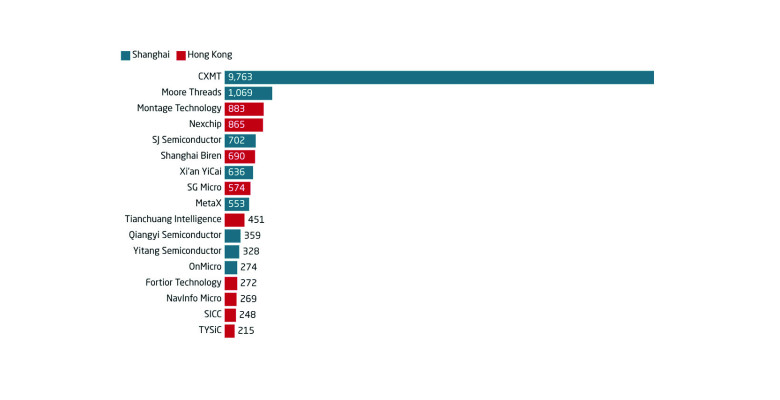
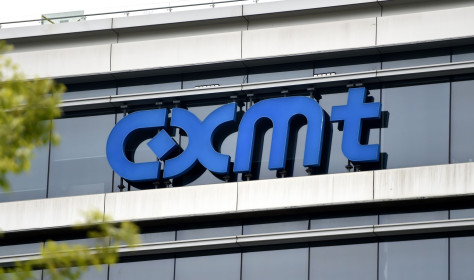
An increasing number of Chinese chipmakers are going public to finance their capacity expansion. In the past, local government financing has served as the backbone of China’s self-sufficiency drive in semiconductors. However, this local-government driven model faces a bottleneck due to fiscal constraints while self-sufficiency goals have become even more ambitious. CXMT is the most visible example of this trend. In July 2026, the company raised CNY 66.6 billion (USD 9.8 billion), nearly quintupling its value and making it China’s largest listed company. Other major players, such as YMTC, are expected to follow.
Last update: September 10, 2026
In push for self-reliance, Chinese chipmakers up R&D investments
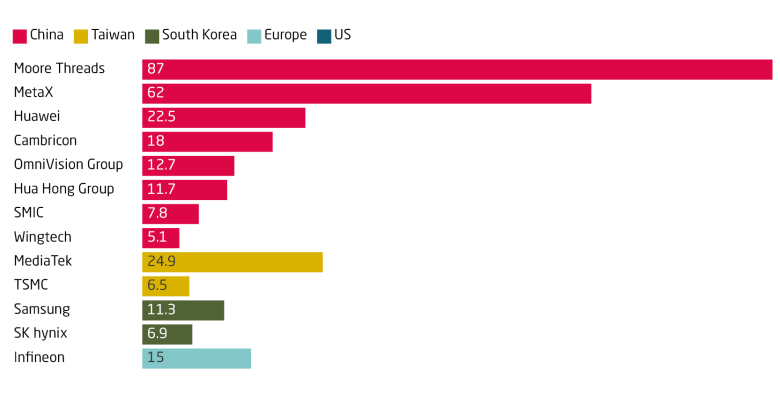

Chinese chipmakers are actively increasing their R&D expenditure. This is driven by the AI boom, rising demand for computing power, and China’s drive for self-sufficiency in advanced semiconductors. The chips are critical for artificial intelligence (AI) infrastructure, where the country lags behind foreign rivals. China’s leading chipmakers are investing a growing share of their revenue in R&D, on par with global leaders. However, their total investment remains lower in absolute terms. Subsidies by the Chinese government may also inflate their ability to invest in R&D.
China’s footprint in memory chips grows slowly
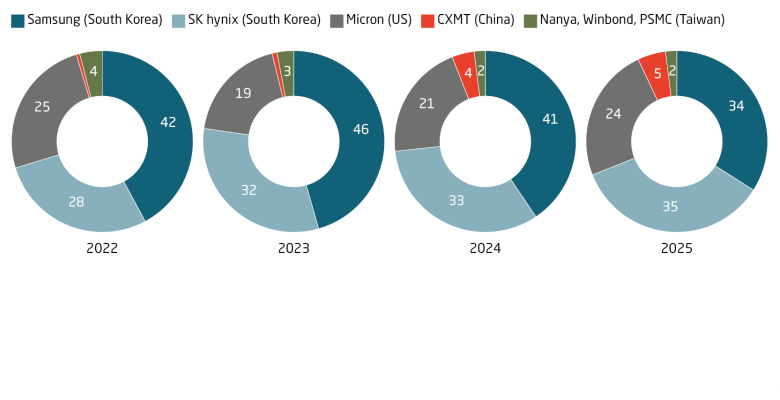
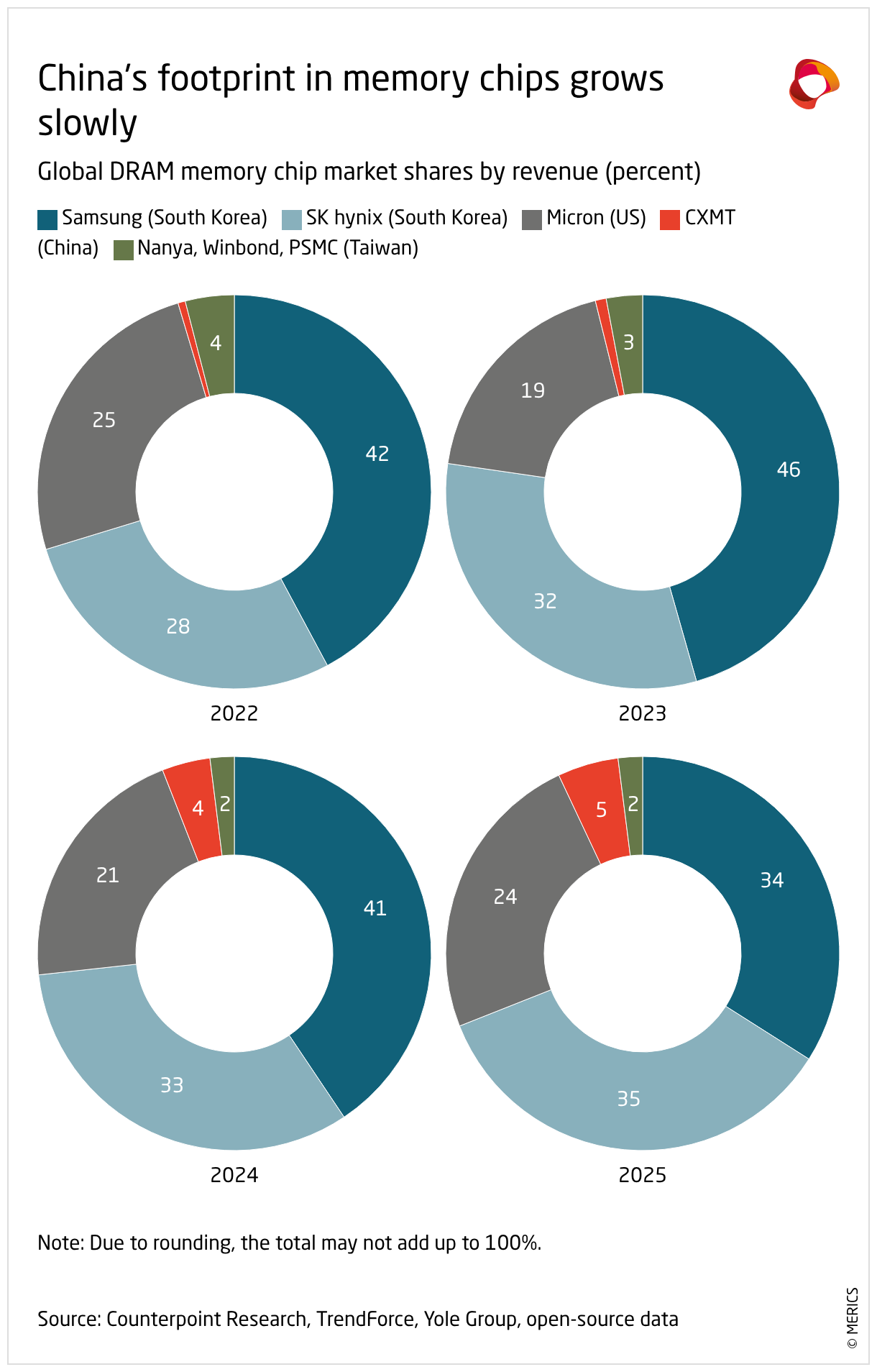
China gains ground in DRAM global market, competing with Samsung, SK hynix, and Micron. Its share of the global memory chip market has climbed from 0.6 percent to 5 percent in just four years, driven largely by ChangXin Memory Technologies (CXMT), now the world’s fourth-largest DRAM maker by capacity. CXMT mainly produces mature products like DDR4 and LPDDR4 chips but is signaling ambition toward DDR5 and HBM which are important for AI chips. In the last two years, CXMT has expanded to three 12-inch wafer fabs in Beijing and Hefei and is planning new plants in Shanghai with two to three times the Hefei capacity. CXMT’s gain in the memory market is a milestone for China in challenging the dominance of South Korean and US memory chip makers, but it still has a long way to go to compete at scale.
Semiconductors in China: Timeline of crucial events
Development
Policy/regulation
The US adds Huawei and its subsidiaries to the Entity List, restricting exports to them. This impacts Huawei's supply chain, with 33 of its 92 core suppliers based in the US.
Jan 2019
US applies Foreign Direct Product Rule to Huawei, blocking its technology access globally. Companies are barred from using US technology (mainly semiconductors) to supply Huawei.
May 2020
Top Chinese scientist suggests China use open-source RISC-V chip design architecture to overcome Western sanctions, and create an ecosystem around “RISC-X” in Belt and Road countries.
Nov 2020
US expands export controls on advanced semiconductors and manufacturing equipment, restricting tech specs of chips and including arms-embargoed countries.
Sep 2023
Huawei and SMIC release Kirin 9000S, a 7nm 5G chip for Huawei's latest high-end smart phone – even after US export controls blocked equipment considered necessary to make such chips.
Sep 2024
Ant Group says it has used domestic semiconductors, including from Alibaba and Huawei, to develop ways to train AI models that would cut costs by 20% compared to Nvidia’s.
Mar 2025
SMIC intends to acquire the outstanding shares of Semiconductor Manufacturing North China (Beijing) Corporation (SMNC), currently 51% owned by SMIC.
Sep 2025
SMIC tests a domestically produced immersion deep ultraviolet (DUV) photolithography machine that uses multiple patterning to produce 7nm chips without extreme ultraviolet (EUV) tools.
Sep 2025
A Dutch court rules there are "well-founded reasons to doubt" that the Chinese semiconductor company Wingtech is being managed correctly and, suspends Zhang Xuezheng as its CEO.
Oct 2025
Chinese AI startup Zhonghao Xinying launches Chana, a tensor processing unit (TPU), as a domestic alternative to Google’s TPU chips.
Dec 2025

Second tranche of Big Fund raises CNY 2 trillion (EUR 25.6 billion) to support Chinese semiconductor industry – beyond just fabs – to create an ecosystem for making semiconductors in China.
Oct 2019
COVID-19 severely disrupts supply chains for automotive chips. Car companies must cut output due to the shortage. Chinese chip companies evolve to meet the demand of its auto industry.
Jun 2020
US institutes country-wide semiconductor export controls, a major policy shift that restricts all of China’s access to "chokepoint" technologies, not just certain entities.
Oct 2022
Third phase of China Integrated Circuit Industry Investment Fund (Big Fund III) raises CNY 3.4 trillion (EUR 44.3 billion) from state-owned investors for semiconductor industry, the largest to date.
May 2024
China’s chip exports exceed CNY 1trn for the first time in 2024, reflecting growing production prowess. But imports are still twice as high as exports and are rising again after a dip in 2023.
Jan 2025
A subsidiary of Ant Group acquires a stake in memory chip developer InnoStar Semiconductor, as part of China’s efforts to support domestic suppliers. InnoStar raises its capital to CNY 50 m.
Sep 2025
The Dutch government seizes control of Dutch semiconductor manufacturer Nexperia, a subsidiary of China’s Wingtech, following concerns that it was transferring operations and IP to China.
Sep 2025
Shenzhen launches a CNY 5-bn fund to support semiconductor startups and strengthen local chip supply chains. The fund is part of Shenzhen's "20+8" industrial policy and has a 10-year duration.
Oct 2025
As China announces a one-year suspension of export controls on critical minerals, the US cuts tariffs on Chinese imports by 10% and delay certain restrictions on Chinese subsidiaries.
Nov 2025
The US approves exports of Nvidia’s H200 chip series to China under strict conditions. The chips could relieve China’s short-term compute shortages and accelerate domestic chip innovation.
Jan 2026
Recent developments
- The State Council revised the Regulations for the Protection of Integrated Circuit Layout Designs, notably expanding coverage to include “layout designs integrating photonic, quantum” to address intellectual property challenges for next generation ICs. (Source (CN): Xinhua, August 4, 2026)
- A previously unknown firm, Shanghai-based Aishengna (爱晟纳) reportedly began small scale production of the country’s first domestically made immersion deep-ultraviolet (DUV) lithography machine, which is rumored to be delivered this year. The system would be four generations behind ASML’s. (Source (EN): Reuters, July 28, 2026)
- China has imposed a temporary ban on helium exports, a critical material for semiconductors, to protect the domestic supply chain as global disruptions intensify. Qatar produces 30% of global helium, so the closure of the Strait of Hormuz hits the market hard. (Source (CN/EN): Mofcom, Reuters, July 10, 2026)
- Shenzhen University opened its own IC school, joining 36 others to form a talent pipeline for China’s technological self-sufficiency ambitions in the semiconductor industry. (Source (CN): eefocus, June 5, 2026)
Semiconductors in China: Profiling the actors
Publications

Topics