

picture alliance / Xinhua News Agency | Liu Shiping
Content
MERICS Briefs
MERICS China Essentials
China and the dispute over Greenland + Trade deal with Canada + Population decline
Top story
China criticizes Trump over Greenland, but seeks to remain above the Arctic fray
US President Donald Trump’s recent hostilities towards European countries in the dispute over the status of Greenland has given Beijing an opportunity to again present itself as a responsible global actor. China’s foreign ministry criticized Washington’s use of what it calls “the China threat” to undermine international law, but Beijing has otherwise remained conspicuously silent – likely in hope of avoiding scrutiny of its geopolitical ambitions in the broader Arctic well beyond the Danish territory.
China has in the past signaled interest in Greenland’s infrastructure and critical-minerals sectors, and Greenlandic stakeholders have tried to lure Chinese investment, but most major projects have never materialized. With the exception of two research stations in Iceland and on Norway’s Svalbard Islands, China’s main path to more Arctic influence runs through Russia. It has invested in mining, energy and infrastructure in Russia’s north, and has teamed up with Moscow to jointly develop the Northern Sea Route and expand military cooperation, with joint patrols taking place mostly in areas near Alaska.
Trump has falsely claimed “there are Russian [naval] destroyers, there are Chinese destroyers” off the coast threatening to “occupy Greenland.” But the US-European crisis this has precipitated has one obvious downside for China: greater attention on the Arctic could subject its presence and ambitions in the High North to geopolitical pushback. China has explicitly linked the Arctic to competition with the US and other Western countries, declaring itself a “near-Arctic” state and the region a “strategic new frontier.” One aim is to create a “Polar Silk Road” with new shipping routes and infrastructure.
But there are also potential opportunities for Beijing. China’s leaders will see a chance to exploit the growing fractures in the transatlantic relationship, presenting China as a more stable and predictable actor – and potentially more attractive partner – to Europe, albeit always in exchange for concessions. Different dynamics would come into play should the US seize Greenland and establish a substantial military presence there.
"While China’s presence in Greenland is limited, it does have ambitions to become an Arctic power, with implications for Western countries. But the transatlantic crisis triggered by Washington will create new opportunities for Beijing to convince Europeans that mending fences with China might be best.”
Helena Legarda, Head of Program, Foreign Relations, MERICS
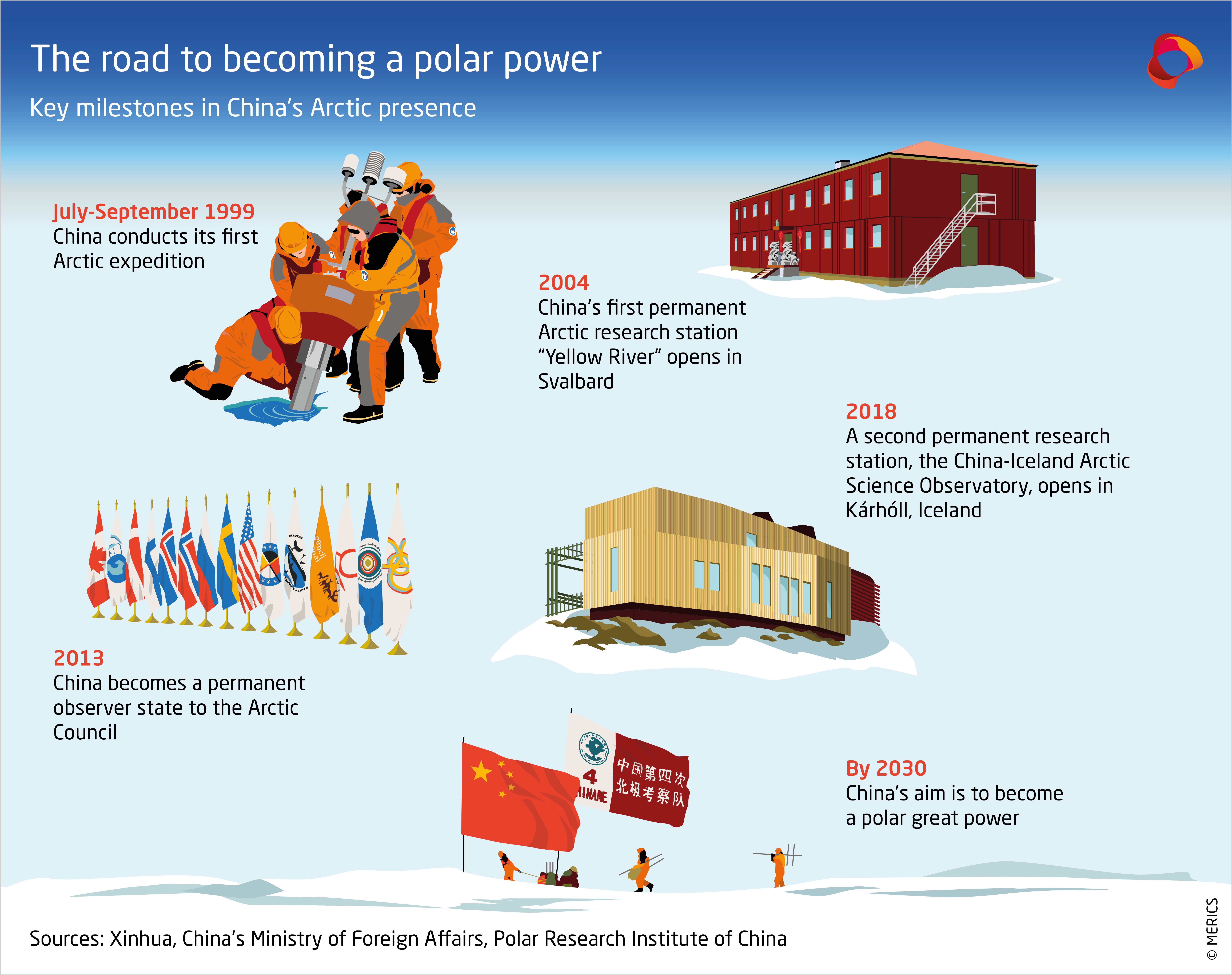
More on the topic: The Arctic, outer space and influence-building: China and Russia join forces to expand in new strategic frontiers, MERICS Report by Helena Legarda
Media coverage and sources:
- Chinese MFA: MFA Spokesperson statement on Greenland
- New York Times: Trump announces new tariffs on some European countries in Greenland standoff
METRIX
1.2 trillion USD
China’s trade surplus hit a new record in 2025, reaching USD 1.2 trillion. This is despite a marked decline in exports to the United States due to a trade conflict in the course of last year. Exports have been absorbed by third markets, especially countries in Africa and Southeast Asia. Africa recorded the strongest growth with an increase of 41 percent year-on-year in the third quarter. China’s record trade surplus is likely to trigger increased policy pushback from third countries and will raise the pressure on Beijing to address industrial overcapacity to reduce the reliance on external demand. (Source: MERICS)
Topics
Trump’s attacks on allies pushes Canada to hedge its bets with China
Beijing has dealt Washington a significant symbolic blow by striking a trade deal with Canada. China will lower barriers for Canadian canola, lobsters, crabs and peas, while Canada will cautiously open its market to Chinese electric vehicles (EVs), allowing 49,000 cars a year to bypass the 100% tariff Ottawa introduced in 2024 alongside the US. Although it also includes commitments to consider further commitments, the deal is far from comprehensive. But it is likely to prompt other countries frustrated with Washington’s aggressive tariff policy to reconsider their trading options with China.
Canada had raised barriers to China’s EVs in step with the US, signaling that the North American auto market was united in its concerns about cheap Chinese EVs – subsidized thoroughly by the state – undermining local competitors. The China-Canada deal has now re-opened that door – albeit under quota limits – and also calls for Chinese EV makers to invest in production facilities in Canada. With 75 percent of Canadian exports going to the US, Prime Minister Mark Carney wants to double shipments to other countries over the next decade – a goal Canada can only achieve by growing trade with China.
Canada’s agreement with China reflects a key challenge facing many countries: managing distortions caused by imports from China while also navigating the disruption of their own exports in the wake of US tariff hikes – quite apart from also contending with Washington’s threats to annex your country or an ally’s territory. Ottawa’s move will not banish the risk of China’s overproduction undermining domestic players and distorting the Canadian market, nor will it solve any of Canada’s strategic dependencies on China. But it does reflect the political reality that today’s problems created by countries close by often take precedence over tomorrow’s risks caused by those further away.
“Beijing has played its cards on trade skillfully, while Washington has squandered what was a strong hand. With an opponent like Donald Trump, Xi Jinping must feel that destiny is indeed on the side of the Chinese Communist Party. The US President is so willing to cast aside traditional allies that even Canada is looking to Beijing to hedge its bets – even if only to trade electric vehicles for canola and crabs.”
Jacob Gunter, Head of Program, Economy and Industry, MERICS
Media coverage and sources:
- Prime Minister of Canada: Prime Minister Carney forges new strategic partnership with the People’s Republic of China focused on energy, agri-food, and trade
- BBC: Canada's deal with China signals it is serious about shift from US
- The Guardian: Mark Carney in China positions Canada for "the world as it is, not as we wish it"
Lowest-ever birth rate shows China’s pro-baby policies are falling flat
The fourth annual decline in China’s population and lowest-ever birth rate are the clearest evidence yet that China’s expanding birth support efforts are not working. Until effective policies to prevent job loss and workplace discrimination against women of childbearing age are tackled, the downward trend will likely continue steadily. The risk is that, in the long-term, China’s overburdened pension and healthcare systems will not be able to support its quickly aging population. The current outlook might push authorities to intensify their drive for births even further.
China’s population shrank by roughly 3.5 million from 2024, while registered births fell by 17 percent, the lowest birth rate since records began in 1949, the National Bureau of Statistics reported on January 19. The fertility rate tipped below one child per woman on average.
The government has been slow to implement its plans, cash incentives and improvements to healthcare services for mothers and children. But in late December, it unveiled a new draft law on childcare services that has been widely welcomed. If effectively enforced, the measures are expected to significantly improve access to and quality of services for parents.
Authorities continue to seek “sustainable” levels of population growth, with top leaders laying out goals for China’s 15th Five-Year Plan ahead of the National People’s Congress in March. For the first time, these include “high-quality” population development as a major task, with the number one goal to change people’s attitudes toward marriage and childbearing – a largely ideological undertaking that, as the numbers show, has generated more backlash than compliance.
“Demographers had anticipated low numbers, but the outlook they reveal is grimmer than anyone had predicted. Beijing is walking a tight rope on an issue that is becoming increasingly sensitive, and the leadership might feel more pressured to extend larger social security benefits in the near future.”
Daria Impiombato, Senior Analyst, MERICS
More on the topic: When giving birth is a national duty: Beijing’s struggle to reverse demographic decline, MERICS Report by Daria Impiombato and Nis Grünberg
Media coverage and sources:
- People’s Daily (CN): 促进人口高质量发展--专题报道 (Promoting high-quality population development - Special Report)
- National Bureau of Statistics (CN): 王萍萍:2025年全国人口总量为140489万人 人口高质量发展持续推进 (Wang Pingping: China's total population will reach 1,404.89 million in 2025; high-quality population development continues to advance)
- Sixth Tone: China unveils draft law to expand childcare services
China’s probe of Manus AI acquisition by Meta reveals fears about AI tech exodus
In a sign Beijing is worried about losing homegrown AI companies, the government has launched a probe into US-based Meta’s December acquisition of Manus AI. Manus is an agentic AI software developed by Chinese startup Butterfly Effect.
Meta bought the startup for around USD 2 billion after Manus moved to Singapore in June and laid off its Chinese employees, – de facto severing ties with China. Although it was founded in Beijing and Wuhan by Xiao Hong (肖弘), a Chinese citizen, and counted investors like ZhenFund and Tencent, its general-purpose AI agent is not available in China.
Manus is not the first Chinese AI company to domicile in Singapore. The trend known as “Singapore-washing” has seen tech companies moving there, mostly drawn to the ease of access to US capital and technology. It has Beijing concerned about a larger exodus of AI engineering talent and technology in the sector that is central to its strategy for self-reliance in national and economic security, particularly if it means American influence over innovations that originated in China.
For that reason, authorities are scrambling to find a hook to meddle with Meta’s deal, such as investigating a possible violation of export controls. Still if Beijing finds Manus failed to apply for a technology export license or that it transferred sensitive training data without approval, it could not only throw a wrench in the deal but also spell trouble for others pursuing a similar strategy.
"Manus does not serve the Chinese market. Assuming that Manus’s creator Butterfly Effect did comply with rules around outbound investment, Beijing’s options seem limited. What happens next will make or break the ‘Singapore-washing’ strategy among Chinese AI founders.”
Rebecca Arcesati, Lead Analyst, MERICS
Read more: Singapore-washing or how Chinese corporates future-proof their global business – Analysis by former MERICS Analyst Aya Adachi
Media coverage and sources:
- Chinese MOFCOM (CN): 商务部召开例行新闻发布会(2026年1月8日)(The Ministry of Commerce held a regular press conference (January 8, 2026) )
- Zaobao (CN): 忧企业效仿“去中国化”路径中国或审查Meta收购Manus交易 (China could review Meta’s acquisition of Manus)
- Sina Finance (CN): Manus被审查 (Manus is investigated)
MERICS China Digest
He Lifeng tells Davos forum China never pursued trade surplus (Reuters)
Following a record trade surplus of 1.2 trillion USD in 2025, Chinese Vice Premier He Lifeng told the World Economic Forum on Tuesday that China never deliberately pursued a trade surplus. China is also willing to leverage its "mega-sized market" and "more vigorously" expand imports, He said at the WEF's annual meeting in Davos. (26/01/20)
BRI investments reach record volume in 2025 (BRI investment report)
According to the BRI investment report of the Green Finance and Development Center at Fudan University, preliminary data on Chinese engagement in the 150 countries of the Belt and Road Initiative through investments and construction contracts show a total engagement of USD 213.5 billion, up 73 percent increase over 2024. More than half of the engagement in 2025 was directed towards Africa and Central Asia. (26/01/18)
Xi stresses the need to win the fight against corruption in China (Reuters)
Party and state leader Xi Jinping called China’s fight against corruption “a battle it cannot lose” in his speech kicking of a three-day plenary session of the Central Commission for Discipline Inspection which took place in Beijing from January 12-15. According to new figures released by the country’s top anti-graft watchdog in January, last year saw probes of a record number of 65 high-ranking officials ("tigers”). At the same time, Beijing also targets lower-ranking officials ("flies"), as it expands scrutiny to more sectors and industries. (26/01/12)
A new documentary shown on state television last week revealed how Chinese investigators tracked down cryptocurrency bribes paid in to a former senior official at the People’s Bank of China. The release of the CCTV documentary coincided with an annual meeting of the Central Commission for Disciplinary Inspection (CCDI) which called for “high-pressure deterrence” against corruption. (26/01/15)
Are you dead? The viral Chinese app for young people living alone (BBC)
An app with the bleak title “Are you dead” has taken China by storm. Users check in with the app every two days, confirming they are still alive. Launched in May last year, it has become the most downloaded paid app in China and is especially popular among young people living alone in Chinese cities. (26/01/12)
China and EU agree on steps to resolve EV imports dispute (AP News)
The EU is replacing the EV import tariffs on Chinese cars: A “guidance document” released on January 12 gives instructions for Chinese EV manufacturers on making price offers for battery EVs. These must include minimum import prices, which need to be set at a level “appropriate to remove the injurious effects of the subsidization,” said the EU. A statement by China’s Commerce Ministry called the development “conducive not only to ensuring the healthy development of China-EU economic and trade relations, but also to safeguarding the rules-based international trade order”.
Content