
picture alliance / Xinhua News Agency | Yan Yan
Content
MERICS Briefs
MERICS China Essentials
China and the war in Iran + The new Five-Year Plan + NPC outcomes
Top story
War on Iran: In muted reaction, China puts pragmatism before anti-Western ideals
Despite Iran’s inclusion in what Western foreign-policy experts dub the “axis of upheaval” alongside China, Russia, and North Korea, Beijing’s muted reaction to the US-Israeli war on Iran shows that Tehran is not central to its geopolitical strategy in the way Moscow is. While Xi Jinping was willing to risk straining ties with the US and EU by supporting Russia through diplomatic and economic means after the 2022 invasion of Ukraine, Beijing’s approach to Iran since the beginning of March reflects cool economic and geopolitical pragmatism rather than any anti-Western ideology.
Chinese Foreign Minister Wang Yi did recently note that the conflict “should never have happened” and – referring to military actions of “major countries” – cautioned against the world reverting “to the law of the jungle” in a call with the French Foreign Minister. But he also used his traditional “Two Sessions” press conference to hail 2026 as “significant” for US–China relations. Beijing is counting on a visit by US President Donald Trump scheduled for end of March to help manage great-power differences over Taiwan, technology and trade and promote greater cooperation. Its earlier calls in March for respecting Iranian sovereignty and a ceasefire also did nothing to endanger those goals.
Wang repeated this call for an end to the fighting in phone conservations with counterparts from several Gulf countries, emphasizing China’s concern about threats to their security. While Beijing has significant investments in Iran and is thought to buy up to 80 percent of Iran’s oil exports, its economic relations with the Gulf states are far more substantial. China imports three times more oil from Saudi Arabia and the five other Gulf Cooperation Council countries than from Iran – and the volume of trade with Saudi Arabia was recently almost ten times that of trade with Iran.
China’s geopolitical and economic stakes in Iran are simply not high enough for Beijing to risk jeopardizing manageable relations with Washington and Gulf states, as well as its longer-term diplomatic priorities. While Xi in June 2025 personally voiced “deep concern” about a first round of US-Israeli attacks on Iran, the Chinese leader has said nothing publicly nine months later. China’s official condolences following the killing of Iran’s Supreme Leader Ali Khamenei were delivered only at the level of a deputy foreign minister, signaling a clear downgrade in Beijing’s engagement over the past months.
For China, Iran is not Russia. For all its talk of being a stabilizing force in a turbulent world and standing up for multilateralism and the Global South, China’s muted response to the Iran crisis shows the limits of its influence and ideological convictions in the face of its economic and geopolitical calculations involving the US and Gulf states.”
Claus Soong, Analyst, MERICS
Media coverage and sources:
- Chinese MFA: Member of the Political Bureau of the CPC Central Committee and Foreign Minister Wang Yi Meets the Press
- HK01: 為什麼不會軍援伊朗? 中國在中東的戰略需要是什麼 (Why there will be no military aid to Iran? What China needs in its Middle East Strategy)
- New York Times: For China, Billions of Dollars Are at Risk From a Widening War
Five-Year Plan treats social provision as economic policy
Beijing increasingly seems to recognize that its longstanding goals of technological advancement and self-reliance cannot substitute for a stronger domestic economy, even as its new Five-Year Plan (FYP) points to greater urgency in pursuing them. The 2026 budget approved by the National People’s Congress last week shows Beijing is moving more decisively to improve conditions for domestic demand.
If China wants a more resilient and sustainable growth model, it can no longer rely primarily on high-tech development. Like other major economies with large and resilient domestic markets, it also needs to strengthen the domestic factors of growth: public goods provision, social welfare, and a more integrated national market.
The 2026 budget provides for investment in public goods and social services via a CNY 100-billion special fund designed to mobilize credit for private investment and household consumption. New FYP targets on childcare, eldercare, and healthcare staffing, along with President Xi Jinping’s recent emphasis on health policy reinforce this effort. The idea is that social provision can reduce household insecurity and care burdens, strengthen the safety net, and over time lower precautionary savings that dampen spending. The plan treats social provision not as a by-product of growth, but as part of a strategy to make growth more sustainable – with the clear expectation that citizens will spend more.
The FYP also includes efforts to build a unified national market to drive economic growth by curbing local protectionism and reining in abusive preferential treatment. It aims to “regulate the economic promotion behavior of local governments” when wooing investors, strengthen “antimonopoly and anti-unfair competition law enforcement,” and “comprehensively address ‘involutionary’ competition” by making local implementation less patchy and easing destructive competition, at least in some sectors.
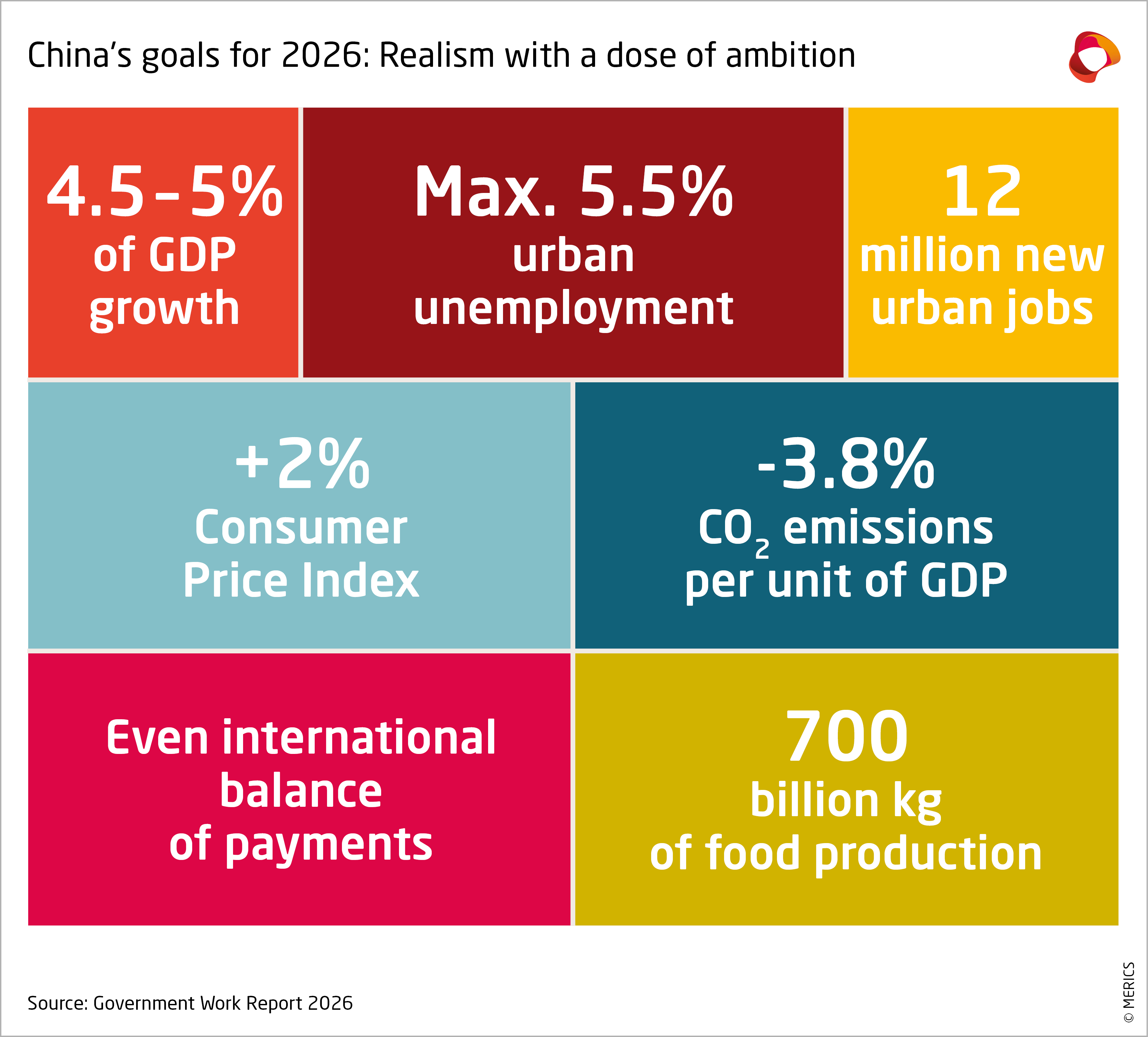
But this shift requires time. Taken together, the 2026 policy package attempts to bridge short-term stabilization and medium-term reform. The government lowered its 2026 GDP growth target to 4.5–5 percent, below the “around 5 percent” target of the past three years, while infrastructure-related spending is set to rise to CNY 5.7–5.9 trillion, about 8–12 percent above last year. This combination matters politically: Higher infrastructure spending can keep the growth engine ticking while creating room for more difficult structural adjustment, namely, the “orderly exit of backward and inefficient productive capacity.”
The domestic-demand agenda will succeed only if Beijing tackles market fragmentation and social policy with the same determination it has shown in technology and digital development.”
Alexander Davey, Analyst, MERICS
Media coverage and sources:
- NPC Observer [CN]: Draft of the 15th Five-Year Plan
- Xinhua [CN]: March 6, Two Sessions press briefing on the economy
- NPC Observer [CN]: 2026 draft budget
Beijing targets EUR 1 trillion growth in six “emerging industries” and AI by 2030
China’s Five-Year Plan aims to boost “six emerging-industry pillars” and artificial intelligence (AI) in its broader strategy to drive economic growth and reduce reliance on foreign technology – putting European companies under new pressure in high-end markets. Zheng Shanjie, chairman of the National Development and Reform Commission (NDRC), said that total output of semiconductors, aerospace, bio-medicine, the low-altitude economy (including drones), new energy storage and intelligent robots was expected to grow more than 10 percent per year and exceed CNY 10 trillion (EUR 1.25 trillion) by 2030, while AI would surpass the same milestone, implying 60 percent annual growth.
The country has retooled its economy around the goal of unleashing the “new quality productive forces” championed by Xi Jinping. Beijing plans to increase research and development spending by at least 7 percent per year, well above expected economic growth. Zheng highlighted science and technology megaprojects (some comparable in scale to the EU’s entire Horizon Europe research budget for 2021-2027), a one-trillion-yuan capital fund to support mergers and acquisitions (complementing an existing government-led venture capital fund) and a range of policies to boost domestic demand for Chinese high-tech products and services, like recently expanded insurance measures to absorb the financial risk of buying and investing in experimental technologies.
Confident in its “innovation chain” approach – which aims to keep every stage of research, development, commercialization and market adoption in China – Beijing is already eying earlier-stage technologies to dominate. Zheng highlighted six “future industries” that are to follow the model established by the six emerging-industry pillars: quantum technology, biomanufacturing, hydrogen and nuclear-fusion energy, brain-computer interfaces, embodied AI, and 6G mobile networks. The draft of the Five-Year Plan also called upon universities and public research organizations to contribute through research challenges and “horse-race” funding schemes, in which different teams of experts compete to solve the same problems, with the best results receiving continued support.
China’s focus on building six ‘emerging pillar’ industries and a multi-trillion-yuan AI sector is an effort to dominate tomorrow’s global supply chains. For Europe, this brings the risk of competition in advanced technologies and new dependencies in fast-growing sectors like robotics, energy storage and biotechnology.”
Jeroen Groenewegen-Lau, Head of the Science, Technology and Innovation Team, MERICS
Media coverage and sources:
- NPC Observer [CN]: Draft of the 15th Five-Year Plan
- NDRC [CN]: 郑栅洁主任在十四届全国人大四次会议经济主题记者会上答记者问 (Director Zheng Shanjie answers reporters' questions at the economic-themed press conference of the Fourth Session of the 14th NPC)
- 21 JingJi [CN]: 四部门护航科技保险高质量发展 推万亿“耐心资本”涌向科技前沿 (Four departments are safeguarding the high-quality development of technology insurance, driving trillions of yuan of "patient capital" to the forefront of technology)
MERICS China Digest
China’s exports start strong in 2026 after record-breaking year (Reuters)
Outbound shipments from the world's second-largest economy grew 21.8 percent in USD terms in the January-February period compared to last year, surpassing the median forecast in a Reuters poll of 7.1 percent growth. (26/03/10)
European freight truck makers brace for wave of low-cost Chinese rivals (Reuters)
With better technology and lower prices, at least half a dozen Chinese manufacturers are planning to launch European heavy truck sales in 2026, including BYD, Geely Holding unit Farizon, China's top-selling electric truck brand Sany, Sinotruk, and startups Windrose and SuperPanther. (26/03/10)
Taiwan Premier makes surprise visit to Japan (Taipei Times)
Premier Cho Jung-tai made a one-day trip to Japan, meeting with lawmakers and attending a baseball game. It is the first time an incumbent Taiwanese premier has visited Japan since Taipei and Tokyo severed diplomatic ties in 1972. (26/03/08)
Primary school enrollment falls for second year in a row (Caixin)
According to the National Bureau of Statistics, nationwide primary school enrollment in China fell to 14.617 million in 2025. This represents a drop of nearly 10 percent from the previous year and a contraction of 22 percent from the peak in 2023. This effect of the sinking birthrate has also led to the closure of numerous kindergartens. (26/03/03)
AI agent OpenClaw takes China by storm (ChannelNewsAsia)
Created by Austrian developer Peter Steinberger, the AI agent with the lobster logo can fulfill various tasks – when granted user permission. Enthusiasts are touting its talents, such as booking flights and drafting reports, across Chinese social media. The speed of adoption reflects China’s push to harness AI across industries, but analysts and authorities are also warning of security risks. (26/03/11)
Content