picture alliance / HPIC | stringer
Kommentar
As they expand in China, Europe’s companies are hollowing out Europe
European companies are moving ever more parts of their value chains to China. Andreas Mischer says the EU must make sure this does not hollow out the region’s industrial base.
The ongoing drive of European companies to expand operations in China threatens European “derisking,” the reduction of economic dependencies and exposure to the country. Through “localization”, German companies in particular hope to gain better access to a huge market, insulate themselves from supply chain and other global business risks, and boost their competitiveness by lowering costs. But in doing so, they overlook that these advantages come at the expense of the EU’s industrial competitiveness. The EU needs to take action.
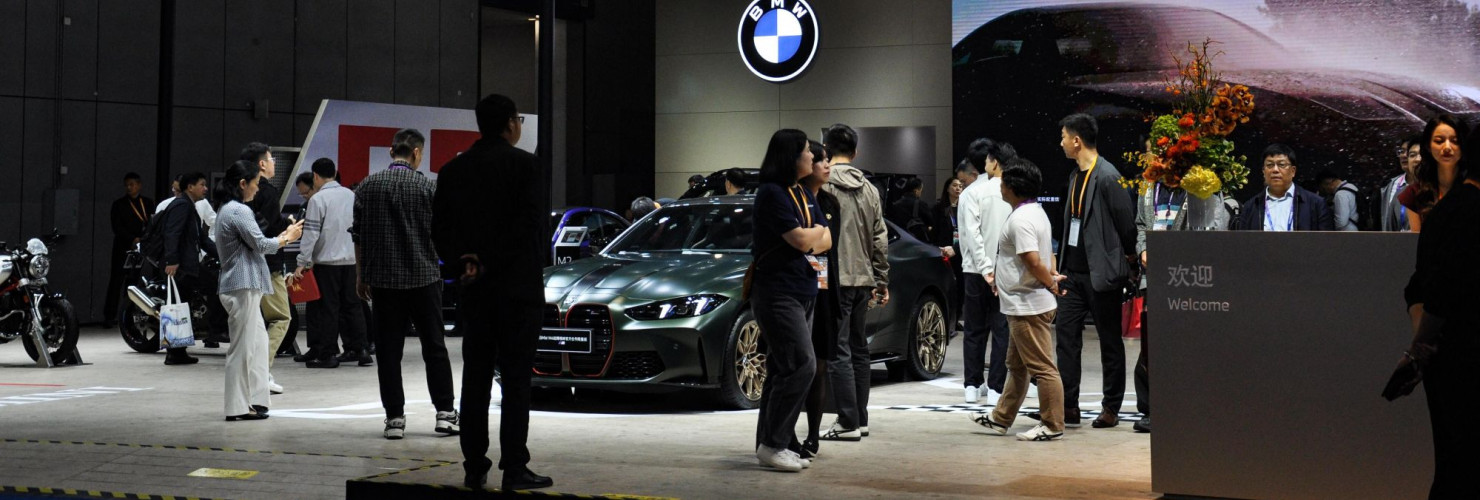
German carmakers have been prominent proponents of an “in China, for China” strategy, localizing ever greater parts of the value chain in the country. Volkswagen built its largest research and development (R&D) center outside Germany in Hefei, China, to design car models tailored to the preferences of Chinese customers. Together with its Chinese partner Xpeng, the company has also been looking for ways to reduce the number of electronic control units in its locally designed and made cars. In combination with local suppliers joining the development process earlier, this is meant to reduce Volkswagen’s R&D costs in China by up to 50 percent.
German carmakers seem to be fighting a losing battle in China
But despite such aggressive localization drive, German carmakers seem to be fighting a losing battle in China. In the second quarter of 2026, Volkswagen, Mercedes-Benz, and BMW each saw sales slump by more than 30 percent year-on-year. Much of Volkswagen’s production capacity in China stands idle as a result. The company closed its Nanjing factory in 2025, after 17 years of operation with joint-venture partner SAIC. Estimates put utilization across all VW-SAIC’s factories that year at just 58 percent of a total annual capacity of 2.1 million cars.
With so much capacity sitting idle, foreign carmakers could be tempted to use their Chinese factories to make ever more cars for export. China’s recently published 15th Five-Year Plan for intelligent and connected vehicles already suggests that joint ventures between foreign and Chinese carmakers should concentrate more on exports. Should persistently declining sales in China make this option too tempting to resist, German and other European manufacturers would shift towards an export-oriented localization, adding to the flood of Chinese-made cars into Europe – and compounding their own problems in their home market.
Other German companies understand localization in China as a way to reduce business risk. BASF, which has cut 2,800 jobs at its headquarters in Ludwigshafen since 2024, inaugurated its EUR 8.7 billion integrated chemical plant in Zhanjiang in March 2026, the largest single investment in company history. BASF expects the complex to generate sales of EUR 5 billion by 2030 and to lift China’s share of its annual revenue to 20 percent. The country accounts for half of global chemicals demand but makes up only 14 percent of BASF’s sales. From this perspective, BASF is simply correcting China’s underrepresentation in its global business.
But this purported risk reduction comes with risks of its own. BASF concedes that the Zhanjiang site will become profitable later than originally planned because China’s chemicals sector, like the car industry, is beset by overcapacity and low margins. The company believes Beijing will be able to stamp out so-called economic involution, yet the question is how quickly. Another worry is China’s recently revised national defense mobilization law, which allows the government to seize company assets in certain circumstances. As unlikely as this appears at present, geopolitical uncertainty makes it a possibility companies should from now on consider.
Deepening localization in China is undermining Europe’s economic security
A third group of German companies is deepening localization in China while reducing capacity at home. Virtually all major German car-parts suppliers are cutting jobs at home while expanding operations in China. Bosch plans to cut 22,000 jobs globally by 2030, many of them in Germany, while ZF Friedrichshafen wants to cut 14,000 jobs in Germany alone over the coming years. This comes as Volkswagen is also reducing capacity at home. Its plan to cut another 50,000 jobs and close up to four factories is the most prominent example of hollowing out of European industrial capacity and the growing threat of deindustrialization.
Taken together, these corporate decisions and their consequences show that deepening localization in China is undermining Europe’s economic security and prosperity. In the past, companies built factories abroad to exploit greater economies of scale and generate profits that could be reinvested at home in R&D and well-paid, high-value jobs. Today, European companies that built factories in China are locally reinvesting the profit they make there while cutting jobs at home. As a result, boardroom decisions in Germany and elsewhere in Europe are increasingly coming into conflict with the region’s long-term economic interests.
The EU should do more than protect Europe from Chinese overcapacity or make European companies diversify their supply chains. It also needs to start scrutinizing the investments European companies make abroad, in particular in China. The EU Commission, in 2025, asked member states to monitor their companies’ outbound investments in semiconductors, artificial intelligence and quantum technologies. EU leaders should now make screenings mandatory and expand this regime to more technologies and sectors. Further steps should follow, for example, making access to EU public funds conditional on retaining R&D and industrial capacity within Europe.
A German-language version of this article was published by Handelsblatt on November 3, 2026.