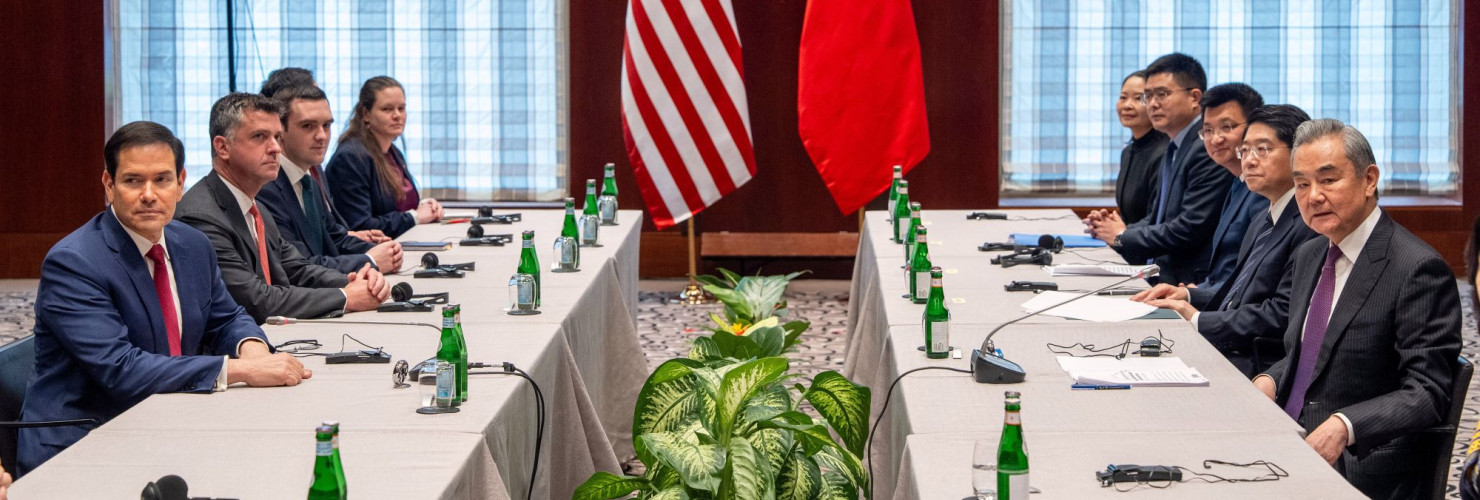
picture alliance / ASSOCIATED PRESS | Alex Brandon
Kommentar
China sees opportunities in global disorder
Beijing is largely unconcerned by recent US actions. From a European perspective, China may now appear more reliable than the United States. But Chinese policies and strategic objectives have not changed, says Helena Legarda.
2026 has started with a geopolitical bang. The United States’ incursion into Venezuela and the Trump administration’s threat to impose tariffs on European countries for opposing his declared wish to annex Greenland herald a year of disruptions—and of tough choices for Europe. While the transatlantic partners deal with growing tensions and distrust, Beijing will see opportunities to leverage this new geopolitical landscape to expand its global influence.
US actions have limited impact on China
Washington’s actions in Venezuela and vis-à-vis Greenland have both been framed as being about China (and Russia). Trump administration officials have cited the need to counter Beijing’s and Moscow’s growing influence in the region as a justification for the raid in Caracas. And the fact that there are “Russian and Chinese ships all over the place” near Greenland is the argument used by US President Donald Trump to justify his intent to take over the Danish territory.
These US actions will have some downsides for China. There will be economic costs: Beijing sourced around 4 percent of its total oil imports from Venezuela, and Chinese companies have poured money into the country over the last few years—investments that might now be at risk if the US pushes for a review of Maduro-era contracts. Greater focus on the Arctic, meanwhile, will also place China’s activities in this “strategic new frontier” under greater scrutiny, potentially increasing pushback across the High North.
But the immediate impact that either of these actions will have on China’s strategic ambitions and its current presence in Latin America and the Arctic is likely to be limited. China has diversified its oil imports and will be able to replace Venezuelan oil—likely with Iranian and Russian crude—even if at a price. Arguments that Beijing’s inaction to support Nicolás Maduro will hit China’s credibility and value as a partner are overstated. At this point it won’t be news to anyone that China’s support for partners is diplomatic and economic in nature and does not extend to security guarantees unless its core interests are affected. This has proven enough to draw many countries to closer ties with China.
Greenland, meanwhile, has not been Beijing’s top priority in the Arctic region. In the past, China has signaled interest in Greenland’s infrastructure and critical minerals sector, but most large-scale projects never materialized, with the exception of China’s Shenghe Materials’ involvement in a stalled project to develop the Kvanefjeld mineral deposit. Some were blocked by Denmark, but others stalled simply due to the fact that Chinese companies were unwilling to take the risks and costs involved. In consequence, little is at stake for China in Greenland today. Its growing cooperation with Russia to increase its polar footprint also means that Beijing has alternatives in the region.
Fishing in troubled waters
Washington’s actions are providing Beijing with some (likely unexpected) opportunities. The Venezuela and Greenland crises are propaganda gold for China. They will be used to support China’s portrayal of the United States as a hegemonic, imperialistic country that does not respect the sovereignty of smaller, weaker countries—in contrast to Beijing’s role as a defender of multilateralism and a bulwark against a “might makes right” world. This is an old story, but the more that the US appears as the more acute threat to the global order, the likelier it is that China’s narratives will find broader support.
Beijing’s biggest boon, however, is likely to be the damage that Trump’s Greenland threats are doing to the transatlantic alliance. It was not that long ago that Chinese leaders were criticizing new NATO language around China’s role as a “decisive enabler” of Russia’s war against Ukraine and preemptively warning against the expansion of NATO into the Indo-Pacific—a longstanding concern of Chinese analysts and policymakers. Today, NATO’s discussion on China is likely to be deprioritized, as allies focus instead on preventing the weakening of the alliance.
This shaky global order and the fractured transatlantic partnership create a world that is ripe for Chinese action. Seizing these opportunities would require some adjustments on Beijing’s part, and even a few tactical concessions here and there. And it is unclear that China’s leaders will be willing to do so. Despite internal socio-economic tensions, Beijing seems to be riding a foreign policy confidence high. Coming out of its perceived victory in the trade dispute with the US last year, China’s leaders feel vindicated in their path and are signaling their intention to stay the course and to “move beyond preparedness, fight, and turn crisis into opportunity.” Compromise and concessions may be hard to come by.
Europe’s familiar dilemma
After a year of trying to find ways to work with the Trump administration on trade in order to preserve stability on the security front, the Europeans find themselves in a familiar tough spot: facing a US intent on linking economic and security considerations, while being subjected to continued pressure from an emboldened China.
Unless it wants to remain merely an observer of this changing global order, Europe will have to accept that we live in a new reality and find ways to muster a bold response that mends fences where possible, but also demonstrates willingness to stand its ground.
If the Trump administration continues to criticize and alienate allies, threatening tariffs for non-compliance, Europe will have to make some difficult choices. The economic costs of a trade war with the US alongside those associated with the China-focused de-risking agenda might prove too much for Europe, especially for a European public that has not been fully explained the objective, costs and long-term upsides of such actions.
In such a scenario, lowering tensions in relations with China is likely to prove an attractive proposition for many. Not out of a desire to rebalance, but out of perceived necessity. Canadian Prime Minister Mark Carney’s recent visit to Beijing, during which he agreed to a strategic partnership and a trade deal with China, will be seen as a potential path to follow. China will see the opportunity in the transatlantic crisis and is likely to offer similar offramps to visiting European leaders—in exchange for some concessions, of course.
However, the Europeans should not lose sight of the structural and systemic challenges that China poses. US threats should be taken seriously, but so should Beijing’s support for Russia, or the loss of 10,000 manufacturing jobs a month in Germany due to intensifying industrial competition with China. Beijing might look more reliable than Washington at the moment, but its policies and strategic objectives have not changed substantially.
That said, many of the changes to the geopolitical landscape we are witnessing will stay, and their effects will be felt even after Trump leaves the White House. With collective transatlantic action effectively out of the question for the time being, the times call for a new approach to this changing geopolitical reality that prioritizes strengthening Europe’s resilience, capabilities and cohesiveness, and finding alternative partnerships and coalitions.
This article was first published by IP Quarterly on February 9, 2026.
Autor(en)

Programmleiterin
Autor(en)
Programmleiterin