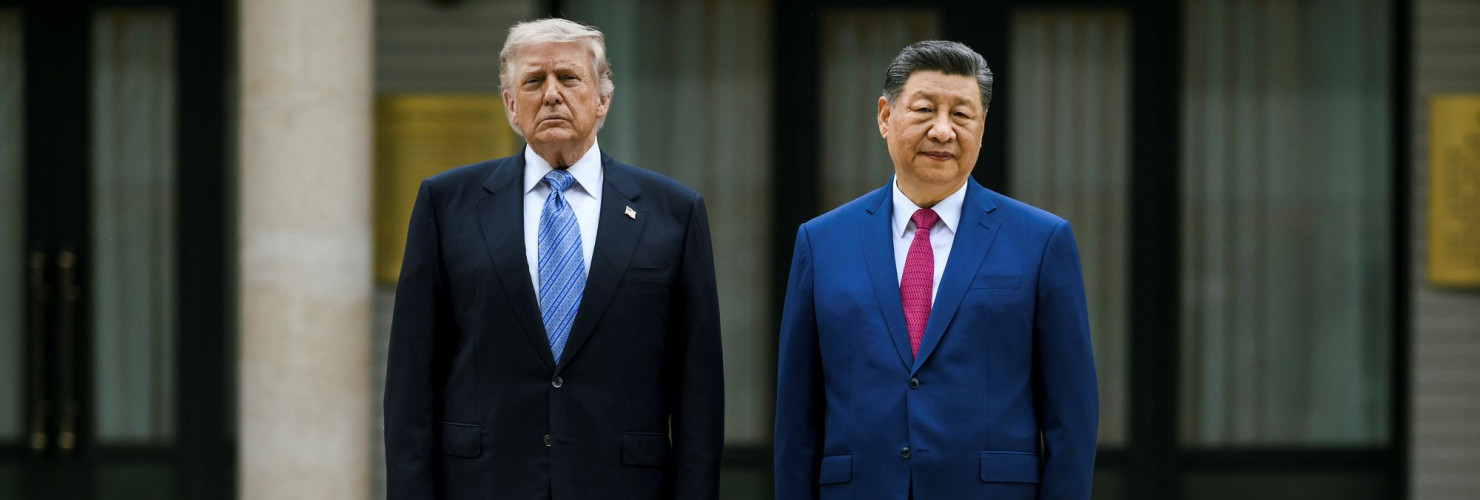
picture alliance / ZUMAPRESS.com | Handout/White House
Tracker
China Security and Risk Tracker
MERICS China Security and Risk Tracker 01/2026
Trump's remarks after China Summit compromise Taiwan's security
by Aurelio Insisa
Taiwan’s security outlook deteriorated in the aftermath of the Xi-Trump summit, held on 14-15 May in Beijing, with the US announcement that a fresh USD 14 billion arms deal with the island is now “under review”. The US move also raises questions for European actors over the sustainability of their behind-the-scenes security engagement with Taiwan.
Before the two presidents met for the US-China summit, Beijing reportedly asked the US side to make an explicit statement opposing “Taiwan independence” and endorsing Taiwan unification with the People’s Republic China (PRC). However, the US made no such remarks. Instead, US Secretary of State Marco Rubio stated on 15 May that “US policy on the issue of Taiwan is unchanged as of today.” There was no mention of Taiwan in the White House’s readout of the summit released on 17 May.
Yet, US President Donald Trump himself managed to cast uncertainty in an interview immediately after the summit. Asked whether the “people of Taiwan” should “feel more or less secure”, President Trump replied “Neutral … I’m not looking to have somebody go independent. And, you know, we're supposed to travel 9,500 miles to fight a war. I'm not looking for that. I want them to cool down. I want China to cool down”. Trump added that he would hold “in abeyance” the signing of the new USD 14 billion arms deal with Taiwan because it is “a very good negotiating chip” with China. He went on to emphasize the power asymmetry between Beijing and Taipei and repeated past tirades against Taiwan’s “theft” of the chip industry from the United States.
On 20 May, Trump raised further uncertainty, publicly stating that he would speak with Taiwan’s President Lai Ching-te about the new arms deal. A conversation between Taiwan’s leader and the US president conflicts with normal US practice for handling its ’One China’ policy. On 21 May, US Acting Secretary of the Navy Hung Cao announced that the sale would be paused because of the US needs to replenish its own munitions due to its war against Iran. Later on June 4, Rubio contradicted Cao, stating that the arms sale was not paused but “under review as it’s being processed”, due to its scale and consequent implications for the US defense industrial base and production capacity.
 Hover over/tap the charts to see more details.
Trumps’s aspirations and Taiwan’s reality
Trump’s post-summit statements reflect his mercantilist worldview, in which traditional US alliances are considered both burdens and transactional instruments. His apparent wish to use arms deals with Taiwan as a bargaining chip in the management of Sino-American relations is an immediate concern for Taiwan. Trump floated this idea shortly before starting his first presidency (2016-2020). However, his administration rapidly veered towards a more muscular China policy. Any major agreement between Beijing and Washington involving Taiwan continues to appear unrealistic. China arguably has no urge to grant major concessions to the United States, especially as it publicly professes confidence in its ability to achieve unification.
At the same time, while Trump maintains his grip on the Republican Party, there would likely be extreme internal opposition in the United States to any major “deal” involving the island. However, Taipei should be more immediately concerned with the capability of the US to deliver on its existing commitments, given the shortcomings of the American defense industrial base amid the wars in the Middle East and Ukraine.
Arguably more insidious for Taipei is Trump’s comment on the risk that “Taiwan independence” may drag the US into war with China. His words buy into Beijing’s framing of current cross-Strait relations, which seeks to depict President Lai Ching-te and his Democratic Progressive Party (DPP) as separatists conspiring for Taiwan independence – namely the cessation of the Republic of China and the establishment of a “Republic of Taiwan”.
Although in the early stages of his political career Lai unequivocally supported Taiwan independence, Beijing’s accusations are disingenuous. Chen Shui-bian’s failed flirtations with independence referenda during his first term (2000-2004) and Beijing’s own 2005 Anti-Secession Law effectively closed any available pathway for this outcome.
Recent polls show support for independence remains a minority position with the Taiwanese public – it is favored by only 26.3 percent, whereas a solid majority (59.8 per cent) prefer to maintain the status quo. Equally significant is that only a fringe minority (7.7 per cent) endorses unification with the People’s Republic of China (PRC).
Hover over/tap the charts to see more details.
Lai and the DPP are unlikely to explicitly renounce independence because the cause has been central to the DPP’s identity formation and its historical constituencies. Instead, Lai and his predecessor Tsai Ing-wen defend the status quo by claiming Taiwan is a state “already independent” under the name “Republic of China”: this formulation seeks to protect Taipei’s autonomy vis-à-vis Beijing, while neither alienating their supporters nor providing Beijing with a rationale for a coercive takeover.
Feeding the “doom loop” over Taiwan’s future
Such nuances are, unsurprisingly, lost on Trump, as his incoherent post-summit statements have shown. By warning against Taiwan independence, the US president acknowledged President Xi Jinping’s red lines, while at the same time publicly announcing a call with Lai as if he wanted to reassert his administration’s leverage vis-à-vis Beijing.
Ultimately, Trump’s statements feed into a narrative “doom loop” normalizing precariousness in discussions of Taiwan’s security. They build mistrust towards the United States among the Taiwanese public, a mood that can be used by both Beijing and the main Taiwan opposition party, the Kuomintang (KMT). They are able to portray Lai and the DPP as political actors making a losing bet on Washington. Undermining the DPP’s credibility has important consequences for Taiwan’s own military capabilities as the KMT – which controls a relative parliamentary majority – is seeking to obstruct domestic procurement for the island’s military build-up.
The issue goes beyond the DPP’s prospects of remaining in power beyond the 2028 presidential elections. The KMT argues it is the only party capable of projecting stability in cross-Strait relations by rebuilding ties with Beijing by applying the so-called “1992 Consensus”. However, it has been unable to explain how it would do so without providing concessions towards at least soft forms of unification.
The new KMT chairperson Cheng Li-wun has already emerged as a divisive figure, even within the KMT itself, for her perceived pro-Beijing stance. Taiwanese voters may eventually reward the KMT for the usual domestic reasons common in democracies, notably incumbency fatigue, but the KMT would be reckless to interpret an election victory as a mandate to overhaul the status quo.
How current uncertainty shapes Beijing’s calculus – and Europe’s choices
There are no signals that Beijing intends to use military force against Taiwan in the short term as a result of Trump’s ambiguous statements. At the same time, the securitization of China’s economy, China’s growing military capabilities and diplomatic efforts to build international support in the Global South on the Taiwan issue are readying the country for such a contingency. Furthermore, the most recent round of purges within the PLA, while not affecting operational capabilities, may make Beijing more cautious in the short run.
It is not impossible that Beijing might be tempted to exploit an opening due to Trump’s risky brinkmanship and political dysfunctionality in Taiwan, trying to force a change of status quo through such coercive tactics as a blockade. Regardless, Trump’s lack of discipline in messaging inevitably destabilizes the Lai administration in its already-grueling political contest with the KMT.
In the short term, Trump’s misguided warnings towards Taiwan may contribute to further confusing European public opinion unfamiliar with the intricacies of cross-Strait relations. If Taiwan’s public were to become more skeptical about the chances of sustaining the status quo with Beijing, such confusion could easily grow.
This scenario would have two consequences for Europe. First, European public opinion could become prone to accept simplistic framings of the Taiwan issue favorable to Beijing, undermining support for the island’s autonomy. Second, these developments would challenge the behind-the-scenes security engagement that the European Union (EU) and European state actors have with the island in areas concerning societal resilience and countering hybrid threats.
Top China Risks 2026
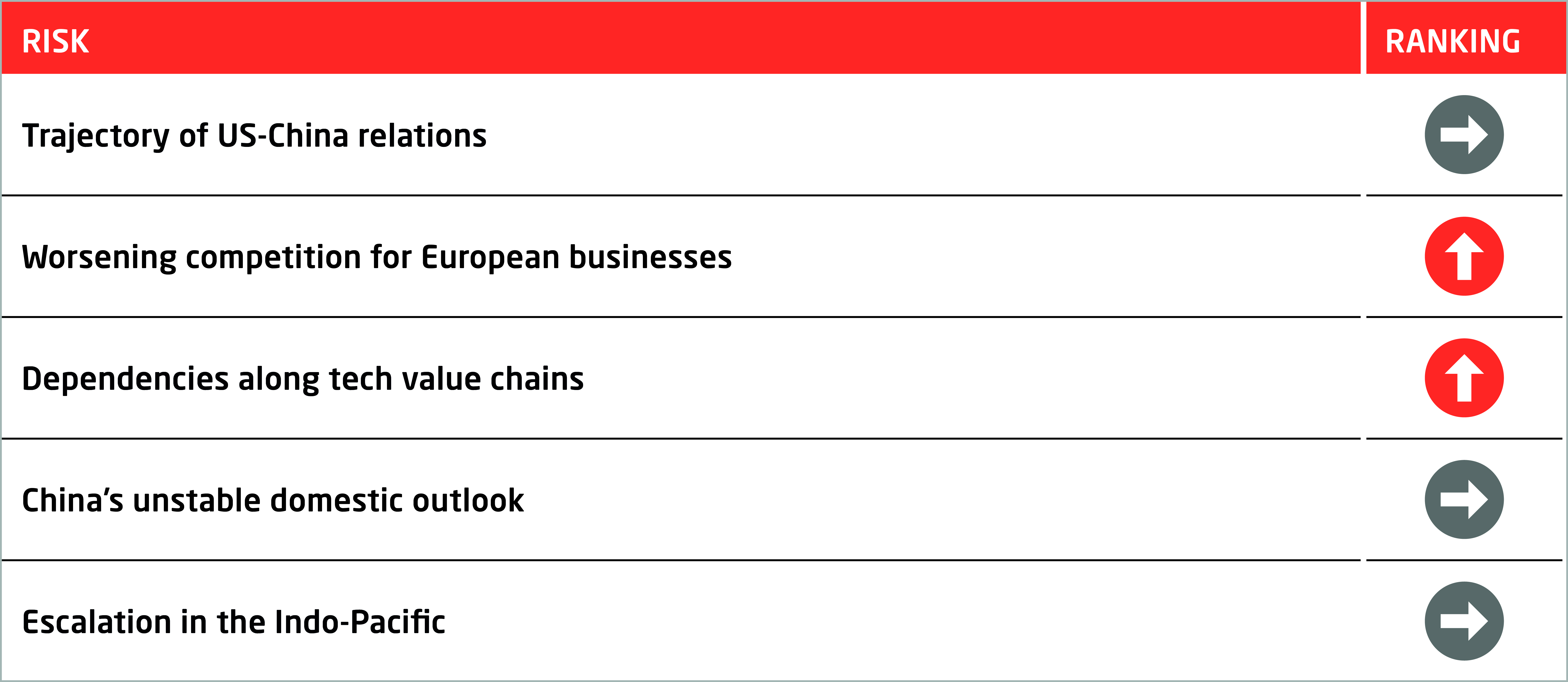
Growing global fragmentation and volatility accelerated by the Trump administration’s policies is translating into a more complicated risk environment for Europe. While Brussels and European capitals struggle to navigate the turbulence, Beijing displays rising confidence in its ability to achieve its strategic objectives.
In this issue of the MERICS Security & Risk Tracker, we identify shifts in the likelihood or probable impact of some of the 2026 top China risks that MERICS identified in late 2025. Stability the in US-China relationship is potentially positive for Europe, with the hazard that it can decrease pressure to act on key policy files. European businesses face stiffening competition from Chinese firms. Beijing’s growing extra-territorial legal toolbox will worsen the situation, as companies are more likely to find themselves caught between conflicting compliance regimes. Meanwhile, tensions remain high in the Indo-Pacific as Beijing continues to test its coercion playbook against Japan. Below, we outline some key developments that have altered our risk assessments.

Trajectory of US-China relations: US-China stability is good news for Europe, but also carries risks
Beijing emerged from the May summit between Xi Jinping and Donald Trump with renewed confidence in its chosen path and its prospects of ‘winning’ the strategic competition with the United States. Xi agreed to Trump’s proposal to set up Boards of Trade and Investment and acquiesced to (limited) purchases of US farm products and Boeing aircraft. These gestures were probably viewed as a small price to pay to achieve Xi’s primary objective: to buy time to implement his agenda for China’s self-reliance, industrial and technological development and military modernization.
China’s sense of victory is likely to be compounded by Xi’s success in getting Trump to agree to his definition of the relationship as a “constructive relationship of strategic stability.” The changed vocabulary matters for Beijing. Beyond the symbolic value of putting China and the United States on equal terms, Beijing will use the new formulation as it seeks to shape US behavior during the Trump administration, and beyond. China is likely to accuse Washington of violating this consensus any time it takes any action (on Taiwan, export controls, or anything else) it deems escalatory. Expect demands for a retraction set against threats that this could derail the relationship.
Renewed US-China stability is good news for the EU, as it gives Brussels time to work on its own policy priorities. The summit’s worst-case scenarios did not materialize, to the relief of European capitals and companies. There was no Trump-Xi grand bargain, nor a carve out on rare earth export controls leaving the EU out.
However, this stalemate still presents clear risks. China’s increasing self-confidence means that Europe will find it is less willing to compromise with (in its view) a weak global actor. Lacking an acute sense of crisis after the Xi-Trump summit, Europe could drift on implementing its own de-risking strategy. However, the sense that Europe stands alone in its approach to China, with high-level transatlantic coordination neither possible nor expected, is greater than ever. European actors should remember the structural issues in the US-China relationship remain unsettled. Fresh US-China tensions are inevitable; it is a question of when, not if.

Worsening competition for European businesses: China’s industrial scale and competitiveness risks Europe’s industrial base
European companies are struggling to keep pace with their Chinese counterparts in a variety of areas. For many, the answer is to integrate further into China’s industrial ecosystem and supply chains – even if that is bad news for European national interests.
European market shares in a variety of sectors continue to face pressure from Chinese manufactures. European wind turbine producers, for example, are struggling to match the speed and scale of production from Chinese competitors which are growing rapidly. Between 2024 and 2025, Vestas (Europe’s largest wind turbine producer) went from producing 10.2 gigawatts of capacity to 10.6 GW.
In this same time period, Goldwind (China’s largest producer) raised output from 19.3 GW of capacity to 29.3 GW. Eight out of ten of the largest wind turbine producers in 2025 were Chinese; European rivals Vestas and Siemens Gamesa placed seventh and tenth. At home, even Germany is seeing Chinese carmakers gain market-share; they account for 5.1 percent of new car registrations in Germany in 2026 thus far, up from 3 percent in 2023.
Hover over/tap the charts to see more details.
The allure of China’s industrial clusters and the hyper-efficient value chains they support is drawing in European companies. The European Union Chamber of Commerce in China’s (EUCCC) newest Business Confidence Survey, published May 27th, outlines this in detail:
“The country is the heavyweight champion of highly efficient and cost-effective supply chains: 75% of respondents categorize their China production as more efficient than their production in the rest of the world; and 94% see the market as important for sourcing. It has a dynamic research and development (R&D) ecosystem and is highly competitive, with more members (48%) now reporting Chinese firms in their industry as more innovative than European ones.”
There are significant risks to European national interests. For individual European companies, it is a rational choice to integrate more deeply into China (via more investment or by having more China-based suppliers) as it enhances their own competitiveness. However, every time a European company invests in more China-based production, it generates further economies of scale there, enhancing the competitiveness of China’s industrial base relative to Europe’s. Similarly, when European firm shift to China-based suppliers they do so at the expense of European suppliers or those in third markets.
The effect is a one-two-punch for Europe, increasing deindustrialization pressures here while enhancing China’s industrial scale and competitiveness.

Dependencies along tech value chains: China is redefining extra-territoriality to assert its techno-industrial interests
China’s government continues to ramp up its legal toolbox to counter what it deems as undue extra-territorial influence over Chinese national and corporate interests. In recent years, it has frequently engaged in economic coercion to push countries back in line or deter them from taking measures it views as harmful to China’s national security. Sweeping export controls imposed on rare earths last year were a case in point.
In parallel, various authorities were also codifying and institutionalizing their powers to shield Chinese actors from foreign laws they dislike. Many countries are striving to secure critical supply chains and become more economically resilient, often in response to the PRC’s techno-industrial dominance agenda. Beijing is therefore gearing up to better enforce its ‘blocking statute’ (designed to counteract the effect of foreign long-arm legislation, such as sanctions) and the Anti-Foreign Sanctions Law, both introduced in 2021.
Regulations effective in April are intended to counter “unlawful” (不当, also translated as “improper”) long-arm jurisdiction where an “appropriate connection exists to China”. They signal stronger support for Chinese companies to take the responsible foreign actors to court while allowing China’s authorities to choose from a range of countermeasures. For example, China’s government bodies can add individuals or entities to a newly created Malicious Entity List (恶意实体清单). The rules also empower bureaucrats across different State Council departments to launch investigations, order corrections, and mobilize social actors for support.
The April regulations must be seen in the Chinese context. In international law, extra-territoriality refers to a state imposing rules beyond its territory. Other countries’ laws often do this, for example in areas like national security, criminal law or environmental protection. China takes this a step further by linking extra-territorial jurisdiction to more broadly defined security, development and business interests.
Beijing’s sweeping definition of its red lines faced one of its first tests in May. The Ministry of Justice ordered Nuctech, a partially state-owned company, not to comply with an ongoing European Commission investigation which is based on the EU’s Foreign Subsidies Regulation. Now, Beijing has labelled the European Commission’s probe into suspected anticompetitive subsidies as an unlawful extraterritorial measure.
The consequences could be significant. Court cases are time-consuming and costly, so could hamper the EU’s capacity to investigate and impose measures on Chinese companies suspected of violating European market regulations. Member states may also be too fearful of Beijing’s riposte to act. Moreover, given the CCP’s broad definition of national and economic security, companies operating between China and abroad can expect to be caught in the crossfire of irreconcilable compliance requirements more often.

China’s unstable domestic outlook: Geopolitical instability forces China to tackle barriers to creating a single market
Since the release of the Five-Year Plan, China’s government has increased its efforts to curb local protectionism and create a single national market in order to give a boost to domestic demand and its lagging economic growth. China’s export-dependent model leaves it exposed to weak global demand and foreign policy decisions – constituting a central risk for its leaders.
At the national level, China’s export dependency reflects a structural imbalance in which investment-driven industrial policy expands production capacity faster than domestic demand can absorb it, pushing excess output into export markets. But China’s fragmented political economy is an equally important driver. Provinces and cities protect their local firms through subsidies, tax breaks, weak regulation and informal barriers. This keeps inefficient firms alive, drives price wars and prevents capital, labor and demand from moving across the country. Local governments often support weaker producers to protect growth, jobs and tax revenue, rather than letting them exit or merge. The result is excess production in sectors such as metal, chemical and automotive, making many domestic firms unprofitable while creating unfair competition conditions abroad. In the auto sector, for example, capacity utilization at Chinese car plants fell to an average of 50 percent in 2024, its lowest level in a decade, illustrating how excess production capacity is squeezing profitability at home while pushing firms to seek demand abroad.
Shifting from policy exhortation to enforcement and institutionalization, the government launched a May–December special campaign against market-fragmentation barriers on May 13. The next day, the State Council released its annual legislative plan, which includes formulating regulations on the construction of a unified national market.
If these measures cannot tackle the barriers to a single market, the dependence on export-driven growth may continue without enough external demand to meet the supply. This will negatively affect China’s manufacturing industries with a major knock-on effect for employment, tax revenue and fiscal spending on social services. This would compound current issues like unemployment, regional inequalities and current AI-driven workforce shifts, all risks to China’s social stability.
Whereas, if the government manages to halt local protectionism in sectors like EVs and other sectors where Western firms compete, it could eradicate many zombie firms, ease pressures and gradually increase domestic demand. It is perfectly possible that Beijing may allow local governments to continue propping up firms overproducing in other sectors to maintain employment. Muddling through could be good enough and is the likely scenario. Doing so would portray Beijing as attempting to curb overcapacities and could help avoid the more punitive reactions from foreign governments.
Domestically, the gradual and partial approach would buy time for some of these firms to become more competitive, and at the same time prevent simultaneous market exit of firms and related mass layoffs, maintaining relative societal stability. The risk for Europe is clear. It would continue to act as the outlet for overcapacities supported by local protectionism, as European industry is already finding out, and therefore is in its best interests to support Beijing’s efforts to eradicate local protectionism and build a single market.

Escalation in the Indo-Pacific: China deploys its economic and grey-zone coercion playbook against Japan
While wars in the Middle East and Ukraine, alongside the deepening China-Russia relationship, pose the most direct security challenges to European interests, rising tensions in the Indo-Pacific are reshaping regional security dynamics. They increase the risk of miscalculation or accidental escalation and create additional challenges that cannot be ignored.
Beijing is keeping up its pressure on Taiwan and the Philippines, but its attention is increasingly focused on Japan too. Ever since Japanese Prime Minister Sanae Takaichi said last November that a Chinese blockade of Taiwan could be a “survival-threatening situation” for Japan that would justify action in self-defense, Beijing has been testing its expanded coercion toolbox on Japan. Along with increasingly aggressive rhetoric, Beijing has imposed new restrictions on dual-use exports (including rare earths), suspended seafood imports, warned its citizens against traveling to Japan and stepped up its military and coast guard activities in waters surrounding Japan.
China’s growing belligerence vis-à-vis Japan, and more broadly in the region, might well backfire. Beijing is following the coercion playbook it has previously deployed against Australia, South Korea and Lithuania, hoping to force Tokyo and other capitals to change course. But it looks like it is having the opposite effect, by consolidating support for more assertive actions in opposition to China’s behavior and pushing countries to diversify away from China and strengthen their strategic alternatives.
As threat perceptions rise, countries across the Indo-Pacific are racing to upgrade their military capabilities and strengthen their security partnerships. The Taiwanese legislature has recently passed a bill approving USD 24.8 billion in extra defense spending. Japan, meanwhile, is undergoing its most significant military transformation since WWII in response to rising security threats from China and North Korea. Its defense expenditure has risen to an all-time high. Takaichi has called for revisions to Japan’s pacifist constitution and this year Japanese troops participated for the first time in the US-Philippines Balikatan exercises in an active combat role.
Beijing’s response to this trend, especially in the case of Japan, has been predictably aggressive. Japan’s reforms and more assertive security stance are described by Chinese officials (reportedly including Xi himself) as evidence of the country’s “remilitarization” that goes “beyond the scope of self-defense.” This is language meant to evoke Japan’s militarism during WWII and justify further coercive actions against Tokyo.
Increased military activity by China and other parties in the Indo-Pacific will translate into more encounters both in the air and the sea: it increases the risk of sustained tensions, in the best-case scenario, and of miscalculation and accidental escalation in the worst-case. Any form of escalation would have strong negative implications for Europe. It would affect global trade routes and critical supply chains and hit regional and global economic and geopolitical stability that is already shaken by the Iran War. But even barring military escalation, Beijing’s economic and grey-zone coercion of Japan – and Taiwan – should be seen as a sign in Europe of how far Beijing is willing to go in pursuit of strategic objectives and drive further action on the EU’s de-risking agenda.

What to watch in the months ahead
- July 7 – 8, 2026: NATO’s approach to China will feature prominently at the annual leaders’ summit in Ankara. The meeting takes place at a critical time for the alliance’s unity and cohesion. With NATO facing growing criticism from the Trump administration, discussions are likely to center on defense spending and burden-sharing, but a review of NATO’s approach to China – and especially China-Russia relations – will also be on the agenda.
- September 24: Trump has invited Xi for a White House visit, overlapping with the UN General Assembly (UNGA) high-level week and general debate. It is unclear if Beijing will accept the invitation. If they do, it would be Xi’s first US visit since 2023. There is also speculation Xi might speak at the UNGA, which would be his first in-person speech there since 2015.
- November 10 – 12: The Philippines will host the ASEAN Summit in Manila amid ongoing tensions with China and with the region reeling from the oil shock caused by the crisis in the Middle East. Manila hopes to secure agreement on a South China Sea Code of Conduct designed to encourage stability and to help unlock opportunities for joint oil and gas exploration.
Acknowledgements
The authors would like to thank Pau Garcia, intern in the Foreign Relations team, for his contribution to this edition of the MERICS China Security and Risk Tracker.
Autor(en)

Programmleiterin

Ko-Programmleiterin

Analyst

Programmleiter

Senior Analyst
Autor(en)
Programmleiterin
Ko-Programmleiterin
Analyst
Programmleiter
Senior Analyst