
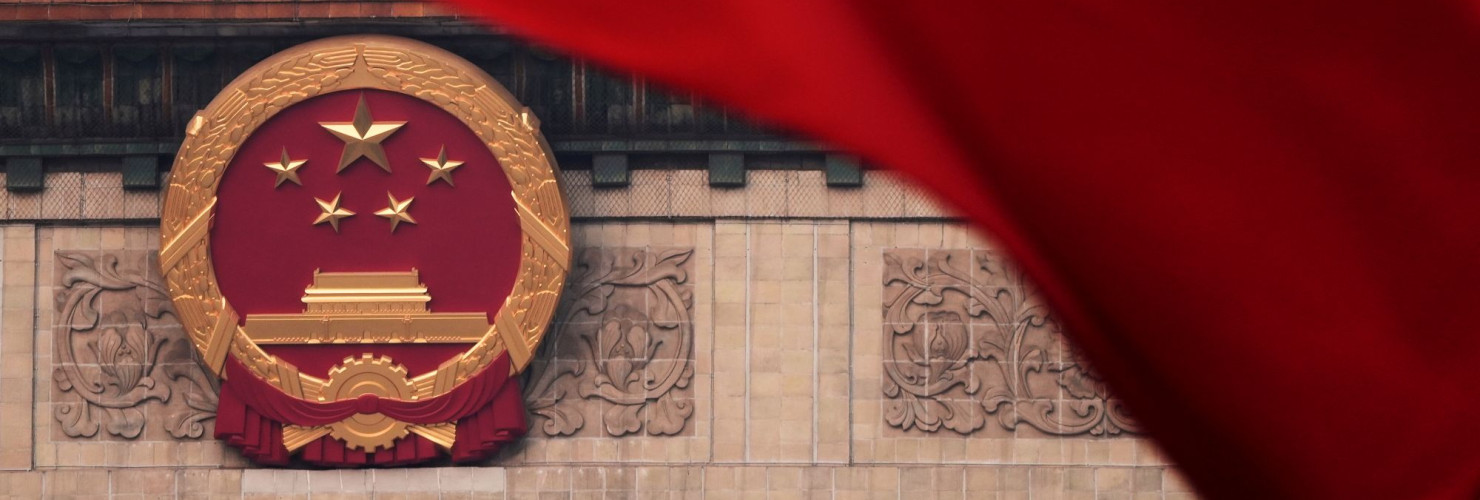
picture alliance / ASSOCIATED PRESS | Andy Wong
Content
MERICS Briefs
MERICS China Essentials
China’s 15th Five-Year Plan + German Chancellor Merz’s visit to China
Top story
China’s make-or-break Five-Year Plan: A test of Beijing’s economic resolve
By Alexander Davey and Katja Drinhausen
China’s “Two Sessions” annual political meetings beginning on March 4 and 5 will be a chance to project stability, strength, and policy direction – culminating in the release of the 15th Five-Year Plan (FYP). Roughly 2,900 delegates will convene in Beijing for the plenary session of China’s National People’s Congress (NPC), and about 2,100 members will gather for the Chinese People’s Political Consultative Conference (CPPCC). What may seem like the usual political theater could this year have real market consequences. The FYP will reveal just how serious the government is about reforms to tackle economic weakness and pursue self-reliance and global leadership in areas like technology and innovation.
Key is whether President Xi Jinping’s directive to turn domestic demand into a major driver of the economy is backed up by substantial policies. Continued reliance on exports to soak up China’s manufacturing glut will keep the country strategically vulnerable to US trade pressure – giving the US leverage to undermine China’s ambitions. The question is whether Beijing is willing to pay the political and fiscal price of building greater demand at home. Xi has spoken of “tough reforms” needed to tackle local protectionism and intense domestic competition causing “involution” – overproduction that is sapping profits.
China is facing steep challenges in its transformation from traditional manufacturing to newer industries like integrated circuits, aerospace, and biomedicine. It has to balance automation and digitalization while ensuring jobs and livelihoods, and secure food, energy and other resources for its sustainable development. Improving domestic demand is a priority, but policies aimed at China’s green transition, technological breakthroughs, social welfare, military modernization, and global ambitions will also feature.
Projecting strength and a clear direction
The NPC is China’s top annual legislative meeting that passes laws, approves budgets and endorses macro policy. At the start, the government will release its annual Government Work Report (GWR) with priorities for the year. China’s annual headline GDP growth target is set out in the GWR delivered at the NPC’s opening plenary; in 2025, Beijing pitched growth at “around 5 percent” and lifted defense spending by 7.2 percent to about RMB 1.78 trillion, and markets will be watching for a similar growth target (close to 5 percent, perhaps with a slight downside tilt) and another mid-single-digit defence increase this year.
At the end, the NPC will publish the 2026-2030 FYP, which fleshes out specific targets for various government sectors, clarifying the country's strategic intentions and showing how it will guide the behavior of market entities. Afterwards, sub-plans will cascade from ministries and provinces, driving allocation and cadre evaluations. Equally important is the plan’s significance in conveying to the Chinese people that the party state can and does achieve its goals.
Indeed, China is eager to project its strength – not just to a domestic audience but also internationally. Since January, Beijing has received a slew of foreign leaders – from Germany, the UK, Uruguay, Finland, Canada, South Korea and Ireland – who want to stabilize ties with China amid turbulent relations with the US. In 2025, despite tariffs and trade restrictions, China’s economy grew at five percent, exports hit a record high and official numbers assert that the labor market has stabilized. Later this year, in his first official visit since 2017, US President Donald Trump will visit China, and Xi will need to project a clear response to any US trade pressure.
A number of policy fields will be cornerstones of the 15th FYP:
- Updating economic and industrial policy for a new era: China will focus on upgrading traditional manufacturing and consolidating industries and markets (i.e., fighting involution); removing barriers in the domestic market and on leveraging growth potential via urban renewal and in less economically integrated regions, especially rural areas.
- Pulling ahead in technology and innovation: The PRC will focus on leadership in science and applied innovation, especially in strategic technology fields (such as embodied AI and superconducting quantum computing). The green transition and reaching “peak carbon” is a core part of China’s new growth model and quest for self-reliance.
- Social governance through welfare and control: Social policy will focus on employment, household incomes, and social welfare – such as allocating public services based on resident population – to ensure that people’ needs are met and to encourage births, an urgent task due to China’s steeply declining population.
- Projecting international leadership: China will pursue “high level opening,” i.e. market access on its preferred terms. This means ensuring access (including through pressure and economic coercion) and exploring new opportunities from sea to space.
- Military modernization and conflict readiness: Increasing military capabilities and power projection is a key goal, especially the PRC’s ability to take Taiwan by force if deemed necessary. This is accompanied by overall efforts to expand capacity to safeguard national security and to strengthen crisis and conflict preparedness.
“The next years will determine if China can tackle internal and international imbalances and land on solid ground for high quality, sustained growth. For stakeholders abroad this means dealing with China-first policies, hard competition, and no backing down – but also pinpointing narrow avenues where cooperation and market access still exist.”
Alexander Davey, Analyst, MERICS
Media coverage and sources:
METRIX
36 million
dollars’ worth of bubble tea (CNY 250 million) is how much Alibaba customers drank in a nine-hour giveaway served up by the internet retailer’s AI assistant Qwen. In a Spring Festival promotion, the 10 million free bubble teas swamped the app’s system and flooded eateries across the country with orders. The goal was to recruit new users to the Qwen app and drum up business for its on-demand delivery service. Alibaba spent USD 430 million (CNY 3 billion) across all platforms during the festival, with tech firms Baidu and Tencent dishing out their own promotions for customers to get to know their AI assistants. (Source: South China Morning Post)
Topics
Beijing fixed on hollow promise of support for consumers alongside industry
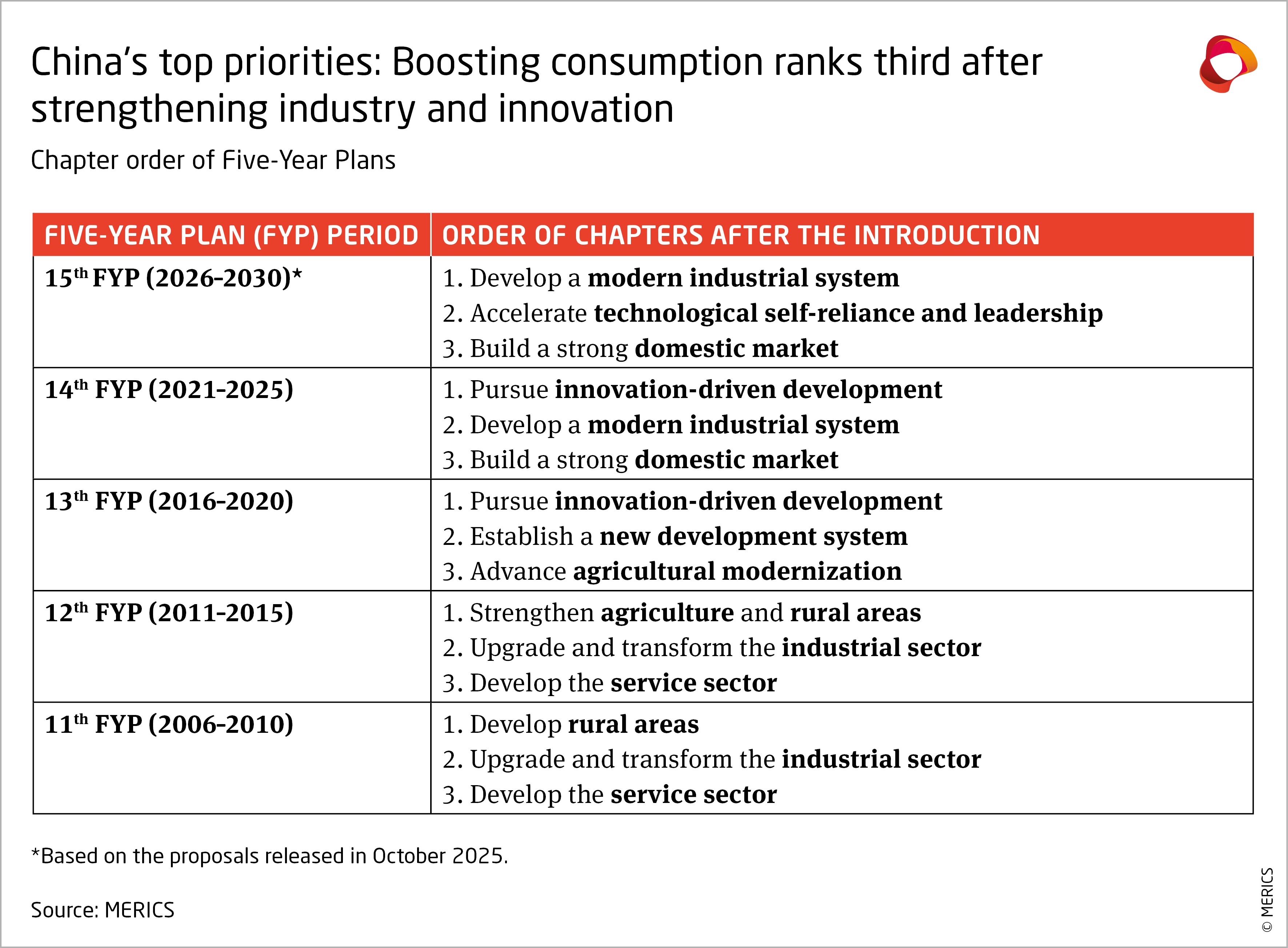
China’s 15th FYP looks set to declare the dual goals of strengthening the country’s industry and boosting domestic consumption as top priorities – but in practice, Chinese households are likely to see as little benefit from this ambition as they did under the country’s previous economic plan. The CCP leadership’s recommendations for the 2026-2030 planning period call on officials to “use new demand to guide new supply, and new supply to create new demand, so as to promote a virtuous cycle between consumption and investment” – while the country’s ongoing flood of exports and low domestic demand clearly show in which direction the Chinese economy remains skewed.
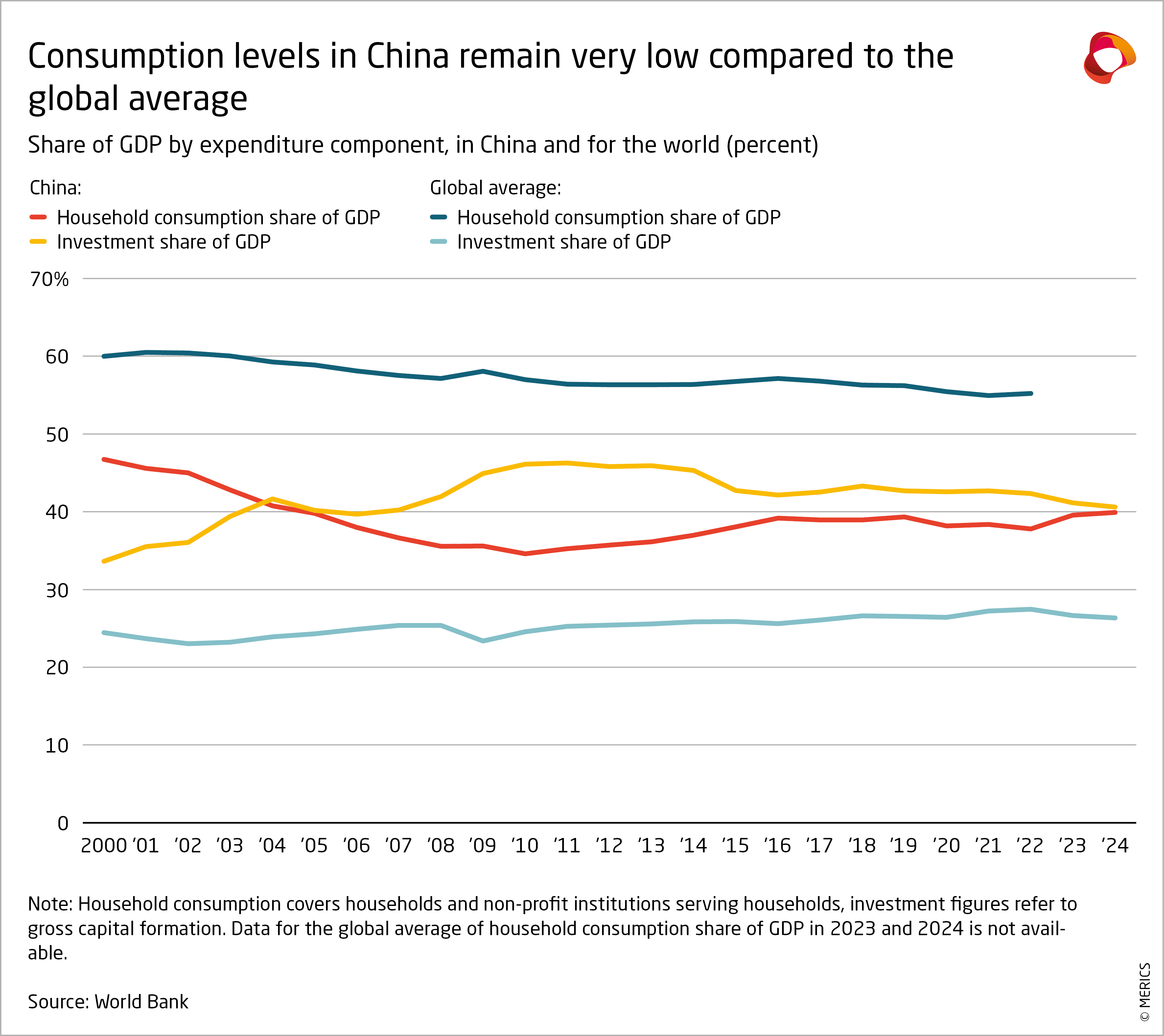
Precariously balanced as it is, China’s economic policy will continue to systematically favor companies over households. Beijing will persist in slow-rolling measures to expand social welfare, while using generous subsidies and tax incentives to drive industrial growth and upgrading. The leadership is convinced this approach best serves China’s resilience in times of great power competition and its long-term economic development. They hope innovation will trigger a cascade of higher productivity, profits, wages, tax revenue and, eventually, welfare spending. But for now, their expansive industrial policy looks likely only to continue inflating China’s corporate and government debt.
“Stronger action from China’s major trading partners would put Beijing under greater pressure to deliver on its plans to boost domestic consumption. It is clear that the EU, in particular, should strengthen its trade defense measures.”
Alexander Brown, Senior Analyst, MERICS
More on the topic:
- China’s new Five-Year Plan will embrace industry – and once again give consumers the cold shoulder – MERICS Comment by Alexander Brown
- China's economy in Q4: Strong exports offset domestic weaknesses - MERICS Economic Indicators Q4 2025
Media coverage and sources:
- Xinhua (CN) : 中共中央关于制定国民经济和社会发展第十五个五年规划的建议 (Proposal of the Central Committee of the Communist Party of China on Formulating the 15th Five-Year Plan for National Economic and Social Development)
- Qiushi (CN): 扩大内需是战略之举 (Expanding domestic demand is a strategic move)
- China Daily: Expanding domestic demand a strategic move to sustain high-quality development
Xi vows to unify national market amid domestic and global pressure
Beijing appears intent on using the 15th FYP to finally overcome the fragmentation of China’s market for goods and services, which remains a highly inefficient patchwork of dozens of provincial and hundreds of local jurisdictions. The CCP Central Committee’s October 2025 recommendations to “eliminate local protectionism and market segmentation” and to “ensure that the underlying institutions and rules of the market are unified across the nation” elevated the creation of a “unified national market” from a long-standing nominal commitment to a top-tier economic priority for 2026 – 2030.
The persistent gap between central aims and local actions has shaped China for over four decades. But the domestic burden of sluggish consumer demand and global pressure about the country’s export flood appear to have strengthened Xi Jinping’s resolve: A more unified market could nationally reallocate locally shielded overcapacity, labor and capital, reducing price wars, export reliance and ultimately raising wages. Xi has since 2025 used the slogan “five unifiers and one opening up” to signal his intent to unify not only China’s market, but also its legal, fiscal, technological and regulatory systems.
“China’s overcapacity is [...] a side-effect of how the Chinese state functions […] With trading partners increasingly concerned about China’s export glut, Beijing now has a strong incentive to reduce its reliance on external demand by finally making its domestic market more integrated, efficient and competitive.”
Alexander Davey, Analyst, MERICS
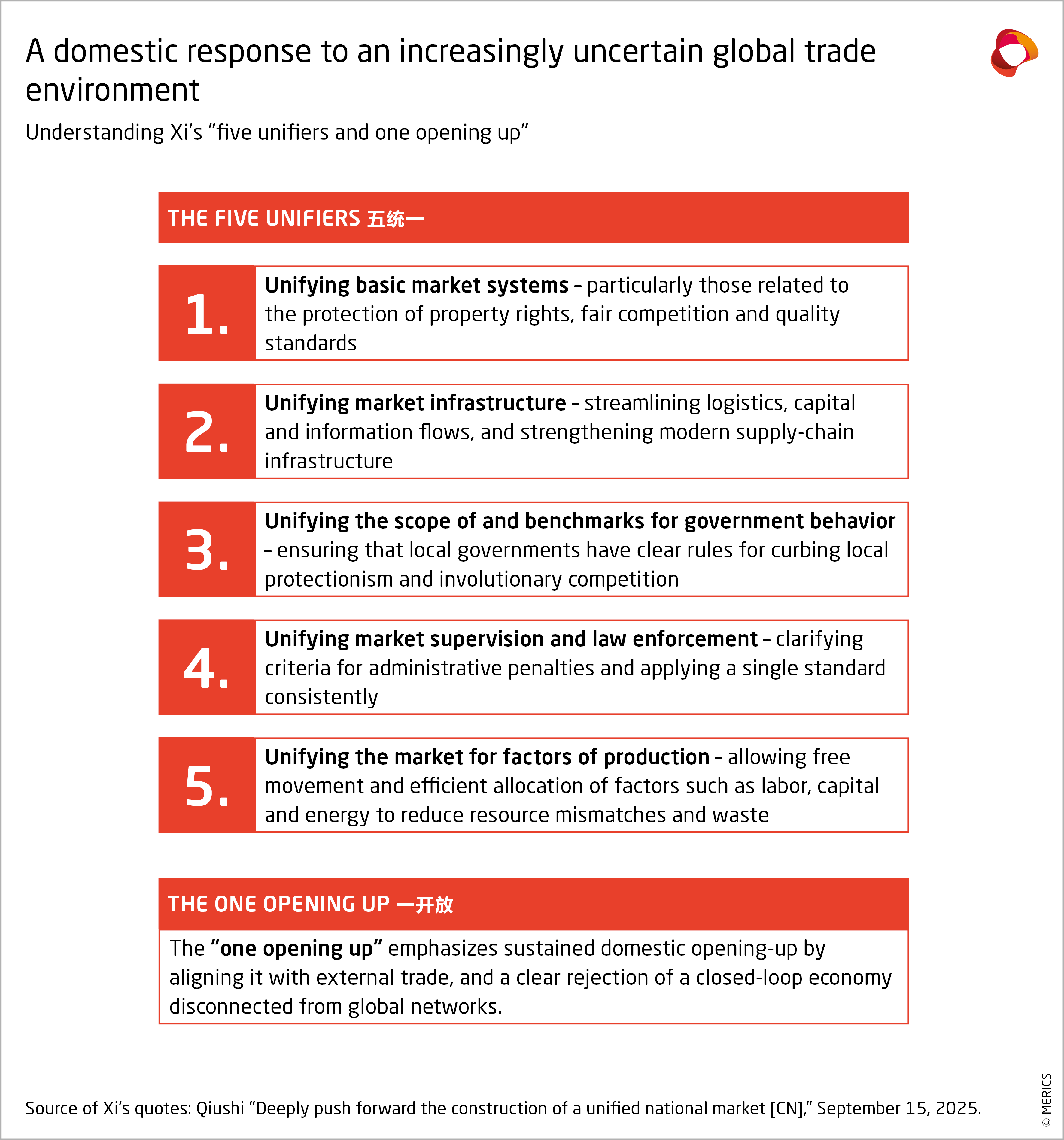
More on the topic: China moves to unite national market to curb cut-throat competition at home – MERICS Comment by Alexander Davey
Media coverage and sources:
- EuroHub4Sino: What’s rational for the national and what’s focal for the local towards a unified economy
- Qiushi (CN): 优化实施“两新”政策“两重”项目 (Optimize the implementation of policies for new economic entities and new social organizations, and prioritize key projects)
- State Administration for Market Regulation (CN): 国家市场监督管理总局规章 (Regulations of the State Administration for Market Regulation)
China upgrades climate objectives, but tolerates ongoing use of coal
The National People’s Congress is widely expected to deliver a significant upgrade to China’s climate objectives when it signs off on the country’s 15th FYP at the start of March. By integrating climate and environmental issues with energy policy under the theme of the green transformation of the country’s economy, Chapter XII of the new plan looks set to elevate climate goals into a policy area long dominated by economic and national security concerns. By pledging to “continuously increase the share of new energy in supply [and] promote the safe, reliable, and orderly replacement of fossil fuels,” the recommendations of the CCP leadership show the 15th FYP will be crucial to Beijing’s efforts to reach peak greenhouse gas emissions by 2030 at the latest.
With the country’s emissions flat or declining slightly since March 2024, one key remaining question is by how much China can beat this deadline – if at all. The uncertainty persists because local authorities in coal-rich localities, seeking to sustain economic growth, approved a record number of coal-fired power plants during the 14th FYP. Adding to these doubts, the People’s Daily recently reported that coal consumption would not peak until “around 2027” and then “enter a plateau phase”. While this will complicate China’s green transition, Beijing appears to view tolerating coal as politically expedient – not least as a means of delaying job losses in coal regions.
“The tension between the green ambitions of the 15th FYP and the more charcoal-colored reality on the ground holds an important lesson: The energy transition is a challenge even for the mighty Central Committee of the CCP. While it has succeeded in creating a world-leading green-technology sector, it is aware of associated risks.”
Johanna Krebs, Analyst, MERICS
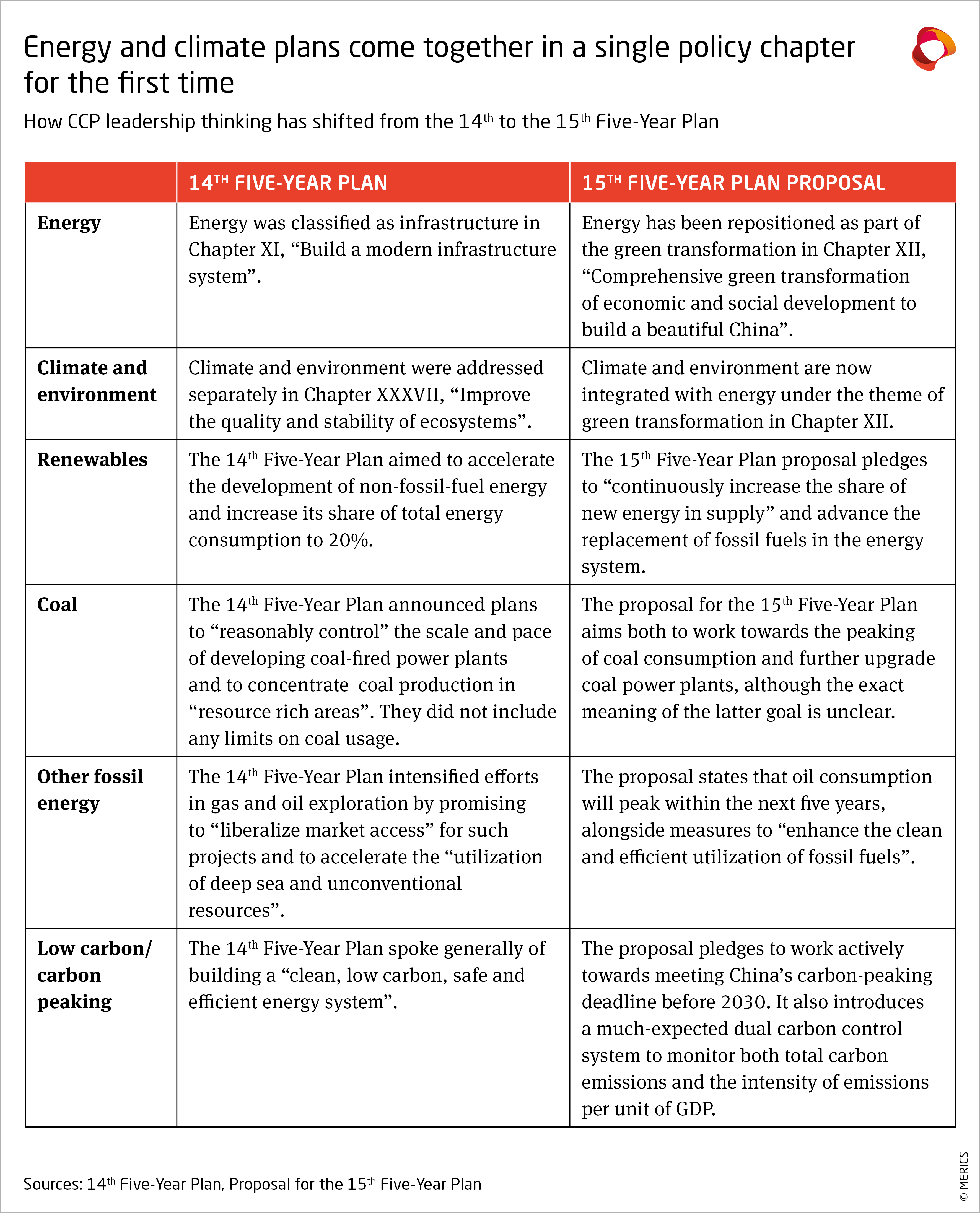
More on the topic: China’s new FYP upgrades climate objectives while accepting continued role of coal - MERICS Comment by Johanna Krebs
Media coverage and sources:
- Carbon Brief: Analysis: China’s CO2 emissions have now been ‘flat or falling’ for 21 months
- Global Energy Motor: Coal is losing ground, but not letting go
- Chinese government website: China to strengthen control over carbon emissions
Big AI goals signal Beijing’s ambitions – but not necessarily its realism
China’s economic planners are betting on artificial intelligence (AI) over the next five years to secure the country’s dominance across entire industrial chains. The proposals for the 15th FYP show CCP leadership ambitions to exploit AI to power breakthroughs in core technologies like industrial machine tools or biomanufacturing, in emerging industries like new energy technologies and innovative materials, and future industries like quantum technology, general-purpose humanoids and brain-computer interfaces. Leveraging China’s scale and low energy prices, the new FYP looks set to double down on building massive AI infrastructure, increasingly independent of foreign technology.
Yet the party-state’s embrace of AI does not guarantee success. The hope is that the technology will help address a range of problems, from demographic decline to the climate crisis, but challenges in employment and sustainability loom large—and economic returns are not assured. Nevertheless, Beijing’s August 2025 “AI+” initiative will set the tone for AI policy from 2026 to 2030: The goal is for roughly 90 percent of devices and systems used in business and society to have integrated AI by the end of the planning period. While this target may prove over-ambitious, it is meant to signal the leadership’s determination to deploy AI in industry and harness it for scientific research.
China’s performance at turning tech investments into actual social and economic dividends over the next five years will determine whether the CCP’s huge bet on AI pays off. But the hype and open questions about AI diffusion should raise a few skeptical eyebrows.“
Rebecca Arcesati, Lead Analyst, MERICS
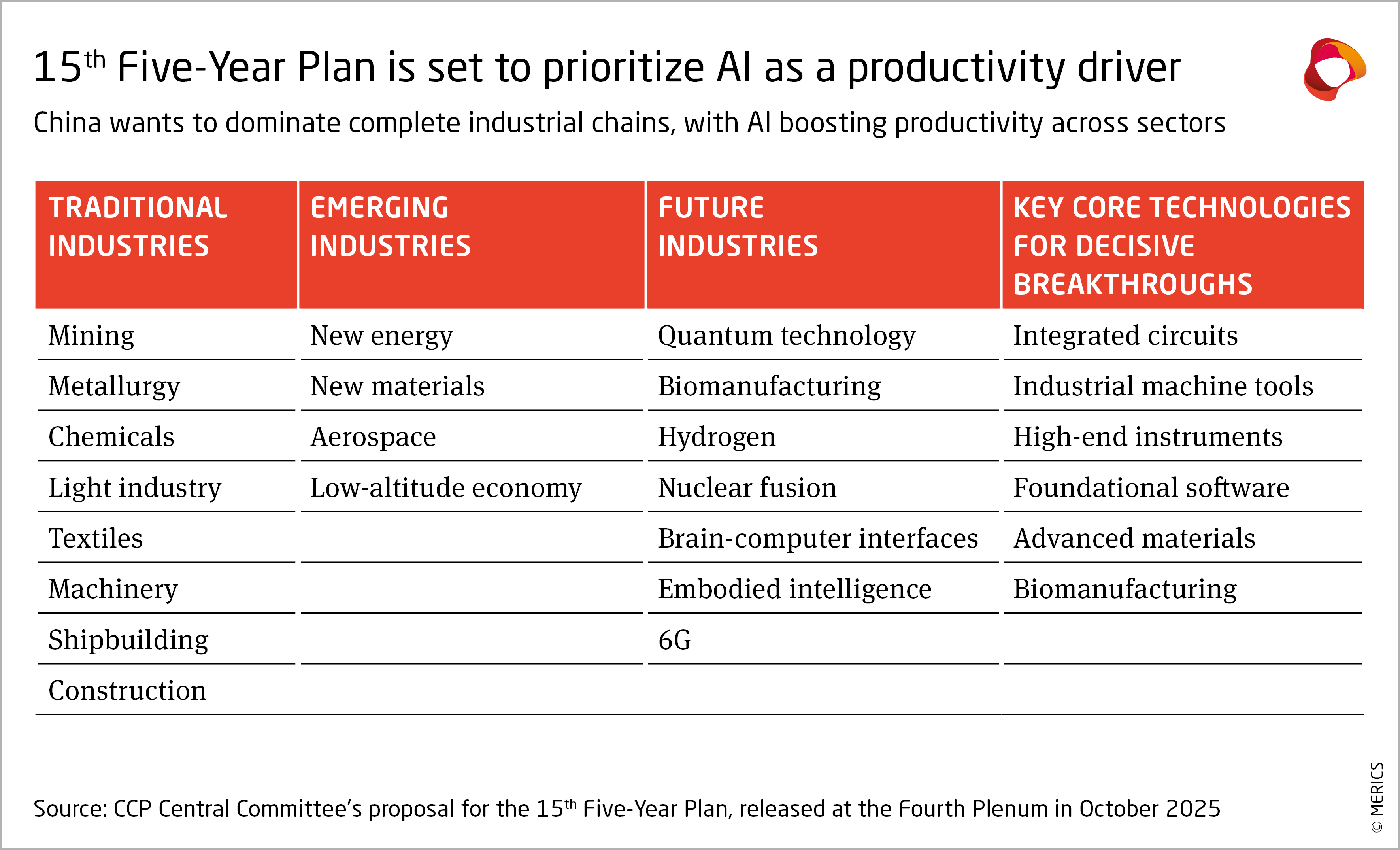
More on the topic: China’s next five-year bet on AI: Self-reliance, diffusion, and a lot of hype – MERICS Comment by Rebecca Arcesati
Media coverage and sources:
- CAC (CN): “人工智能+”行动加速赋能经济社会高质量发展 (The "AI Plus" initiative accelerates the empowerment of high-quality economic and social development)
- Chinese government website: 国务院关于深入实施“人工智能+”行动的意见 (Opinions of the State Council on Deepening the Implementation of the 'Artificial Intelligence +' Action)
- Asia Society: China’s total factor productivity is either extremely low or surging past the United States
Vis-à-vis
MERICS expert: “Merz largely achieved what was realistically possible on a first visit”
MERICS China Essentials Brief spoke with Eva Seiwert, Senior Analyst in the MERICS Foreign Relations Team
How do you assess the course and outcomes of the visit? Did Friedrich Merz achieve his goal of pursuing a “principled realism” vis-à-vis China?
Friedrich Merz largely achieved what was realistically possible on a first visit. He seems to have raised all the sensitive issues he wanted to raise beforehand – trade imbalances, unfair competition, export controls, overcapacities, Ukraine, and Taiwan – without escalating tensions. That reflects “principled realism” at the rhetorical level.
However, outcomes were modest. The signed agreements focused on non-controversial areas such as climate cooperation, animal disease control, sports exchanges, and limited agricultural trade. The only economically significant deal was China’s commitment to purchase 120 aircraft from Airbus. There were no concessions on structural issues like market access or subsidies – but expectations were low, so this does not come as a surprise.
Equally important to individual deliverables was process: Merz clearly prioritized restoring regular dialogue, including German–Chinese intergovernmental consultations later this year. The visit was therefore less about breakthroughs than about rebuilding a working relationship under the current difficult conditions.
How does China portray the visit?
China’s official messaging frames the visit as a major success and even a potential turning point in relations with Germany, and by extension Europe. State media emphasized Merz’s interest in deepening economic ties and portrayed Germany as reassessing earlier assumptions about China.
This narrative glosses over the lack of substantive progress on contentious issues. Tellingly, the Chinese readout of the joint statement notes Germany’s emphasis on “reducing dependency,” but places this phrase in quotation marks, which signals distance rather than endorsement. From Beijing’s perspective, the visit supports a business-as-usual storyline and the hope that Germany will resist deeper economic de-risking at the European level.
With which concrete steps can Merz advance de-risking without cutting all bridges to China?
Germany should pursue de-risking in a selective and European way. Rather than reducing ties across the board, Germany should focus on critical sectors – such as rare earths, batteries, semiconductors, and critical infrastructure – while allowing cooperation in non-sensitive areas. An important aspect of this is diversification: finding alternative suppliers, shifting parts of production to third countries, and limiting exposure to Chinese overcapacities. Perhaps most crucially, Berlin must embed its China policy firmly at the EU level. Real leverage only comes if member states act through the EU, also using trade-defense and investment-screening tools when necessary.
How should Germany’s economy position itself given that China made no visible concessions?
German companies should not misread political stabilization as economic improvement. The fundamentals remain unchanged: a widening trade deficit, declining exports, and persistent asymmetries in market access and competition. For businesses, this means diversification, stronger risk management, and closer alignment with EU-level instruments. What benefits individual firms in the short term is not necessarily good for Germany’s or Europe’s economic resilience.
MERICS China Digest
German car exports to China plunge by a third in 2025 (German Economic Institute)
German car exports to China plunged by roughly a third in 2025. Compared to their peak in 2022, the sector’s sales to China have declined more than 50 percent, according to a study released by the German Economic Institute (IW). (26-02-24)
BMW in talks with EU on tariff exemption for 'Made in China' Minis (Handelsblatt)
Following an agreement with Volkswagen, BMW and the European Commission are in talks about a possible minimum pricing model that could replace EU tariffs on the Chinese-made Mini electric vehicles that BMW developed in a joint venture with Great Wall Motors. (26-02-24)
Polish army bans Chinese vehicles from military premises (Cyber News)
The Polish army has banned Chinese made cars from entering military facilities, hoping to prevent the collection of sensitive data by technologically advanced automobiles. Smart cars made elsewhere will be permitted to enter if certain functions are disabled. (26-02-19)
DeepSeek allegedly trained new AI model on Nvidia's best chip despite US ban (Reuters)
Chinese AI startup DeepSeek's latest AI model, set to be released as soon as next week, was trained on Nvidia's most advanced “Blackwell” AI chip, a senior Trump administration official said on Monday. If true, this could represent a violation of US export controls. (26-02-24)
Radio Free Asia says it has resumed broadcasts to China (Reuters)
RFA had resumed its broadcasts in Mandarin, Tibetan and Uyghur, according to its CEO Bay Fang. Earlier in February, a bipartisan spending bill was signed into law the by US President Trump which included funding for USAGM, which oversees RFA and other government-funded outlets. RFA had been off the air after funding cuts in 2025. (26-02-18)
Content