
picture alliance / Photoshot
Content
MERICS Briefs
MERICS China Essentials
Xi's summits with Trump and Putin + China's economy loses momentum + Hong Kong dissidents
Top Story
Xi’s summits with Trump and Putin project Beijing as a hub of global diplomacy
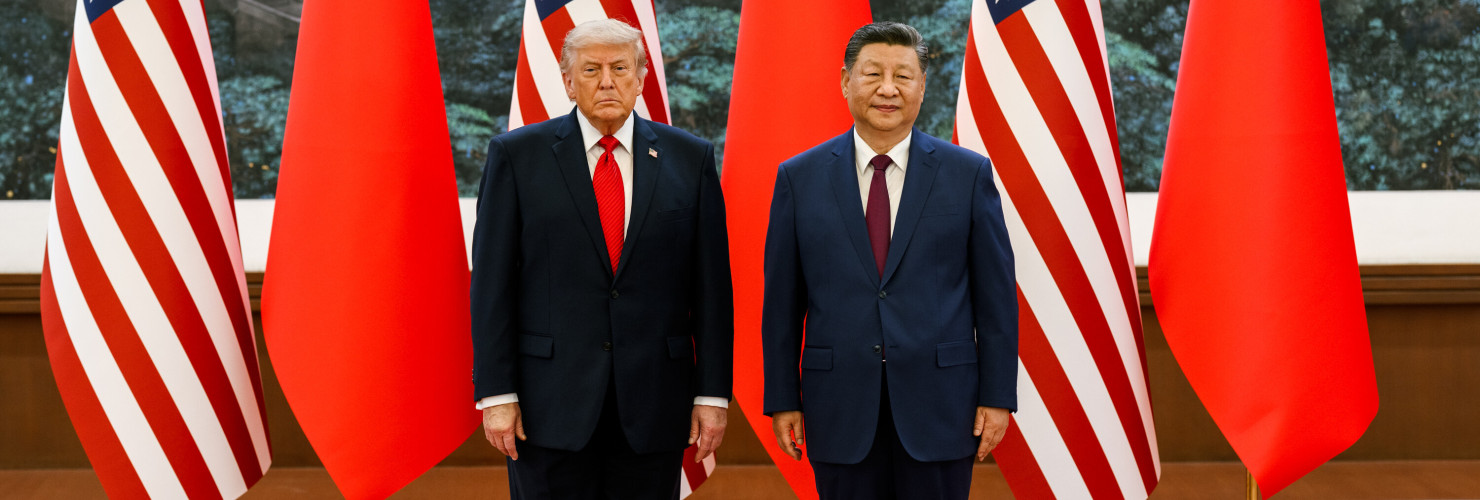
By hosting US President Donald Trump and Russian President Vladimir Putin in back-to-back summits in Beijing, Xi Jinping was able to project China’s unprecedented global influence and advance its preferred worldview: building what he calls “constructive strategic stability” with the US, while enlisting Russia to push for a multipolar world order through the doctrine of “a new type of international relations.”
Xi was helped by his guests appearing keen to impress. After Xi calling Taiwan “the most important issue in China-US relations,” Trump said he was “not looking to have somebody go independent” – and more generally seemed willing to finally treat China as a peer major power. After Xi implicitly criticized the US by noting that “unilateral hegemonic currents are running rampant,” Putin said China-Russia relations had reached “unprecedentedly high levels” and were “key stabilizing factors on the international stage.”
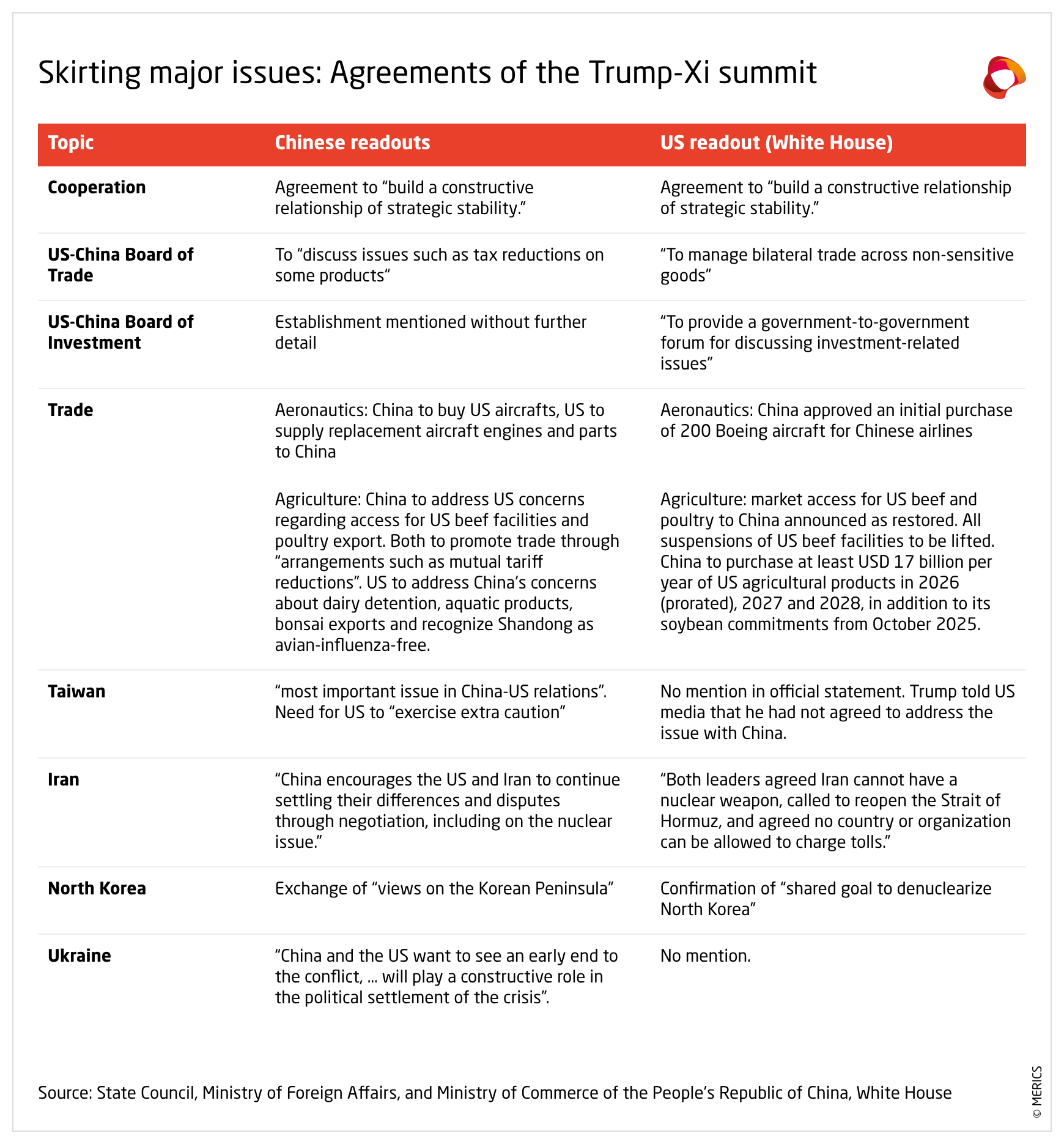
Xi treated Trump with generous courtesy, managing to project confidence rather than deference. Compared with Trump’s 2017 visit to the imposing Forbidden City, an imperial-style spectacle designed to impress the US president on his first trip to Beijing, the visit to the tranquil Temple of Heaven was meant to convey a more restrained sense of confidence and control. Over the past decade, Beijing has developed its own diplomatic style and no longer relies quite so much as before on theatrical displays of hospitality. But the power dynamic has also shifted. With Washington no longer holding blanket leverage, relations are characterized by mutual dependence. The US continues to seek China’s help in de-escalating tensions with Iran, while also pressing for bigger economic concessions alongside modest recent transactional gains (see table).
Xi’s third meeting with Putin in the space of a year had a more workaday character, beginning in the Great Hall of the People. Ongoing competition with the US means that Beijing is continuing its efforts to build an alternative to the US-led order, a project for which Russia remains an essential partner. A new China–Russia declaration on building a “new type of international relations” signaled continued alignment in diplomatic framing, reflecting longstanding shared interests in opposing Western dominance and reshaping the global order in their preferences.
The sequencing of Putin’s meeting with Xi immediately after Trump’s visit, highlighted Russia’s continued importance in Beijing’s foreign policy agenda. It also signaled that the China–Russia alignment is unlikely to weaken even as Beijing and Washington continue to explore “constructive strategic stability” as great-power peers in an increasingly complex geopolitical environment.
His summits with Trump and Putin have brought Xi closer to parity with Trump in perceived status and further reinforced Beijing as a center of global diplomacy. This evokes the old imperial saying of “all nations coming to court” (萬國來朝) – a tribute-paying order centered on China, in which foreign envoys came seeking favors. With a wave of Western and non-Western leaders visiting China in recent months, Beijing has positioned itself as one of the few capitals capable of hosting world leaders from across the globe – from the Global South and the West, from developed and developing countries, from established powers and emerging states.”
Claus Soong, Analyst, MERICS
Media coverage and sources:
- Chinese MFA: Xi Jinping had meeting with US President Trump (习近平同美国总统特朗普会谈)
- Chinese MFA: Xi Jinping had meeting with Russian President Putin (习近平同俄罗斯总统普京会谈)
- Australian Broadcasting Corporation: US President Donald Trump, Chinese President Xi Jinping end unipolar age in Beijing
- CNN: May 14-15, 2026 — Trump’s China state visit and meetings with Xi Jinping
- BBC: Xi and Putin wrap up talks in Beijing with no final details on gas pipeline
METRIX
34%
This is the share of member companies in a recent survey by the German Chamber of Commerce in China that expect their business situation to improve in 2026, a 15-percentage-point increase in optimism from last year. The jump helps to explain why two-thirds of surveyed companies said they intend to increase investment in China over the next two years. But it also raises the question whether this reflects confidence in future growth or a deepening dependence on an increasingly risky market. Despite heavy investment, German carmakers, for example, have seen annual vehicle sales in China decline by a quarter over the past five years, reaching 3.9 million in 2025. Given that Beijing is now more forcefully demonstrating its willingness to weaponize dependencies by setting export controls, the issue could be a challenge for German Economy Minister Katherina Reiche when she visits Beijing next week. (Source: AHK China)
TOPICS
Warning signs multiply as China’s economy loses momentum in April
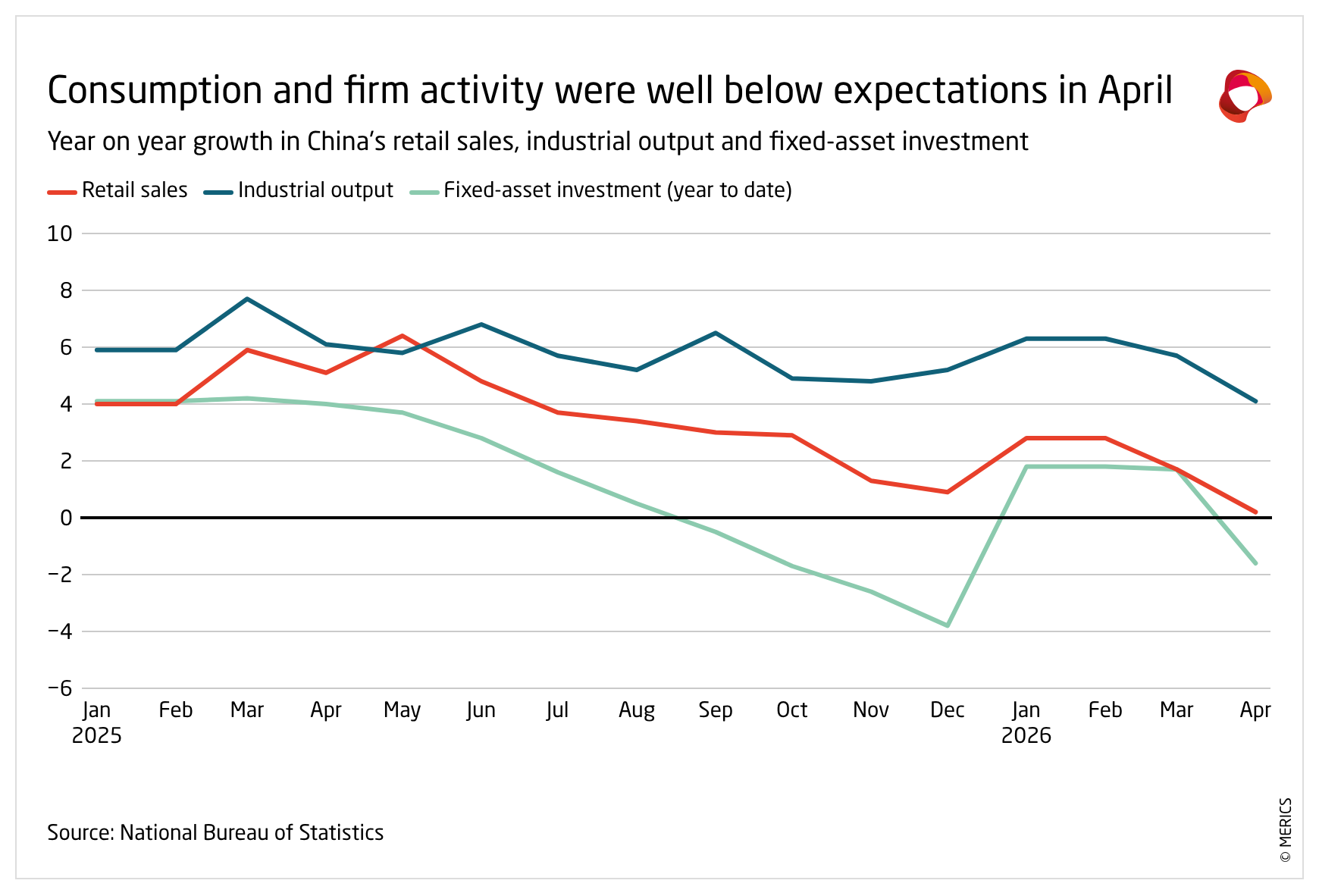
The chances of Beijing stepping in to stimulate China’s economic growth over the summer have risen after the economy weakened following a strong first quarter. Surging exports were the only good news in April, rising 14.1 percent from a year earlier in US dollar terms, while retail sales rose only 0.2 percent – and investments in infrastructure and other fixed assets between January and April unexpectedly contracted by 1.6 percent (see graphic). These trends underscore China’s persistent economic imbalance, which has left the country ever more dependent on consumption abroad rather than at home.
Chinese exporters have recently benefitted from strong demand for high-tech goods such as semiconductors and electric vehicles, as well as a rush to buy components before prices rise because of the US-Israeli war with Iran. But persistently high oil prices and increased costs will eventually force foreign customers to tighten their belts, threatening China’s growth driver.
Domestic demand looks unlikely to compensate, as the housing market slump continues to weigh on consumers. Property investments have fallen since April 2022, with no end in sight. They contracted 13.7 percent in annual comparison from January to April, worsening from an 11.2 percent decline in the first quarter.
China’s exporters gave the country’s economy a boost in the first months of 2026, posting strong growth even amid geopolitical turbulence. But this is unlikely to continue as the global energy crisis bites. Even if exports stay relatively stable, they will not be able to make up for domestic consumption remaining sluggish and investment continuing to contract. If we see more of the same in May, Beijing will likely step in during the summer with new measures to shore up the economy.”
Alexander Brown, Senior Analyst, MERICS
More on the topic: The MERICS Economy and Industry team provides updates on the latest macroeconomic trends and their impact on Europe in our quarterly “MERICS Economic Indicators”. The findings are presented on a dashboard in interactive charts and explained in concise texts. Explore the current edition here. MERICS Members have privileged access to this publication.
Media coverage and sources:
- Reuters: China April exports rebound strongly, trade surplus widens ahead of Trump visit
- CNBC: China’s economy loses steam in April as retail sales hit 40-month low
- Caixin: China Retail Sales Barely Grow as Consumer Demand Weakens
- ING: China’s April slowdown highlights dilemma between growth and inflation
An assertive Xi shows resolve in pursuing Hong Kong dissidents
Beijing appears not only unmovable but also increasingly confident in its hardline crackdown on political dissent in Hong Kong, shrugging off US pressure as prosecutors continue to seek severe punishments. US President Donald Trump dashed any hopes of fulfilling his election campaign promise to secure the release of Hong Kong dissident Jimmy Lai, telling US broadcaster Fox News that Xi Jinping’s response to the issue, raised during the two presidents’ meeting in Beijing, was “not positive”.
An influential Hong Kong media entrepreneur and one of the leaders of the city’s 2019 protest movement, Lai has been in detention since late 2020. Earlier this year he was sentenced to 20 years in prison for various offences, including conspiring to collude with foreign forces.
While Trump was in Beijing, state prosecutors in Hong Kong charged activist Joshua Wong with the same offence, which could carry up to a life sentence. Already serving time after being found guilty of another crime under Hong Kong’s National Security Law, Wong was charged with conspiring with self-exiled activist Nathan Law and “other people unknown” in late 2020 to persuade foreign governments and organizations to sanction Hong Kong or China. Where Beijing might in the past have delayed the charges being published to ensure smooth exchanges with official guests from abroad, diplomatic optics appeared to play no role. Leverage the US or other democracies once had to raise human rights concerns seem to have diminished in the face of a more assertive Beijing and a more authoritarian Washington.
China has faced limited consequences internationally for its crackdown in Hong Kong and its pursuit of pro-democracy activists. Despite ongoing international criticism, Beijing thinks it can continue unchallenged, keeping its diplomatic and economic priorities separate from human rights issues raised by other countries.”
Daria Impiombato, Senior Analyst, MERICS
Media coverage and sources:
- Hong Kong Free Press: Jailed activist Joshua Wong to face foreign collusion charge at High Court
- South China Morning Post: Trump ‘not optimistic’ on Jimmy Lai’s release after raising case with Xi
- Reuters: Trump says China may release the detained pastor but tycoon Lai 'is a tough one'
Beijing undermines EU foreign subsidy investigation by banning data sharing
Beijing is trying to undermine EU efforts to curb competition-distorting foreign subsidies by blocking Chinese companies from disclosing information to European investigators. Two years after the European Commission launched its first probe into a Chinese company under the Foreign Subsidies Regulation (FSR), China’s Ministry of Justice announced that the European regulatory investigation of Chinese security-scanner manufacturer Nuctech constituted an “improper extraterritorial measure” and that “no organization or individual may implement or assist in the implementation of such measures”. It was the first time Beijing applied legal powers introduced in April to shield Chinese companies from what it views as improper foreign interference.
The reaction reflects Beijing’s increasingly assertive approach to data as a strategic national asset. While Brussels describes the FSR as a “standard measure” to address market-distorting foreign subsidies, Beijing worries that it may give Europe overly broad access to potentially politically sensitive information about corporate financing. It has accused the EU of demanding “extensive and non-essential information within China” and called upon Brussels to “immediately correct wrong practices”.
China’s ability to restrict transfers of data stored domestically creates an asymmetry in enforcement powers: While Beijing can limit the access of foreign regulators to Chinese information, it can still compel extensive disclosures from foreign companies operating in its market.
Beijing’s willingness to block Chinese companies from sharing data with EU investigators shows that claims to extraterritorial jurisdiction are becoming a problem for global trade. For companies like Nuctech, operating in China and the EU now means exposure to two legal regimes whose demands are drifting apart – making compliance ever harder. The question is what Brussels will do with companies that do not co-operate. Will it risk confrontation with Beijing by restricting their market access or continue with subsidy probes regardless?”
Altynay Junusova, Analyst, MERICS
More on the topic:
- The EU sees early successes in using foreign subsidy regulation against Chinese companies, MERICS comment by Andreas Mischer
- China is "securitizing" its economy, MERICS China Essentials
- EU Industrial Accelerator Act + Critical materials + Platform exports, MERICS Europe China 360°
Media coverage and sources:
- European Commission: Commission opens in-depth foreign subsidies investigation into Nuctech's activities in the threat detection systems sector
- China’s Ministry of Justice (CN): 司法部发布关于欧盟外国补贴调查相关做法构成不当域外管辖的公告 (Announcement Regarding EU FSR: Certain Practices Constitute Improper Extraterritorial Jurisdiction)
- China's Ministry of Justice (CN): 司法部新闻发言人就欧盟外国补贴调查相关做法构成不当域外管辖答记者问 (Press release regarding EU practices in Foreign Subsidies investigations constituting improper extraterritorial jurisdiction)
MERICS CHINA DIGEST
Germany arrests married couple on suspicion of spying for China (Reuters)
German authorities arrested a Chinese couple on suspicion of espionage for a Chinese intelligence agency. The couple allegedly built contacts with German scientists and invited them to China with the aim to obtain intelligence on military technology. While Beijing has repeatedly denied similar accusations in the past, German authorities warn of growing security concerns coming from China. (2026/05/20)
Leaked: The secret Chinese surveillance program tracking people like me (The Telegraph)
Cybersecurity researchers uncovered that China’s security apparatus comprehensively pools information about anyone “of interest”, including foreigners. On the so-called “Dynamic Control Platform”, Chinese authorities integrate millions of data points pulled from surveillance cameras, visa details etc. to holistically track people. The platform includes a feature for relational mapping, which tracks who someone under surveillance meets with. (2026/05/19)
Wang Xiaodong, derided over Covid-19 handling, comes under corruption cloud (South China Morning Post)
Wang Xiaodong, former governor of Hubei Province is currently under investigation for corruption during the Covid-19 outbreak. Only last month, his subordinate and previous mayor of Wuhan Zhou Xianwang was indicted on bribery charges. Both officials were ridiculed online for contradictory statements during a press conference in 2020. Wang had stated that mask supplies were extremely short, while Zhou had said that medical supply issues were resolved. (2026/05/17)
China's marriages drop to decade low, deepening demographic concerns (Reuters)
Chinese authorities recorded nearly 1.7 million marriage registrations during the first quarter of 2026. This number is down by 6.2% year-on-year and has halved since 2017. As most couples decide to have children only once they are married, low marriage registrations give an indication that China’s demographic challenges will intensify even further. (2026/05/11)
China state broadcaster reaches World Cup deal with FIFA (AP)
After months of negotiations, China Media Group and FIFA finally reached a deal on broadcasting rights for the men’s World Cup. With the first tournament less than a month away, some Chinese fans had feared that they might not be able to watch the World Cup at all. While FIFA had initially sought USD 300 million, the two sides now settled at USD 60 million, according to Chinese media. (2026/05/15)
Former China defense ministers convicted of corruption in latest purge of military leaders (The Guardian)
Marking some of the most severe crackdowns on corruption in recent years, two ex-defense ministers Li Shangfu and Wei Fenghe were given suspended death penalties for bribery. Their sentences are expected to be commuted to life imprisonment and should probably serve as a warning to other generals in the armed forces that nobody is safe from purges. (2026/05/08)
Content