
picture alliance / ZUMAPRESS.com | Andre M. Chang
Kommentar
The AI race: US leads at the frontier, but China is gaining ground in adoption
China is pushing cheap, adaptable AI as an alternative to proprietary US systems. But Wendy Chang and Olaf Schulz warn that these open-weight models create risks of their ownn
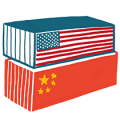
“We’re leading China in AI […] and, frankly, I want to keep it that way because whoever wins AI wins,” US President Donald Trump said in September, making the lead in frontier models the measure of American ambition. Meanwhile, Beijing is changing the terms of this superpower competition – by betting that domestic and global adoption of Chinese AI models that are good enough for practical use will reinforce its industrial dominance and extend its global influence.
One way in which China has taken the lead in the global distribution of AI is by driving global governance, for example through calls for more international cooperation. The UN Global Dialogue on AI Governance in July stressed that AI governance should “reflect the priorities of all nations, not just the most technologically advanced” and that the benefits be shared by all. Its emphasis on inclusiveness and openness was echoed by Xi Jinping two weeks later. At the World AI Conference & High-Level Meeting on Global AI Governance, WAIC in Shanghai, he urged governments to “adhere to the principle of openness,” to “recognize the important role of the United Nations” and to ”prevent creating new historical injustice in AI.”
Beijing wants to shape the rules to make AI more inclusive – and Chinese
While leading US AI companies keep their so-called closed AI models under wraps, allowing users to access them only through an interface, their Chinese competitors typically allow users to download their so-called open-weight models and to modify them using the published parameters or model weights. Relatively low costs for users have allowed China to catch up with the US in terms of AI model dissemination, even before incidents involving US AI agents added another argument in their favor. A China Daily editorial argued that August’s revelations about an AI attack on the developer platform Hugging Face put an end to “Silicon Valley’s reigning orthodoxy” that its closed-source models were the pinnacle of safety. (Whether Chinese companies are allowed to disclose incidents with Chinese agents is a different question.)
With July’s launch of the World AI Cooperation Organization (WAICO), China created an intergovernmental organization to promote “an open, fair, just and non-discriminatory environment for the development of AI”. Twenty-nine countries signed the founding charter of the Shanghai-based institution, including Brazil, Indonesia, South Africa, and Russia, China’s stalwart anti-Western partner.
While China is championing openness and broad diffusion of its open-weight models, the US is pursuing controlled diffusion, keeping its AI technology proprietary and building trusted networks around it. Leading US AI companies see closed models as the best way of retaining control of frontier AI models and maintaining their own lead, as well as that of the US, in the race to build the holy grail of artificial general intelligence (AGI), with potentially huge scientific, industrial and military advantages, thereby “Winning the Race” with China. As continued leadership depends on secure supply chains, the US launched the Pax Silica initiative in late 2025 “to reduce coercive dependencies [and] protect the materials and capabilities” necessary for AI. It already counts the EU and India among a select group of 20-plus “trusted partners.” The government’s American AI Exports Program (AAEP) seeks to “ensure that American AI technologies, standards, and governance models are adopted worldwide.” It benefits from the US leadership in frontier model development, although recent near-frontier open-weight models such as Xiaomi’s -V2.6 or Moonshot’s Kimi K3 show that Chinese developers are only months behind their US peers.
Beijing’s approach is tempting, but also comes with strings attached
At a time in which many countries are looking to integrate AI into industry and government, China’s approach is an attractive one. It offers ready access to capable models, without relying on a US provider. Chinese open-weight models can be adapted beyond their provider’s control. But “openness” does not mean freedom from state control. All Chinese AI services require approval from the Cyberspace Administration of China, and Communist Party control poses the risk they could be used for propaganda and manipulation, at home and abroad. A problem is that scrutiny of open-weight models remains limited. Unlike open-source models, they do not lay open their underlying code and training data.
Governments should also be wary of creating a dependency on Chinese technology in critical domains. The adaptability of open-weight models is an advantage for many, but it can lead to their deeper integration into software systems. Once customized models are interwoven with the IT systems of public administrations, logistics providers or corporate research and development, switching to other providers can cost considerable time and money. Chinese technology is already embedded in Western telecoms networks and other critical infrastructure – and there is little doubt about the motivation of state-sponsored Chinese actors in gaining access to them. AI models can be attacked and can be compromised and misused. Governments should keep in mind that globally disseminated, “prepositioned” Chinese AI models could create new opportunities for exploitation.
Necessary caution about China comes alongside Europe’s unease about US policies. While Europe cannot quickly catch up with the US on AI-related technologies, it can enhance its sovereignty in some areas, choose its partners carefully and make better use of its own AI capabilities, including AI models. To do this, it will need strong AI expertise in industry and government – all the more so given the world’s new fear of catastrophic AI incidents created by rogue artificial super-intelligent agents – or their malicious human users. Appropriate risk mitigation would require the US and China to agree on safeguards or even a pause of the AI race – an unlikely outcome at a time when both see AI frontier advances as strategically important in their great-power rivalry.
Autor(en)

Senior Analyst

Senior Associate Fellow
Autor(en)
Senior Analyst
Senior Associate Fellow