

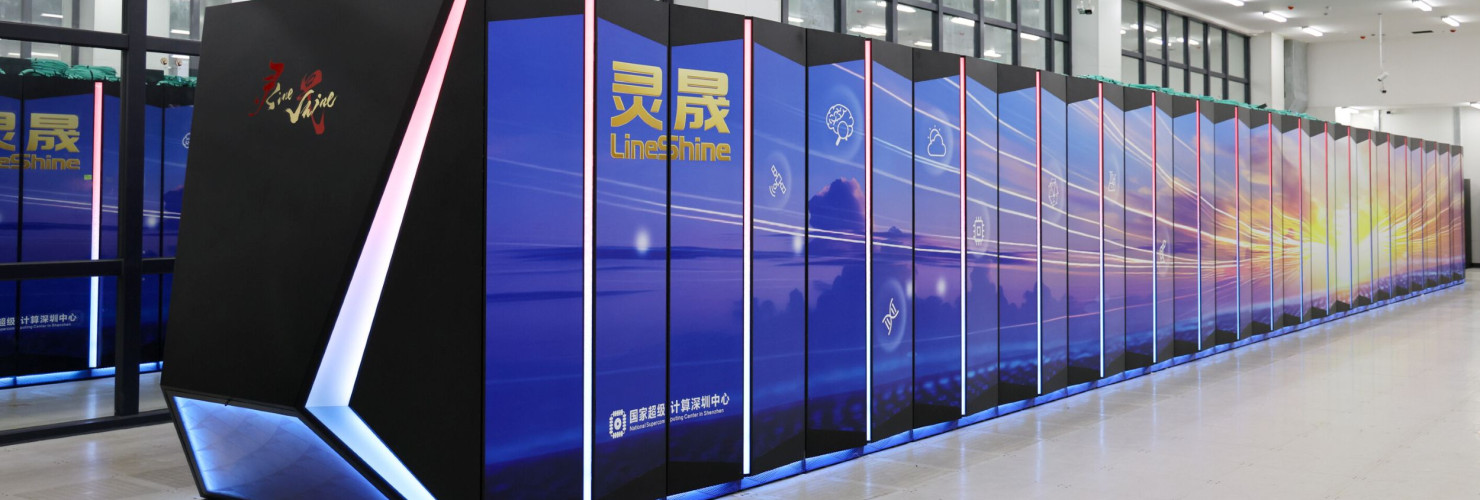
picture alliance / Xinhua News Agency | Liang Xu
Kommentar
Supercomputer LineShine: A restrictions-driven leap with limitations
In June 2026, the Chinese all-CPU supercomputer LineShine (灵晟) debuted atop the world’s premier supercomputing ranking, the TOP500 list. This marks China’s return to the TOP500 after a two-year gap, showcasing the confidence Beijing now has in its domestic tech ecosystem. The country had stopped submitting data to the TOP 500 in 2019 after the US imposed export controls on advanced computing chips, presumably to avoid further restrictions by obfuscating China’s progress and the technology used.
Despite the headline hype, the supercomputers’ design, driven partly by necessity due to China’s GPU weakness, has key limitations. LineShine uses CPUs only, instead of the more common combination of CPUs and high-performance GPUs. This means that while it leads by some benchmarks, its AI computing capabilities are limited. LineShine ranks only fourth on the HPL MxP benchmark, designed to test AI workflows. It performs significantly worse than the No. 1 US-based system El Capitan, reflecting its CPU only design. By contrast, GPU equipped systems like El Capitan, Aurora, and Frontier can be used for large scale AI model training.
The constraints do not end with GPUs. LineShine’s LX2, its Huawei-designed chip, integrates AI computing into its main processor, mirroring a broader industry trend. The developers hope this will enable AI enhanced digital simulations to tackle previously intractable problems in science, like protein folding and drug discovery, where a computer would need to test many possibilities at the same time. However, the LX2 is based on instruction set architecture ARMv9 under a perpetual license held by chip designer Huawei. Because ARM licenses are version specific, Huawei (or other Chinese designers) could be cut off from future generations like the upcoming ARM v10 and therefore miss out on new features and performance gains.
China has been pursuing supercomputing independence for more than a decade, since the Obama administration in 2015 blocked exports of Intel chips to a Chinese supercomputer. Since most computers at the time mainly used CPUs, China invested a lot in supercomputing CPU design, so LineShine is not its first CPU-only supercomputer. While developers extol the virtues of this design, as those using both chip types require data to move back and forth repeatedly between GPUs and CPUs, China’s capacity to design and manufacture GPUs is still behind that of the US. This constraint, and the long-term investment in CPU-based supercomputing, continue to influence design choices. LineShine is thus unlikely to meaningfully help break China’s AI training bottleneck.
“China submitting its new supercomputer to benchmarks after a hiatus showcases the confidence the government now has in homegrown technology. It is also part of a broader trend from concealment to open demonstration of China’s growing self-reliance. US export controls, which led to increased independence, also shape design choices and limitations.”
MERICS Head of Program Science, Technology and Innovation (Co-Lead) Antonia Hmaidi
Autor(en)

Ko-Programmleiterin
Autor(en)
Ko-Programmleiterin

Topics