
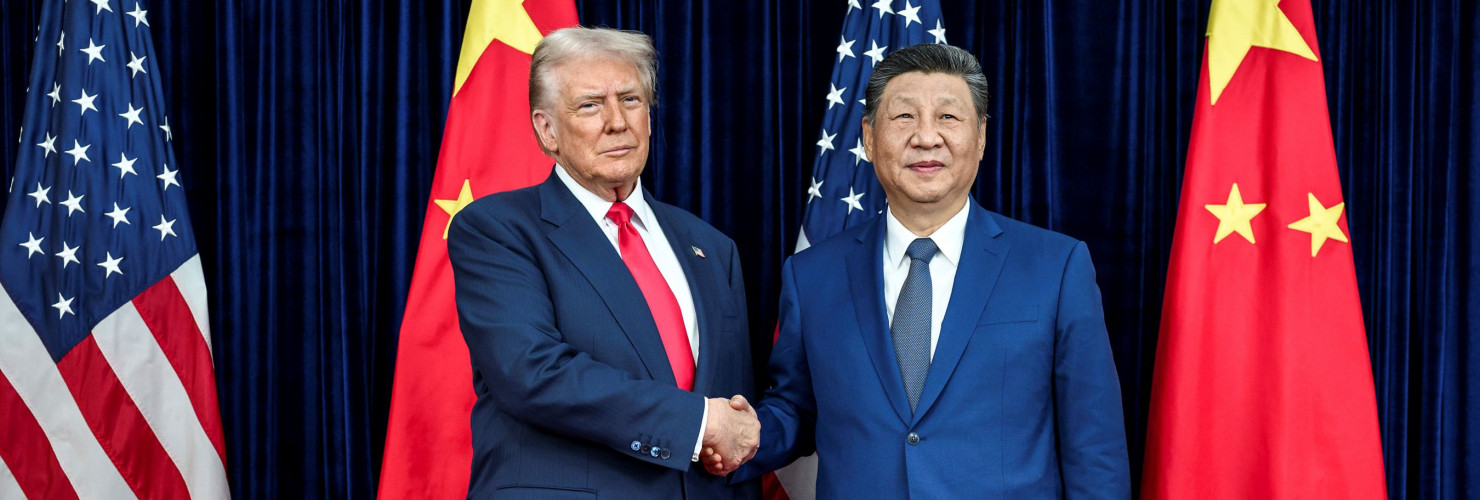
picture alliance / ZUMAPRESS.com | Daniel Torok/White House
Tracker
China Security and Risk Tracker
MERICS Top China Risks 2026
Risks for Europe rise amid US-China tensions
Europe faces a demanding year in 2026. President Donald Trump’s impulsiveness and transactional approach to foreign policy make transatlantic relations hard to predict. Washington and Beijing’s focus on bilateral negotiations will marginalize Europe. Worse, Europe’s declining relevance in Beijing’s foreign-policy thinking means Brussels should prepare for a China unwilling to offer meaningful concessions.
To help European actors anticipate what 2026 might bring, MERICS has developed a foresight effort to identify key China risks, especially those with the biggest impact on European interests and security. To identify these, we hosted two separate, off-the-record foresight workshops with officials and experts from across Europe. They assessed China’s likely trajectory over the next five years, and which trends might have the deepest impact on Europe-China relations. We then held a further, internal workshop with analysts from MERICS’ research teams to refine our selection of risks.
MERICS Top China Risks 2026 examines the most probable and highest-impact risks, those with urgent implications for European policymakers and businesses. Upcoming issues of the MERICS China Security and Risk Tracker will track them throughout the year.
Nor will we lose sight of the risks our expert groups thought less impactful or less likely to materialize in 2026. Many harbor the potential to present Europe with major implications. Among such risks, we include the fragmentation of the global governance system, China’s partnership with Russia as the war in Ukraine continues, the use of AI for more sophisticated hybrid operations, or the continued impact of Chinese overcapacities on European markets.
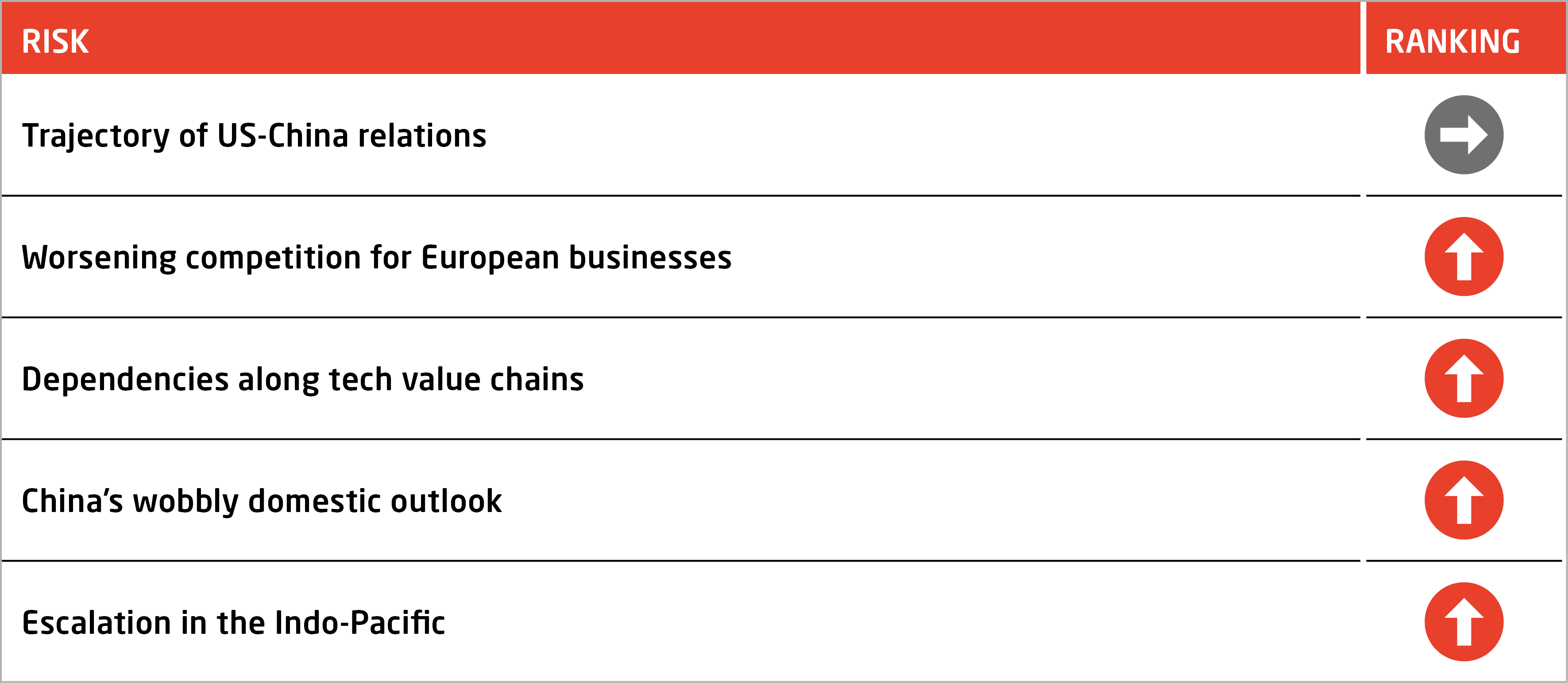
Top China risks 2026

Trajectory of US-China relations: Europe risks being cut out of negotiations and falling behind on China agenda
EU-China relations will continue to be shaped by developments between Washington and Beijing. The key risk for Europe is that it will be left out of any strategic decision-making in Washington, but it will be impacted by any deals or actions taken by either power.
China’s rare earths export restrictions are a case in point. Although ostensibly aimed at the United States, they also had a significant impact on Europe. Similarly, Europe benefitted from the pause in the restrictions agreed when the US and Chinese presidents met in South Korea on October 30. Whether this de-escalation agreement holds remains to be seen.
The United States and China remain locked in competition, so new bouts of escalation seem likely. But the October talks made something clear: today, both Washington and Beijing favor bilateral deals and seem to increasingly see the world in ‘G2’ terms.
Europe has felt the impact of the various measures taken by both sides over the last few months. But it had little say in the negotiations. European policymakers no doubt feel some relief that US-China frictions have stabilized. But being excluded from negotiations should be a matter of concern. Transatlantic cooperation on China will remain difficult and unreliable next year.
Without a seat at the table, Europe’s interests and concerns vis-à-vis China are likely to be disregarded.
There is also a risk the US-China truce, alongside the multitude of other challenges the EU is facing, diminishes Europe’s sense of urgency about tackling key frictions and dependencies in China relations. Europe cannot afford such complacency against the background of growing geopolitical fragmentation and rising volatility.
The challenges that China poses to Europe are long-term and, in many cases, structural. Actions would be much more effective if coordinated across the Atlantic. But as long as this remains difficult, Europe should work on developing its own, more proactive approach that reflects its own interests, and on building greater coordination with other partners around the globe.

Worsening competition for European businesses: European companies face a grim outlook in China and abroad
European companies are having a hard time. Their business confidence towards the Chinese market is at record low levels. During the next two years, 71 percent expect China’s economic slowdown to have a negative impact on their China business, while 60 percent are worried about competitive pressures on their sector in China. Regulatory barriers could make matters worse. In 2026, the new “Made in China” product standards, will take effect, giving domestic products a 20 percent discount in government procurement evaluations. European companies exporting to or assembling in China could become increasingly locked out of China’s substantial government procurement market, worth CNY 3.38 trillion (about USD 477 billion) in 2024.
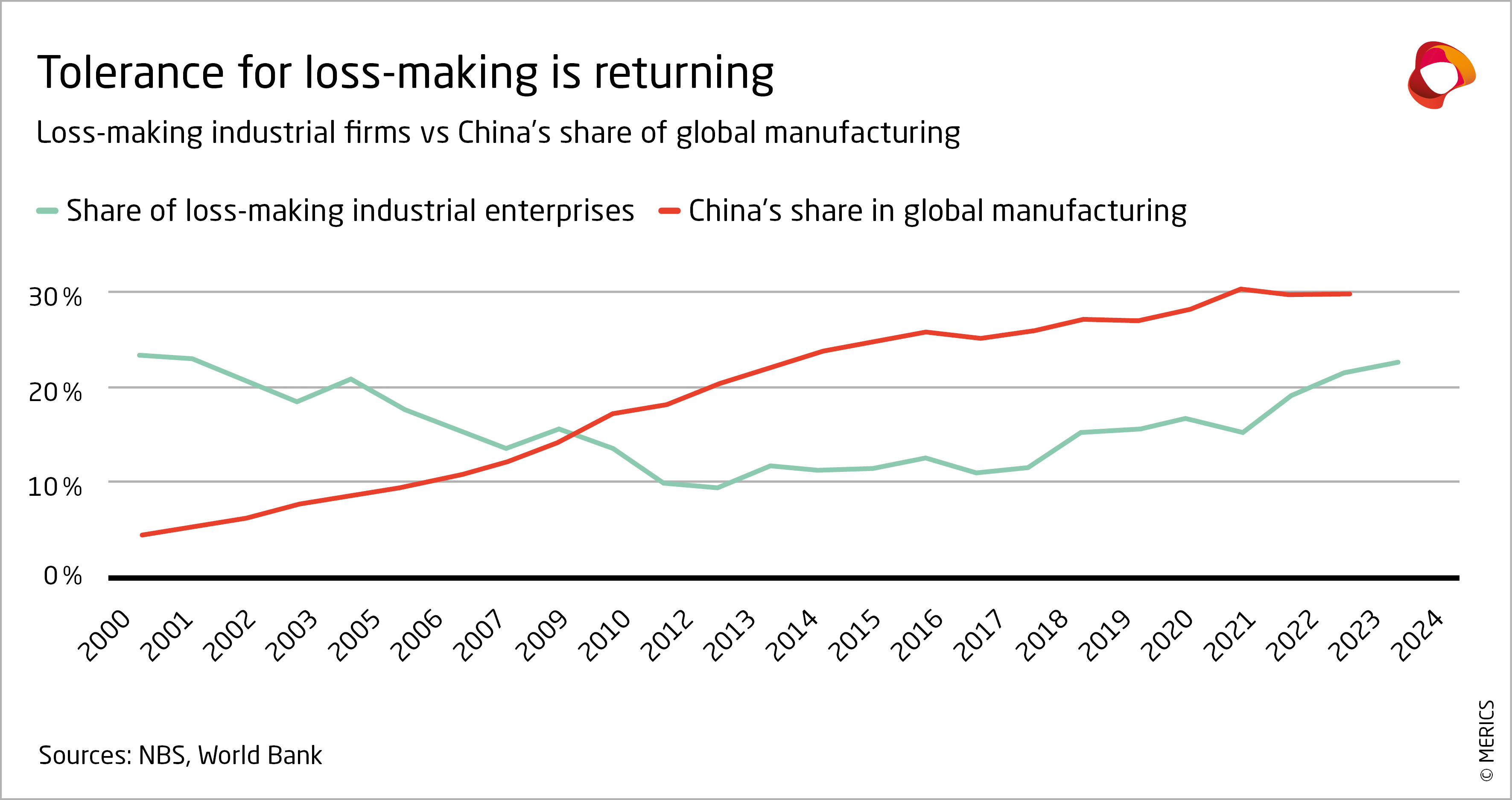
Several trends within China look ominous for European companies’ global operations. First, continuing price wars, overcapacity, and sluggish demand, mean a record low number of European companies are optimistic about their revenue growth and profitability in China over the next two years. In the past, European companies relied on high growth and plush profits in China to cushion themselves against challenges and fund projects in other markets. Their declining profit margins and market share in China put the future viability of this approach in doubt.
Second, European companies pressured by more cost-efficient Chinese rivals tend to withdraw to the premium segment of their respective markets, further limiting the scope of their business in China. Such moves strain the funds available for their operations globally, including vital R&D spending, and jeopardize their overall technological and commercial competitiveness.
Chinese companies will turn up the pressure on European companies in Europe as well. For instance, the EV-maker BYD’s sales in Europe jumped threefold to 80,807 vehicles between January and September 2025, compared to a year earlier. This trend is likely to continue and extend beyond the automotive sector as exports fill the void left by downbeat consumer confidence in China. Moreover, fixed asset investment (FAI) took a hit over the past few months, another reason why China may need to rely even more on exports to keep economic growth stable.

Dependencies along tech value chains: Nexperia case highlights China’s chokehold around Europe’s tech industries
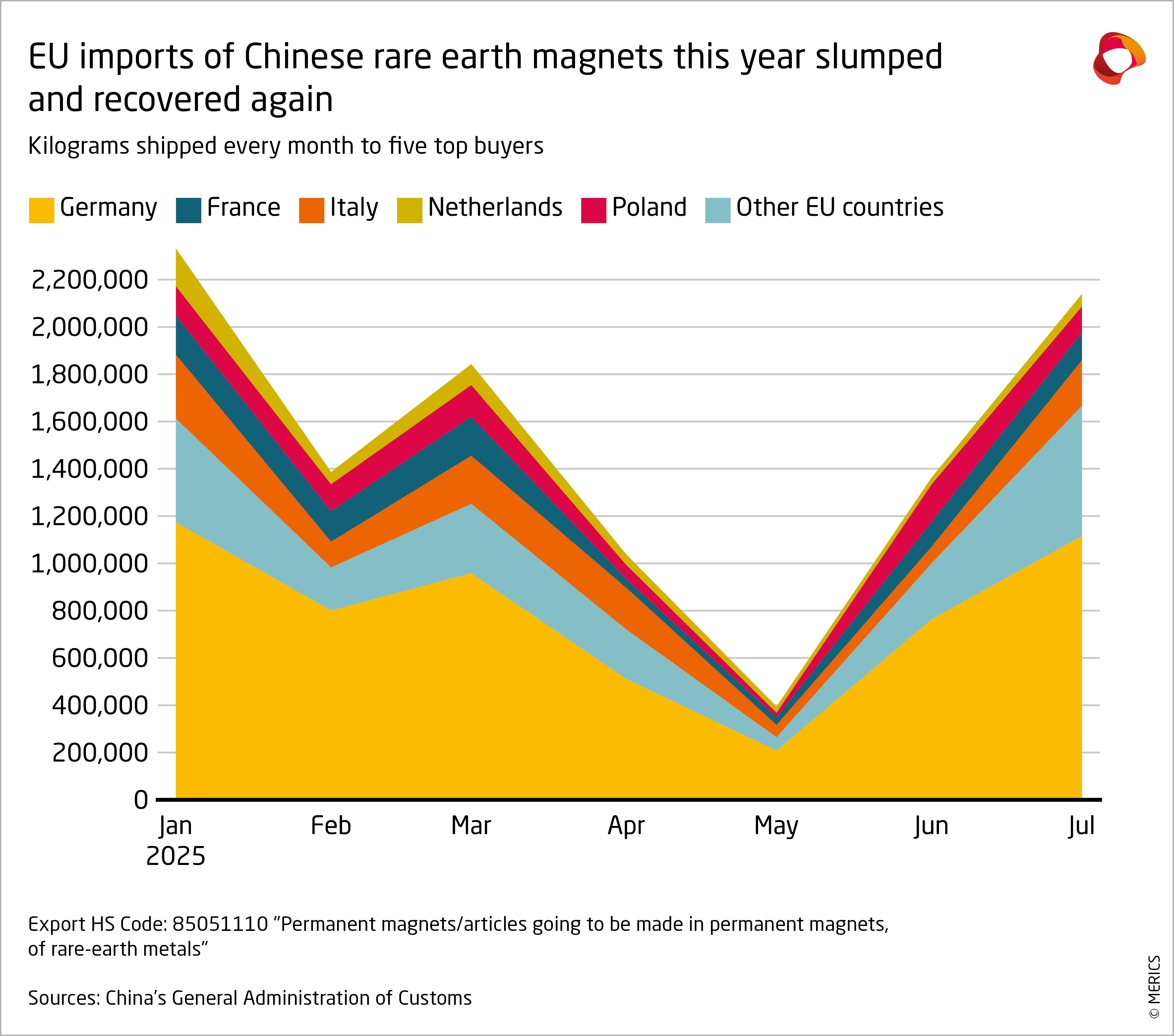
European industries in high-tech sectors can expect continued uncertainty and significant pressure from China’s export restrictions. Despite the 12-month truce on China’s rare earth export controls negotiated in South Korea, Chinese exports of many critical raw materials (CRMs) remain subject to strict licensing requirements. This includes CRMs that are foundational to technology-intensive industries, such as gallium, germanium, graphite, and several rare earth elements (REEs).
China also has controls in place on critical intermediate inputs, like permanent magnets and semiconductors. Given Europe’s enduring import dependencies, such export restrictions are a major risk factor in 2026.
Persistent uncertainties surrounding the future of Netherlands-based semiconductor maker Nexperia highlight the stakes. Disruptions persist despite US government claims to have obtained a commitment from Beijing to the resumption of trade flows from Nexperia’s plants in China. The uncertainties have put the automotive industry in crisis mode; Bosch was forced to cut production at three of its plants as of late November. Shipments from Nexperia’s China fabs were suddenly halted after the Dutch government used emergency powers to take control of the company in October, amid allegations of improper transfers of assets, funds and IP by its Chinese owner, Wingtech. The Dutch later suspended the order, but the company’s ownership remains mired in a legal dispute.
Behind the spat between the Hague and Wingtech lie existential questions around the resilience of the European semiconductor industry. An export control rule by the US government, since suspended for one year, played a role in the Dutch decision to nationalize Nexperia.
What is also true is that the Chinese owner had been quietly trying to move the company’s resources and production to China, raising concerns in Europe about the risk of losing technology and know-how. Indeed, the US Bureau of Industry and Security added Wingtech to its Entity List in 2024 citing efforts to acquire western assets “with the objective of relocating these entities to China to help indigenize a semiconductor manufacturing ecosystem.”
Any European companies in China – particularly those controlled by a Chinese entity – and their local suppliers could face similar disruptions. Beijing’s export controls are designed to keep technology value chains in China and prevent the emergence of foreign competitors who might undercut the PRC’s industrial ambitions. As this is a systematic strategy, European industry cannot rely on political reprieves to make the problem go away. Companies that depend heavily on China for supplies or production should understand the geoeconomic risk premium: Beijing can choose to pull the rug from under them pretty much whenever it wishes.

China’s wobbly domestic outlook: Unaddressed socio-economic tensions will lead to a more assertive China
Over the next year, China’s leadership will still be busy managing domestic discontent over some major social issues. Particularly concerning is youth unemployment in urban areas, and consequently, a large gig economy that increasingly threatens social stability. There are signs the leadership may be overlooking how this sector is a core obstacle towards achieving a “moderately prosperous society”.
This is a hard issue to tackle because of China’s uneven and inadequate social security system, which is underfunded and insufficient for much of the population. Local governments are tasked with addressing this but lack financial resources. The 15th Five Year Plan (2026-2030) will attempt only partial solutions, as the central government’s priorities remain fixed on boosting manufacturing and innovation. The plan shows the CCP has a similar risk assessment to external observers, but a different set of solutions. The hope is that renewed economic growth in targeted sectors will flatten some of these obstacles – or at least push them further into the future and contain their fallout.
While the potential for unrest, especially labor protests, remains, there is little likelihood of such incidents spiraling into wider instability, given the government’s prevention, control and crackdown capabilities. However, ineffective provision of social welfare may stand in the way of the CCP’s most ambitious objectives.
Foreign policy issues, such as the trade war with the United States, present a useful distraction from pressing domestic faultlines. The leadership’s worries about shakier social resilience will influence their external posture, making them less willing to compromise or negotiate with external partners and, potentially, fueling greater Chinese assertiveness that European counterparts and stakeholders have struggled to manage. They should expect Beijing more as a hard-handed competitor resolutely staying its course – less open, more nationalistic and with significant structural challenges that bring additional risks.

Escalation in the Indo-Pacific: Growing military activity increases risk of accidental escalation
Tensions are mounting in the Indo-Pacific again, increasing the risk of escalation in 2026. Beijing has been emboldened by its leverage over critical mineral supply chains and its perceived victory in the US-China trade conflict, so will continue to expand its military presence and put pressure on other regional actors.
Beijing’s ongoing spat with Japan in the wake of Japanese Prime Minister Takaichi Sanae’s remarks on Taiwan’s strategic importance to her country, has escalated tensions in the East China Sea. Beijing has sent its coast guard on a “rights enforcement patrol” to the Senkaku Islands, which are administered by Japan but claimed by China. Meanwhile, Tokyo has also accused Beijing of flying military drones close to Japanese territory.
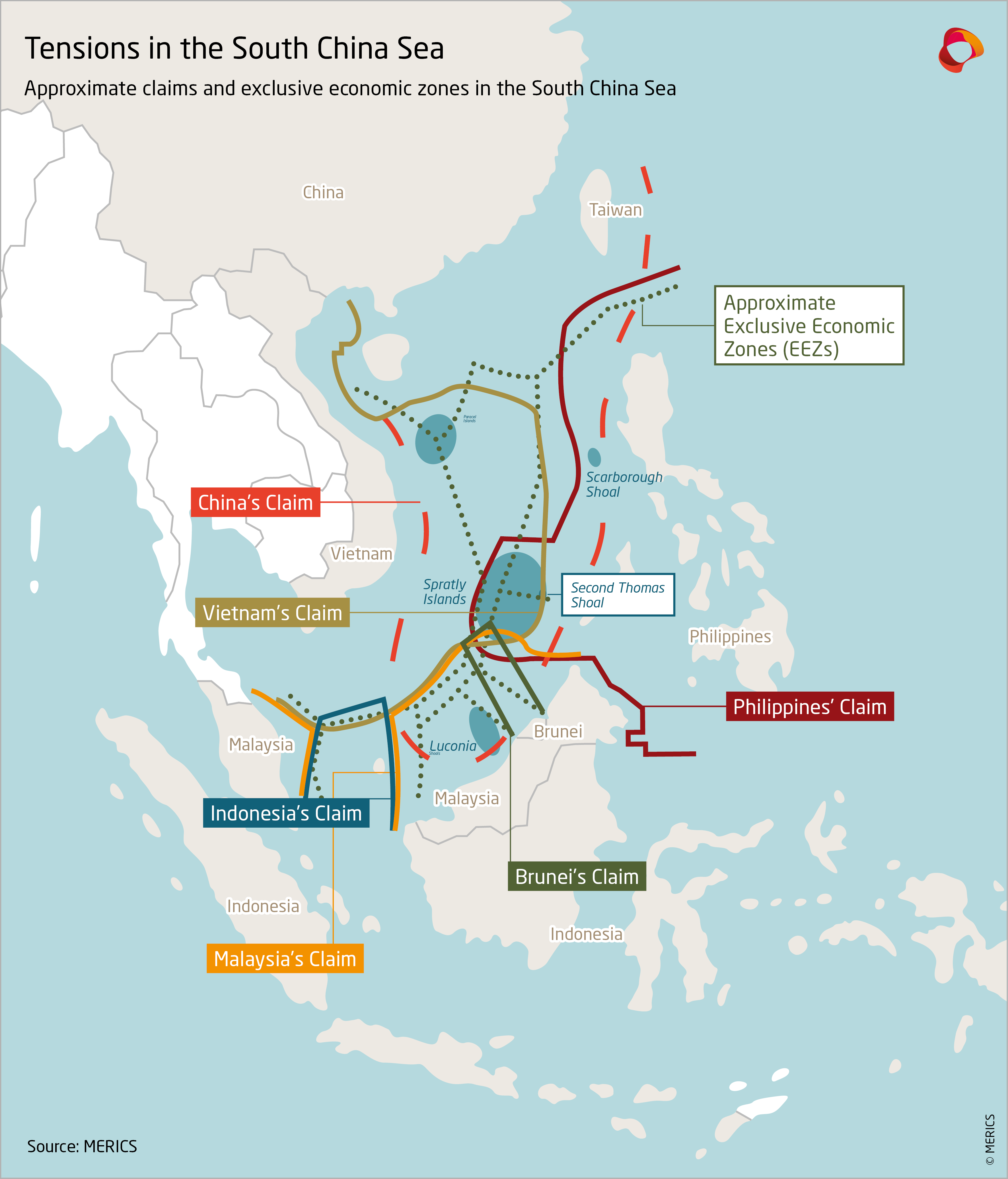
The South China Sea also remains tense. Beijing’s announcement of a new “nature reserve” at the Scarborough Shoal was meant to institutionalize China’s claims to the area. And China’s Coast Guard continues to harass Philippine ships. The use of water cannons and ramming maneuvers against fishing vessels and other ships in areas China claims is becoming increasingly commonplace. Military activities in the Taiwan Strait are also an almost daily occurrence.
Open conflict in the region remains unlikely. But Beijing’s growing assertiveness in foreign policy, and its growing confidence in its capabilities to emerge victorious in its competition with the United States, will invite more adventurous behavior in 2026. As the CCP vies for new sources of legitimacy amid an economic slowdown, Beijing may well resort to a more confident foreign policy posture to distract from domestic tensions.
Meanwhile, the recent purges in the People’s Liberation Army (PLA) could create incentives for mid-level officers to prove their political loyalty by engaging in riskier, more proactive behavior. The mix of rapidly accumulating tensions, increasingly defined positions, heightened military activity and more intense Chinese harassment could easily produce an accidental escalation that might draw in the United States, Europe and other powers.

Acknowledgements
The authors would like to thank Simon Nguyen, intern in the Foreign Relations team, for his contributions to this edition of MERICS China Security and Risk Tracker.
Autor(en)

Programmleiterin

Ko-Programmleiterin

Senior Analyst

Analyst
Autor(en)
Programmleiterin
Ko-Programmleiterin
Senior Analyst
Analyst
Inhalt