


picture alliance / Xinhua News Agency | Guo Cheng
Kommentar
China is commercializing energy-efficient underwater data centers
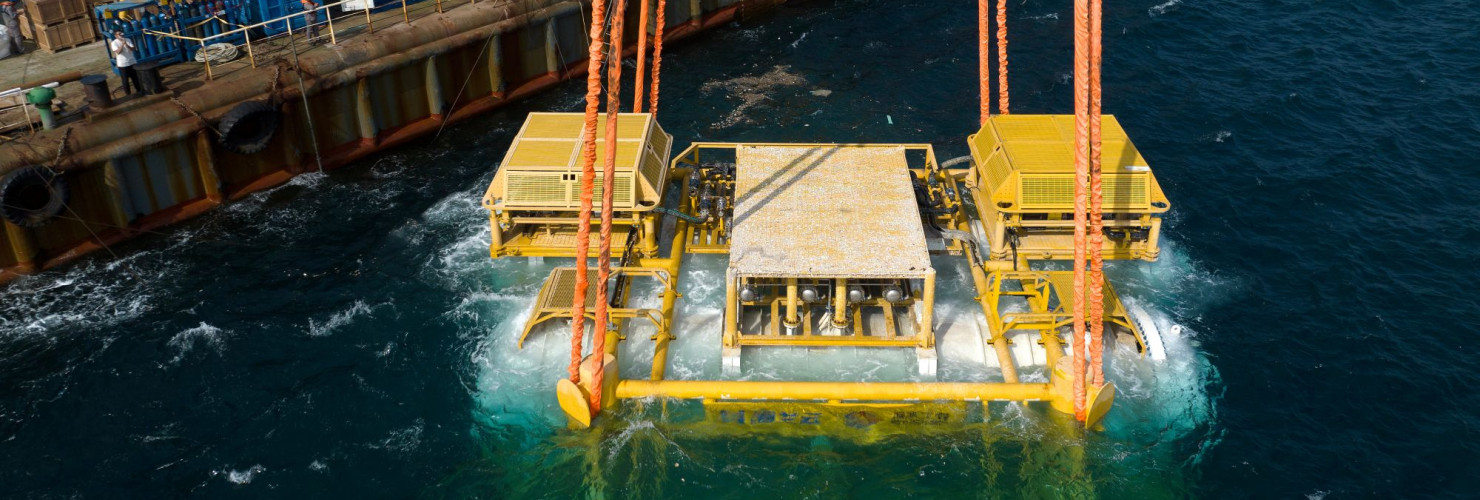
China unveiled the world’s first commercial underwater data center in Hainan and a wind-powered module in Shanghai. The technology could help slow the growth of energy consumption as China builds ever more data centers for digitization and AI. Seawater is a huge, free, consistent cooling source, which makes the Hainan facility 40-60 percent more power efficient than traditional facilities. While onshore facilities spray chilled water, the underwater centers are pumping seawater through radiators on the back of server racks.
As China (and the world) bets big on AI, its data centers use more and more land and energy. Underwater data centers provide a solution, especially when powered with offshore wind power. However, underwater data centers also pose engineering challenges such as sealing modules, the corrosiveness of sea water as a cooling liquid, the high-pressure environment undersea, and the difficulty of maintenance that may require lifting entire modules to the surface Their environmental impacts, particularly on marine ecosystems during heatwaves, also remain understudied. Microsoft pioneered underwater data center technology in 2018, but has shelved the concept for now.
The Hainan underwater data center offers medium-size storage and computing capacity: Each cabin, located 35 meters underwater, has 24 server racks capable of holding up to 500 servers (ultra-large data centers hold over 10,000 servers). The project boosts national champions in fiber-optic cables, such as Zhongtian Technology, Tongguang Cable, and Hengtong Group. The main engineering of the Hainan facility is led by marine tech firm Highlander, a frontrunner in subsea computing. Although its subsidiaries are on the trade-restricted US Entity List, the company still uses technology from acquired Canada’s OceanWorks and other foreign suppliers.
Pilot testing in Hainan started in 2023, initially providing data storage for Hainan’s free-trade port and telecom operators before expanding to cloud and AI firms. If these first projects are a success, wind-powered, green, underwater data centers could scale rapidly, as billions are being poured into AI infrastructure.
Altynay Junusova, Analyst, MERICS: “China needs its data centers to be energy efficient because it is simultaneously building massive amounts of computing power for AI and transitioning to a green economy. Underwater data centers are a small but strategic part of a multi-faceted layout of energy and data center infrastructure. They showcase China's innovation and engineering prowess.”
Autor(en)

Analyst
Autor(en)
Analyst

Topics