

picture alliance / CFOTO
Kommentar
Domestic substitution in AI chips: China’s big gamble
After years of struggling against US export controls on advanced semiconductors and their manufacturing equipment, Beijing has now started directing its companies to “use domestic” in a systemic way. The government is incentivizing data centers with energy subsidies to use domestic chips that are less energy efficient. Policymakers want demand for chips like Nvidia’s H20 to now be filled by Chinese companies. Chinese large language models such as DeepSeek are announcing new versions tailored to run on domestic chips.
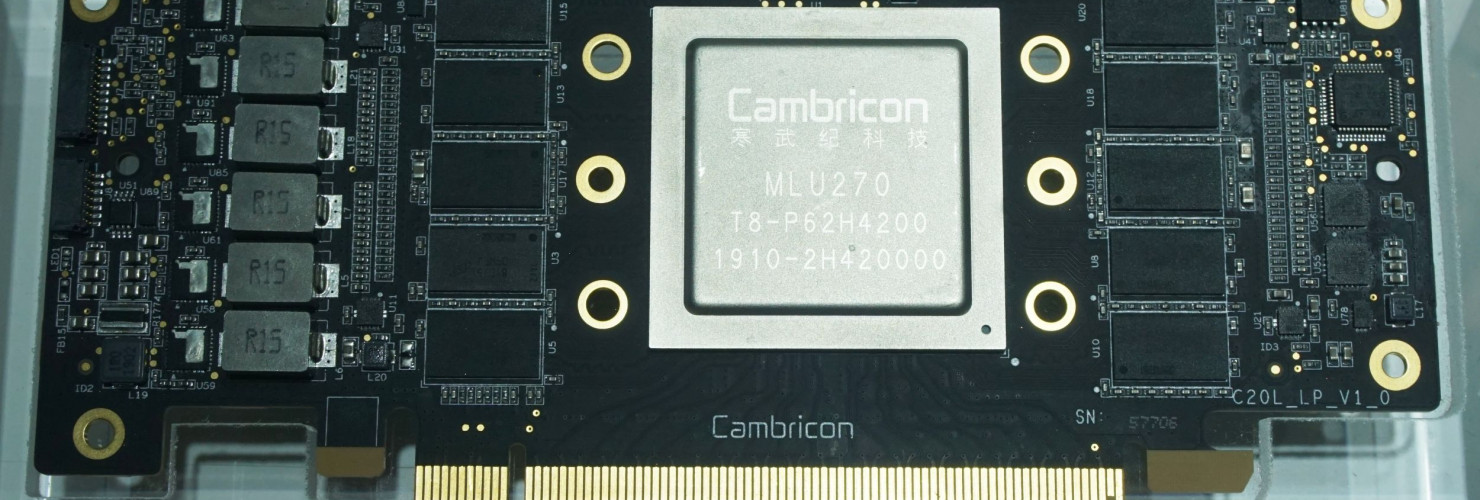
China’s push for tech companies to use domestic AI hardware comes at a time when those chips are neither as good nor as plentiful as Western ones. Nevertheless, the perceived policy change has cast a spotlight on Chinese AI chipmakers. In addition to Huawei, whose Ascend AI chips are the domestic standard, Cambricon (寒武纪) is an emerging competitor, with reported deals with tech giants Alibaba Cloud and ByteDance.
The localization effort is also benefitting Chinese suppliers, including silicon wafer company Eswin (See profile). The high-bandwidth memory (HBM) used for AI chips, also restricted, form another bottleneck for Chinese chip production. China’s memory makers are looking into replacing HBMs with large quantities of DDR5s, a type of cheaper, lower-bandwidth memory they can produce domestically.
To break dependence on Nvidia’s GPUs, Chinese companies have also pursued alternative chip designs that can be used for AI computation. Startup Zhonghao Xinying (中昊芯英), for example, has announced a home-grown GPTPU chip, an Application-Specific Integrated Circuit (ASIC) fashioned after Google’s TPU. A research team from Peking University has also announced an analog chip with breakthroughs in computation speed for certain types of tasks.
All this progress in domestic AI chip development ultimately hinges on China’s ability to produce enough chips to supply domestic demand, especially when Huawei is counting on networked solutions, requiring more chips, to compete with Nvidia. Projected volumes for Huawei’s and SMIC’s Chinese AI chip production are a fraction of domestic demand. Given that all Chinese AI chip companies depend on SMIC’s capacity, China will likely remain constrained in AI chip production in the near future.
Wendy Chang, Senior Analyst, MERICS: “Beijing’s push for indigenizing AI chips shows its determination to reduce reliance on Western technology and its ability to make companies follow its policy. It is also a giant bet that domestic technology could compete, and that AI development would not suffer as a result."
Autor(en)

Senior Analyst
Autor(en)
Senior Analyst

Topics