

picture alliance / Xinhua News Agency | Zhou Mu
Kommentar
Science funding call provides insight into China’s AI priorities
A recent annual call for project proposals by the National Natural Science Foundation of China (NSFC), China’s basic research funder, shows how China is prioritizing the application of AI in scientific discovery. As Chinese policymakers see it, integrating AI with the real world should push scientific and technological frontiers and bring China to the global forefront, potentially even in developing systems that possess human-like intelligence.
According to some leading Chinese AI thinkers, scientific discovery is the ideal testbed for artificial general intelligence (AGI). Shanghai AI Lab Director Zhou Bowen (周伯文) is convinced that humanity is experiencing a historic moment at the intersection of AI and science, where “scientific abilities will be AGI’s core.” According to Zhou, one prerequisite of AGI will be its ability to do science, and he thinks his generation will witness this breakthrough. In its proposals for the upcoming 15th Five-Year Plan, the CCP said that China should “lead a paradigm shift in scientific research with AI.”
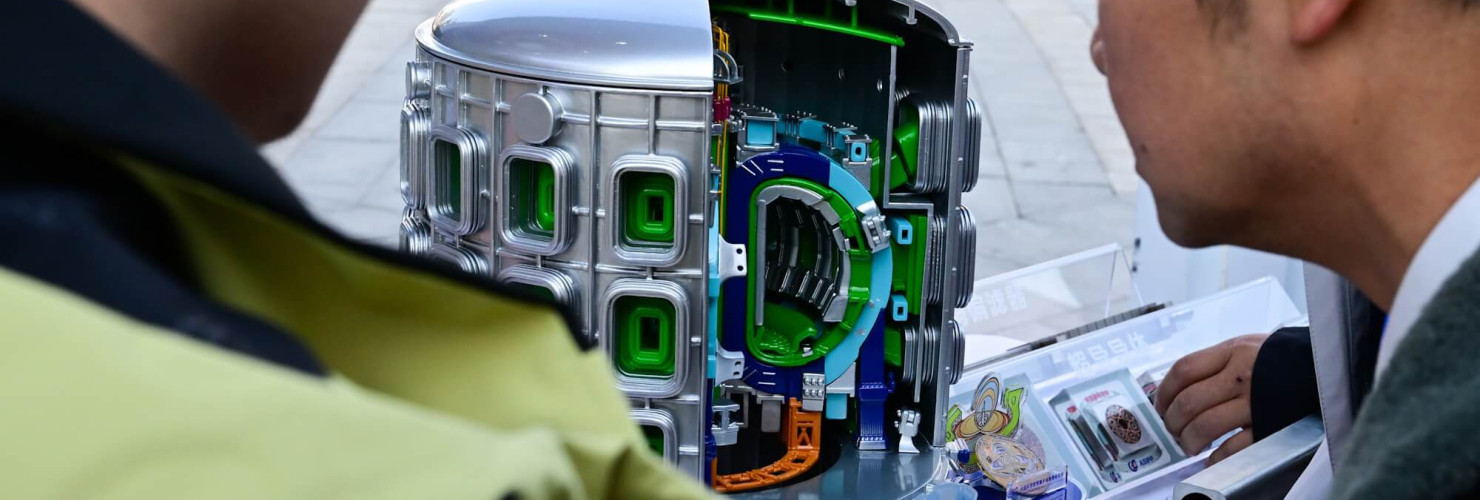
This year, roughly half of the project categories on the NSFC’s list fit this aspiration. For example, one focuses on using generative AI to automate the design of complex fusion reactors. Another one seeks to build a design platform for biological components tolerant to extreme environments to solve pain points in biomanufacturing. The name of this sub-program – “explainable and general-purpose next-generation AI methods” (可解释、可通用的下一代人工智能) – suggests a link with the next-generation AI megaproject. Sixteen S&T megaprojects geared toward 2030 were announced in 2017, but their implementation has been secretive.
While the NSFC’s funding for this may appear small (ranging between EUR 240,000 and EUR 600,000 per project), new projects are funded each year. More importantly, this is part of a systematic and long-term effort to promote AI for science. Frontier research labs across China have been building large models and compute clusters to support scientific research. Chinese scientists have been developing AI models that can control plasma during nuclear fusion, map the universe, and autonomously intuit physics principles. The NSFC’s “Major Research Program” (重大研究规划), under which this specific sub-program falls, is only one of many funding schemes and initiatives that support cutting-edge research in strategic fields.
Rebecca Arcesati, Lead Analyst, MERICS: “The scale and speed of China’s efforts to speed up scientific discovery through AI technology would be unthinkable in Europe. This is a close race between China and the United States, and one where China is rushing ahead by several metrics. This is due to consistent investment in research, talent cultivation, and large-scale infrastructures.”
Autor(en)
Ko-Programmleiterin
Autor(en)
Ko-Programmleiterin

Topics