
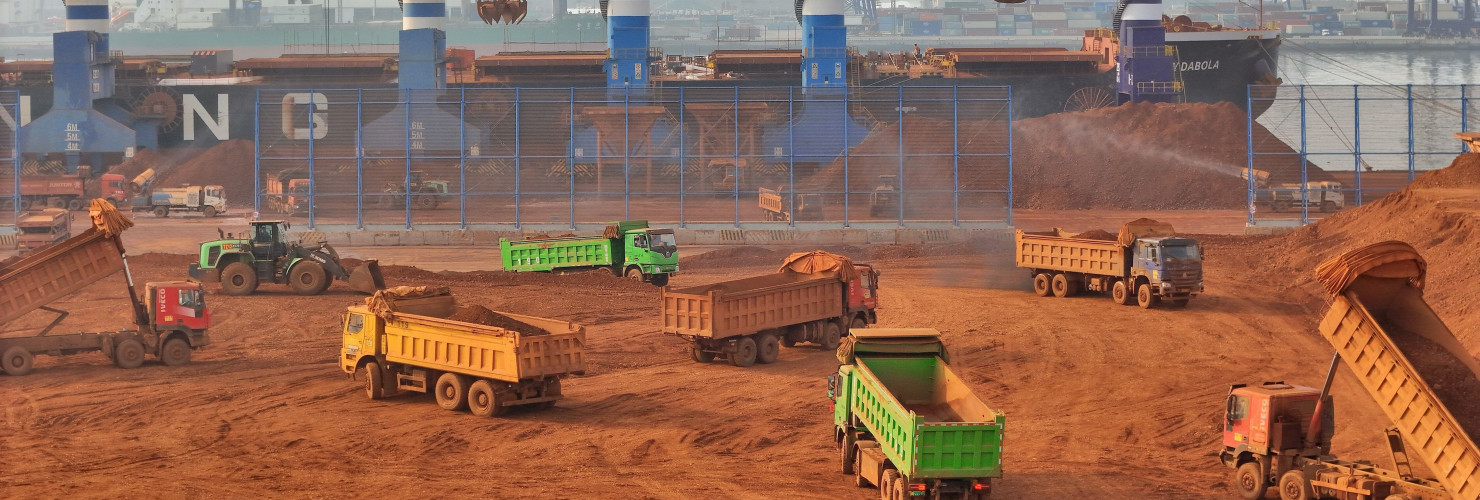
picture alliance / Photoshot
Inhalt
Studie
China's economic security offensive: How the PRC pursues dominance in industry, trade and technology
Key findings
- China’s government sees leadership and control across industries and value chains as a prerequisite for national security. Industrial and innovation policy are designed to secure the path to the CCP’s vision of self-reliant modernization.
- The PRC strives to secure maximum space for its development interests abroad. Domestic economic challenges and persistent reliance on foreign markets and technology underpin Beijing’s drive to secure access to markets, goods, and know-how for its continued economic and technological rise.
- Regulations released in mid-2026 reflect a major shift in the scope and application of economic security policies in China. They are part of a broader strategy to sanction-proof China’s economy, maintain access to foreign markets and inputs, and prevent unwanted outflows of technology and know-how.
- China’s economic security toolbox has expanded under Xi Jinping. Efforts to pro-mote indigenous industries and technologies, protect the domestic market and innovation system, and pursue diverse partnerships abroad sit alongside a recent push to deter and punish countries or firms that infringe on China’s interests.
- China’s leadership is going on the offensive. It combines legal and extralegal measures and uses economic coercion to defend political red lines. This asymmetric, hybrid approach creates unpredictability and strengthens deterrence.
- The party state is ramping up institutional capacity through new horizontal and vertical risk monitoring and response mechanisms. Investigative and punitive pow-ers and personnel are expanding, marking a shift from ad-hoc to routinized defense of economic security interests.
- Beijing has built significant leverage and knowledge of foreign dependencies. Not all threats are credible, but the willingness to act – by imposing penalties and restrictions and leveraging dependencies – rises as China builds up enforcement capacity and sees the geopolitical opportunity to play a hard hand.
- Despite offers of cooperation and “high-level opening-up”, China only seeks limited economic partnerships. It is doing its utmost to avoid dependencies and the loss of technology or manufacturing capacity, while its economic policies and resulting overcapacities clash with the industrial ambitions of many countries across the world.
- Europe must make hard choices. Beijing is trying to derail European derisking efforts. Inaction may prevent retaliation in the short term, but it will increase vulnerability in the long term. China’s industrial model warps the EU’s market integrity, displaces European firms in third markets, and drives deindustrialization.
- Europe must also ensure it can muster the political will to credibly fight back. In addition to putting minimum protection measures in place and working with partners, the EU needs credible deterrence, a communication strategy for the public and negotiations with Beijing on a stable corridor of cooperation.
China moves onto the offensive in economic security policy
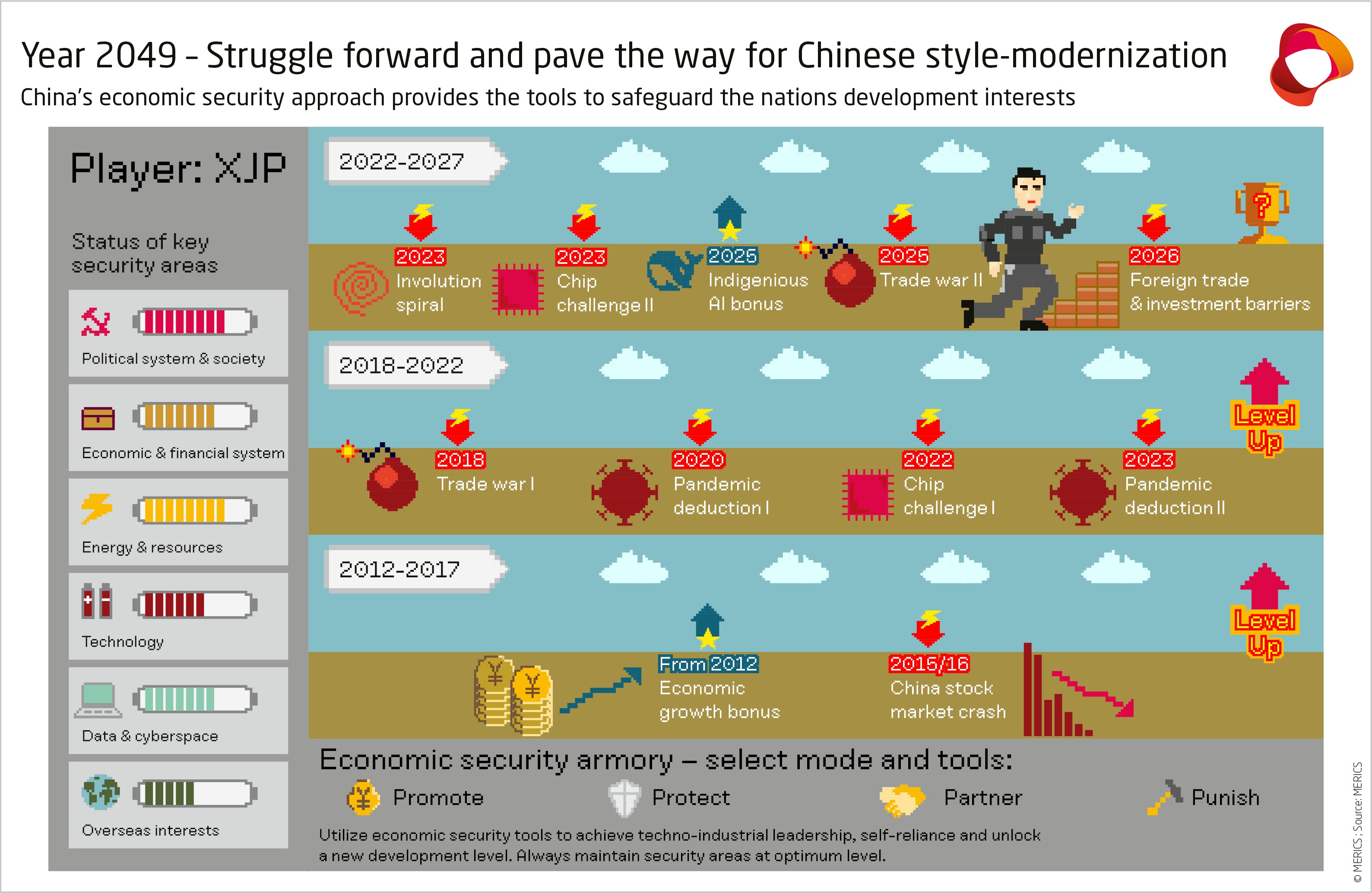
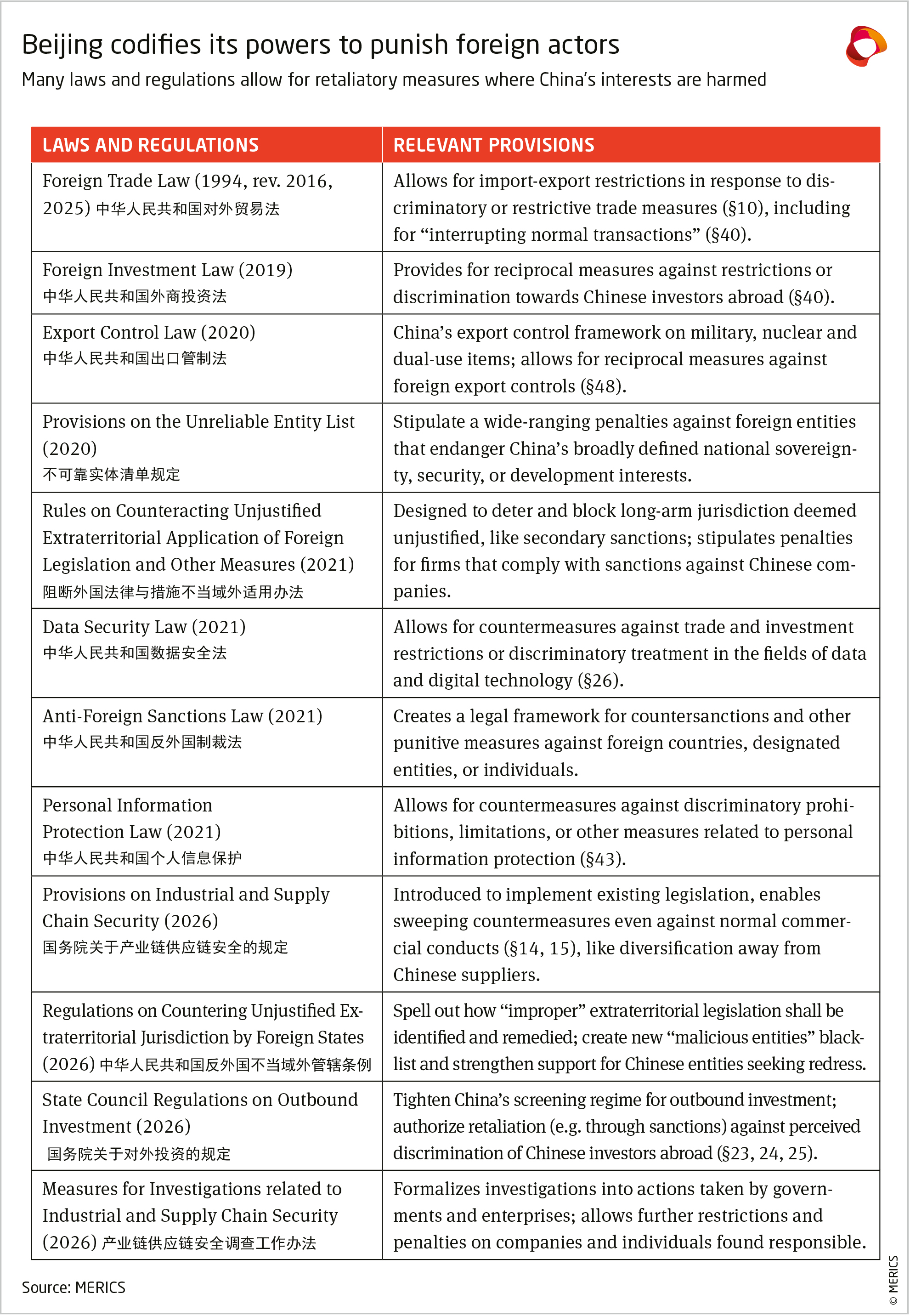
In mid-2026, Beijing issued a slew of new regulations designed to counter foreign sanctions and restrictions, deter foreign governments and companies from derisking and due diligence efforts, and prevent unwanted outflows of technology, know-how, and talent (see exhibit 1).1 Further steps to block and counter financial sanctions were set in motion.2
The measures are part of China’s growing armory for defending its economic security interests and offer a host of new options for targeting and punishing foreign counterparts. They allow for broad interpretation while also permitting selective compliance with other jurisdictions. This gives China’s authorities substantial wiggle room in applying measures, ranging from managed cooperation to escalation.
The new regulations reflect a deeper shift in how China’s leadership defines and pursues its economic security interests. Over the past years, Beijing has leveraged dependencies on the PRC for processed rare earth elements (REEs) and other critical raw materials (CRMs) to assert its interests across numerous global supply and value chains. This tough show of economic power was at full display in the US-China trade row.
However, China’s coercive economic statecraft is increasingly hitting Europe, too – a trend that may accelerate as Beijing views existing and possible new EU measures as a compounded threat to its interests. These include, for example, the draft Industrial Accelerator Act, the proposal for a revised Cybersecurity Act, the Foreign Subsidies Regulation, public procurement instruments and a new forced labor ban.3
This new stage in the PRC’s quest for economic and national security brings unprecedented risks for international stakeholders. Beijing has embraced an extraordinarily expansive national security doctrine under Chinese Communist Party (CCP) and state leader Xi Jinping. The party has reestablished leadership over the economy and pursues an ambitious industrial and innovation policy to achieve self-reliance and leadership across domains.
The 15th Five-Year Plan (2026-2030, FYP) further reinforces China’s economic security strategy: it seeks short- to medium-term resilience against trade and technology wars and economic and technological dominance in the long run.4 Maintaining and even increasing foreign dependencies on China while preventing the loss of China’s own competitive edge fit this logic.
As the PRC’s pursuit of technological dominance conflicts with other nations’ efforts to protect their markets and industrial bases, friction is growing. China’s leadership is preparing to strike back against restrictions and containment efforts. The growing list of foreign-facing rules is designed for hands-on application. Recent cases involving companies like Nuctech, Nexperia and Manus AI show how swiftly they can be wielded.5
To navigate the path forward, policymakers, business leaders and other stakeholders in Europe and elsewhere need to understand the scale, political reasoning and distinctive aspects of China’s economic security approach, as well as how it might be implemented. Companies, in particular, are being squeezed between conflicting security regimes and should pay close attention to the shifting political and regulatory environment.
Economic security is front and center in China's modernization and global leadership quest
Economic security is understood as the ability to protect and sustain national economic stability and growth by building resilience against external and internal threats.6 The term has been adopted by party leaders since the 1990s and has been discussed by Chinese experts over decades.
Throughout the reform period, China’s leaders remained deeply fearful of financial and market liberalization potentially causing crises the government cannot control and with foreign dependencies being weaponized. Since the 2008 global economic crisis, the party has backtracked on market reforms and returned as the central economic actor.
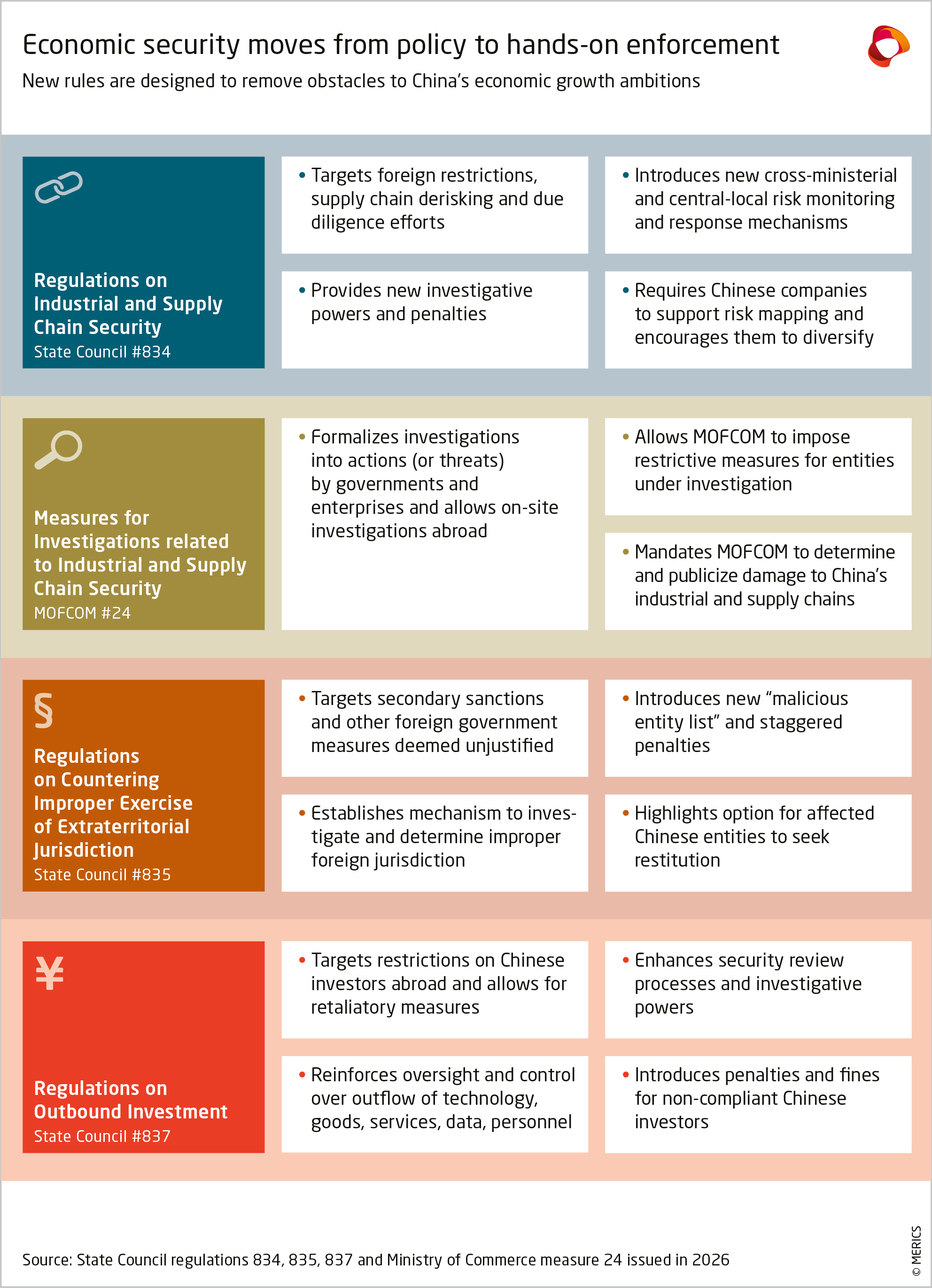
Xi Jinping has turned national security into a key paradigm that permeates all aspects of policymaking, with economic security described as the ‘basis’ (基础).7 Since the introduction of the Comprehensive National Security concept in 2014, the priority areas included in this doctrine have doubled from ten to twenty, with many areas relating to the broader economic and technology cluster.8
Beijing’s understanding of economic security is expansive – and closely integrated with technology and data security
In China, economic security is conceived in broad terms, covering not just material supplies or strategic stockpiles, but also access to markets, technology, and scientific and engineering know-how. Today, it has been elevated to an organizing principle of economic policy, and Beijing is taking steps to prepare for any eventual escalation of conflict, whether economic or military in nature.
During Xi’s first term from 2013, China faced a comparatively predictable and stable international environment. The revival of the national security-state was driven by the will to reestablish party control over society and economic actors, with industrial and trade policies focusing on efforts such as Made in China and the Belt and Road Initiative. In 2018 and 2019, human rights sanctions over Xinjiang, the US-China trade war and US government restrictions on Huawei and ZTE accelerated a wider push towards inner resilience.
Between 2020-2023, the Covid-19 pandemic kicked off major new efforts at managing supply chain security and vulnerabilities, supported by substantial private investment towards building entire production and value chains in China. It also left the economy in a bind, compounding fierce competition and shrinking profit margins, a phenomenon often referred to as ‘involution’ (内卷). Economic security has since taken center stage, with lessons learned from G7-led sanctions on Russia, US-led export controls targeting critical technologies such as advanced semiconductors and the US-China trade war triggering a host of new security-related legislation.
Since 2016, economic security has had a dedicated section in successive Five-Year Plans and has appeared prominently across party documents and policies.9 It encompasses the following core areas:
- Industrial and supply chain security, i.e. safeguarding China’s production and innovation capabilities and access to raw materials, components and technologies;
- Financial security, i.e. preventing systemic risks, such as banking crises and severe capital market volatility, and risks from cross-border financial flows;
- Energy and resource security, i.e. ensuring sufficient supply and reserves of coal, oil, gas and critical minerals to meet industrial and household needs;
- Food security, i.e. guaranteeing stable national grain production and maintaining reserve systems to meet the basic living needs of the population.10
However, economic security is best understood as an overarching term and integral part of a cluster of security interests, whose composition and priorities change in response to domestic and international developments. This includes scientific and technological security – a priority area since 2014 that has grown significantly in importance. “Never before have science and technology influenced the future and destiny of our nation so profoundly,” according to Xi,11 who views strategic technologies as a route to both national security and competitiveness.
Technological security mainly covers the effectiveness of the science, technology and innovation system and the development of ‘key and core technologies’ (关键核心科技) which “must not be controlled by others”.12 China’s development still depends on access to foreign technology, such as semiconductor manufacturing equipment, a crucial resource in the ongoing competition in the field of AI. Beijing therefore seeks to close these chokepoints and sanction-proof its innovation system, while strengthening efforts to protect technology and know-how where it has gained the edge.
Cyber and data security are interlinked with economic and technological security. Data, information and intellectual property (IP) are treated as strategic resources needing to be protected and kept in China.13 At the same time, the CCP seeks to protect China’s information space from unwanted foreign information and insights into domestic affairs, including information about its economic and technological development.14
Xi has often warned that mishandling economic security may jeopardize political and societal security, as weak growth may compromise public support for the party.15 Domestically, China is not only still recovering from the Covid-induced economic slowdown but also navigating multiple challenges. Basic industrialization in remote areas and traditional industries happens alongside a profound industrial transformation and new digital revolution, with automation and AI impacting the labor market and incomes. A continued real estate slump, local fiscal challenges and low domestic demand mean China remains highly dependent on foreign markets to drive domestic growth.
China’s security interests therefore have a strong international dimension. Overseas security interests not only entail the safety of Chinese citizens and companies, but also the need to ensure that the PRC can access what it needs for its continued development: technology, know-how, resources, and markets. New security categories – maritime, deep sea, polar, and space – intersect with economic security, insofar as they relate to access to resources and opportunities for commercial exploration.
China’s current policy initiatives and especially the new FYP capture the party state’s quest for long-term resilience to hedge against geoeconomic risks.16 The plan seeks to remedy vulnerabilities and strengthen resilience against internal and external shocks, while outlining an ambitious socioeconomic transformation whereby China is to achieve global leadership across economic and technological domains.
The new Five-Year Plan reflects China’s quest for resilience
Key priorities and policy arenas outlined in the plan:
- Secure access to critical supplies of energy, food, and other inputs and internalize strategic value chains.
- Promote and protect strategic sectors, safeguard the manufacturing base and maintain an appropriate share of manufacturing in China's GDP mix.
- Support domestic demand as a growth pillar to hedge against global risks.
- Support China’s green transformation as a growth catalyst, to counter resource constraints and as a domain of international trade and cooperation.
- Promote digitization, automation and AI adoption to boost productivity and efficiency, develop new sectors and mitigate the effects of demographic change.
- Pursue self-reliance and sovereignty of the innovation ecosystem, including through “extraordinary measures” to achieve technological breakthroughs.
- Expand global markets for China’s goods and promote global trade order reform, with China as a key player and standard setter.
- Expand and improve China’s national security system to address all relevant security concerns in times of growing friction.
Xi's modernization vision entails the conviction that security comes from being ahead
China’s pursuit of economic security is part of a broader geopolitical vision. On arriving in power Xi set the goal of achieving China’s all-round modernization and rejuvenation by 2049, the 100-year anniversary of the PRC.17 For CCP leaders, ‘Chinese-style modernization’ (中国式现代化) means not merely catching up but staying ahead of the curve and “seizing the opportunity” to lead future waves of technological and industrial transformation, including by positioning China as a science and technology leader by 2035.18
As Xi sees it, the CCP must steer through a domestic industrial transformation and fortify China’s economy to withstand geopolitical headwinds. “Xi Jinping’s Economic Thought”19 emphasizes moving towards resilient, self-reliant development, expressed in the concept of ‘dual circulation’ (双循环).20 Strong internal circulation, from boosting domestic value creation and demand, is supposed to lessen China’s dependence on exports to meet Beijing's growth targets. Simultaneously, China should better manage external circulation and engage in trade as a high-value and technology exporter that shapes global value chains and networks.
The government strives to make Chinese goods and technologies indispensable across industries and supply chains as a matter of security. Foreign actors should remain dependent on China for their “production chains,” providing the PRC with both growth opportunities and geopolitical leverage.21 It increasingly views derisking efforts by other governments as encroaching on China’s legitimate rights.
While references to the trifecta of “national sovereignty, security and development interests” date back to the early 2010’s, they now regularly populate speeches, policy plans, and legislation. Over the past two years, Xi has repeatedly listed China's ‘development interests’ (发展利益) among its red lines in meetings with U.S. and other nation’s leaders – one it is increasingly willing to defend with a hard hand.22
The monitoring and enforcement apparatus for economic security is growing
The PRC’s governance logic demands that economic actors see themselves within a “wholeof-nation” effort to achieve strategic objectives. “On the new journey of Chinese modernization, everyone is a key actor”, as Xi put it.23 Through a mix of discipline and incentives, the CCP has re-inserted itself into the private sector and intensified control to ensure all market actors – domestic and foreign – align with national goals.24
Party discourse emphasizes the identification and prevention of risks, with Xi regularly calling upon cadres to prepare for potentially ‘extreme situations’ (极端情况).25 Cadres should not just pay attention to local economic benefits from a particular industry; they should consider the security of the entire value chain and enhance its independence and controllability.26
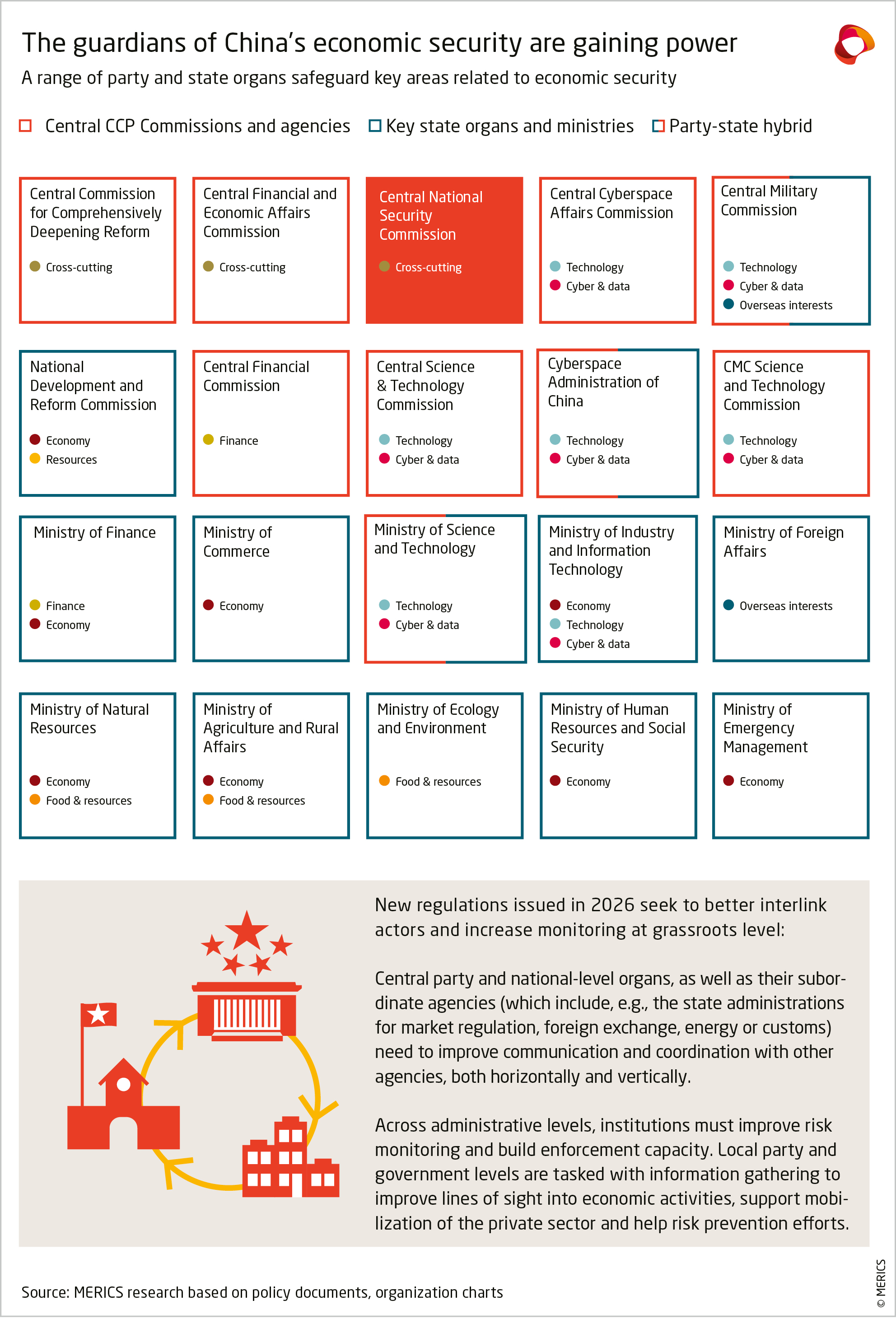
All this requires top-level steering. Responsibilities for economic, technological and other core security areas have grown over the past decades and are dispersed through multiple party and state entities (see exhibit 2). Many of the institutional guardians of China’s economic and technological security are important interlocutors for foreign stakeholders. Now, a new push for both expansion of competencies and streamlining of administrative processes is underway.
For example, 2025 saw the creation of a multi-agency process to enforce strategic mineral export restrictions in the spirit of ‘full-chain control’ (全链条管控), involving the Ministry of Commerce (MOFCOM), Ministry of Industry and Information Technology (MIIT), customs, and the intelligence services, along with other agencies.27
The 15th FYP and the batch of State Council regulations released in 2026 mandate the creation of new horizonal and vertical structures across ministries and departments as well as across all administrative levels to build new risk monitoring, reporting and response mechanisms. These are meant to promote information sharing and provide new lines of sight, from central to local, to better identify not only China’s vulnerabilities and chokepoints but also foreign ones. The new rules also strengthen investigative and punitive powers, with agencies such as MOFCOM swiftly following up with implementation measures.28
To power China’s economic intelligence efforts, reporting requirements for Chinese and international firms are growing. Export licensing regimes, for instance, already require foreign companies to submit detailed supply chain information that their home governments do not always have access to.29
This growing bureaucracy of national and economic security has serious implications for foreign stakeholders. For many officials in functional departments, tasks, resources and careers now revolve around spotting risks and addressing them – ideally before they materialize. They are equipped with new rules and powers ready to be wielded in a routinized rather than ad-hoc fashion. In a political system driven by performance and loyalty signaling to avoid disciplinary purges, this likely means more action – and a heightened risk of overreaction. Foreign governments and companies can expect more investigations, restrictions and penalties in the coming years.
A concerted effort is underway to mobilize Chinese companies and industry associations in defending the PRC’s economic security interests. They are encouraged to share information, trigger investigations and seek financial restitution in cases where they see their interests harmed.30
China is forcefully wielding its economic security armory
China’s economic security toolkit has steadily expanded through the creation of legal authorities, institutional structures, and mechanisms. Its priorities can be clustered into four groups, though in practice some instruments fall into multiple categories (see exhibit 3). For the first three categories (“Promote”, “Protect”, “Partner”) we use the same nomenclature as the EU, to afford readers comparability. However, China pursues its economic security objectives on a scale and with an intensity that far surpass the EU’s narrower approach.
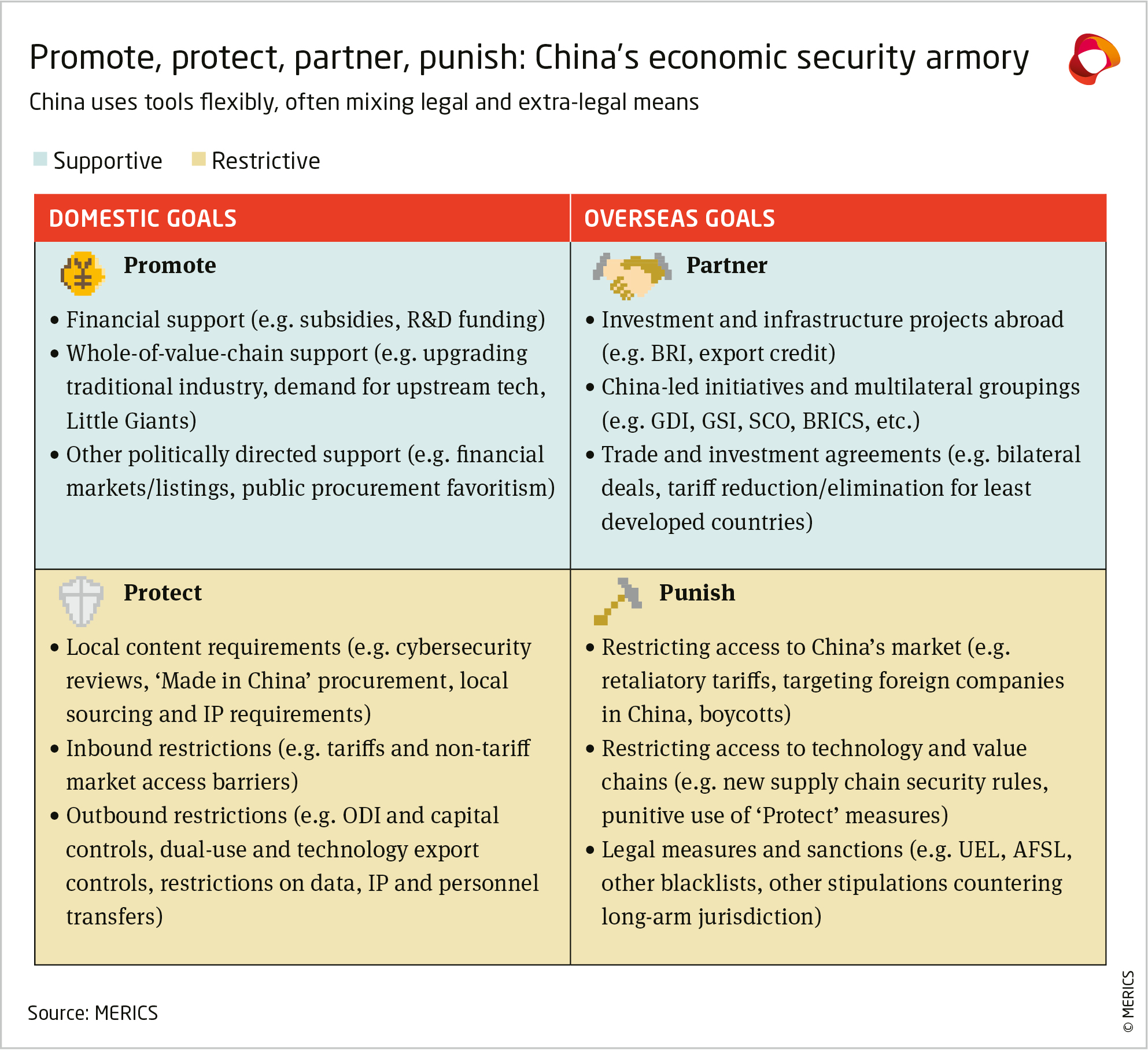
- “Promote” – develop foundational technologies to break other countries’ chokeholds over China, while seizing the commanding heights in emerging and future technologies.
- “Protect” – preserve China’s leading edge where it has it, whether in advanced technology or at the lower end of the manufacturing base.
- “Partner” – engage with other countries to ensure access to key commodities and materials or export markets.
- “Punish” – struggle against adversarial countries that infringe on China’s economic security interests, using deterrence or retaliation.
In safeguarding its interests across economic, technological and data security, Beijing has shifted from a self-strengthening rationale towards defensive tools and, most recently, offensive measures and economic statecraft. Old and new laws and regulations sit alongside the continued use of (gray-zone) political and economic pressure tactics. China’s tools are not used in discrete ways, to achieve only specific results: they tend to be ‘mixed and matched’ to equip the country’s grand strategy for economic security.
Promote: China must take the leading edge everywhere
Rising up the value chain and making technological breakthroughs are central to Beijing’s economic security doctrine. Technological catch-up liberates China from chokeholds other governments might exploit to stall its progress. However, taking the lead in more advanced technologies allows China to credibly threaten to weaponize its own chokepoints. ‘Promote’ measures therefore support multiple goals at once.
Firstly, the FYP stresses catching up and self-reliance in ‘key and core technologies’ such as semiconductors, machine tools and instrumentation equipment. Such weaknesses in the national innovation system are often referred to as ‘deficits to be compensated’ (also translated as ‘short boards,’ 短板), or ‘chokeholds’ (掐脖子).31
China’s playbook is clear: systematically map out technical supply chain vulnerabilities,32 demand that actors from research organizations to industry associations provide input into priority lists and catalogues,33 then mobilize sectoral and local authorities around import substitution. Import substitution strategies encompass research funding schemes (e.g., National Key R&D Projects) and industry support (e.g., through programs like Little Giants that foster innovators), with a focus on linking together different industries and along the entire chain.34
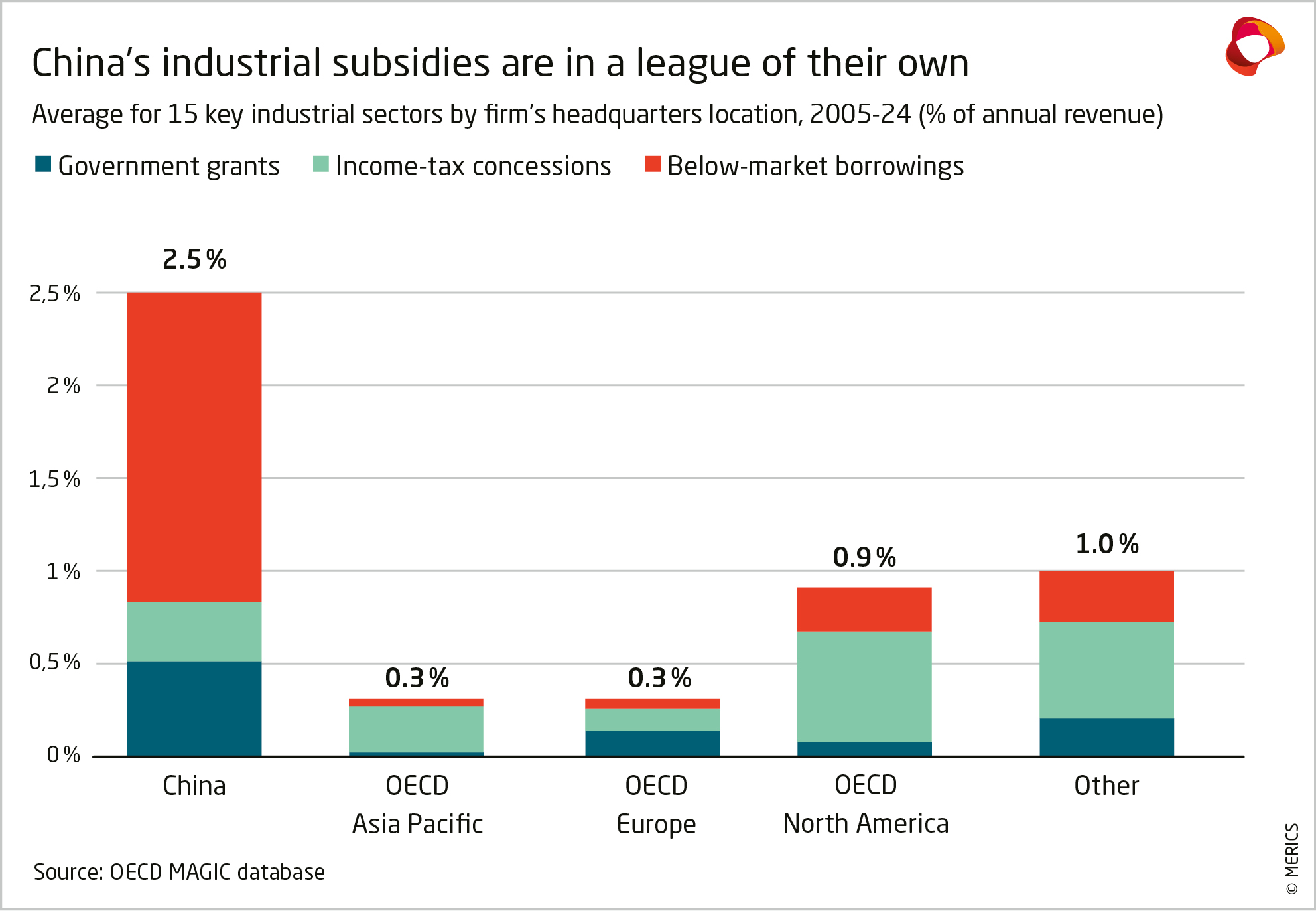
Secondly, the latest Five-Year Plan cements the concept of ‘new quality productive forces’ (新质生产力), which is party-speak for technologies and industries with multiplier effects.35 For example, ‘embodied’ AI, advanced manufacturing and clean energy technology can boost output, efficiency, and quality.36 From Beijing’s perspective, the double benefit of such growth and innovation engines is that they help Chinese firms ascend global value chains, while also helping lower-end industries upgrade. Officials have considerable policy space to use the ‘Promote’ toolkit to unlock the economic potential of new productive forces (see exhibit 4).
Thirdly, cadres are instructed to set their eyes on breakthroughs in frontier technologies too, like quantum computers and brain-inspired science. There is some overlap with the new quality productive forces, but the focus here is on the most cutting-edge, experimental R&D. By mastering future technologies, China would obtain a “trump card” (杀手锏, literally ‘assassin’s mace’) advantage it can leverage against foreign countries.37
As these technological and industrial ambitions continue to absorb large amounts of resources, official pledges to “expand domestic demand” (扩大内需) are less about household incomes than supporting demand upstream.38 Simply put, CCP planners want households to afford EVs, but the bigger goal is to support China’s EV makers who stimulate demand for upstream technologies – batteries, chips, machinery, sensors, and more. At the same time, traditional industries like steel or tire makers also need EV sales revenues to fund their technological upgrading.39 This whole-of-value-chain approach demonstrates the comprehensive nature of the PRC economic security strategy.
Protect: the entire industrial chain must stay in China
Once China has conquered industrial value chains, it must maintain its hard-fought advantages. To avoid the fate of market economies like the United States where offshoring drove deindustrialization, Xi wants China to “maintain an appropriate share of manufacturing” (保持制造业合理比重), measured as a share of GDP.40 Lower value-added manufacturing firms should not chase cheaper wages overseas but be upgraded through new productive forces.41 This is bad for return on investment but supports national goals by maintaining employment and building resilience.42
Moreover, the country is to preserve an asymmetric advantage in global technology and industrial production for resilience, deterrence, and geopolitical leverage. Export controls, generally used by advanced economies to address narrowly defined national security and foreign policy concerns, are instead treated as tools to nurture and protect China’s indigenous innovation.43 They now extend from critical minerals to personnel, for example, AI engineers.44
The amended Foreign Trade Law, which came into force in March 2026, allows for export restrictions that can help “establish or accelerate the establishment of a specific domestic industry,”45 codifying existing practice. To close a loophole in technology and IP transfer controls, Beijing has also tightened screening of outbound investments through regulations taking effect on July 1, 2026.46
Two examples – battery electric vehicles and rare earth processing – showcase Beijing’s use of export controls to defend its value-chain dominance. In the first instance, it restricted exports of certain types of dual-use graphite (critical for battery production) and civilian technology and IP crucial for high-end lithium-ion batteries.47 As to the rare earth industry, magnet exports, outflows of relevant refining and processing equipment, and even the movement of any Chinese persons who work in the sector are closely managed.48
Partner: No allies wanted, but transactional partners desired
Economic security concerns guide China’s foreign economic policy, which puts a premium on diversification. China remains heavily dependent on imports of commodities and raw materials, and relies on exports to drive growth, so rising trade frictions cannot be allowed to jeopardize its export markets. China utilizes many tools to foster beneficial economic relationships. At the same time, it carefully avoids overreliance on any single partner.
The Belt and Road Initiative (BRI) is the most obvious example. Many BRI-financed projects have a clear economic security rationale, creating infrastructure to facilitate trade, usually with resources going one way and China-made manufactures the other.49 Beyond that, China’s one-stop shop approach to projects – power plants, electrical grids, ports and railways – has an appealing simplicity. Beijing brings a financing model, a consortium of service providers and equipment makers and the diplomatic heft to make things happen quickly.50
China often mandates overseas investment by state-owned enterprises (SOEs) to secure supplies of key commodities. For example, COFCO, China’s main food trader, has a large footprint in South America to facilitate exports of soybeans.51 These ties now empower China to hit US soybean exports. Another example, CNPC, one of China’s main oil and gas SOEs, invests in drilling, pipelines and crude terminals globally to secure China’s access to oil and gas.52
These firms do not need to be profitable as their government stakeholder favors strategic goals over commercial interests. Unlike their free-market counterparts, the primary orientation of state-run enterprises like COFCO, CNPC, COSCO or China Merchants Group, is to send resources to China, rather than to the highest-paying buyer.
Bilaterally, China signs imperfect trade and investment agreements that are good enough for both sides to conclude quickly.53 Regionally, it secures its economic interests through initiatives like dropping all tariffs for almost all African countries. Agreements like the Regional Comprehensive Economic Partnership, a trade bloc which includes 15 countries in east and southeast Asia which account for roughly 30 percent of global GDP, help China to lock in regional supply chains and protect its interests.54
These efforts serve to diversify growth opportunities away from industrialized markets like the US and Europe, even though the PRC also seeks to maintain access to rich markets and advanced technologies wherever possible. At the same time, China is careful not to be overly dependent on even its closest strategic partners, like Russia. This approach has clearly paid off in terms of energy security: China largely escaped the supply shock during the recent Iran war, while retaining its ability to set the terms of its fossil fuel imports from Russia.55
Punish: China moves from tit-for-tat retaliation to economic statecraft
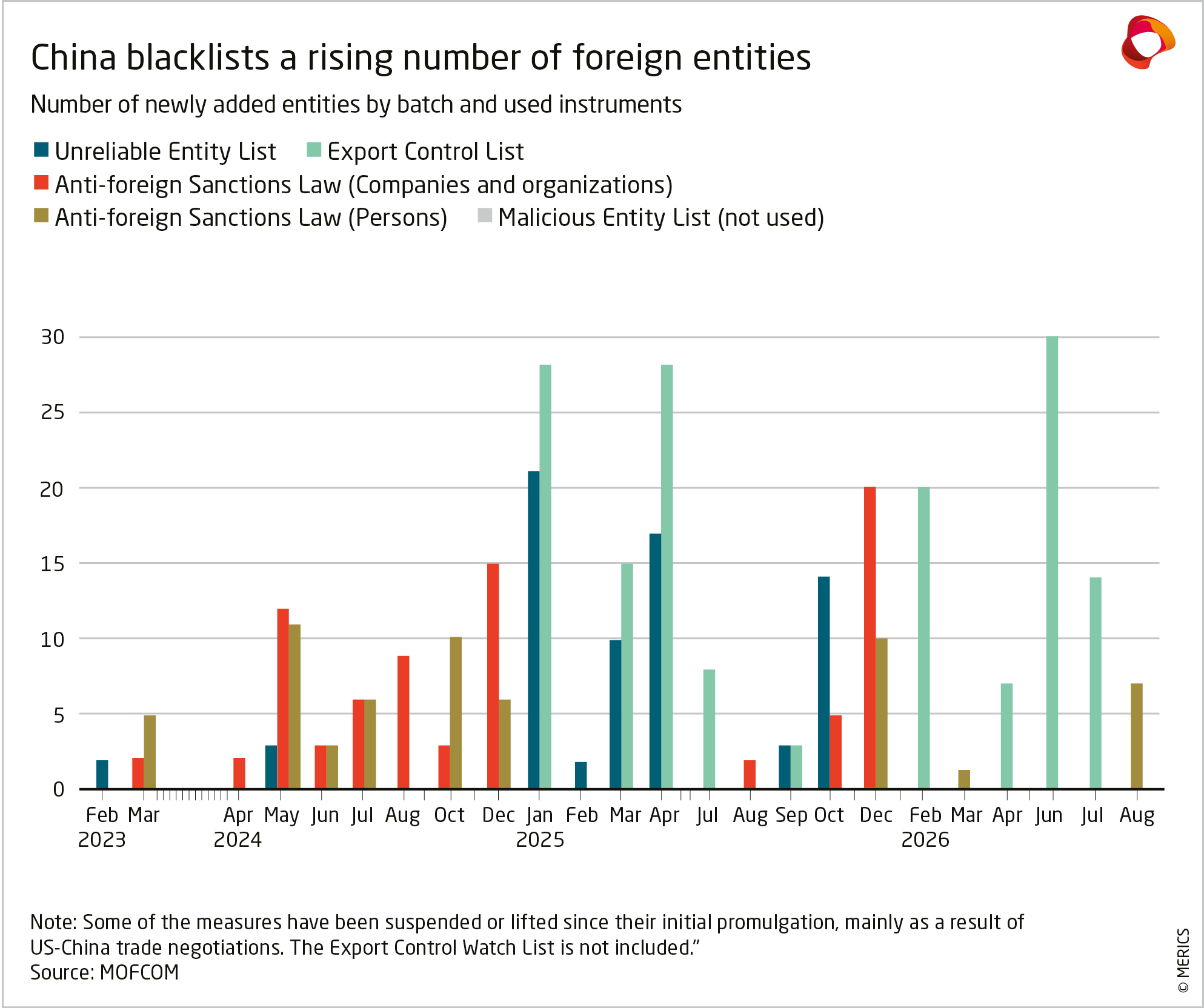
To shape globalization around the CCP’s interests, China must confront the proliferation of export controls, sanctions, and de-risking measures from foreign governments. As well as sharpening existing instruments, it has introduced new ones. Laws and regulations specify a growing list of punitive and retaliatory measures where China’s interests are harmed (see overview in annex). They are designed to counter two parallel trends: restrictions on China’s access to critical inputs (e.g., semiconductor technology) and an emerging reconfiguration of global supply chains to lessen dependencies on China. Beijing’s response combines punitive measures, coercive tactics and lawfare, sometimes mirroring US economic statecraft.
Beijing’s initially measured posture towards Washington’s containment efforts targeted a handful of entities and items but has since widened in scope and scale. The first shots came between 2023 and 2024, with stringent licensing requirements for exports of gallium, germanium, and other minerals.56 Several others followed in 2025, including some rare earth elements.57 After trade negotiations, outright bans on the exports of some of these CRMs to the United States, along with sweeping new restrictions Beijing had imposed on October 9, was postponed till November 2026.
Meanwhile, Chinese and foreign companies alike face growing pressure not to comply with US controls and sanctions, including measures with extraterritorial reach. Regulations in force since April 2026 further cement the institutional set-up to monitor and counter foreign measures deemed “improper” – even including EU investigations into subsidized Chinese firms.58
Foreign companies can also expect consequences if they obstruct China’s progress towards ‘secure and controllable’ (安全可控) industrial and supply chains (see exhibit 5). Here, ‘Protect’ tools like export controls can be applied to derail decoupling, or derisking: for example, companies creating alternative manufacturing or R&D capacity in countries like India may find their plans contingent upon their ability to obtain or move certain assets from inside China.59 This ‘anti-derisking’ logic was spelled out in the new provisions on industrial and supply chain security, which stipulate penalties for actions as vague as “disrupting transactions with Chinese organizations or individuals.”60
Despite the growing legal toolkit, the PRC pursues a hybrid approach of legal and extralegal tools, including political pressure, indirect threats relayed through Chinese partners and suppliers or encouragement of public boycotts, e.g., when companies attempted to exclude Xinjiang cotton from their supply chains.61 Notably, China also imposes economic costs for political reasons, too, with Japan experiencing sustained economic pressure over Japanese Prime Minister Sanae Takaichi’s remarks on Taiwan’s security.62
Beijing's rigorous economic security agenda inflicts pain even without punishment
In many respects, China’s strategy has borne fruit. It has managed to maintain a formidable manufacturing base, dominate technology supply chains like renewable energy, diversified its export markets and energy sources, and stood up to the Trump administration’s tariffs.
But structural imbalances and lack of domestic demand have also fueled overcapacities and continued reliance on foreign markets and technologies. In 2025, nearly a third of China’s economic growth was from exports, without which the country could not meet its GDP targets in the short, medium, or long term.63 In many technologies, from lithography machines to machining tools and metrology instruments, China remains relatively far behind the frontier.
Catching up will cost time and money – at the expense of other priorities. As fierce domestic competition throttles profits and fiscal space become tighter, the party state may be unable to subsidize investment and R&D at current levels. Even though China has gained significant strength, self-reliance remains an elusive goal, and Beijing is getting ready to safeguard China’s economic security interests abroad more fiercely.
China’s punishment doctrine and willingness to use it are expanding
Beijing has a history of utilizing different punishment measures when its economic interests were hit or political red lines were crossed.64 These measures can generally be grouped into four categories: non-credible threats, limited coercion, tit-for-tat responses, and escalation. This typology helps understand the range of Beijing’s potential choices, even if the rationale for choosing specific levels and types of punishment is changing as the drivers of retaliatory action are increasing.
Firstly, the CCP’s definition of its economic, technological and other security interests has expanded significantly, so a wider range of foreign conducts may trigger a reaction. Beijing has always been willing to roll out assertive punitive measures over certain geopolitical red lines, as seen during the Senkaku Island dispute with Japan in the 2010s. But the past ten years have also seen a rapid expansion of political red lines, especially on human rights and over Taiwan, all of which can trigger economic coercion.
Secondly, China’s ability to punish others has grown over the last decade, both in terms of the institutional and administrative capacity to do so and because it has more points of leverage that it can utilize. Compared with the initial shots of the US-China trade war in 2018, China now has a more comprehensive economic security toolkit, with more personnel in place to enforce measures such as export controls.65 It also has a higher level of self-reliance to resist US pressure and controls more supply chain chokepoints, while Chinese firms have achieved leadership across several key technologies.
Thirdly, internal support for a harder stance on economic security issues is apparent. As every round of the US-China trade and technology wars have hit the PRC’s economy – compounded by the pandemic and efforts by other countries to derisk from China – there is greater political consensus in the CCP and broader administration and public that the US and its allies are attempting to contain China’s rise, and that the nation must struggle and ‘eat bitterness’ (吃苦) rather than compromise if it wants to move ahead.66
The shifting drivers of China’s punishment rationale make it difficult to perfectly gauge how and when it might climb the escalation ladder. But it is important to consider how Beijing views measures abroad – especially by multiple countries – as an aggregate threat rather than discrete and targeted measures addressing specific issues. For example, what the EU may view as targeted regulatory measures are likely regarded in Beijing as a potential ‘death by a thousand cuts’ for which it must deter and punish Europe.
Europe and others face the risk of massive deindustrialization
Even the non-punitive measures China pursues to promote and protect its economic development, open external markets through diversified partnerships, and gain market share carry huge implications. Rich, middle-income and poor countries alike all face a cascade of exports from China. Its trade surplus grew by 20 percent in 2025 to a shocking 1.2 trillion USD. China’s export value over export volume has stagnated in recent years (see exhibit 6), which is counterintuitive for an economy that is climbing up global value chains and reflects the scale of the country’s industrial overcapacity.67
As the Centre for European Reform and Council for Foreign relations underlined in their May 2026 report: The external shock is worsening, with China hitting an export record of 10 million cars a year in 2025 (which it was only expected to reach by the end of the decade) and China’s overall export volumes growing more than twice the pace of global trade.68
Industrialized countries face fierce competition from Chinese companies that can count on Beijing’s support when expanding into more markets. Rhodium Group and the US Chamber of Commerce explored this issue in a May 2026 report, noting that advanced economies face the risk of sustained erosion in manufacturing competitiveness, particularly in sectors such as automotive, machinery, and chemicals: “In aggregate, up to USD 650 billion—equivalent to around 12 percent of G7 manufacturing exports—could be directly exposed to Chinese market share gains by 2030.”69
But the challenges emanating from China’s policy approach are not limited to advanced economies. Among the countries and territories covered by China’s customs authorities, only about 20 percent have a trade surplus with China. Those that do are overwhelmingly commodity exporters like Brazil, Russia, Chile, Australia, and the DRC.70 Notable exceptions include South Korea and Taiwan, which owe their surpluses to semiconductor trade with China.
The PRC’s whole-of-value-chain strategy means it can saturate global markets. Middle-income countries like Brazil, Turkey, Mexico, and much of Southeast Asia are at risk of seeing their industrialization ambitions undercut by China’s export surge.71 Developing countries also find themselves in a difficult position. Although they may benefit from China’s demand for commodities and raw materials, their own efforts to industrialize are blocked by Chinese exports.72 China’s insistence on holding onto even the low end of value chains shrinks their developmental opportunities.
Europe needs bolder, faster responses to China's economic security push
For Europe and others, inaction is not an option. The short-term pain Beijing can inflict by waging punitive measures will arguably be dwarfed by the medium- and long-term cost of acquiescence. Europeans face widespread deindustrialization pressure and challenges to their market shares domestically and globally, as Chinese companies climb up the value chain and PRC measures to promote and protect its industries undermine competition.
If China comes to dominate more chokepoints, Europe’s dependencies on Chinese goods and technologies will increase, constraining future space for action. Even if the PRC’s strategy loses steam, its exports and protective actions can disrupt European competitiveness, security, and prosperity.
Options for European stakeholders
- Europe must prepare for heightened trade and political friction. Beijing is likely to leverage chokepoints to deter EU efforts at building alternative supply chains. EU member states must therefore build credible deterrence and prepare for acting against such moves. They also need to strengthen their capacity to assess the credibility of Beijing’s threats, including by gaming out possible escalation and deescalation ladders in the event of a potential economic conflict.
- Europe needs more flexible tools to manage the systemic effects of China’s economic model. Measures in the pipeline should be fast-tracked to give European leaders effective (however imperfect) instruments. Beyond ideas like an overcapacity instrument or proposed legislation such as the Industrial Accelerator Act, more agile trade defense instruments are needed. Rather than launching separate anti-subsidies investigations into every category of steel, for example, a preponderance of findings in this sector could allow for provisional tariffs being imposed on all steel imports from China.
- Europe must be ready to bring its own advantages to bear. The single market is critical for China’s exports. China also relies on European technology, such as machine tools, metrology equipment, the lithography value chain, and aerospace components. The Anti-Coercion Instrument is one tool that could unlock countermeasures which exploit EU market and technology advantages. But the credibility of this and other instruments is contingent upon capitals’ political will to activate them.
- Policy intervention is necessary to resolve the ‘first-mover disadvantage’ and incentivize firms to derisk. Resilience comes at the cost of efficiency and higher pricing. Any individual firm that adopts a derisking strategy will lose some level of competitiveness compared to firms that do not. Whether it be stockpiling of critical inputs or purchasing commitments for trusted supply chains, companies are unlikely to act first without policy measures that back them up. For strategic inputs, mandatory stockpiling, prohibition of single-country sourcing and robust offtake agreements could resolve this dilemma. The ability to coordinate and work with partners within and beyond the EU is a crucial asset.
- Information asymmetries must be addressed. China demands massive amounts of supply chain data before it grants export licenses. European companies oppose similar disclosures at home, yet they have complied in China. The EU’s Internal Market Emergency and Resilience Act should be complemented with more robust national provisions that compel or incentivize companies to safely disclose data on their exposure in high-risk third countries – including any information they have already shared with these countries’ governments.
- Policymakers in the EU and member states should seize the current window of opportunity to negotiate with China. Beijing’s expanding administrative apparatus is increasingly equipped with versatile instruments to defend its national interests. However, these laws and regulations also include off-ramps and potential exemptions, offering strategic flexibility in their enforcement. European officials should clearly communicate EU interests and demonstrate a collective resolve, while actively charting a cooperative path forward. For instance, structured political dialogue is a prerequisite for establishing enforceable conditions on high value Chinese investment in Europe.
- Europe needs public buy-in and political will to use its toolkit. Small and medium enterprises are hard hit by China’s broader economic strategy. Governments should step up outreach to private companies beyond the biggest players. Parliaments, too, have an important role to play in public communication to the private sector and society at large, to facilitate an open discussion of the hard choices between deindustrialization risks and intensified trade friction. Unions and workers councils should also get involved in public conversation, policy debates and, where applicable, boardrooms, to navigate the challenges ahead.
- Endnotes
1 | State Council of the People’s Republic of China (2026). “国务院关于产业链供应链安全的规定” (Provisions of the State Council on industrial and supply chain security). Beijing: State Council Order No. 834. March 31. https://www.gov.cn/zhengce/content/202604/content_7064837.htm?mc_cid=56d762dffc. Accessed: August 5, 2026; State Council of the People’s Republic of China (2026). “中华人民共和国反 外国不当域外管辖条例” (Regulations of the People’s Republic of China on countering improper extra-territorial jurisdiction by foreign states). Beijing: State Council Order No. 835. April 7. https://www.gov.cn/zhengce/content/202604/content_7065398.htm. Accessed: August 5, 2026; State Council of the People’s Republic of China (2026). “国务院关于对外投资的规定” (Provisions of the State Council on outbound investment). Beijing: State Council Order No. 837. May 5. https://www.mee.gov.cn/zcwj/gwywj/202606/t20260602_1157822.shtml. Accessed: August 5, 2026; Ministry of Commerce of the People’s Republic of China (2026). “产业链供应链安全调查工作办法” (Measures for industrial and supply chain security investigations). Beijing: MOFCOM Announcement No. 24 of 2026. June 22. https://www.mofcom.gov.cn/zwgk/zcfb/art/2026/art_6203fd463c704de1bd870597f24bbcb4.html. Accessed: August 5, 2026.
2 | Fan, Qianchan (2026). “China Advances Central Bank Law Revision to Counter Foreign Sanc-tions.” Caixin Global. June 24. https://www.caixinglobal.com/2026-06-24/china-advances-cen-tral-bank-law-revision-to-counter-foreign-sanctions-102456982.html. Accessed: August 10, 2026.
3 | Richter, Amelie, Zimmermann, Antonia and Köckritz, Angela (2026). “EU trade-defense instruments: Why Beijing is banking on German doubts.” Table.Briefings. June 8. https://table.media/en/china/talk-of-the-town/eu-trade-defense-instruments-why-beijing-is-banking-on-german-doubts . Accessed: Au-gust 5, 2026; Global Times (2026). “EU’s Industrial Accelerator Act risks ‘counterproductive outcomes’: China Chamber of Commerce to EU.” June 20. https://www.globaltimes.cn/page/202606/1363955.shtml. Accessed: August 5, 2026; Bermingham, Finbarr (2026). “China threatens EU firms over cyber-security plans targeting Chinese companies.” South China Morning Post. April 20. https://www.scmp.com/news/china/diplomacy/article/3350763/china-threatens-eu-firms-over-cybersecurity-plans-tar-geting-chinese-companies. Accessed: August 5, 2026.
4 | State Council of the People’s Republic of China (2026). 中华人民共和国国民经济和社会发展第十五个五年规划纲要 (Outline of the 15th Five-Year Plan for National Economic and Social Development of the Peo-ple’s Republic of China). Beijing: State Council. March. https://www.gov.cn/yaowen/liebiao/202603/content_7062633.htm Accessed: August 5, 2026.
5 | Legarda, Helena, Arcesati, Rebecca, Davey, Alexander, Gunter, Jacob, and Insisa, Aurelio (2026). “MERICS China Security and Risk Tracker 01/2026.” MERICS. June 18. https://merics.org/de/tracker/merics-china-security-and-risk-tracker-012026. Accessed: August 5, 2026; Bartsch, Bernhard and Wessling, Claudia (eds.) (2026). Fragmented Europe: Dealing with China as a Technology and Inno-vation Power. European Think-tank Network on China Report. Berlin: MERICS, June. https://merics.org/sites/default/files/2026-07/MERICS%2BETNC_Report_2026_WEB%20%281%29.pdf. Accessed: August 5, 2026; MERICS (2026). MERICS China Essentials 1/2026. Berlin: MERICS, January 22. https://merics.org/sites/default/files/2026-01/1%202026_MERICS%20China%20Essentials%20EN.pdf. Accessed: August 5, 2026.
6 | OECD (2025). Economic Security in a Changing World. New Approaches to Economic Challenges. Paris: OECD Publishing. September 11. https://doi.org/10.1787/4eac89c7-en. Accessed: August 5, 2026.
7 | Drinhausen, Katja and Legarda, Helena (2022). “Comprehensive National Security unleashed: How Xi’s approach shapes China’s policies at home and abroad.” Berlin: MERICS. September 15. https://merics.org/en/report/comprehensive-national-security-unleashed-how-xis-approach-shapes-chinas-poli-cies-home-and. Accessed: August 5, 2026; Quishi (2024). “国家安全,习近平总书记心中的‘头等大事’” (National security: The ‘top priority’ in General Secretary Xi Jinping’s mind). April 15. http://www.qstheory.cn/zhuanqu/2024-04/15/c_1130109410.htm. Accessed: August 5, 2026.
8 | Legarda, Helena, Arcesati, Rebecca, Drinhausen, Katja, Impiombato, Daria, and Gunter, Jacob (2025). “MERICS China Security and Risk Tracker 01/2025.” MERICS. June 18. https://merics.org/en/tracker/merics-china-security-and-risk-tracker-012025. Accessed: August 5, 2026.
9 | See e.g. sections in the 13th, 14th and the most recent 15th FYP released in 2026. National Develop-ment and Reform Commission (2026). “中华人民共和国国民经济和社会发展第十五个五年规划纲要” (15th Five-Year Plan on Economic and Social Development of the PRC). Beijing. https://www.ndrc.gov.cn/fggz/fzzlgh/gjfzgh/202603/U020260317369114704096.pdf. Accessed: August 5, 2026.
10 | National Development and Reform Commission (2021). “‘十四五’规划《纲要》解读文章之36|强化国家经济安全保障” (Interpretation of the 14th Five-Year Plan Outline, No. 36: Strengthening national econom-ic security guarantees). Beijing. December 25. https://www.ndrc.gov.cn/fggz/fzzlgh/gjfzgh/202112/t20211225_1309724.html. Accessed: August 5, 2026.
11 | Xi, Jinping 习近平 (2021). “努力成为世界主要科学中心和创新高地” (Strive to make China a major global science center and innovation hub). March 15. https://archive.is/pC0k7 . Accessed: August 5, 2026.
12 | CCP Central Committee and State Council (2016). “国家创新驱动发展战略纲要” (Outline of the National Innovation-Driven Development Strategy). Translated by Etcetera Language Group, Inc.; edited by Ben Murphy. Washington, DC: Center for Security and Emerging Technology, December 11, 2019. https://cset.georgetown.edu/publication/outline-of-the-national-innovation-driven-development-strategy/ . Accessed: August 5, 2026.
13 | Arcesati, Rebecca, François Chimits and Antonia Hmaidi (2024). Keeping value chains at home: How China controls foreign access to technology and what it means for Europe. Berlin: MERICS. August 8. https://merics.org/en/report/keeping-value-chains-home. Accessed: August 5, 2026.
14 | Brussee, Vincent, von Carnap, Kai (2024). “The increasing challenge of obtaining information from Xi’s China.” Berlin: MERICS. February 15. https://merics.org/en/report/increasing-challenge-obtaining-in-formation-xis-china. Accessed: August 5, 2026; Messingschlager, Stefan (2026). “When the Evidence Base on China Becomes a Policy Risk.” China Observers in Central and Eastern Europe. June, 29. https://chinaobservers.eu/when-the-evidence-base-on-china-becomes-a-policy-risk/. Accessed: August 10, 2026.
15 | National Defense University Research Center for Xi Jinping Thought on Socialism with Chinese Charac-teristics for a New Era (2022). “坚持把政治安全放在首要位置——学习《总体国家安全观学习纲要》系列谈 6” (Uphold political security as the top priority: Series of discussions on studying the Outline for Study-ing the Holistic Approach to National Security, no. 6). CPC News. June 29. https://archive.is/zJ2R8. Accessed: August 5, 2026.
16 | State Council of the People’s Republic of China (2026). 中华人民共和国国民经济和社会发展第十五个五年规划纲要 (Outline of the 15th Five-Year Plan for National Economic and Social Development of the Peo-ple’s Republic of China). Beijing: State Council, March. https://www.gov.cn/yaowen/liebiao/202603/content_7062633.htm Accessed: August 5, 2026; Mischer, Andreas and Alexander Brown. (2026).
Domestic Obstacles, Global Opportunities: The Road to Implementing China’s 15th Five-Year Plan. MERICS. July 29. https://merics.org/en/report/domestic-obstacles-global-opportunities. Accessed: August 10, 2026.
17 | Institute of Party History and Literature of the CPC Central Committee and Xinhua Institute (2024). Chi-nese Modernization: The Way Forward. Beijing: Xinhua Publishing House. May 4. https://mchinaview.xhinst.net/Home/detail/20240504/19436403_Report-onChinese-Modernization-The-Way-Forward. html. Accessed: August 5, 2026.
18 | Xinhua (2026). “Xinhua Headlines: China’s five-year roadmap bets big on innovation in strategic leap.” March 10. https://english.news.cn/20260310/4221a813a22141b2859f01d65d0b3578/c.html. Accessed: August 5, 2026.
19 | Xinhua (2026). “Xiconomics: How China’s innovation drive charts a future of shared prosperity.” March 6. https://english.news.cn/20260306/5026fb2a256045a2a89d9c8081651117/c.html . Accessed: August 5, 2026.
20 | Research Center for Xi Jinping Economic Thought (2023). “统筹发挥国内大循环主体作用和国内国际双循环相互促进作用” (Coordinate the principal role of domestic circulation and the mutual promotion of domes-tic and international circulation). Beijing: Research Center for Xi Jinping Economic Thought. https://www.ndrc.gov.cn/wsdwhfz/202303/t20230322_1351592.html. Accessed: August 5, 2026.
21 | Xi, Jinping (2020). “国家中长期经济社会发展战略若干重大问题” (Certain Major Issues for Our National Medium- to Long-Term Economic and Social Development Strategy). Beijing: Speech to the seventh meeting of the Central Financial and Economic Affairs Commission. April 10. Translated by the Center for Security and Emerging Technology. https://cset.georgetown.edu/wp-content/uploads/t0235_Qi-ushi_Xi_economy_EN-1.pdf. Accessed: August 5, 2026.
22 | Ministry of Foreign Affairs of the People’s Republic of China (2024). “习近平同美国总统拜登在利马举行会 晤” (Xi Jinping meets US President Joe Biden in Lima). Beijing: Ministry of Foreign Affairs of the People’s Republic of China. https://www.mfa.gov.cn/zyxw/202411/t20241117_11527702.shtml. Accessed: August 5, 2026.
23 | Ministry of Foreign Affairs of the People’s Republic of China (2024). “国家主席习近平发表二〇二五年新年贺词” (President Xi Jinping delivers his 2025 New Year address). Beijing: Ministry of Foreign Affairs of the People’s Republic of China. . https://www.mfa.gov.cn/web/wjdt_674879/gjldrhd_674881/202412/ t20241231_11524929.shtml. Accessed: August 5, 2026.
24 | Zenglein, Max J. and Gunter, Jacob (2023). The party knows best: Aligning economic actors with Chi-na’s strategic goals. Berlin: MERICS. October 12. https://merics.org/en/report/party-knows-best-align-ing-economic-actors-chinas-strategic-goals. Accessed: August 5, 2026.
25 | Goodrich, Jimmy (2024). China’s Evolving Fortress Economy Outlook. IGCC Working Paper No 5. Oakland, CA: Institute on Global Conflict and Cooperation. https://escholarship.org/uc/item/9q53t1sz. Accessed: August 5, 2026.
26 | Cheung, Tai Ming, Naughton, Barry, and Hagt, Eric (2022). China’s Roadmap to Becoming a Science, Technology, and Innovation Great Power in the 2020s and Beyond: Assessing its Medium- and Long-Term Strategies and Plans. La Jolla: University of California Institute on Global Conflict and Coopera-tion. July. https://ucigcc.org/wp-content/uploads/2022/07/Ocea-revised-19-July-2022-1.pdf. Accessed: August 5, 2026.
27 | Ministry of Commerce of the People’s Republic of China (2025). “国家出口管制工作协调机制办公室部署 开展打击战略矿产走私出口专项行动” (The Office of the National Export Control Coordination Mechanism launches a special action to combat the smuggling and export of strategic minerals). Beijing: Ministry of Commerce. May 9. Ministry of Commerce News Office. https://www.mofcom.gov.cn/syxwfb/art/2025/art_61943875866b46aa93d768080b4e6822.html. Accessed: August 5, 2026.
28 | Ministry of Commerce of the People’s Republic of China (2026). “商务部公告2026年第24号 公布《产业链供应链安全调查工作办法》” (MOFCOM Announcement No. 24 of 2026: Issuance of the Measures for Industrial and Supply Chain Security Investigations). Beijing: Ministry of Commerce of the People’s Republic of China. June 22. https://www.mofcom.gov.cn/zwgk/zcfb/art/2026/art_6203fd463c704de1bd-870597f24bbcb4.html . Accessed: August 10, 2026.
29 | Leonard, Jenny (2025). “German Firms Hand Over Secrets That China Could Use for Leverage.” Bloomberg. October 25. https://www.bloomberg.com/news/articles/2025-10-25/german-firms-hand-over-secrets-that-china-could-use-for-leverage. Accessed: August 5, 2026.
30 | Notable provisions to that extent are included in the Regulations on Industrial and Supply Chain Secu-rity and in the Regulations on Countering Improper Exercise of Extraterritorial Jurisdiction. But efforts to strengthen private sector involvement into the implementation of economic security policies date farther back in time, for example through the creation of the CCP Societal Work Department in 2023.
31 | Naughton, Barry, Xiao, Siwen, and Xu, Yaosheng (2023). The Trajectory of China’s Industrial Policies. IGCC Working Paper no. 6. La Jolla, CA: UC Institute on Global Conflict and Cooperation. June. https://ucigcc.org/wp-content/uploads/2023/06/Naugton-et-al-working-paper-1-jun-2023.pdf. Accessed: August 5, 2026.
32 | Sina Finance (2021). “发改委等13部门:研究国家制造业供应链安全计划” (NDRC and 12 other departments to study a national manufacturing supply-chain security plan). March 23. https://archive.is/OQ5xv.
Accessed: August 6, 2026; She, Huimin 佘惠敏 (2021). “如何加快解决‘卡脖子’难题” (How to accelerate solutions to “chokepoint” problems). August 12. https://archive.is/xvEOo. Accessed: August 6, 2026.
33 | Murphy, Ben (2022). Chokepoints: China’s Self-Identified Strategic Technology Import Dependencies. Washington, DC: Center for Security and Emerging Technology, May. https://cset.georgetown.edu/pub-lication/chokepoints/. Accessed: August 5, 2026.
34 | Schindowski, Robin, Groenewegen-Lau, Jeroen, and Zenglein, Max J. (2026). Industrial Policy and Technology Linkages: Conceptualizing China’s Approach. VIVES Discussion Paper no. 107. Leuven: VIVES Research Center for Regional Economics, KU Leuven. April. https://feb.kuleuven.be/VIVES/pub-lications/discussion_papers/files/vives-discussion-paper-107-schindowski-zenglein-groenewegen-lau-dp-industrial-policy-and-technology-linkages-conceptualizing-chinas-approach-004.pdf. Accessed: Au-gust 5, 2026; Groenewegen-Lau, Jeroen and Laha, Michael (2023). “Controlling the innovation chain: China’s strategy to become a science & technology superpower.” MERICS. February 2. https://merics.org/en/report/controlling-innovation-chain. Accessed: August 5, 2026.
35 | National Development and Reform Commission (2024). “〖专家观点〗 加快形成新质生产力:是什 么、为什么、做什么?” ([Expert view] Accelerating the formation of new quality productive forces:
What it is, why it matters and what to do). February 6. https://www.ndrc.gov.cn/wsdwhfz/202402/t20240206_1363980.html. Accessed: August 5, 2026.
36 | Chang, Wendy, Arcesati, Rebecca and Junusova, Altynay (2026). “Embodied AI: China’s ambitious path to transform its robotics industry.” MERICS. April 30. https://merics.org/en/report/embodied-ai-chi-nas-ambitious-path-transform-its-robotics-industry. Accessed: August 5, 2026.
37 | CPC News (2016). “习近平论科技赶超战略:应该有非对称性‘杀手锏’” (Xi Jinping discusses the strategy for catching up in science and technology: China should possess asymmetric “assassin’s mace” capabili-ties). March 22. https://archive.is/5QVW7. Accessed: August 5, 2026.
38 | State Council of the People’s Republic of China (2026). 中华人民共和国国民经济和社会发展第十五个五年规划纲要 (Outline of the 15th Five-Year Plan for National Economic and Social Development of the Peo-ple’s Republic of China). Beijing: State Council, March. https://www.gov.cn/yaowen/liebiao/202603/ content_7062633.htm Accessed: August 5, 2026.
39 | Gunter, Jacob (2026). “Beijing’s ‘support for demand’ is more about investment than consumption.” MERICS. January 23. https://merics.org/en/tracker/beijings-support-demand-more-about-invest-ment-consumption. Accessed: August 5, 2026.
40 | Xiao, Guiyu 肖贵玉 (2025). “保持我国制造业合理比重是个重大问题” (Maintaining a reasonable share of manufacturing in China is a major issue). Qiushi. November 16. https://www.qstheory.cn/20251114/ ba063b5c1f4848c2a24fa1ab41f45f2a/c.html. Accessed: August 5, 2026; Gunter, Jacob (2026). “FYP’s call for an ‘appropriate share of manufacturing’ spells trouble for Europe.” MERICS, March 12. https://merics.org/sites/default/files/2026-03/4%202025_MERICS%20China%20Essentials%20EN.pdf. Accessed: August 5, 2026.
41 | Qiushi (2025). “发展新质生产力不是忽视、放弃传统产业” (Developing new quality productive forc-es does not mean neglecting or abandoning traditional industries). July 9. https://www.qstheory.cn/20250709/20c0d1396725470c906e0ade0e836dd8/c.html. Accessed: August 5, 2026.
42 | State Council of the People’s Republic of China (2026). 中华人民共和国国民经济和社会发展第十五个五年规划纲要 (Outline of the 15th Five-Year Plan for National Economic and Social Development of the Peo-ple’s Republic of China). Beijing: State Council, March. https://www.gov.cn/yaowen/liebiao/202603/ content_7062633.htm Accessed: August 5, 2026; Jeroen, Groenewegen-Lau (2024). Whole-of-Nation Innovation: Does China’s Socialist System Give it an Edge in Science and Technology? IGCC–MERICS special series. Berlin and La Jolla: MERICS and University of California Institute on Global Conflict and Cooperation, February. https://merics.org/sites/default/files/2024-03/Jeroen-Whole%20of%20Na-tion%20Innovation-02.24.24.pdf. Accessed: August 5, 2026.
43 | Arcesati, Rebecca, Chimits, François and Hmaidi, Antonia (2024). Keeping value chains at home: How China controls foreign access to technology and what it means for Europe. MERICS. August 8. https://merics.org/en/report/keeping-value-chains-home. Accessed: August 5, 2026.
44 | Reuters (2026). “China bars Manus co-founders from leaving country amid Meta deal review, FT re-ports.” March 25. https://www.reuters.com/world/asia-pacific/china-bars-manus-co-founders-leaving-country-it-reviews-sale-meta-ft-reports-2026-03-25/. Accessed: August 5, 2026. Additional regulations were issued in August 2026: State Council of the People’s Republic of China (2026). “国务院关于出境入 境管理的规定” (State Council Regulations on Exit and Entry Administration). Beijing: State Council Order No. 831. July 31. 国务院关于出境入境管理的规定_外交、外事_中国政府网. Accessed: August 5, 2026.
45 | Standing Committee of the National People’s Congress of the People’s Republic of China (2025). “中华人
民共和国对外贸易法” (Foreign Trade Law of the People’s Republic of China, 2025 Revision). Presidential Order No. 67. Beijing: Standing Committee of the National People’s Congress. December 27. https://www.mofcom.gov.cn/zwgk/zcfb/art/2025/art_03fbae1ec4bd48459099930e803bce5e.html. Accessed: August 5, 2026.
46 | State Council of the People’s Republic of China (2026). “国务院关于对外投资的规定” (Provisions of the State Council on Outbound Investment). State Council Order No. 837. Beijing: State Council of the People’s Republic of China. May 5. https://www.gov.cn/zhengce/content/202606/content_7070755.htm. Accessed: August 5, 2026.
47 | Some of these controls have been suspended until November 2026 following a deal negotiated between Xi Jinping and US President Donald Trump. For more information see: Arcesati, Rebecca, Chimits, François and Hmaidi, Antonia (2024). Keeping value chains at home: How China controls foreign ac-cess to technology and what it means for Europe. MERICS. August 8. https://merics.org/en/report/keep-ing-value-chains-home. Accessed: August 5, 2026; Laha, Michael (2025). Chinese Export Controls on Cathode Technology: The EU Must Increase Insight into Supply Chains. DGAP Memo 54. Berlin: German Council on Foreign Relations. December 18. https://doi.org/10.60823/DGAP-25-43040-en. Accessed: August 6, 2026.
48 | Emont, Jon (2025). “China Is Tracking Down Its Rare-Earth Experts—and Taking Away Passports.” The Wall Street Journal. June 25. https://www.wsj.com/world/china-to-block-its-rare-earth-experts-from-spilling-their-secrets-8d69b75f. Accessed: August 5, 2026; Arcesati, Rebecca and Gunter, Jacob (2025). “China’s multi-purpose export controls raise pressure on Europe to derisk.” MERICS. October 1. https://merics.org/en/comment/chinas-multi-purpose-export-controls-raise-pressure-europe-derisk. Accessed: August 5, 2026.
49 | Banach, Clark and Gunter, Jacob (2024). “Mapping China’s global port network: On the backfoot in 2024, but still well entrenched.” MERICS. November 7. https://merics.org/en/comment/mapping-chinas-global-port-network-backfoot-2024-still-well-entrenched . Accessed: August 5, 2026.
50 | European Union Chamber of Commerce in China (2020). The Road Less Travelled: European Involve-ment in China’s Belt and Road Initiative. Beijing: European Union Chamber of Commerce in China. January 16. https://www.europeanchamber.com.cn/en/publications-archive/762/The_Road_Less_Trav-elled_European_Involvement_in_China_s_Belt_and_Road_Initiative. Accessed: August 5, 2026.
51 | Adachi, Aya, Gunter, Jacob and Mardell, Jacob (2022). “Economic stress has repercussions for China’s ambitions.” MERICS. July 7. https://merics.org/en/tracker/economic-stress-has-repercussions-chi-nas-ambitions. Accessed: August 5, 2026.
52 | Gunter, Jacob, Adachi, Aya, and Ghiretti, Francesca (2022). “Xi’s global engagements outside “Fortress China” in Q3.” MERICS. September 30. https://merics.org/en/tracker/xis-global-engagements-out-side-fortress-china-q3 . Accessed: August 5, 2026.
53 | Gunter, Jacob, Adachi, Aya, Ghiretti, Francesca and Sebastian, Gregor (2023). “China Inc is recalibrat-ing its approach to its overseas footprint as the BRI turns 10 years old.” MERICS. September 27. https://merics.org/en/tracker/china-inc-recalibrating-its-approach-its-overseas-footprint-bri-turns-10-years-old. Accessed: August 5, 2026.
54 | Gunter, Jacob, Adachi, Aya, Ghiretti, Francesca and Sebastian, Gregor (2023). MERICS China Glob-al Competition Tracker No. 3. Berlin: MERICS, September 27. https://merics.org/sites/default/files/2023-09/MERICS%20China%20Global%20Competition%20Tracker%20No.%203%202023_0. pdf. Accessed: August 5, 2026.
55 | Ghiselli, Andrea (2026). “China Has Not Escaped the Middle East. It Has Learned to Live with the Risk.” Royal United Services Institute. June 25. https://www.rusi.org/explore-our-research/publications/commentary/china-has-not-escaped-middle-east-it-has-learned-live-risk. Accessed: August 5, 2026; Kalwasiński, Maciej and Rudnik, Filip (2026). “Closing ranks: Russia-China energy cooperation amid escalating confrontation with the West.” MERICS. February 11. https://merics.org/en/comment/clos-ing-ranks-russia-china-energy-cooperation-amid-escalating-confrontation-west. Accessed: August 5, 2026.
56 | State Council of the People’s Republic of China (2026). “中华人民共和国反外国不当域外管辖条例” (Regula-tions of the People’s Republic of China on Countering Improper Extraterritorial Jurisdiction by Foreign States). State Council Order No. 835. Beijing: State Council of the People’s Republic of China. April 7. https://www.gov.cn/zhengce/content/202604/content_7065398.htm. Accessed: August 5, 2026;MER-ICS (2026). “China is ‘securitizing’ its economy.” April 23. https://merics.org/en/merics-briefs/chi-na-securitizing-its-economy. Accessed: August 5, 2026; Reuters (2026). “China orders entities not to comply with EU probe into Nuctech.” May 15. https://www.reuters.com/world/china/china-orders-enti-ties-not-comply-with-eu-probe-into-nuctech-2026-05-15/. Accessed: August 5, 2026.
57 | Ministry of Commerce of the People’s Republic of China and General Administration of Customs of the People’s Republic of China (2025). “商务部 海关总署公告2025年第18号 公布对部分中重稀土相关物项实施 出口管制的决定” (MOFCOM and GACC Announcement No. 18 of 2025: Decision to Implement Export Controls on Certain Medium and Heavy Rare-Earth-Related Items). Announcement. Beijing: Ministry of Commerce and General Administration of Customs. April 4. https://www.mofcom.gov.cn/zwgk/zcfb/art/2025/art_9c2108ccaf754f22a34abab2fedaa944.html. Accessed: August 5, 2026; Ministry of Commerce of the People’s Republic of China and General Administration of Customs of the People’s Republic of China (2025). “商务部 海关总署公告2025年第10号 公布对钨、碲、铋、钼、铟相关物项实施出口管制的决定” (MOFCOM and GACC Announcement No. 10 of 2025: Decision to Implement Export Controls on Items Related to Tungsten, Tellurium, Bismuth, Molybdenum and Indium). Announcement. Beijing: Ministry of Commerce and General Administration of Customs. February 4. https://aqygzj.mofcom.gov.cn/qdml/art/2025/art_a7ac614d3a784deb8f88700cdadd471c.html. Accessed: August 5, 2026; Gunter, Jacob and Junusova, Altynay (2025). “What you now need to know about China’s expansion of REE export controls.” MERICS. October 15. https://merics.org/en/interview/what-you-now-need-know-about-chinas-expansion-ree-export-controls. Accessed: August 5, 2026.
58 | State Council of the People’s Republic of China (2026). “中华人民共和国反外国不当域外管辖条例” (Regula-tions of the People’s Republic of China on Countering Improper Extraterritorial Jurisdiction by Foreign States). State Council Order No. 835. Beijing: State Council of the People’s Republic of China. April 7. https://www.gov.cn/zhengce/content/202604/content_7065398.htm. Accessed: August 5, 2026; MERICS (2026). “China is ‘securitizing’ its economy.” April 23. https://merics.org/en/merics-briefs/china-securitizing-its-economy. Accessed: August 5, 2026; Reuters (2026). “China orders entities not to comply with EU probe into Nuctech.” May 15. https://www.reuters.com/world/china/china-orders-enti-ties-not-comply-with-eu-probe-into-nuctech-2026-05-15/. Accessed: August 5, 2026.
59 | Legarda, Helena, Arcesati, Rebecca, Drinhausen, Katja, Impiombato, Daria and Gunter, Jacob (2025). MERICS China Security and Risk Tracker 01/2025. Berlin: MERICS. June 18. https://merics.org/en/ tracker/merics-china-security-and-risk-tracker-012025. Accessed: August 5, 2026.
60 | State Council of the People’s Republic of China (2026). “国务院关于产业链供应链安全的规定” (Regulations of the State Council on the Security of Industrial and Supply Chains). State Council Order No. 834.
Beijing: State Council of the People’s Republic of China. March 31. https://www.gov.cn/zhengce/con-tent/202604/content_7064837.htm. Accessed: August 5, 2026; MERICS (2026). “China is ‘securitizing’ its economy.” April 23. https://merics.org/en/merics-briefs/china-securitizing-its-economy. Accessed: August 5, 2026; Deutsche Welle (2026). “China’s new rules give the West a new headache.” May 13. https://www.dw.com/en/chinas-new-rules-give-the-west-a-new-headache/a-77075741. Accessed: August 5, 2026.
61 | Brant, Robin. BBC News (2021). “Xinjiang Cotton: Western Clothes Brands Vanish as Backlash Grows.” March 26. https://www.bbc.com/news/world-asia-china-56533560. Accessed: August 10, 2026; Reu-ters (2025). “China Puts PVH Corp, Illumina on Its Unreliable Entity List.” February 4. https://www.re-uters.com/world/china/china-puts-pvh-corp-illumina-its-unreliable-entity-list-2025-02-04/. Accessed: August 10, 2026.
62 | Ministry of Commerce of the People’s Republic of China (2026). “商务部公告2026年第27号 公布将20家日 本实体列入出口管制管控名单” (MOFCOM Announcement No. 27 of 2026: Inclusion of 20 Japanese Entities on the Export Control List). Announcement. Beijing: Ministry of Commerce of the People’s Republic of China. June 29. https://www.mofcom.gov.cn/zwgk/zcfb/art/2026/art_df87be1437044874a35f-85cf6e076f3d.html. Accessed: August 5, 2026; Kuo, Lily, Wu, Pei-Lin and Notoya, Kiuko (2026). “China Tightens the Screws on Japan.” The New York Times. June 30. https://www.nytimes.com/2026/06/30/world/asia/china-japan-rare-earths-patrols.html. Accessed: August 5, 2026.
63 | Brown, Alexander (2026). “China’s economy in Q4: Strong exports offset domestic weaknesses.” MERICS. January 23. https://merics.org/en/tracker/chinas-economy-q4-strong-exports-offset-domes-tic-weaknesses Accessed: August 5, 2026.
64 | Adachi, Aya, Brown, Alexander and Zenglein, Max J. (2022). Fasten your seatbelts: How to manage China’s economic coercion. Berlin: MERICS. August 25. https://merics.org/en/report/fasten-your-seat-belts-how-manage-chinas-economic-coercion. Accessed: August 5, 2026.
65 | By our count, the bureau in charge of export control enforcement within MOFCOM recruited at least three people this year, its fourth recruitment round since it began publishing hiring stats in 2022.
66 | Xi, Jinping, (2025). “以中国式现代化全面推进强国建设、民族复兴伟业” (Advance the Building of a Strong Nation and the Great Rejuvenation of the Chinese Nation on All Fronts through Chinese-Style Mod-ernization). Qiushi. January 1. https://www.qstheory.cn/20241231/d21bd57c012d4d29824219effd-18ca35/c.html. Accessed: August 10, 2026.
67 | Goreichy, Esther and Gunter Jacob. “China Overcapacities Monitor.” MERICS. https://merics.org/en/ china-overcapacities-monitor. Accessed: August 5, 2026.
68 | Tordoir, Sander and Setser, Brad (2026). China shock 2.0: The cost of Germany’s complacency.
London: Centre for European Reform. May 20. https://www.cer.eu/sites/default/files/pb_BS_ST_chi-na_shock_2.0_18.5.26.pdf. Accessed: August 5, 2026.
69 | Boullenois, Camille, Black, Malcolm, and Caruso, Alessia (2026). China’s Next-Generation Industrial Policy. New York: Rhodium Group. May 11. https://www.uschamber.com/assets/documents/Chi-nas-Next-Generation-Industrial-Policy-Final.pdf. Accessed: August 5, 2026.
70 | Luo, Zhiheng 罗志恒 (2026). “万亿顺差从何而来?” (Where did the trillion-dollar trade surplus come from?). Sina Finance. January 26. https://finance.sina.cn/zl/2026-01-26/zl-inhiqswz9438580.d.html?. Accessed: August 5, 2026.
71 | Chatterjee, Shoumitro and Subramanian, Arvind (2026). China’s Mercantilist Squeeze on Developing Countries. PIIE Working Paper 26-7. Washington, DC: Peterson Institute for International Economics. https://www.piie.com/publications/working-papers/2026/chinas-mercantilist-squeeze-develop-ing-countries. Accessed: August 10, 2026.
72 | Gunter, Jacob and Soong, Claus (2026). “Many countries launch new trade measures – but China’s exports just keep growing.” MERICS. February 19. https://merics.org/en/comment/many-countries-launch-new-trade-measures-chinas-exports-just-keep-growing. Accessed: August 10, 2026; Gunter, Ja-cob and Soong, Claus (2024). “It’s not us, it’s you: China’s surging overcapacities and distortive exports are pressuring many developing countries too.” MERICS. November 27. https://merics.org/en/tracker/its-not-us-its-you-chinas-surging-overcapacities-and-distortive-exports-are-pressuring-many. Accessed: August 10, 2026.
Autor(en)



Autor(en)
Inhalt